
If your vendor audit ends in a spreadsheet nobody uses, you still have a hiring control problem.
I’d keep the report short and built for action. You need to show what was reviewed, what went wrong, what it costs, and who fixes it by when. That is how you cut waste, reduce hiring delays, and give CEOs, CFOs, and HR leaders a clear basis for vendor decisions.
A strong report should cover:
- A plain-English summary of the audit purpose, review period, vendors checked, and overall result
- Clear scope and limits so leaders know where findings apply, and where they do not
- Evidence-led findings with the issue, proof, business effect, and cause
- Risk ratings based on cost, delay, reporting errors, and compliance exposure
- Corrective actions with one owner, one due date, and a check step before closure
- Management responses and review dates so open issues do not drift
The commercial point is simple. Recruitment vendors can cost 15% to 25% of first-year salary, while average cost-per-hire often sits around $4,700 to $5,475 for non-executive roles. If your reporting is weak, overspend, process gaps, and SLA misses stay hidden for longer.
If you want the audit to drive action, not admin, this is the structure I’d use.
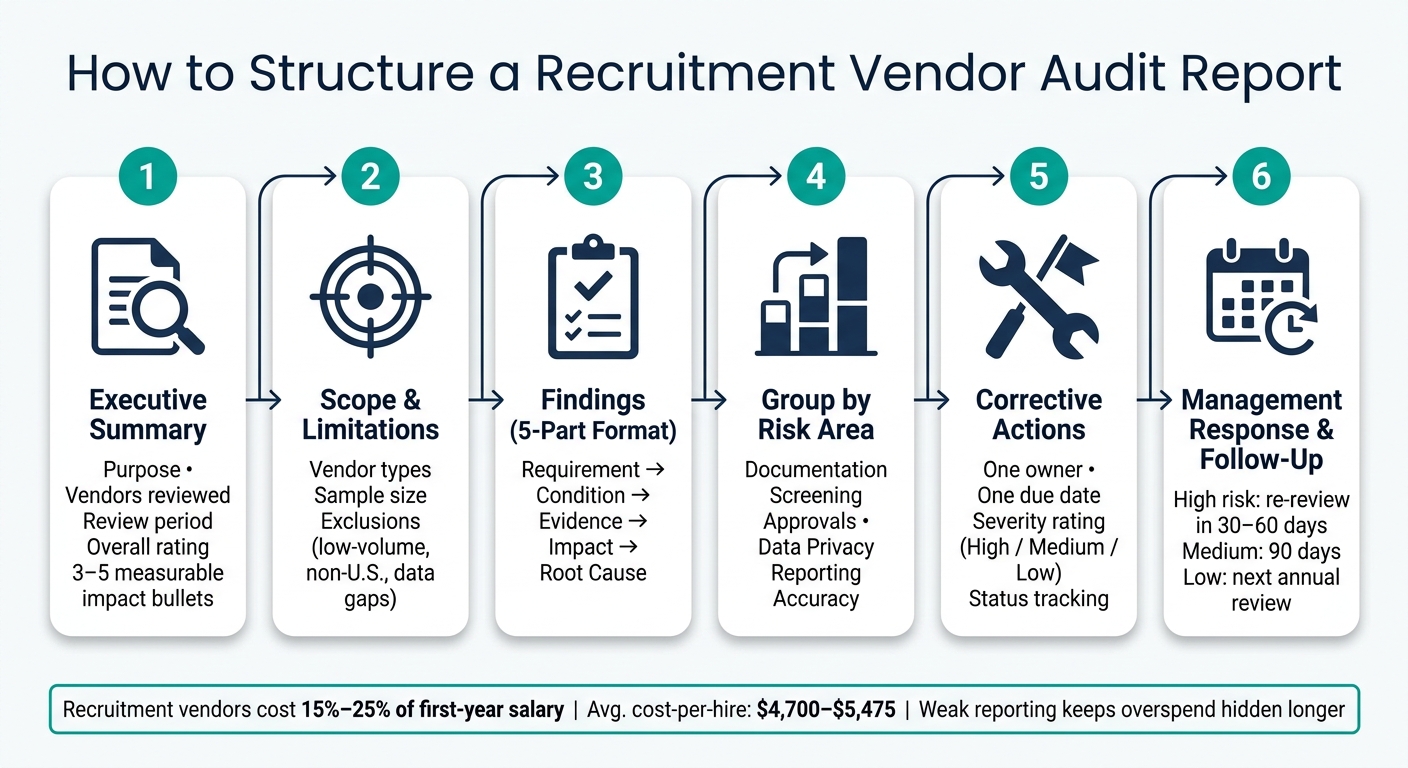
Recruitment Vendor Audit Report Structure: 6-Step Framework
How to Write Effective Audit Findings and Recommendations
sbb-itb-a23bd6a
Start with an executive summary and clear audit scope
Your executive summary should be short, sharp, and easy to scan. The Institute of Internal Auditors says it should answer five questions, in this order: why the audit happened, what was tested, what was found, the overall conclusion, and what management needs to do next.[1][2]
Write the executive summary in plain business language
Start with one sentence that explains the purpose. Then set out the review period, the vendors reviewed, and the overall rating. For example:
This audit reviewed 9 recruitment vendors supporting U.S. Technology, Sales, and Operations hiring against our hiring policies and SLAs from January 1 to June 30, 2026. Overall compliance is partly met.
Then add 3 to 5 bullet points that show measurable business impact. Focus on metrics leaders care about, such as:
- changes in time-to-fill
- shifts in cost-per-hire
- error rates
- SLA misses
- policy exceptions
Use U.S. number formatting so the impact is easy to read at a glance.[4] If a sentence does not affect a decision, cut it.[3]
Once the headline summary is in place, define the exact boundaries of the review.
Define scope, criteria, and limitations upfront
The executive summary gives leaders the top line. The scope tells them what sits behind it.
Right below the executive summary, add a short scope section. Set out the vendor types, agreements, workflows, files, and controls included in the sample.[5][6] For example: Scope covered all vendors responsible for at least 10 U.S. hires in the last 12 months, based on a sample of 250 candidate files.[5][6]
Be specific about what was reviewed, then be just as clear about what was left out. That matters, because weak scope wording can lead readers to stretch findings beyond what the audit actually covered.[7]
Call out exclusions plainly, such as:
- low-volume vendors
- non-U.S. activity
- internal hiring
- data gaps caused by system migrations
For example, if background check records before 2023 were incomplete, say they were excluded from the documentation findings.[7]
Done well, the scope keeps the rest of the report grounded. It shows leadership where the findings apply, where they do not, and how much weight they should put on the results.
Present findings with evidence, impact, and root cause
Once scope is set, use the same five-part format for every finding so readers can check issues and move fast. The main body of the report should make each issue easy to verify, rank, and fix. That matters for management review, but it also matters for cost, time, and risk. When every finding is judged against the same scope, you give leaders a clear basis for action.
Use a consistent format for every finding
Every finding must include all five elements: Requirement, Condition, Evidence, Impact, Root cause. This structure keeps each finding evidence-led and ready for management review. [10][14][15]
Example:
- Requirement: The vendor must retain complete applicant files.
- Condition: Three of 25 sampled files were missing interview notes.
- Evidence: File IDs and report extracts.
- Impact: Weaker traceability and slower hiring decisions.
- Root cause: Inconsistent upload practices.
Do not skip root cause; it turns a finding into action. [9][11][13]
Without root cause, a report just points at symptoms. With root cause, you can fix the process behind the issue. That’s the difference between cleaning up one file and stopping the same gap from showing up again next month.
Keep evidence specific and countable. Phrases like "several records" or "some approvals" are too vague to act on. Use exact figures: "4 of 30 sampled requisitions lacked hiring manager approval before candidate outreach." [8][14]
That level of detail helps leaders judge scale fast. It also makes vendor follow-up easier. If a CFO, HR leader, or Talent Lead reads the report, they should be able to see the size of the problem without chasing extra context.
Group issues by risk area
After documenting each finding, group them by risk area to show repeat control failures. Random order hides patterns. [11][12] Useful groupings include documentation controls, screening completion, approval workflow compliance, data handling and privacy, and reporting accuracy.
This is where the report starts to do more than list problems. It shows where hiring controls are breaking down across the process, or rate your recruitment health to find other hidden gaps. If three findings sit under documentation controls, leadership can deal with one process gap instead of treating each issue as a one-off. If the same approval gap appears across multiple vendors and hiring stages, that points to a broader governance problem.
For scaling teams, that kind of pattern spotting saves time. It can also cut waste. Fixing one weak approval step may remove delays across dozens of requisitions, not just one.
| Risk Area | Example Finding |
|---|---|
| Documentation controls | Interview notes missing from 6 of 40 candidate files |
| Screening completion | Background check evidence inconsistent across locations |
| Approval workflow compliance | 8 of 32 requisitions lacked pre-submission approval in the ATS audit trail |
| Data handling and privacy | Candidate data shared without documented access approval |
| Reporting accuracy | Monthly vendor report overstated completed screenings versus ATS records |
Prioritize risks and assign corrective actions in a tracking table
Once you’ve grouped the findings, the next job is simple: rank them by impact, then assign an owner and due date.
If you skip this step, the audit turns into a long list of issues with no movement. That creates drag for HR, Finance, and leadership, and it leaves hiring risks sitting in the business longer than they should.
Rate severity based on business and hiring impact
Not every finding deserves the same level of attention. Treating a minor template issue the same way you treat a candidate data or privacy problem pulls focus from the items that can hit hiring speed, reporting, cost, or compliance.
Rate each finding against:
- compliance risk
- hiring delay
- reporting accuracy
- spend impact
- leadership visibility
For most SMEs, a simple three-level scale is enough:
| Severity | Definition | Example Threshold |
|---|---|---|
| High | Regulatory breach, delay to critical hires, or material reporting error | Potential privacy violation; 10+ day delay on a critical role; overbilling above contracted rates by $500 to $1,500 per hire |
| Medium | Recurring friction or moderate risk with limited immediate harm | 3 to 10 day onboarding delay; repeated reporting inaccuracy that affects trend analysis |
| Low | Efficiency or clarity issues with no material compliance or hiring impact | Minor template inconsistencies; cosmetic reporting issues; delays under 3 days |
Document these thresholds in your audit methodology so ratings stay consistent across reviewers and reporting cycles. [18][20][22]
That consistency matters. If one reviewer marks a reporting issue as low and another marks the same issue as high, your remediation plan gets messy fast. Clear scoring keeps action plans tighter and reporting cleaner.
Use the rating to decide action order and deadline.
Include a corrective action table in Markdown format
Once severity is set, turn each finding into a single corrective action row. Use this table as your remediation log until closure is checked and confirmed. [17][21]
Each item should have one named owner. Avoid shared ownership where possible. When everyone owns it, no one owns it.
Each row should show the gap, corrective action, due date, status, and verification method. [17][21][22]
| Finding | Vendor Owner | Compliance Gap | Risk Level | Corrective Action | Due Date | Status | Verification Status | |----------------------------------------|----------------------|------------------------------------------|------------|-----------------------------------------------------------|------------|-------------|---------------------| | Unapproved agency fee structure | Finance Manager | Vendor charged above contracted rate | High | Audit invoices against contracted rates; update approval flow and contract terms | 09/30/2026 | In Progress | Not Verified | | Incomplete candidate screening records | Recruitment Ops Lead | Missing background check documentation | High | Retrieve missing records; enforce mandatory checklist | 09/22/2026 | In Progress | Not Verified | | Inconsistent time-to-fill reporting | Head of Talent | Different definitions used across vendors | Medium | Standardize reporting definitions and review templates | 10/15/2026 | Not Started | Not Verified | | Misclassified vendor invoices | Finance Manager | Vendor costs not tagged consistently | Medium | Apply standard cost allocation rules | 10/15/2026 | Not Started | Not Verified | | Lack of standard evaluation forms | Head of Talent | Subjective assessments, no scoring rubric | Medium | Roll out standardized evaluation form across vendors | 11/01/2026 | Not Started | Not Verified | Set due dates based on severity and complexity. Higher-risk items should be closed sooner. Medium and low items can sit in a longer remediation window if the business impact is contained. [16][18]
Use MM/DD/YYYY format throughout. That keeps dates clear for U.S.-based Finance and HR stakeholders and cuts down on back-and-forth.
Use four statuses only:
- Not Started
- In Progress
- Completed
- Verified
Reserve Verified for items checked through sample review, re-audit, or system validation, not just owner confirmation. [17][19][21]
If an item goes overdue, escalate it to senior leadership with the reason and a new due date. That gives decision-makers a clean view of risk, likely hiring impact, and where delays may start to affect cost or reporting.
After actions are assigned, document management response and review dates.
Close with management response and next steps
Document responses and re-review dates
Once corrective actions are assigned, record management’s formal response, the owner, and the next review date for each finding. The tracking table shows what needs to change. This part shows how management has responded and when you will check progress.
For each finding, note the response status, accepted, partially accepted, or disputed, along with the next review date. If a finding is disputed, add the reason and name who owns the residual risk in the row detail. That keeps the record clear and avoids confusion later.
Re-review timing should match the level of risk.
- High-risk findings, such as a compliance gap in background checks, should be re-reviewed within 30 to 60 days
- Medium-risk findings can be checked at 90 days
- Low-risk process issues can wait until the next annual vendor review or contract renewal
A finding should only be marked closed after independent verification. That means reviewing supporting evidence or re-testing a sample once the fix is in place. Record who verified it, what they reviewed, and the date it was confirmed closed. Audit reporting is not finished until the finding has been accepted, assigned, and checked again.
For leadership, a short status view helps them see open risk fast:
| Risk Area | Number of Findings | Response | Remediation Status |
|---|---|---|---|
| Compliance | 2 | Accepted | In Progress |
| Cost Control | 1 | Partially Accepted | In Progress |
| Cost Control | 1 | Disputed | Under Review |
| Process Quality | 1 | Accepted | Not Started |
This gives leadership a quick snapshot of open issues and remediation progress.
Conclusion: keep reports short, evidence-led, and actionable
The best recruitment vendor audit reports stick to a tight structure: executive summary, scope and criteria, evidence-based findings, risk prioritization, corrective actions, and verified follow-up. That structure is not just admin for the sake of it. It helps decision-makers act fast. They can see what was reviewed, what was found, and what changes have been agreed, without digging through pages of commentary.
Evidence-led reporting also helps build trust. When findings come from ATS data, compliance records, and vendor invoices, not opinion, stakeholders are far more likely to accept them and take action. Pair each material finding with a named owner, a due date, and a clear verification method, and the report becomes a working remediation plan instead of a document that gets filed and forgotten.
For scaling companies running multiple vendors across fast-moving hiring cycles, this kind of structure matters even more. Companies using an embedded recruitment model, such as Rent a Recruiter, often find audit reporting and remediation easier to manage because experienced recruiters work directly inside the company’s systems and workflows. That creates clearer visibility into vendor input, compliance steps, and pipeline data, the exact evidence base a strong audit report relies on. Clients can cut hiring costs and save internal time, which gives teams more room to run tighter vendor governance and move through remediation faster.
Book a Call to see how an embedded recruitment model can bring more structure and control to your hiring process. Or See Your Potential Savings to understand what a more efficient, auditable recruitment function could mean for your growth.
FAQs
Who should own each audit action?
Each audit action and record set should have one named owner. That keeps accountability clear and stops work from falling between teams.
In practice, ownership usually looks like this:
- HR Managers: compliance oversight and hiring files
- Hiring Managers: role definitions, interview notes, and selection records
- Leadership: strategic alignment and offer approvals
- External or embedded recruiters: sourcing logs, screening notes, and status updates
- Senior HRBP or Legal Counsel: EEO compliance or AI inventories
This matters for a simple reason. When ownership is shared too broadly, audit prep slows down, records go missing, and decisions get harder to defend. One owner per action means faster follow-up, cleaner documentation, and less risk for your business.
How do I decide whether a finding is high, medium, or low risk?
Start with pass/fail checks for legal and security issues. If a vendor fails either, treat the finding as high risk and do not proceed. Only score delivery after those checks pass.
Then rate the remaining findings against clear KPIs, such as time-to-first-submittal, time-to-fill, and 12-month retention. Use a consistent weighted scoring model. For each criterion, document the owner and the supporting evidence.
This keeps the process tight and cuts a common problem in vendor reviews: teams debating delivery performance before the legal or security basics are cleared. For CEOs, CFOs, and HR leaders, that means less wasted time, cleaner governance, and fewer expensive mistakes later.
What evidence is enough to verify a finding is closed?
Enough evidence means proof, not promises: a documented record that shows the audit step was completed, what changed, and the outputs that prove the control worked over time, not just in a single snapshot.
That record should include the named owner and date, the corrective action taken, supporting documents, logs or reports linked to the control, recorded review results in your compliance or audit system, and proof of delivery or screening that can be checked later.