We recommend setting your interview questions and scoring rules before the first interview, so your team compares answers, not impressions. For scaling companies, implementing talent acquisition strategies helps reduce repeat interviews, wasted panel time, and decisions based on personal preference.
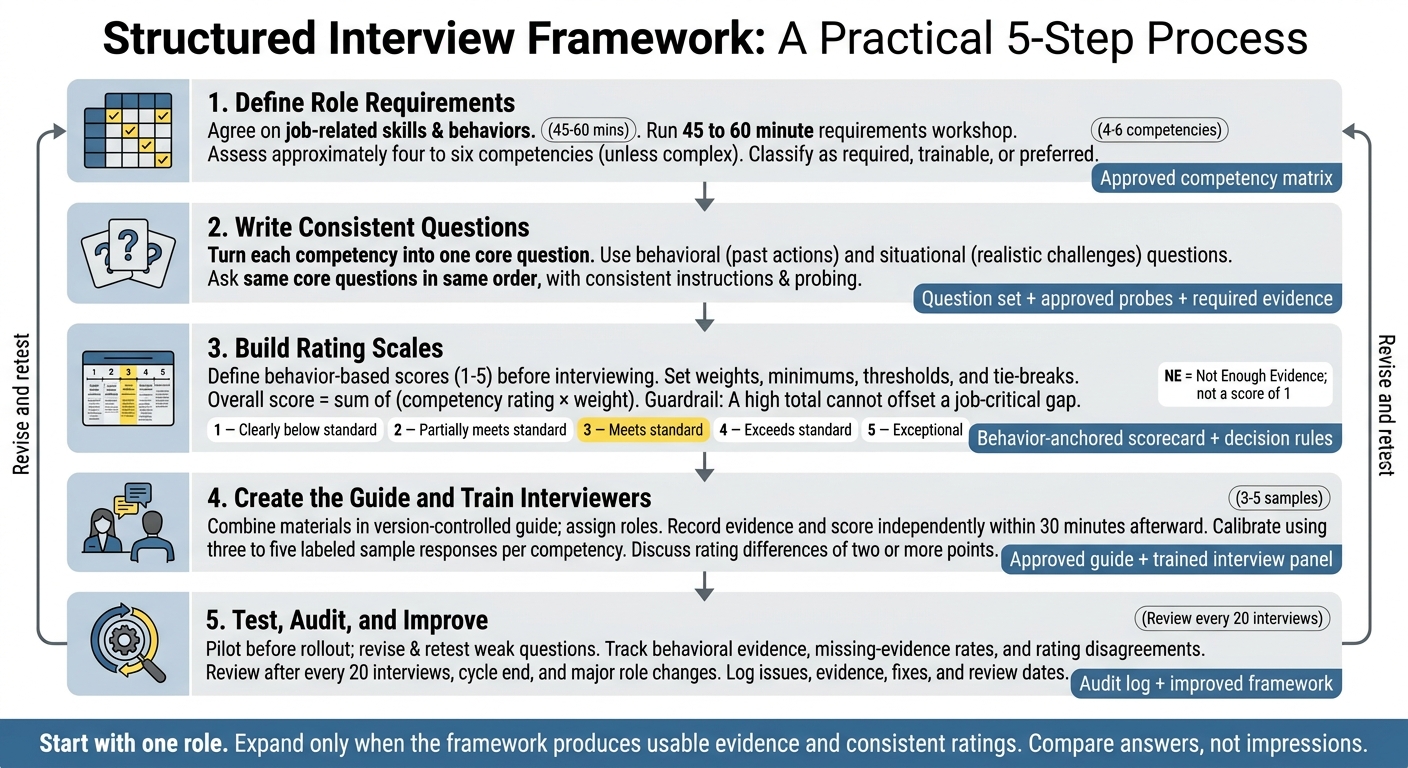
Our five-step approach gives you a clear starting point:
- Define role requirements: Agree on the skills and behaviours your hire needs.
- Write consistent questions: Assess each applicant against the same job requirements.
- Build rating scales: Define what scores from 1 to 5 mean before interviews begin.
- Train interviewers: Practise asking questions, recording answers, and scoring independently.
- Test and improve: Track interview time, missing information, and scoring differences to see what needs fixing. You can also rate your recruitment to identify other hidden inefficiencies.
Start with <u>one role</u>. We’ll show you how to build a process your team can use consistently, then check whether it supports better hiring decisions with less wasted time.
5 Steps to Build Structured Interview Frameworks
Structured Interviews
sbb-itb-a23bd6a
Step 1: Define Role Requirements and Competencies
Start with a job analysis to set clear standards for every interview question, score, and decision rule. Review the job description, performance goals, KPIs, onboarding materials, and input from the hiring manager and top performers.
Document the role’s core responsibilities, required knowledge, technical and interpersonal skills, abilities, working conditions, and behaviors linked to effective performance. For each requirement, record why it matters, whether it is needed on day one, how you will assess it, and what evidence shows proficiency.[5][6]
This becomes your competency matrix. In Step 2, use it to build the questions, scoring guide, and interviewer notes, keeping everyone focused on the same hiring standards.
Link Responsibilities to Observable Behaviors
Run a 45 to 60 minute requirements workshop with the hiring manager, one or two strong performers, and a recruiting or HR partner. The goal is one competency matrix ready for approval.
Ask the group to define outcomes, describe strong and weak performance, identify common challenges, and rank competencies by importance and frequency. Replace vague traits such as “natural relationship builder” with actions an interviewer can assess.
Keep the scope tight to avoid spending interview time on too many criteria. OPM generally recommends assessing approximately four to six competencies, unless the role is unusually complex or senior.[2]
Hypothetical SaaS customer success manager competency matrix
Responsibility Competency Observable behaviors Interview evidence Manage renewals and retention Renewal-risk diagnosis Identifies warning signals, investigates root causes, and creates a prioritized recovery plan Specific example of rescuing or appropriately qualifying a renewal-risk account Drive product adoption Customer enablement and outcome planning Connects product usage to customer goals, defines milestones, and tracks progress Example showing how the candidate increased adoption or customer value Manage escalations Conflict management and judgment Acknowledges impact, separates urgent from nonurgent issues, coordinates owners, and communicates realistic next steps Example of handling an upset customer without overpromising Coordinate internally Cross-functional influence Builds alignment with sales, support, product, and engineering without relying solely on authority Example of resolving an internal ownership or prioritization conflict
Review and Approve the Competency Matrix
Label each competency as required on day one, trainable during ramp-up, or preferred. Ask whether a new hire could learn it through training, coaching, and practice within 90 to 180 days. If so, avoid making it an unnecessary screening barrier that could exclude people who can do the job.
Advanced product configuration, internal systems, industry terminology, or a company-specific health score model may belong in onboarding rather than screening.
Match the assessment to the requirement. Use interviews to assess judgment, communication, collaboration, and problem-solving. Use work samples or role-plays for tasks such as analyzing a customer health report, presenting a renewal-risk plan, or responding to an escalation.
Before approval, merge overlapping competencies so each measures distinct evidence rather than repeating the same assessment. Record the version number, approval date, reviewers, unresolved assumptions, and planned review date.
Make the hiring manager or functional leader the approval owner, with HR or recruiting and at least one subject-matter expert reviewing the matrix.[5] Once approved, turn each competency into consistent interview questions in Step 2.
Step 2: Write Consistent, Job-Related Questions
Turn each approved competency from Step 1’s competency matrix into one core question. Ask every candidate the same questions, in the same order, with the same instructions, preparation time, and time limits. Define what evidence earns each score before interviews begin, then use that standard to build your question set.[4]
Write Behavioral and Situational Questions
Behavioral questions ask what candidates actually did. Situational questions ask how they would handle a realistic job challenge.[2][4]
Use past-experience questions when candidates can reasonably draw on relevant experience. Use scenarios to assess judgment when backgrounds differ. Both formats must focus on job duties, not personal preferences, family circumstances, health, or unrelated background.[8]
Give every role-specific question the same structure so interviewers know what to ask and what to assess.
Sample customer success manager question blueprint:
Competency Question type Core question Approved probe Required evidence Customer retention Situational A strategic customer’s adoption has declined 30% in two months, with renewal 90 days away. What would you do first, and how would you build a recovery plan? What information would influence your decision? Risk diagnosis, stakeholder communication, coordination, success metrics Customer communication Behavioral Tell me about a time you explained a difficult product limitation to a customer. How did you adapt your explanation? Customer context, candidate’s communication approach, customer response, outcome Problem solving Behavioral Tell me about a time you recovered a dissatisfied customer after a service failure. What was the measurable or observable result? Customer context, response, reasoning, outcome Collaboration Behavioral Describe a time you persuaded product or engineering to address a customer-impacting issue. What evidence did you present? Stakeholders, influence approach, decision, outcome
Prepare Neutral Follow-Up Questions
Agree on a fixed list of follow-up questions and rules for using them. Ask only for missing evidence, such as the candidate’s individual contribution or reasoning. Don’t steer the answer or introduce another competency. Apply the same rules to everyone, record evidence, not impressions, and accept well-supported qualitative outcomes when no metric was tracked.[1][2][4]
Standardize the process while allowing access adjustments where needed. Share the interview format in advance and direct accommodation requests to your designated recruiting or HR contact. You can adjust logistics through captioning, written prompts, additional time, or an alternate response format. Keep the competency and evidence standard unchanged so candidates can access a comparable assessment.[7][9]
Step 3: Build Behavior-Based Rating Scales
Once your questions are set, score every answer against the same behavioral anchors. Create a five-point scale for each question or competency, with 3 defined as meeting the role’s requirements. Then describe the behaviors that fall below or above that standard.
Score against the anchors, not against other candidates. Behavior-anchored scales help interviewers score more consistently.[10][11]
Define Evidence for Each Rating
Build your anchors from actual examples of effective and ineffective job performance. Describe actions, reasoning, and results at each level, rather than relying on broad labels. The hypothetical rubric below separates the five levels. Adjust it to match the role’s responsibilities.
Illustrative competency: Problem-solving and judgment
Rating Observable evidence Score meaning 1 – Clearly below standard Cannot describe a relevant example, focuses on blaming others, skips fact-finding, or proposes an action unrelated to the problem. Provides no credible evidence of independent, job-relevant problem-solving. 2 – Partially meets standard Describes a basic action but relies heavily on others, considers few alternatives, or gives no clear result. Shows limited judgment and would likely need substantial support. 3 – Meets standard Explains a relevant situation, gathers key facts, considers practical options, chooses a reasonable action, and reports an adequate result. Demonstrates the level of judgment expected for routine role demands. 4 – Exceeds standard Separates symptoms from root causes, weighs trade-offs, involves the right stakeholders, and achieves a strong, clearly explained result. Demonstrates reliable judgment in ambiguous or moderately complex situations. 5 – Exceptional Anticipates risks, uses relevant data, makes a difficult trade-off, aligns stakeholders, and produces a significant or repeatable improvement. Demonstrates unusually strong judgment suitable for high-complexity or high-impact work.
Use the anchors to keep evidence recording and score explanations consistent. Give interviewers two separate scorecard fields: Evidence observed records what the candidate said they did; Rating rationale explains which anchor that evidence supports.[1]
Mark unresolved gaps NE, meaning Not Enough Evidence, and note the missing detail. NE is not a score of 1. An incomplete answer alone does not justify a low rating.
Set Weights and Decision Rules
Set weights, minimum ratings, and decision rules before interviewing. Weight each competency according to its impact on the job and the cost of failure. Apply the same weights to every candidate.
A high total score must not offset a job-critical gap. Block advancement when any job-critical competency falls below its minimum rating.
Define how question scores combine into a competency rating. Calculate the overall score by adding each competency rating × its weight, but only once every required competency has a valid rating. Document the advancement threshold, rounding method, and tie-break rule before interviews begin.
For NE ratings, choose one follow-up path: a second structured question or a job-related work sample. Apply that path the same way to every candidate before making a decision.
Step 4: Create the Guide and Train Interviewers
Once scoring rules are set, put them into a single guide so interviewers use the same process.
Combine the approved competencies from the approved competency matrix, rating scales, question order, probes, approved rating anchors, evidence fields, and scripts into one version-controlled guide. Include accommodation instructions and escalation contacts. Assign an owner and record the version number, approval date, effective date, and change log. Archive older versions so everyone works from the same approved materials.[1][3]
Assign Interview Tasks and Timing
Assign each question to an interviewer. Confirm who leads the session, who tracks time, and what each person must score. Set time limits for introductions, competency questions, candidate questions, and closing.
Require concise, job-related notes during the interview and independent scores within 30 minutes afterward, before panel discussion.[1]
Direct accommodation requests to the designated HR or recruiting contact. Interviewers must avoid questions about medical conditions or protected characteristics. Have employment counsel review the guide for legal compliance before launch.[12]
Practice Scoring and Calibrate Ratings
Before interviews begin, require training on question delivery, approved probes, note-taking, scoring errors, accommodation handling, and decision rules.
Use three to five labeled sample responses per competency. Before revealing the ratings, have each interviewer score independently, identify supporting evidence, and flag missing information. This helps the panel apply the same standard.
Discuss any competency where ratings differ by two or more points on the five-point scale.[1] Resolve disagreements using recorded evidence, not seniority or confidence. Record the reason for every rating change, and send unclear anchors to the guide owner rather than rewriting them during the session.
Step 5: Test, Audit, and Improve the Framework
After interviewer training, pilot the framework before full rollout using realistic scenarios or a small sample of live interviews. Test question wording, probes, timing, note-taking, scoring anchors, score calculations, and decision rules. Revise and retest weak questions. Keep only those that produce evidence for the target competency.[4]
Track Evidence Quality, Time, and Scoring Consistency
Track the percentage of ratings backed by behavioral evidence, missing-evidence rates, question completion, withdrawals, average interview length, and interviewer hours per hire. These measures help you assess evidence quality alongside the time your team spends hiring.
Review live score distributions and rating disagreements by question. Repeated identical scores may signal weak rating anchors. Recurring disagreements may point to unclear anchors or inconsistent probing. Shorter interviews are not better if evidence quality drops.
Where lawful and appropriate, HR or legal staff should review advancement and selection rates for potential adverse impact. The EEOC’s four-fifths rule compares each group’s selection rate with that of the highest-rate group. A ratio below 80% may indicate adverse impact, but it does not prove it.[13][14]
Restrict access to demographic data and keep it separate from interviewer materials. Suppress small-group reporting where needed. Use the metrics to decide what needs revision next.
Assign Review Owners and Log Changes
Assign a review owner to audit results after every 20 interviews, at cycle end, and after major role changes. Keep a compact audit log that connects each issue to evidence, a fix, and an owner.
Framework component Observed issue Evidence Fix Owner Review date Question wording Repeated misunderstanding Clarification counts Simplify and retest Recruiting lead Next cycle Rating anchors Score disagreements Rating differences Clarify anchors and retest HR business partner Next cycle Interview timing Final competency rushed Completion rates Rebalance time and retest Hiring manager Next cycle
Make major changes between cycles unless an urgent compliance, accessibility, or safety issue requires action. Record approvals, the reason for each fix, the new version, and its effective date. Then check whether the revision improves results.
Conclusion: Start With One Role
After testing and auditing your recruitment process, pilot the framework with one role. Expand only when it produces usable evidence and consistent ratings.
Keep version 1 lean, version-controlled, and ready to use. Set a review schedule, name an owner, and maintain a change log. You’re building a repeatable hiring process, not just completing a guide.
If you need help putting the framework into practice without slowing hiring, Rent a Recruiter provides embedded recruitment support to add capacity and build a consistent hiring process.
FAQs
How can we assess culture fit without introducing bias?
Replace vague “culture fit” judgments, which invite affinity bias, with four to six observable, role-specific competencies. Tie each one to the business outcomes you expect in the first six months.
Ask every candidate the same questions and score answers using a 1-to-5 rubric with clear behavioral anchors. Before any group discussion, have interviewers independently record verbatim evidence for each competency. This helps prevent anchoring, halo effects, and groupthink from steering hiring decisions.
Can we use one framework across different seniority levels?
Yes. Keep the core framework consistent, but tailor competencies and performance expectations to each seniority level.
Use the same scorecard structure, 1–5 rating scale, interview stages, and recommendation format. Adjust role-specific competencies and rating anchors, the descriptions of performance at each score.
For senior roles, anchors might focus on leading architectural decisions or delivering business outcomes. For junior roles, they might focus on execution.
How do we measure whether structured interviews improve hiring quality?
Each quarter, compare interviewer scores with 6-month and 12-month retention, ramp time, and on-the-job performance. If scores don’t align with employee success, refine the competencies you test so your assessments better reflect what predicts success in the role.
Track differences in interviewer scores and regularly calibrate evaluations to keep standards consistent, support predictive validity, and reduce hiring bias.