
If your interview process changes from one interviewer to the next, you are not comparing candidates, you are comparing opinions.
I’d fix that with a structured interview framework built around five parts: role definition, 3 to 6 job-critical skills, fixed questions, a 1 to 5 scorecard, and interviewer calibration. The payoff is simple: cleaner hiring decisions, less wasted interview time, and stronger hiring outcomes. For scaling teams, that means fewer bad hires, less rework, and more control as hiring volume grows.
Here’s the short version:
- Define the role first, using tasks, outputs, and measurable success targets
- Cut the skill list down to the few things that drive job performance
- Use the same questions in the same order for every candidate in the same role
- Score answers against clear behavioural anchors, not gut feel
- Train interviewers to score on their own first, then debrief as a group
- Review results each quarter against time to hire, completion rates, acceptance rates, and retention or performance data
Research cited in the source material shows structured interviews are more reliable across interviewers and better at predicting job performance than loose, unplanned interviews. That matters when hiring mistakes can cost time, team output, and well over $10,000 in lost manager time, delayed delivery, and replacement effort.
If you want a hiring process that scales without turning messy, this is the framework I’d put in place.
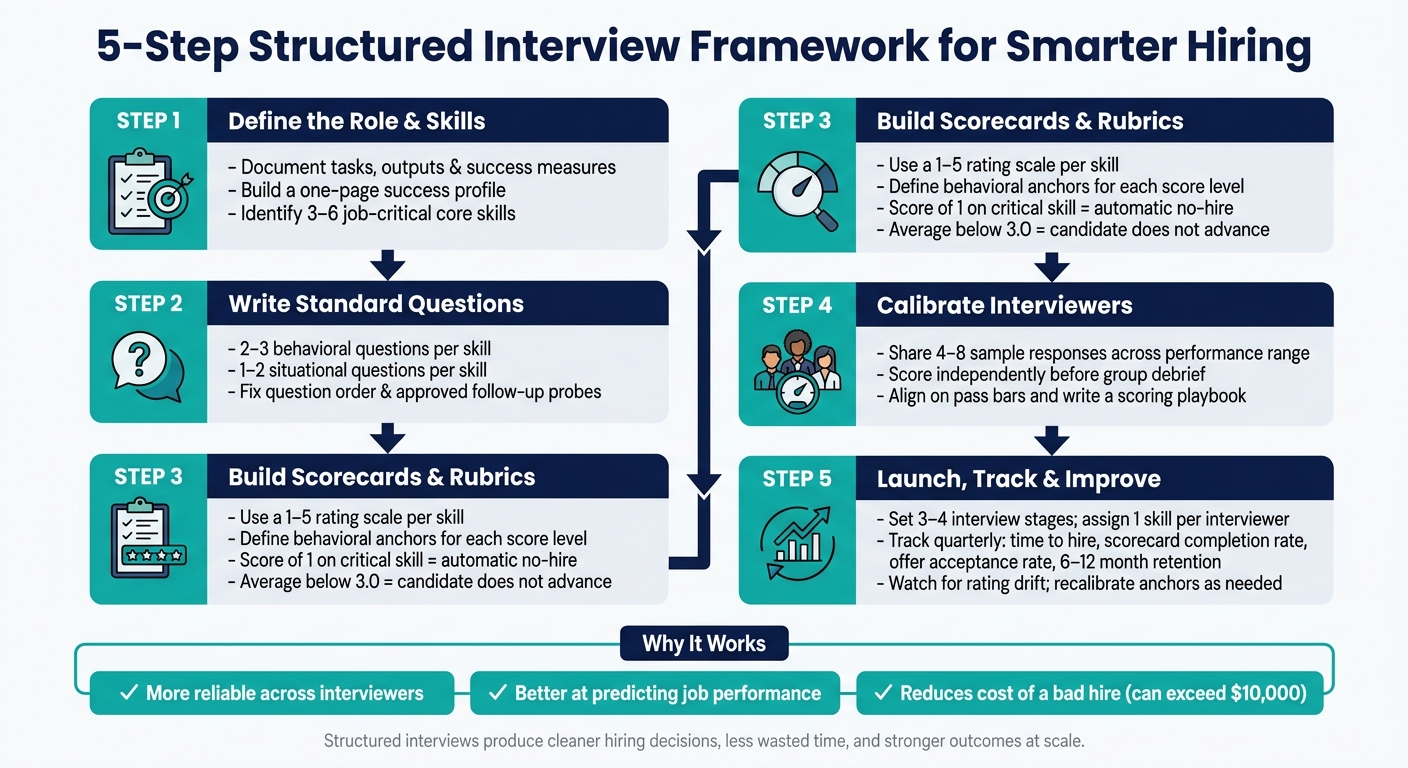
5-Step Structured Interview Framework for Smarter Hiring
Stop Hiring the Wrong People, Use This Interview Structure Instead | Kevin "KD" Dorsey
Step 1: Define the Role and the Skills to Assess
A lot of hiring teams jump straight into interview questions. That’s the wrong place to start.
Before you write a single question, do a job analysis. Get clear on the role’s tasks, outputs, and job-relevant skills. A structured interview is only as strong as the role definition underneath it.
If that foundation is vague, the interview will be vague too. And vague interviews lead to slow decisions, mixed feedback, and expensive hiring mistakes.
Document the Role, Outputs, and Success Measures
Build a one-page success profile with three parts: tasks, outputs, and success measures. List 8 to 12 core activities, turn them into outputs, and set one measurable success metric for each.
Here’s how that can look across common U.S. SME roles:
| Role | Key Output | Success Measure |
|---|---|---|
| Sales Account Executive | Signed contracts and booked ARR | Achieve at least $1,000,000 ARR per fiscal year; maintain at least 3x quota in pipeline |
| Implementation Specialist | Completed implementations and go-lives | Deliver standard implementations within 6 weeks from kickoff; CSAT ≥ 4.5/5 |
| Customer Support Rep | Resolved tickets with high-quality service | First response to new tickets within 2 hours during U.S. business hours; CSAT ≥ 90% |
| Project Manager | Completed projects and coordinated cross-functional work | Deliver 90 to 95% of projects on or before the agreed deadline; keep budget variance within ±5% of plan |
These examples give you clear outputs and success measures to anchor later interview questions and scorecards.[1][2][4] That matters because each interview question should connect back to a job outcome, not a gut feeling.
Turn Job Requirements Into 3 to 6 Core Skills
Next, turn that success profile into the small set of skills your interview needs to test.
Once you have the full list of job requirements, group them into 3 to 6 core skills. Guidance on structured, competency-based interviews recommends keeping this list tight so interviewers can apply it the same way every time.[6][8][9]
Keep only the skills that directly improve your success measures. Remove the rest, or mark them as nice-to-have.[4][5]
For a SaaS Account Executive, that might mean prospecting and pipeline generation, discovery and problem diagnosis, negotiation and closing, and deal execution and forecasting discipline. For a Customer Support Rep, it might mean customer empathy and communication, problem-solving under time pressure, tool proficiency, and resilience in high-volume environments.[1][2][3]
The final step is separating must-haves from nice-to-haves.
Must-have skills have a direct link to success measures and can’t be trained fast. Nice-to-haves, like experience with one specific CRM when broad CRM experience is enough, should stay off the structured scorecard. Keep the scorecard fixed on job-critical skills, not side preferences like tool familiarity.[4][5][7]
That focus does two things. It gives interviewers a cleaner framework, and it helps you avoid rejecting strong people for reasons that don’t move hiring results.
These core skills become the basis for the standard questions in Step 2.
Step 2: Create Standard Questions for Each Interview Stage
Once you’ve defined your core skills, turn each one into a set of standard interview questions. The goal is simple: get answers you can compare across candidates.
That question set becomes the base for the scorecard in Step 3.
Write Behavioral and Situational Questions for Each Skill
For each core skill, write at least two to three behavioral questions and one to two situational questions that tie straight back to that skill.
Behavioral questions focus on past performance. They ask what the candidate actually did.
Situational questions test judgment. They ask how the candidate would handle a realistic challenge in the role.
Map each skill to the right interview stage so you don’t create overlap or miss key areas. A screening call might cover role fit, communication, and motivation. A deeper interview can then focus on problem-solving, execution, and job-specific scenarios.
Each question should test one skill. If it doesn’t, cut it.
Each question pair should measure one core skill from Step 1. Here’s what that looks like for three common U.S. SME roles:
| Role | Skill | Behavioral Question | Situational Question |
|---|---|---|---|
| Account Executive | Negotiation and closing | Describe a time you revived a stalled deal late in the quarter. What did you do, and what happened? | A key prospect has gone silent one week before renewal and usage has dropped. How do you approach this over the next 48 hours? |
| Software Engineer | Problem-solving under pressure | Tell me about a time you refactored legacy code under tight time pressure. How did you balance stability and speed, and what was the impact? | You join a team where production incidents are frequent but the release schedule is fixed. How would you stabilize the system over the next 90 days? |
| Operations Manager | Process improvement | Tell me about a time you improved a process that was causing delays or cost overruns. What data did you use and how did you implement the change? | Your warehouse accuracy has dropped to 95% and customer complaints are rising. What do you do in the first 30 days? |
Write questions that are specific and non-leading. You want candidates to explain context, actions, and outcomes, not guess what answer you want to hear.
Then lock the wording before you move on to sequencing and follow-up prompts. That matters more than many teams think. If one interviewer asks a sharp version and another asks a vague one, your scoring starts to drift. And when scoring drifts, hiring decisions get slower, messier, and more expensive.
Use the Same Core Questions, Order, and Follow-Up Prompts
Once the questions are set, fix the order and stick to it.
Every candidate for the same role should go through the same sequence. That’s what makes answers comparable. It also stops interviewer habits and personal style from shaping the result too much.
Use a fixed 45- to 60-minute agenda:
- 5 to 10 minutes for introductions and rapport
- 25 to 35 minutes for core skill questions
- 5 to 10 minutes for candidate questions
- 5 to 10 minutes to close
Within the skill-focused section, start with simpler questions first. Let the candidate settle in. Then move into more complex situational scenarios.
Pre-write two or three approved probes for each question and use the same ones every time. For example:
- What was your role?
- What options did you reject?
- What would you do differently?
These probes keep the conversation consistent without pulling the interview into new topics.
Put all of this into a simple one- to two-page interviewer guide for each role. Include the agenda with time boxes, the exact question wording, the approved follow-ups, and space for notes.
Then your interviewers follow the guide.
Next, turn the same questions into a scorecard with clear rating criteria.
sbb-itb-a23bd6a
Step 3: Build Scorecards and Rating Rubrics to Cut Subjectivity
Once your questions are set, you need to score them the same way. That’s where a scorecard helps.
A scorecard turns interview feedback into comparable evidence. Instead of each interviewer using their own standard, everyone scores the same candidate against the same bar. That gives you cleaner decisions, less bias, and a hiring process you can defend.
Build a 1 to 5 Rating Scale With Behavioral Anchors
For each core skill from Step 1, create one scoring row with a 1 to 5 rating scale. Define each score using observable behavior, not vague labels like "good" or "excellent."
A practical anchor structure looks like this:
- 1: No evidence or counter-evidence. The candidate couldn’t show the skill, or showed behavior that goes against it.
- 2: Weak evidence. Some effort is visible, but key parts are missing and outcomes are unclear.
- 3: Meets expectations. The core behavior is there, but the impact is limited or not explained well.
- 4: Strong. Solid, repeatable behavior with measurable positive outcomes and only minor gaps.
- 5: Exceptional. Clear, consistent behavior with major, quantified results and strong self-reflection.
Each scorecard should include the candidate’s name, interview date in mm/dd/yyyy format such as 09/15/2026, the role and interview stage, a rating for each skill, space for evidence notes, and a final recommendation such as "strong hire", "hire", "hold," or "no hire."
The key here is simple: write evidence, not impressions.
Capture the situation, what the candidate did, and what happened as a result. For example: led a cross-functional project, delivered two weeks early, and reduced defects by 30%.
That kind of note is much more useful than "seemed sharp" or "good communicator." It also gives your team a clear record if hiring decisions are reviewed later.
Numeric-Only Scoring vs. Behaviorally Anchored Scorecards
| Approach | Pros for SMEs | Cons for SMEs |
|---|---|---|
| Numeric-only scoring | Fast to set up; minimal training needed; easy to add to existing workflows | Highly subjective; one interviewer’s "3" is another’s "4"; weak documentation for decisions |
| Behaviorally anchored scorecards (BARS) | More consistent across interviewers; easier to justify decisions; stronger audit trail | Requires upfront work to write anchors; needs periodic updates as roles evolve |
For most scaling teams, the smart move is to start simple. Use numeric scores with short behavioral descriptors first. Then move to fully anchored rubrics for high-volume or high-stakes roles, where poor hiring decisions cost more in time, money, and team drag.
Align Interviewers Before You Launch the Framework
A scorecard only works if interviewers use it the same way. If one manager scores hard and another scores loosely, your process slips straight back into opinion.
Run a short calibration session before launch.
Share four to eight sample responses across the performance range: weak, average, strong, and exceptional. Ask each interviewer to score them on their own first. Then compare scores and talk through where they split. Those gaps usually show you where your anchors are too vague.
Once the team agrees on what each score means in practice, set clear pass bars. For example, any score of 1 on a critical competency is an automatic no-hire, and an average below 3.0 means the candidate does not move forward.
Write these rules into a simple scoring playbook that new interviewers can review before their first interview. That way, alignment doesn’t live in someone’s head. It’s built into the process.
Once the team is aligned, train interviewers and roll out the framework.
Step 4: Launch the Framework and Keep Improving It
Once the role, questions, and scorecards are set, the last step is simple: make the framework part of how you hire every time.
Train Interviewers and Standardize the Hiring Process
Once the scorecard is calibrated, build it into a repeatable workflow. Set up 3 to 4 interview stages and give each interviewer one competency to assess. That keeps each stage clear and stops people asking the same questions in different rounds.
Use one shared template for every candidate. It should cover:
- Role title
- Interview stage
- Target skill
- Standard questions
- Rating scale
- Evidence notes
- Final recommendation
If your ATS allows it, make scorecard submission mandatory before a candidate can move to the next stage. Also require independent scoring before group debriefs so you capture each person’s judgement before the team talks it through.
That matters more than it may seem. If people score after the discussion, stronger voices can shape the outcome. You lose clean data, and hiring decisions get harder to trust.
After launch, the next job is to check whether the process is giving you results you can use.
Track Hiring Metrics and Review the Framework Each Quarter
A framework that never gets reviewed will drift. Each quarter, track four core metrics: time to hire, scorecard completion rate, offer acceptance rate, and 6- to 12-month retention or performance. Together, they show where the process is slowing down, where discipline is slipping, and which stages add time without changing the decision.
You should also watch for rating drift, when interviewers get more lenient or more strict over time. When that happens, tighten the scoring anchors and recalibrate interviewers.
If interview scores do not line up with later performance, ramp time, or retention, that is a red flag. It usually means the competency linked to that question is not pulling its weight and should be replaced.
This is where many teams get stuck. The framework looks solid on paper, but no one owns the follow-through. Then hiring slows, confidence drops, and the team slips back into gut-feel interviews.
When Embedded Recruitment Support Can Help
If your team does not have the time to roll out the framework properly, Rent a Recruiter can place experienced recruiters into your team within days to run hiring end-to-end and standardize the process across roles.
That can cut hiring costs by up to 70% and save more than 80 hours a month in internal hiring and admin time.
For scaling teams in SaaS, Technology, Fintech, Engineering, Security, Insurance, and Professional Services, that means fewer delays, tighter process control, and a hiring system your team can actually stick to.
Conclusion: Build a Framework That Improves Hiring and Supports Growth
This framework works because each step supports the next.
A structured interview framework has five linked parts: define the role, pick 3 to 6 core skills, write standard questions, score candidates with anchored rubrics, and train interviewers to use the same process.
That kind of consistency turns interviews into useful hiring data. Scorecards give you comparable data across hires, so leaders can spot where hiring is working, where it is slowing down, and where mistakes are creeping in.
This becomes even more important when hiring pace picks up and the cost of a poor hire climbs. The same framework can be reused across roles with only small changes, which saves time when hiring demand grows faster than your team’s capacity.
If building this in-house is not realistic right now, Rent a Recruiter can place experienced recruiters into your team within days to build and run the process end to end.
Ready to scale hiring? Book a call
FAQs
How do I choose the right 3 to 6 skills?
Start with a thorough job analysis focused on what the role must deliver in its first six months. That shifts the conversation from vague wish lists to business outcomes.
Work with hiring managers and top performers to pin down the observable, measurable skills that link to success. Skip fuzzy traits like culture fit. If a skill can’t be seen, tested, or scored, it usually creates noise in the process.
Then force-rank and weight those skills so the ones that matter most carry the most weight. Keep the list tight, usually three to six skills. That makes interviews easier to run, cuts scorecard drift, and gives you a more objective way to compare people.
What should I do if interviewers score candidates differently?
Different scores usually point to a calibration problem, not just a difference of opinion. In plain terms, your team may be judging the same interview in different ways.
A better process fixes that fast. Ask each interviewer to submit a scorecard before any group discussion, with both their rating and specific, observable evidence to back it up. That stops groupthink and gives you a cleaner read on where views split.
In the debrief, zero in on the largest scoring gaps first. That’s where your process is most likely breaking down. If those gaps keep showing up, run calibration sessions with mock interviews and review your rubric. The goal is simple: make your anchors clear, consistent, and tied to what the interviewer actually saw or heard, not instinct alone.
How often should I update a structured interview framework?
Review and update your structured interview framework every 3 to 6 months so it stays aligned with changing role needs and company growth.
You should also audit recruitment metrics and run calibration sessions quarterly. That helps you spot issues early, like interviewer drift, vague rubric language, and rating standards that no longer line up.
Left unchecked, those problems slow hiring, blur decision-making, and make it harder to compare candidates fairly across interviews.