If your company is scaling without clear job levels and promotion rules, you are likely losing people, overpaying on titles, and slowing hiring at the same time.
I see the fix as simple. You need a career path system that links job levels, promotion criteria, development plans, internal moves, and hiring into one working model. That cuts confusion, saves manager time, supports pay decisions, and helps you keep strong people who might otherwise leave.
A clear system helps you:
- Cut avoidable turnover, when career growth is one of the top reasons people resign
- Save money, because replacing skilled staff can cost 50% to 200% of annual salary
- Reduce title and pay drift, which often shows up during fast growth
- Improve hiring control, because every new role is tied to a defined level and scope
- Give managers a shared standard, so promotion calls are based on proof, not opinion
The article makes one point clear: do not overbuild this. Start with one team, map the roles you already have, set 3 to 4 levels, define what promotion looks like, and review it each quarter as the business changes.
If hiring demand is also putting pressure on your structure, Rent a Recruiter can help you apply the same framework in day-to-day hiring without adding more internal admin.
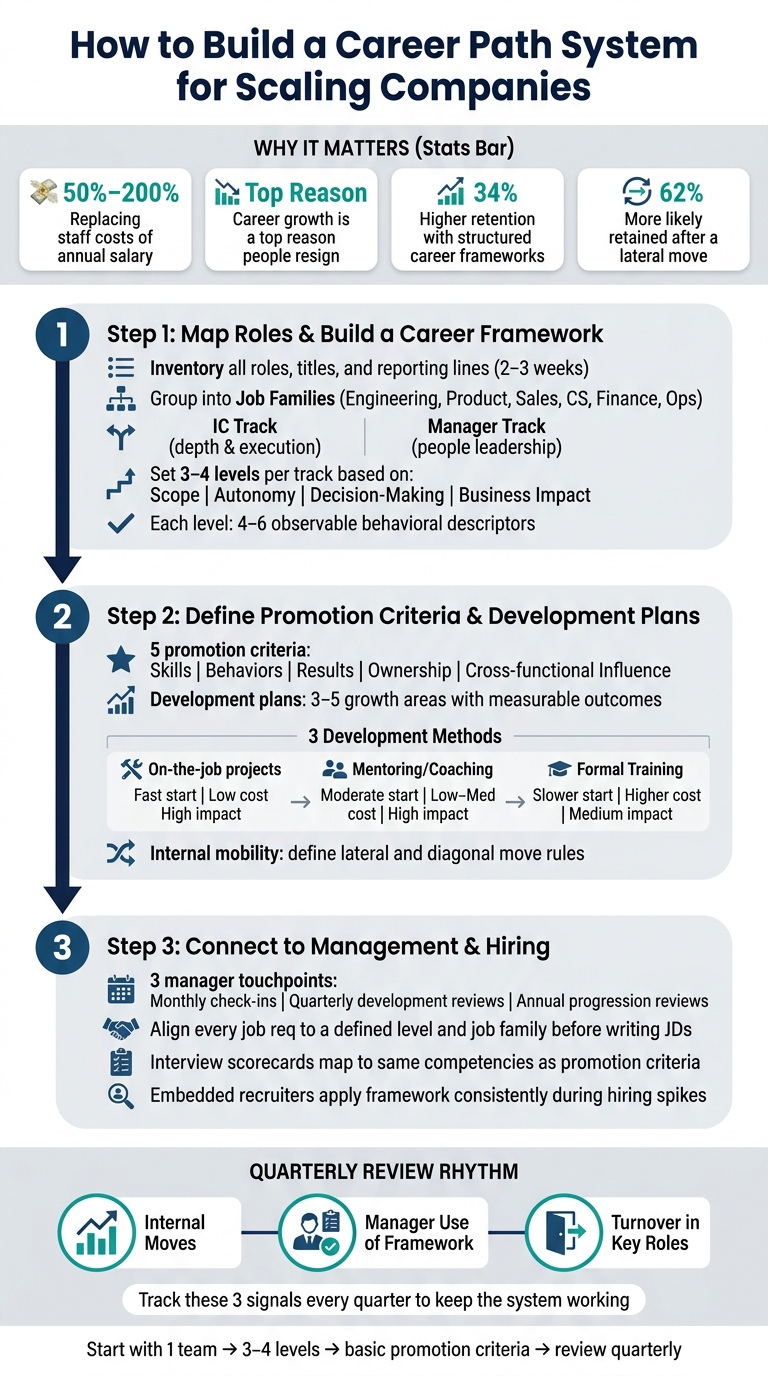
How to Build a Career Path System for Scaling Companies
Step 1: Map Roles and Build a Simple Career Framework
Start simple, make it usable, then tighten it over time.
Inventory Roles, Titles, and Reporting Lines
Map your current roles first. If career paths don’t match how work gets done, the framework falls apart fast.
Export your employee list by function and capture each person’s title, manager, direct reports, core responsibilities, and expected outcomes. Most of this should come from your HRIS, payroll system, or org chart. Then sense-check it with short manager interviews so you can separate the real job from what’s written on paper.
A basic spreadsheet or light HR tool is often enough to map reporting lines and spot unclear ownership or duplicated responsibilities. That matters because fuzzy roles slow hiring, create handoff issues, and waste manager time.
Start with the teams under the most pressure from growth. In most U.S.-based SMEs, that’s sales, customer success, product, engineering, and operations. These are usually the functions where unclear roles hit growth plans and hiring quality the hardest. You should be able to audit the core functions in 2 to 3 weeks.
As you work through the list, flag roles that were set up ad hoc, titles like "Growth Generalist". Those roles often make sense at one stage, then create confusion later. Standardizing them gives you a cleaner structured hiring model and a better view of where headcount should go.
Once you have the inventory, look for overlap. Focus on tasks that two or more roles both claim. Use a simple check for each role based on:
- Outcomes
- Authority
- Collaboration
- Overlap with other roles
Roles with high overlap and low distinct impact are often signs that job definitions need to be tightened before you keep hiring. In some cases, they point to consolidation. In others, they show where clearer separation is needed.
Once the current roles are clear, group them into job families and split IC and manager tracks.
Group Roles Into Job Families and Tracks
With the inventory in place, group roles by shared skills, tools, and business outcomes. Common job families for scaling U.S. SMEs include Engineering, Product, Sales, Customer Success, Finance, and Operations.
Within each family, set two tracks:
- An individual contributor (IC) track focused on depth of skill and execution
- A manager track focused on people leadership, team performance, and business direction
This matters more than many companies think. If the only way to move up is to manage people, you end up pushing strong specialists into jobs they may not want, or may not do well. That’s bad for retention and bad for output.
Give each track a short descriptor. For example, an Engineering IC track might read: "deepens expertise and handles harder technical problems." The manager track might read: "owns team results, hiring, coaching, and business alignment."
Short, plain wording works best. If managers can’t explain the track in 30 seconds, people won’t trust it.
Set 3 to 4 Levels With Clear Scope and Autonomy
After tracks are set, define levels based on scope and autonomy. Keep it tight. For most scaling SMEs, 3 to 4 levels per track is enough.
Define each level using four dimensions: scope, autonomy, decision-making, and business impact. That gives managers a shared way to judge progression and helps stop title inflation before it starts.
For example, a Level 1 Customer Success Manager may handle a smaller client base using standard playbooks. A Level 3 Senior CSM may own large strategic accounts, tailor success plans on their own, and shape retention strategy.
Each level should include 4 to 6 observable behavioral descriptors, phrases like "leads cross-functional projects" or _"sets quarterly team goals"*. The point is simple: managers need signals they can actually see. If level definitions are vague, promotion calls become inconsistent, and that creates friction fast.
Progression should show bigger scope, not just a bigger title.
Start with a simple ladder for each track. You can add lateral moves later. On day one, the framework doesn’t need to be polished. It needs to be clear enough to use, clear enough to support hiring, and clear enough to show people how growth works inside the business.
sbb-itb-a23bd6a
Step 2: Define Promotion Criteria and Development Plans
After you set levels and tracks, the next job is turning them into clear promotion rules and development plans. This is where career paths stop being a slide deck and start shaping day-to-day decisions.
If progression is not clear, managers fill in the blanks themselves. That leads to inconsistency, mixed messages, and distrust. You need people to know what moving up looks like, what they need to prove, and what options exist when a straight upward move is not open.
Write Promotion Criteria Managers Can Apply Consistently
Vague language like "shows potential" or "is ready for the next level" creates problems fast. Managers interpret it in different ways. Employees are left guessing. Both weaken trust.
Strong promotion criteria focus on five things managers can observe: skills, behaviors, results, ownership, and cross-functional influence. Each one should have plain-language descriptors tied to the level under review.
For example, if a mid-level product manager is moving toward senior, the bar might include independent ownership of a product area end-to-end, influence on roadmap decisions across teams, and a track record of delivering outcomes, not just completing tasks.
Promotion decisions should come back to evidence from actual work. Put simply: has this person already shown next-level performance in the role? That gives managers something clear to stand behind in leadership reviews and compensation discussions.
Use one company-wide rubric for scope, autonomy, and impact. Then add function-specific criteria where needed. Sales may include deal size and win rate. Finance may include forecasting accuracy. The role-specific details can change, but the behavior and impact standards should stay consistent across the business.
Calibration sessions matter here too. They help managers line up on borderline cases, reduce uneven decision-making, and lower the risk of promotion calls that feel arbitrary.
Once managers know the standard, you can shift to the next part, helping employees close the gap.
Turn Career Paths Into 6- to 12-Month Development Plans
A career framework only matters if it changes how work is assigned and how growth is managed. That happens through development plans built with managers, not around them.
Start with the criteria for the target level. Review them with the employee, then identify the gaps. From there, narrow the plan to 3 to 5 growth areas with measurable outcomes attached.
"successfully lead one cross-functional launch with positive stakeholder feedback by Q3."
That kind of goal works because it is concrete. It gives the employee something to aim at and gives the manager something to assess.
Then match each gap to the right development method.
| Development Method | Speed to Start | Direct Cost | Progression Impact |
|---|---|---|---|
| On-the-job projects (stretch assignments, new initiatives) | Fast | Low | High, provides direct evidence of next-level performance |
| Mentoring or coaching (internal mentor, external coach) | Moderate | Low to medium | High, best for leadership and influence skills |
| Formal training (courses, certifications, workshops) | Slower | Higher | Medium on its own; strongest when paired with projects |
Use all three, but put the most weight on on-the-job projects. That is where people prove they can operate at the next level. It also gives you the clearest evidence for promotion decisions.
Formal training can close knowledge gaps. Mentoring helps people build judgment, presence, and influence across the business. Used together, these methods also help you get more from your learning budget because each dollar is tied back to a career outcome, better internal progression, and lower replacement hiring costs.
When vertical growth is tight, internal moves become even more important.
Create Internal Mobility Rules That Support Lateral and Diagonal Moves
Not every good career move is upward. Lateral moves let someone move to a new function at the same level. Diagonal moves shift both function and level. In many scaling companies, those moves are the most practical way to keep strong people engaged when senior openings are limited.
Employees who make lateral moves are 62% more likely to be retained than those with no job change at all, who have a 45% chance of staying [2]. That is not just a people point. It has a direct cost impact. Keeping proven employees is usually cheaper, faster, and less risky than replacing them through embedded recruitment in the market.
Lateral moves can also improve the odds of a later promotion. So they should not be treated as a fallback option. They are a real part of career growth.
To make internal mobility work, document the rules clearly, including:
- minimum time in role before someone can apply internally
- performance thresholds
- when managers need to be informed
- how pay changes are handled when people move across functions
Post open roles internally for a set period before, or at the same time as, external advertising. Also define transfer criteria for common moves in your business. For example, spell out which customer success skills transfer into product, or what would help an operations coordinator move into a business analyst role.
When people can see a path across the business, they are less likely to leave to find one elsewhere.
Next, apply the same framework in manager conversations, hiring, and internal transfers.
Step 3: Connect Career Paths to Day-to-Day Management and Hiring
Once your levels and promotion criteria are set, they need to show up in how managers run the team and how hiring gets done. A career framework has no business value if it sits in a slide deck. It needs to guide 1:1s, hiring decisions, and promotion calls.
Train Managers to Run Career Conversations Separate From Performance Reviews
One mistake scaling companies make is blending career chats into performance reviews. They are not the same conversation.
Performance reviews look back at results. Career conversations look ahead at goals, skills, and future roles. When you mix the two, short-term pressure often pushes long-term growth off the table.
Use three touchpoints:
- Monthly check-ins for current work
- Quarterly development reviews for growth plans
- Annual progression reviews for level, title, and pay changes
Separate templates and agendas help make that line clear. They also lower stress. People are more likely to talk openly about growth when they know those goals will not be treated like a performance score.
The same standards should then carry into hiring.
Align Hiring With Your Career Framework From Day One
Every new requisition should be tied to a defined level and job family before anyone writes the job description. If your framework says a Senior Product Manager owns a product line end to end and shapes cross-functional roadmap decisions, the job description should reflect that exact scope. Not a vague list that could fit three different levels.
Interview scorecards should also map to the same competencies used in promotion decisions. If your criteria for a senior engineer include leading complex projects on their own and shaping architecture decisions, those same behaviours should appear on the scorecard and be rated on the same scale used in promotion panels.
This matters for two reasons. First, it cuts the risk of hiring someone at the wrong level when the team is under pressure. Second, it protects internal pay equity by keeping offers inside set compensation bands. When your team sees that new hires are being measured against the same bar, trust in the framework stays in place.
Use Embedded Recruitment Support to Apply the Framework at Scale
When hiring volume jumps after a funding round, a product launch, or a new market entry, the framework is under the most strain. Managers trying to fill roles fast start making exceptions. Titles get inflated. Offers drift outside bands. Scorecards become inconsistent.
That compounds fast, and it gets expensive to fix later. This is usually where leveling drift begins.
Rent a Recruiter places recruiters inside high-growth SMEs to turn role definitions into job descriptions, apply leveling rules, and keep hiring decisions consistent. That gives you more control over cost, saves manager time, and lets leaders stay focused on coaching and progression instead of hiring admin.
Conclusion: Build a Career Path System That Grows With Your Company
Once the framework shows up in hiring and manager conversations, the next job is simple: keep it current.
Use one framework across job structure, development, manager conversations, and hiring, or it will end up as a policy document nobody uses. Companies with structured career frameworks report 34% higher retention than those without one [1].
You do not need a bigger system. You need a simple system your team can run every quarter.
Start Small, Review Quarterly, and Refine as the Company Changes
Start with one business-critical function. Build 3 to 4 levels, write basic promotion criteria, and create a small set of sample development plans. That is enough to get moving.
It does not need to cover every role on day one. It needs to fit the company you have now, not the version you hope to become later.
What matters is a quarterly review rhythm. Scaling companies change fast. A framework built for 50 people often stops fitting at 150 or 300. Review whether your job families still match how work gets done, whether managers are using promotion criteria in the same way, and whether people are moving internally.
If internal mobility is low, or promotion calls still feel arbitrary, something is off. Usually, the criteria need tighter definitions, or managers need more support.
Track three signals each quarter:
- Internal moves
- Manager use of the framework
- Turnover in key roles
These signals show whether the system is doing its job, or just sitting in a shared drive.
When hiring volume climbs, consistency is often the first thing to go. If hiring spikes, Rent a Recruiter can add embedded recruiters who apply the same framework in a steady way.
FAQs
Who should own career paths?
Career paths work best when they’re shared, not pushed onto one side.
Managers should lead the day-to-day conversations. That means regular check-ins on goals, skill gaps, and where each person wants to go next. They also need to make progression clear, with defined criteria and milestones so people know what good looks like and what it takes to move forward.
Leadership has a different job. They need to treat retention as a business priority, not just an HR task. When career pathing is built into the company’s operating strategy, you’re more likely to keep good people, cut avoidable turnover, and give managers a clear framework to work from.
How do we launch this without HR software?
You do not need heavy software to build a scalable career path or hiring system. What matters is a repeatable framework, clear ownership, defined roles and skills, and consistent execution.
If your internal team is stretched, Rent a Recruiter can place experienced recruiters inside your business to bring structure, visibility, and hiring capacity, without the cost of extra software or permanent headcount.
When should we update job levels?
Review and update job levels quarterly as part of your regular workforce and planning cycles.
Treat job levels as a living framework, not a static document. Each review gives you a clear chance to check whether your structure still fits market shifts, business priorities, and team capacity.
If you skip this, level frameworks can drift out of line with how your business is hiring and growing. That often leads to slower decisions, pay confusion, and misaligned headcount plans.
A quarterly review helps you keep job levels tied to what matters most: better hiring decisions, cleaner workforce planning, and tighter control over cost.