
Hiring remotely in Australia means budgeting for Australian obligations, even if your company is based in the US. I recommend confirming the worker’s location, status, work rights, and hiring structure before you commit to an offer. Include the 12% superannuation guarantee in your cost plan, alongside salary, insurance, taxes, and equipment.
Before day one, assign an owner to each check:
- Hiring setup: Choose an Australian entity, employer of record, direct foreign employment, or a genuine contractor arrangement.
- Terms and payroll: Approve the agreement, pay, benefits, withholding, and reporting.
- Remote-work readiness: Check insurance, home-workspace safety, privacy, and system access.
- Review dates: Track visa checks, payroll checks, and proposed location changes.
My starting point is simple: <u>one shared tracker, with written approval for every check</u>. Use qualified Australian advisers for legal and tax decisions, so your team can focus on hiring without avoidable rework or unexpected costs.
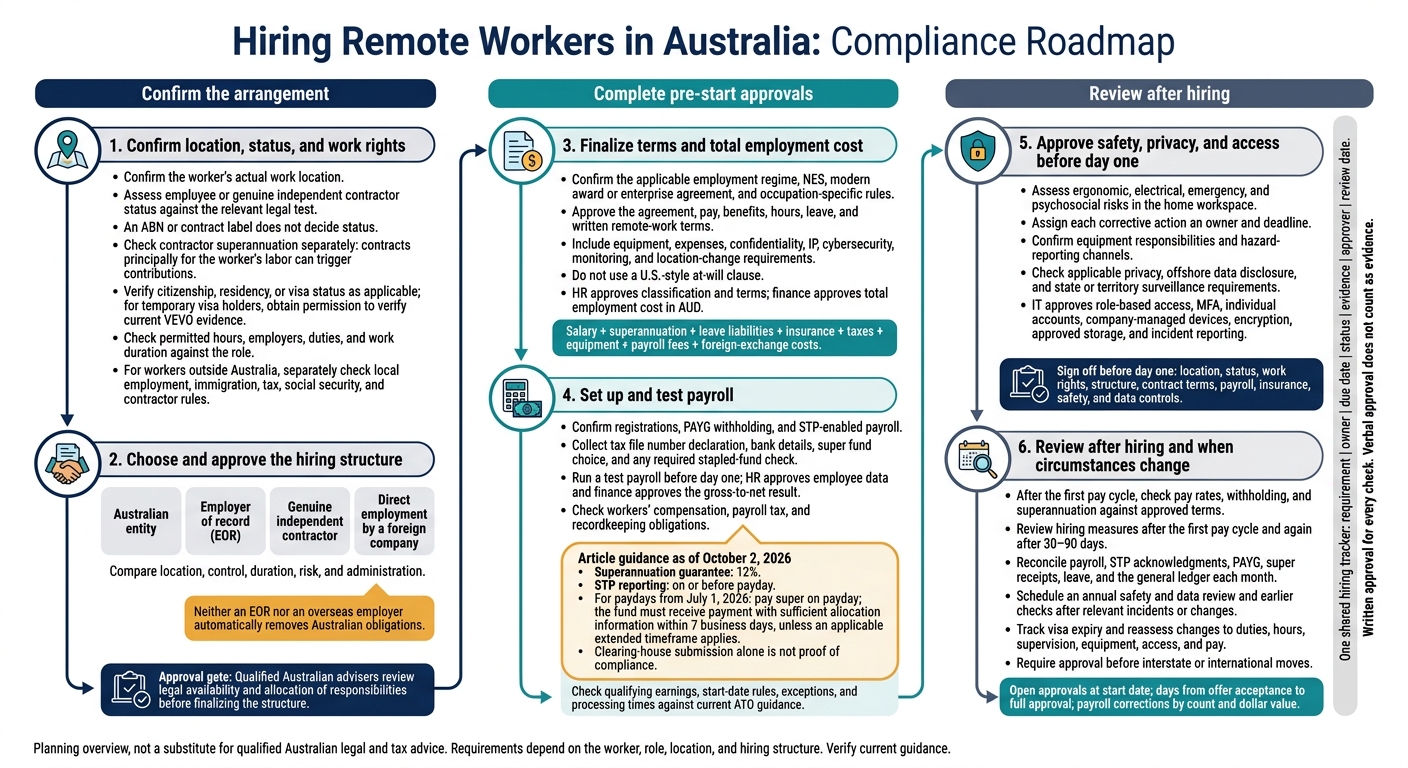
Hiring Remote Workers in Australia: Compliance Roadmap
How To Legally Hire Remote Closers In Australia
sbb-itb-a23bd6a
Step 1: Confirm Worker Status, Work Rights, and Hiring Structure
Confirm the arrangement before finalizing the offer. Start with the worker’s actual work location, then assess their status and work rights.
For workers outside Australia, separately check local employment, immigration, tax, social security, and contractor rules. An Australian agreement does not replace those checks. Once status and work rights are clear, choose a structure that fits the role.
Determine Employee or Contractor Status
Prepare a classification worksheet covering control, business independence, equipment, payment, financial risk, and delegation rights. Assess the full relationship against the relevant legal test. An ABN or contract label does not decide status.[6][8] Employment, tax, and superannuation tests can classify the same worker differently.[6][9]
| Issue | Employee | Genuine independent contractor |
|---|---|---|
| Working arrangement | Works within the employer’s business | Runs an independent business supplying services |
| Equipment and risk | Employer typically supplies equipment and bears business risk | Contractor typically supplies equipment and bears commercial risk |
| Leave | Receives applicable minimum leave entitlements, depending on employment type | No employee leave entitlements |
| PAYG withholding | Employer generally withholds tax from wages | Manages own tax; withholding may apply in specific cases |
| Superannuation | Compulsory employer contributions generally apply | Contributions may apply to contracts principally for the worker’s labor |
| Misclassification risk | Unpaid entitlements, tax and superannuation liabilities, penalties, and sham-contracting exposure | The contract must match the real relationship |
Sham contracting is unlawful. This includes falsely labeling an employee as a contractor or pressuring them to accept contractor status for the same work.[8][10]
Keep a record of your decision and reassess it when duties, hours, supervision, exclusivity, payment, or delegation rights change. Check contractor superannuation separately: a contract principally for the worker’s labor can trigger contributions, even when they have an ABN.[14][15]
Check Work Rights and Visa Conditions
Verify citizenship for Australian citizens, permanent resident status for permanent residents, and relevant Special Category visa status for New Zealand citizens.
For temporary visa holders, obtain permission to verify current VEVO evidence. Do not rely on an old grant notice.[11] Check permitted hours, employers, duties, and work duration against the proposed role.
For sponsored workers, also verify the employer, occupation, location, salary, hours, and sponsorship requirements. Schedule reviews before visa expiry and whenever those details change.[7]
Migrant workers retain workplace protections. These include lawful pay, payslips, superannuation, safe-work rights, and applicable leave and dismissal protections.[12] Confirm that current work rights and visa conditions permit the role you plan to offer.
Choose the Hiring Structure
Compare your options by location, control, duration, and risk, including the administration your business will need to manage.
| Structure | Suitable use | Legal employer and responsibilities | Administrative burden | Main risks |
|---|---|---|---|---|
| Australian entity | Australian team or roles requiring direct supervision | Australian entity handles employment terms, payroll, PAYG withholding, superannuation, records, insurance, and registrations | Entity setup and direct compliance | Misclassification, payroll tax, workers’ compensation, privacy, IP, and licensing |
| Employer of record (EOR) | Market testing or a small team without a local entity | EOR is the contractual employer and usually handles payroll and employment administration; client directs daily work | Vendor oversight | Model legality, labor-hire licensing, safety, cost, IP, sponsorship, and taxable presence |
| Genuine independent contractor | Defined deliverables with autonomy and commercial risk | Contractor manages business, invoicing, tax, and methods; engaging business retains applicable obligations, including possible superannuation | Less payroll administration | Sham contracting, superannuation, confidentiality, IP, safety, and availability |
| Direct employment by a foreign company | Carefully reviewed cross-border employment | Foreign employer may need Australian registrations, payroll, withholding, superannuation, insurance, records, and local-law compliance | Complex cross-border compliance | Taxable presence, employment jurisdiction, payroll tax, insurance, immigration, IP, data transfers, and enforcement |
Before finalizing the structure, have Australian advisers review its legal availability for the role, any regulated duties, and how responsibilities are allocated.[12][13] Neither an EOR nor an overseas employer automatically removes Australian obligations.
Once the structure is set, align the contract, payroll, and benefits with it. Draft the agreement to match the approved arrangement, including duties, location, equipment, confidentiality, IP, and change-notice requirements.
Step 2: Set Employment Terms and Start Payroll
Once worker status and structure are set, finalize contract terms and payroll before day one. Get HR and finance aligned before the employee starts.
Confirm Employment Standards and Remote-Work Terms
Confirm which Fair Work or state industrial-relations regime applies. Identify the NES, any modern award or enterprise agreement, and occupation-specific rules.
Your contract should state the employing entity, role, classification, work location, start date, pay basis, pay cycle, leave, overtime, allowances, probation, notice, termination, and governing award or agreement.
Do not use a U.S.-style at-will clause. Probation is an assessment period, not an exemption from minimum entitlements, notice requirements, or dismissal protections. For salaried roles, check the package against award minimums, including overtime, penalties, allowances, and leave.
Put the remote-work arrangement in writing. Cover the home location, ordinary hours, time-zone expectations, availability windows, meetings, and overtime approval. Specify equipment ownership, internet and phone costs, expense approvals, confidentiality, IP, cybersecurity, and monitoring. Include a process for changing or ending the arrangement, plus after-hours contact rules that reflect Australia’s right to disconnect.
Provide the Fair Work Information Statement and, where relevant, the Casual Employment Information Statement and Fixed Term Contract Information Statement. Check that any fixed-term contract, renewal, extension, or consecutive use meets current restrictions.
Keep HR approval of the classification and terms, alongside finance approval of the total employment cost in AUD. That cost should include salary, superannuation, leave liabilities, insurance, taxes, equipment, payroll fees, and foreign-exchange costs. Once the contract is signed, start payroll setup and reporting.
Set Up PAYG Withholding and Superannuation
Before the first payment, confirm required registrations, register for PAYG withholding, and set up STP-enabled payroll software. Collect the tax file number declaration, bank details, super fund choice, and any required stapled-fund check.
PAYG requires you to withhold Australian tax from wages and remit it to the ATO. STP reporting should include pay, withholding, and superannuation information on or before payday.[17][21]
Run a test payroll before day one. Have HR approve the employee data and finance approve the gross-to-net result.
As of October 2, 2026, the superannuation guarantee rate is 12%. For paydays from July 1, 2026, Payday Super requires employers to pay super on payday. The fund must receive the payment, with enough information to allocate it, within 7 business days, unless an applicable extended timeframe applies. Check qualifying earnings, start-date rules, exceptions, and processing times against current ATO guidance.[16][18][19]
Keep separate schedules for payday obligations, periodic PAYG remittances and reconciliations, and year-end reporting. Retain evidence that the fund received the payment. Clearing-house submission alone is not proof of compliance.[20]
Check Insurance, Payroll Tax, and Recordkeeping
Confirm workers’ compensation coverage for the state or territory where the employee works, including whether the home office is recognized as the workplace.
Check state or territory payroll tax registration thresholds, grouping rules, and wage allocation rules. Review fringe benefits tax, allowances versus reimbursements, and working holiday maker withholding where relevant.
Record pay and payroll in AUD. Document the exchange-rate source, conversion date, and who pays bank fees so finance can track the full cost.
Issue compliant payslips and maintain separate employment and tax record-retention schedules. Keep employee tax and super records for five years.[21] Each month, reconcile payroll, STP acknowledgments, PAYG, super receipts, leave, and the general ledger.
Step 3: Approve Remote-Work Safety and Data Controls
Complete safety, privacy, and access approvals before day one. Working from home does not remove your employer safety duties. Check the arrangement against applicable WHS, privacy, and surveillance laws before the worker starts.[22][30]
Check Privacy, Data Access, and Monitoring
Ask HR or legal to check whether the Privacy Act and Australian Privacy Principles apply. When budgeting for these compliance steps, you can calculate hiring cost savings to offset administrative overhead. They generally cover businesses with annual turnover above AU$3 million and certain smaller organizations. The employee-records exemption is limited, so do not assume it covers applicant or customer data. Map overseas storage, processing, and access, and check APP 8 before disclosing data offshore.[23][25][28][29]
IT should approve role-based access, MFA, individual accounts, company-managed devices, encryption, approved storage, and immediate incident reporting. Set out how access will be removed when duties change or employment ends.[26][27]
Give workers confidentiality rules and a monitoring notice that explains what you collect, who can access it, and how long you retain it. Before enabling camera, keystroke, location, or call monitoring, check the surveillance laws in the worker’s state or territory.[26][27]
Assess the Home Workspace and Equipment
Use a worker self-assessment to record ergonomic, electrical, emergency, and psychosocial risks. Assign each fix an owner and deadline before approval. The safety lead should consult the worker under applicable WHS laws rather than rely on routine home inspections.[22][24][31]
Make equipment responsibilities clear: who supplies it, maintains it, and replaces it. Set up channels for reporting hazards, injuries, and near misses so workers know where to flag problems.[22][24][31]
Schedule Compliance Reviews
Keep the arrangement under review after approval. Add visa-expiry dates and change-triggered reviews to your compliance calendar. Review access and pay changes, and schedule an annual safety and data review. Check earlier after safety incidents or changes to equipment, hours, or supervision.[22][24][30]
Require approval before interstate or international moves. Before agreeing, reassess the jurisdiction and hiring structure, with qualified Australian advice where needed. Keep consultation records, assessments, notices, access approvals, training, and corrective actions under a documented retention schedule.[22][24][30]
Conclusion: Complete the Pre-Start Checklist
Once safety, payroll, and access approvals are complete, use the final pre-start checklist to check for gaps. Sign off on every requirement: work location, status, work rights, hiring structure, contract terms, payroll, insurance, safety, and data controls.[5][32]
Use one shared hiring tracker as your approval record. Include the requirement, owner, due date, status, evidence, approver, and review date. Keep unresolved issues visible. Verbal approval does not count as evidence.
Track open approvals at the start date, days from offer acceptance to full approval, and payroll corrections by count and dollar value. Review these measures after the first pay cycle and again after 30-90 days. After the first pay cycle, check that pay rates, withholding, and superannuation match the approved terms.[5]
If hiring as you scale is slowing approvals, extra recruiter capacity can help move candidates through the final checklist faster.
Get Recruitment Support When Needed
Rent a Recruiter embeds experienced recruiters in your team to manage hiring workflows, with short-term support or longer-term recruitment capacity.[1] Book a call to discuss your hiring volume and internal capacity.
FAQs
Could hiring in Australia create a taxable presence for my U.S. company?
Hiring a remote worker in Australia can create a permanent establishment (PE), meaning a taxable presence, even if you don’t have a local legal entity [1]. This risk arises when the employee’s activities constitute a fixed place of business or they habitually conclude contracts on your behalf [1].
A PE may trigger corporate taxes on related profits, payroll duties, and administrative costs. Review country-specific risks before finalizing each offer so you can account for potential tax and compliance costs [1].
Who is liable if my employer of record misses compliance obligations?
You remain legally responsible for employer compliance, even when you use an Employer of Record (EOR). An EOR can handle payroll, taxes, and benefits to reduce risk, but you must still ensure your hiring practices and documentation meet applicable legal requirements.
To reduce compliance risk, give each task a clear owner, run regular audits, and document your hiring processes in line with federal and state regulations.
What should I do if I misclassified a worker as a contractor?
Misclassifying a worker can leave your business facing back pay, tax liabilities, overtime claims, and government penalties [1][2].
Assess the role immediately under Department of Labor and IRS guidelines, including behavioral and financial control [1][3]. Worker status depends on the economic reality of the relationship, not the title in the contract.
If you’re unsure, file IRS Form SS-8 for a formal determination [1]. Run quarterly classification audits to maintain compliance [4][1].