I recommend giving remote employees a clear reporting route outside their management chain, with a named owner and backup. For your leadership team, that means less time lost to missed reports, confused handoffs, and preventable work disruption.
My checklist is simple:
- Make reporting easy: offer several channels across time zones, including access for contractors and external recruiters.
- Assign responsibility: set acknowledgment targets, document handoffs, and restrict access to case records.
- Respond without penalizing reporters: use impartial investigations and safeguards that protect pay, responsibilities, and opportunities.
- Check what happens next: schedule follow-ups at 30, 60, and 90 days, and review channel performance monthly.
These are process checkpoints, not legal deadlines. I would build reporting guidance into onboarding so each new hire knows where to turn from day one. <u>A reporting channel only works if people can use it and someone acts.</u>
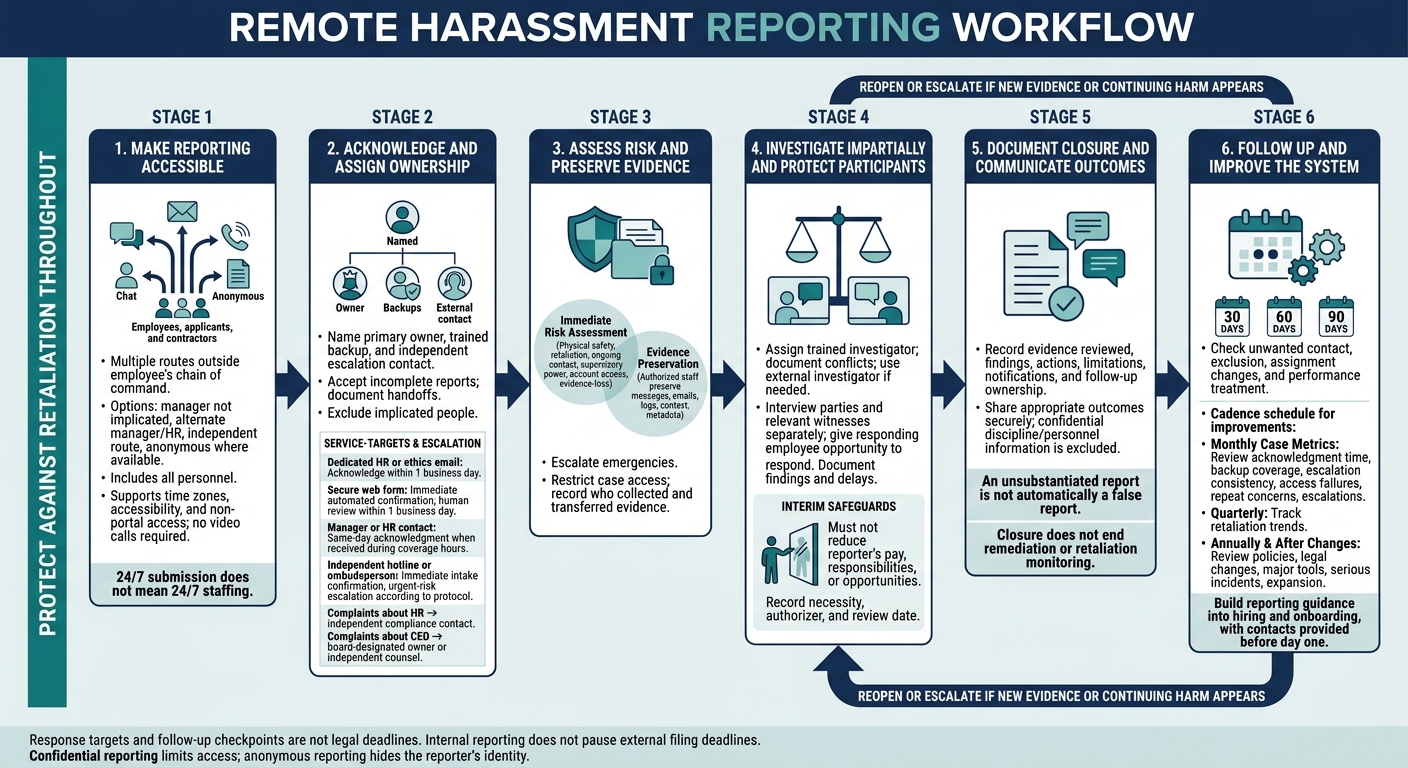
Remote Team Harassment Reporting: From Report to Follow-Up
Reporting Workplace Harassment: What to Do | Free Training
sbb-itb-a23bd6a
Build Accessible Reporting Channels
Once employees understand what conduct they can report, give them multiple reporting routes outside their chain of command. Remote and hybrid teams need access across time zones and platforms, without relying on a single channel.
Publish a plain-language policy covering prohibited conduct, who is covered, reporting contacts, escalation routes, response times, privacy limits, emergency steps, and anti-retaliation protections. Include employees, applicants, interns, contractors, temporary workers, and agency personnel. Make the policy available outside the employee portal.[5][6]
Provide Multiple Contacts and Independent Escalation
Offer access to a direct manager who is not implicated, a second manager or HR contact, and an independent route outside the reporting line. Include anonymous reporting where available.
Direct complaints about HR to an independent compliance contact. Send complaints about the CEO to a board-designated owner or independent counsel. Document each handoff and exclude implicated people from routing decisions.[5][7]
Give contractors and temporary workers direct access, without requiring them to report through their agency first. Name the person responsible for coordinating concerns that involve multiple employers.
Support screen readers, phone and relay access, interpreters, and help with submitting reports. Do not require video calls.
Publish monitoring hours and time zones. 24/7 submission does not mean 24/7 staffing. Include after-hours safety instructions and directions to contact emergency services when someone faces immediate danger.
Compare Channels and Set Response Expectations
Use a channel directory like the one below to make reporting routes and responsibilities clear across time zones. Treat acknowledgment windows as service targets, not legal deadlines. Assign an owner and backup to monitor every route, including during leave and holidays.
| Channel | Response target | Escalation owner |
|---|---|---|
| Dedicated HR or ethics email | Acknowledge within 1 business day | HR or compliance lead, with a named backup |
| Secure web form | Immediate automated confirmation; human review within 1 business day | Case intake owner or independent ethics function |
| Manager or HR contact | Same-day acknowledgment when received during coverage hours | Alternate manager, HR, or compliance if the recipient is implicated |
| Independent hotline or ombudsperson | Immediate intake confirmation; urgent-risk escalation according to protocol | Independent investigator, compliance officer, or board-designated owner |
Confidential reporting limits access; anonymous reporting hides the reporter’s identity. Explain which disclosures may be necessary and any limits on anonymous follow-up.[5][8] Tell reporters how to add information, when to expect updates, and where to escalate a missed acknowledgment.
Manage Reports From Intake to Closure
Acknowledge Reports and Assess Immediate Risks
Move each report straight from intake to triage and evidence preservation. Accept incomplete reports. Missing details should not prevent you from taking action.
Record the reporter’s name, if provided, and preferred contact method. Gather the minimum facts needed to assess the case, including jurisdiction, whether the conduct is ongoing, supervisory authority, and concerns about retaliation or harm. Mark fields “known,” “unknown,” or “not applicable” rather than leaving gaps. Offer a safe way to follow up.
Assess physical safety, retaliation risk, ongoing contact, supervisory power, account access, and the risk of losing evidence immediately. Escalate emergencies to the appropriate security or emergency resources. Preserve evidence while assessing these risks.
For each interim safeguard, document why it is needed, who authorized it, and when it will be reviewed. Changes to meetings, reporting lines, schedules, or permissions should protect people without reducing the reporter’s pay, responsibilities, or opportunities.
Preserve Evidence and Restrict Case Access
Only authorized IT, security, legal, or records staff should handle preservation. Preserve relevant chat messages, direct messages, emails, meeting invitations, calendar changes, documents, comments, file versions, platform notifications, access logs, and existing lawful recordings.
Keep the surrounding context and metadata, including timestamps, time zones, sender and recipient details, thread history, and retention status. Record who collected and transferred each item so you can trace how evidence was handled.
Do not delete or edit records, forward them broadly, access another person’s account, or record without legal guidance. Check local recording, privacy, and device rules before preserving evidence.
Store evidence in a restricted case file with role-based access, multifactor authentication, encryption, and access logs. Give leaders only the progress data they need, not message content, medical details, or witness identities.
Examples of progress data include a coded case ID, owner, stage, case age, handoff dates, and overdue actions.
Review access whenever responsibilities change.
Record Referrals, Closure, and Follow-Up
Refer serious, repeated, disputed, supervisor-related, or retaliation allegations to an impartial investigator. Record the decision-maker, scope, conflicts check, preservation steps, safeguards, referral timestamp, and written acceptance from the receiving owner.
Track acknowledgment and handoff delays as process metrics, not closure targets. This keeps attention on delays without treating case closure as a race.
At closure, document the evidence reviewed, findings, actions, limitations, notifications, and who owns follow-up. Closure does not end remediation or retaliation monitoring.
Set separate completion dates and schedule check-ins at 30, 60, and 90 days. Assess unwanted contact, exclusion, assignment changes, and performance treatment. Reopen or escalate the case if new evidence or continuing harm appears.
Conduct Fair Investigations and Prevent Retaliation
After intake, begin a prompt, impartial investigation and keep monitoring for retaliation. Internal reporting does not pause external filing deadlines. Direct employees to current EEOC and state or local rules that apply to their circumstances.[9][10]
Choose an Impartial Investigator
Assign someone trained in workplace harassment, interviewing, evidence preservation, confidentiality, and applicable federal and state laws. Document conflicts before assignment. Use an external investigator when senior leaders are involved or you need to adapt to the future of recruitment services or your internal team cannot act independently.
Create a written plan. Limit disclosures to people who need the information, and separate fact-finding from discipline where possible.
Interview each party and relevant witnesses separately, with time-zone and accessibility accommodations. Give the responding employee a chance to respond. Assess supporting and conflicting evidence consistently, including relevant prior complaints.
Document findings, reasoning, and any delays. Distinguish allegations from established facts. Do not wait for an admission or a corroborating witness before taking action.[11]
Use Interim Safeguards Without Penalizing Reporters
Interim safeguards should protect safety, preserve evidence, maintain work continuity, and reduce contact or retaliation risks without presuming misconduct.
Consider the reporter’s preferences. Explain each measure’s purpose and expected duration, choose the least disruptive option, and review it regularly. Reporting must not cost someone pay, status, advancement opportunities, information access, or desirable assignments. Use interim measures to reduce risk, not punish the reporter.
| Safeguard | Appropriate use | Responsible owner | Risk | Review |
|---|---|---|---|---|
| Meeting-access changes | Prevent harmful contact in meetings | Manager with HR oversight | Lost information or visibility | Missed decisions or meeting exclusion |
| Reporting-line changes | Remove involved supervisors’ oversight | HR or senior leadership | Demotion or isolation | Effects on pay, title, workload, promotion, or evaluations |
| Schedule or shift adjustments | Reduce contact or immediate risk | Manager and HR | Disrupted pay, caregiving, or collaboration | Reduced hours, unfavorable shifts, or changed needs |
| Communication boundaries | Require work channels, moderated meetings, or no direct contact | HR and involved managers | Delays or inconsistent enforcement | Missed deadlines, obstruction, or violations |
| Temporary leave | Address serious risks when alternatives are inadequate | HR, with legal and benefits input | Lost income, stigma, or benefit disruption | Prolonged, involuntary, unpaid, or avoidable leave |
Share Outcomes and Monitor for Retaliation
Tell the reporter when the investigation is complete, whether your organization found a policy violation, and what general steps will address substantiated concerns. Do not disclose confidential discipline or personnel information.
Tell the responding employee which allegations were considered, what opportunity they had to respond, the finding, and any corrective measures or expectations. Deliver outcomes securely, use plain language, and record them in the case file.
If the evidence is insufficient, explain that it did not establish a policy breach under your organization’s standard. An unsubstantiated report is not automatically a false report.
Treat complaints, witness cooperation, and participation in an internal EEO investigation as potentially protected activity. Under EEOC retaliation guidance, retaliation can include any action that might deter a reasonable person from reporting, not just firing or demotion.
During follow-up, ask neutral questions about exclusion, workload, evaluations, contact restrictions, and new incidents. Compare assignments, workload, performance feedback, compensation, promotion access, and meeting participation against pre-complaint records and similarly situated employees.
Document every check-in, investigate new concerns promptly, and provide a clear reporting route outside the original chain of command.[3][4]
Do: Explain next steps, identify a contact for process questions, remind participants about non-retaliation and evidence preservation, and provide a route to raise new concerns. Avoid: Naming witnesses unnecessarily, disclosing confidential disciplinary details, promising absolute secrecy, suggesting that employees cannot discuss their own experiences, or implying that internal closure eliminates external legal options. Privacy controls should not restrict lawful discussions, cooperation with government agencies, or external reporting.
Conclusion: Assign Owners and Review Procedures
Name an owner for every stage: accessible reporting, documented intake, impartial investigations, interim safeguards, and retaliation monitoring. Assign a primary owner, a trained backup, and an independent escalation contact outside the reporter’s management chain.
Define each owner’s authority, response time, confidentiality and documentation duties, and conflict rules. Clear responsibilities prevent leave, time zones, or conflicts from delaying a report.
Train Staff and Review Reporting Performance
Train owners on their duties, then check that the process works in practice. Employees and managers need to understand their reporting roles. Managers also need intake and escalation training. Investigators need training in impartial interviewing, remote evidence collection, privacy limits, and trauma-informed communication.
Review case metrics monthly: acknowledgment time, backup coverage, escalation consistency, access failures, repeat concerns, and urgent-risk escalations. Test reporting channels across locations, time zones, devices, and accessibility needs.
Track retaliation trends quarterly alongside training completion and channel-access checks. Aggregate small-team results to protect identities. Low complaint counts alone do not prove the system works. The EEOC recommends testing whether reporting systems work in practice.[12]
Update Policies and Recordkeeping Requirements
Update the policy after training and review whenever tools, laws, or jurisdictions change. Align record retention with applicable law, privacy obligations, company policy, and preservation holds. Obtain jurisdiction-specific legal advice.
In California, retain harassment-prevention training records for at least two years, including employee names, training dates, training type, provider, attendance or completion records, and training materials.[13][14]
Keep a short review checklist covering the policy owner, primary and backup contacts, independent escalation contact, investigator roster, channel-test results, training dates, retention rules, access permissions, next review date, and legal-review date.
Review policies annually, and after legal changes, major tool changes, serious incidents, or expansion into a new jurisdiction.
Add Reporting Guidance to Hiring and Onboarding
Build reporting guidance into hiring and onboarding. Give new hires reporting and independent escalation contacts before their first day, and confirm they can access those channels.
Share reporting contacts and guidance with embedded recruiters, contractors, and vendors before day one. Name the internal contact responsible for reports involving external workers so everyone knows where to direct a concern.
FAQs
How can a small remote team handle reports without HR?
Give employees a clear complaint process with multiple reporting channels, including a way to bypass their direct supervisor when needed.
Your policy should guarantee confidentiality, require impartial and timely investigations, and strictly prohibit retaliation against anyone who reports a concern.
An Alternative Dispute Resolution program can also help address issues early and reduce conflict before it takes up more management time.
Can I report harassment in a personal messaging app?
Report harassment through your company’s formal grievance channels, not personal messaging apps [1]. Your company is responsible for providing a clear, accessible reporting process.
Official channels help ensure reports are documented, handled confidentially, and investigated impartially and promptly. They also help protect you from retaliation [1].
Rent a Recruiter encourages companies to put clear, structured reporting channels in place to maintain consistency and trust as teams grow.
Which state’s laws apply if we work in different states?
If your team works across states, each worker’s home-state employment laws matter. You must follow the applicable rules for wages, overtime, paid leave, payroll taxes, and related disclosures. When federal and state rules differ, the stricter standard often applies [1].
For remote teams, that means checking wage and pay transparency requirements in each worker’s state, not just the state where your company is based [1][2].