
A weak EVP costs you money. If your hiring message does not match what employees get, you will see lower offer acceptance, more early exits, and higher cost per hire.
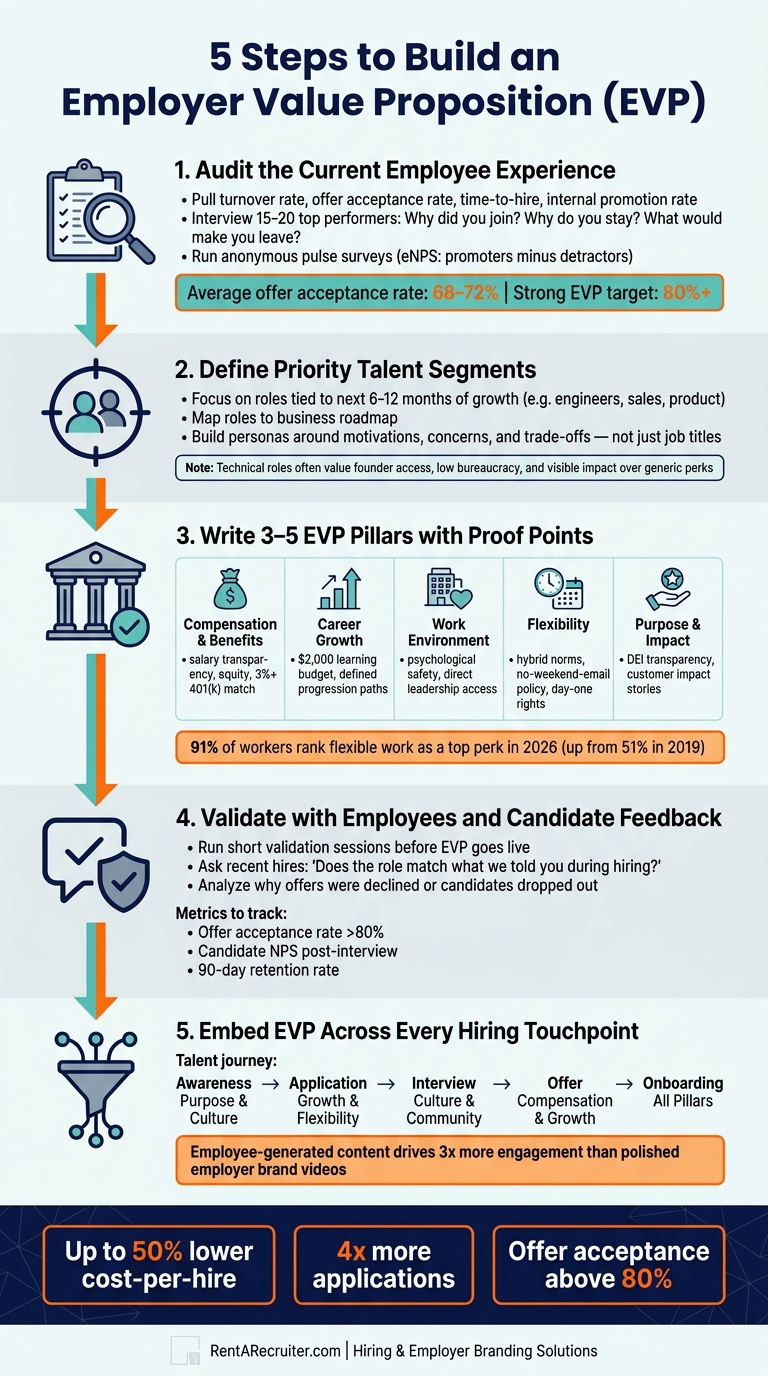
Here is the short version: build your EVP from employee proof, not brand copy. Audit the current experience, focus on the roles that matter most, turn findings into 3 to 5 clear pillars, test the language with employees, then use it in every hiring step. Done well, this can help push offer acceptance above 80%, cut turnover, and lower cost per hire by up to 50%.
If you lead hiring in SaaS, Technology, IT, Fintech, Engineering, Security, Insurance, or Professional Services and need an embedded recruitment service, the article points to five simple steps:
- Audit the current employee experience
- Pick the talent groups tied to the next 6 to 12 months of growth
- Write EVP pillars backed by proof
- Test the message with employees and hiring data
- Use it across ads, interviews, offers, and onboarding
Put simply, an EVP is not a slogan. It is the work deal you can prove, and it only matters if it improves hiring results.
5 Steps to Build an Employer Value Proposition That Improves Hiring Results
EVP 101 – How to Develop an Employee Value Proposition
sbb-itb-a23bd6a
Steps 1 and 2: Audit the current experience and define priority talent segments
Start with the data and employee experience you already have. Skip this, and you risk building a polished careers story that clashes with what people say on review sites. That disconnect costs you time, offer acceptances, and hiring momentum.
Step 1: Audit what employees actually experience today
Pull the numbers first:
- Turnover rate
- Internal promotion rate
- Time-to-hire
- Offer acceptance rate
These metrics show where the day-to-day employee experience drifts from your employer promise. Offer acceptance rates sit at 68% to 72% on average, but companies with strong EVPs often get above 80% [4]. If you’re below that range, your EVP message, your hiring process, or both, aren’t landing.
Exit interviews often show the gap between what was promised and what people got.
Then talk to your top performers. Ask 15 to 20 people three simple questions: Why did you join? Why do you stay? What would make you leave? That gives you the signals your EVP should be built on, not guesswork [5].
Use anonymous pulse surveys to track eNPS too: promoters (9 to 10) minus detractors (0 to 6).
This is where the work starts to pay off. You stop writing broad employer messaging and start building around what your best people say matters. That usually leads to better offer conversion, less hiring drag, and fewer expensive mis-hires.
Use that evidence to spot which roles and personas need EVP support first.
Step 2: Identify the roles and personas your EVP must support
Once the audit is done, narrow your focus. Your EVP does not need to speak to everyone at once. It needs to support the roles that will drive your next stage of growth.
Prioritise the roles tied to the next 6 to 12 months of hiring, such as software engineers, sales, product, and customer success [3].
Map those roles to your business roadmap. If you’re launching a product, put engineering and product first. If you’re moving into a new market, put sales and customer success first.
Then build personas around motivations, concerns, and trade-offs, not just job titles. That’s where many teams get stuck. A software engineer and a sales leader may both want growth, but for very different reasons.
For technical roles, founder access, low bureaucracy, and visible impact often matter more than generic perks. The key point is simple: those insights should come from your audit data, not assumptions.
Turn those findings into 3 to 5 EVP pillars backed by proof. If you can’t prove a pillar in the hiring process or inside the business, it shouldn’t be there.
How structured recruitment support can speed up discovery
If your internal team is stretched, Rent a Recruiter can run recruitment health checks and engagement surveys to speed up the audit and ground your EVP in real data.
That can help you get to the truth faster, especially if you’re hiring across SaaS, Technology, IT, Fintech, Engineering, Security, Insurance, or Professional Services and need clear input before the next growth push.
Steps 3 and 4: Build EVP pillars and validate them with evidence
Step 3: Write 3 to 5 EVP pillars with proof points
Turn your audit into 3 to 5 EVP pillars. Each pillar should be a promise you can prove, not a line that sounds good in a slide deck.
What separates a strong EVP from a weak one? Proof. A $2,000 annual learning budget. A 30/60/90-day onboarding plan. A written hybrid work policy that applies from day one [4][1]. If you cannot point to a real example inside your business today, cut it.
That matters because vague messaging costs you. It slows hiring, weakens trust, and creates drop-off when candidates spot a gap between what you say and how the company works.
Test these pillars with employees before they ever reach candidates.
| EVP Pillar | Supporting Proof Points |
|---|---|
| Compensation & Benefits | Salary transparency, equity, health insurance, 3%+ employer 401(k) match, job postings with salary ranges receive 35% more quality applicants [1][4] |
| Career Growth | $2,000 annual learning budget, defined progression paths, mentorship programs [4][1] |
| Work Environment | Psychological safety, direct access to leadership, low-bureaucracy culture [1] |
| Flexibility | Hybrid work norms, no-weekend-email policy, day-one flexible work rights [1][2] |
| Purpose & Impact | Customer impact stories, DEI progress transparency, community involvement [4][3] |
Flexibility now sits near the top of the list for most workers. 91% of workers rank flexible work options as a top perk in 2026, up from 51% in 2019 [2]. But saying you offer flexibility is not enough. You need a policy, clear norms, and examples people can see.
Step 4: Validate the language with employees and candidate feedback
Now pressure-test each pillar using the same proof from your audit.
Before your EVP appears on a careers page or in a job ad, test it with employees first. Run short validation sessions and ask people for real examples that bring each pillar to life [3]. If employees cannot name one, the pillar is not ready.
One question is worth asking employees who joined in the last 6 to 12 months:
"Does the role match what we told you during hiring?"
Then compare that feedback with interview and offer-stage data. Look for patterns in:
- Why offers were declined
- Why candidates dropped out during the process
- Where your message did not match the hiring experience
Be ruthless with the language. If employees would not say it themselves, remove it. Cut corporate filler. Watch the "we’re a family" cliché too, it often hints at poor boundaries. "Team" or "community" usually lands better [1].
Keep an eye on the metrics that show whether your EVP is working in practice:
- Offer acceptance above 80%
- Candidate NPS after application and interview
- 90-day retention
Once the language is tested and backed by proof, you can map it into your hiring channels.
Step 5: Embed the EVP across the Hiring Process and Employer Brand
Once your EVP is validated, it needs to show up in every hiring interaction. If it only lives in a slide deck or on a careers page, it will not shape hiring outcomes. It has to appear across each touchpoint, from the job ad to the first 90 days.
Map EVP Messages to Each Stage of the Talent Journey
Each EVP pillar should show up where it has the most impact. At the top of the funnel, candidates need to see purpose and culture. At offer stage, they need clear detail on pay and growth.
Use this map to match the right message to the right stage.
| Talent Journey Stage | EVP Focus | Primary Owner |
|---|---|---|
| Awareness | Purpose & Culture | Marketing / Employer Brand |
| Application | Growth & Flexibility | Recruiter |
| Interview | Culture & Community | Hiring Manager |
| Offer | Compensation & Growth | HR Lead / Founder |
| Onboarding | All Pillars | HR / Manager |
| Employment | Ongoing Validation | Leadership |
Job descriptions should lead with the EVP pillars that matter most for that role. Your careers page should put the EVP tagline front and centre. Employee-generated "day-in-the-life" content drives 3x more engagement than polished employer brand videos [4].
Hiring managers also need to do more than repeat stock phrases. They should tell real stories that show what each EVP pillar looks like in practice. Interviews should include questions that test alignment with your core values. Then the offer letter should reinforce the same message by referring back to the pillars discussed during the process.
After someone joins, the EVP still needs to stay visible. Onboarding should set expectations from day one. Internal comms should explain how policy changes support the EVP and what that means for employees. Town halls, team meetings, and orientation materials all help keep that message clear.
Use Your EVP to Improve Hiring Consistency, Speed, and Cost Per Hire
Once the messaging is in place, the next step is to track whether it improves hiring results.
Companies with a clearly articulated EVP can see up to a 50% drop in cost-per-hire and receive 4x more applications than those without one [4]. Offer acceptance rates can rise above 80%, compared with the industry average of 68 to 72%, because candidates reach offer stage already aligned with what your business stands for [4].
That consistency matters. When hiring managers tell the same story, you get fewer misaligned hires, less back-and-forth, and faster decisions. During hiring spikes, that can save a lot of time and avoid costly delays.
For SMEs in growth mode, keeping that consistency across a larger hiring team is often one of the toughest parts. Rent a Recruiter places experienced recruiters inside your team to standardise EVP messaging across job briefs, interviews, and offers.
Conclusion: Turn your EVP into a repeatable hiring advantage
Done well, an EVP shapes how you hire, not just how you market open roles. These five steps move EVP from a branding exercise into a hiring system, helping you shift from reactive hiring to stronger inbound applications and more referrals [5].
The business case is simple. A strong EVP can improve retention, lower cost per hire, and bring in more applicants. But results do not come from the idea alone. They come from execution.
If your EVP lives in a slide deck, it does nothing. If it shows up in every job description, interview, and onboarding conversation, it builds trust. That trust helps turn candidates into hires, and hires into advocates.
Consistency matters. If your messaging changes from ad to interview to offer, candidates notice. And when that happens, conversion drops.
If your team is stretched during a hiring push, Rent a Recruiter embeds recruiters into your team to keep EVP messaging consistent across job ads, interviews, and offers. Book a call to talk through support.
FAQs
How long does it take to build an EVP?
Building an Employer Value Proposition usually takes 4 to 8 weeks if you want to do it properly.
That time goes into the work that matters: gathering employee feedback, reviewing the data, shaping the messaging, and testing it for consistency across the business.
Done well, this gives you an EVP that reflects the actual employee experience, not vague marketing copy. That matters because clear, honest messaging helps you attract the right people, cut wasted hiring time, and avoid the cost of selling a story your business can’t back up.
Who should own the EVP process internally?
The organization should own the Employer Value Proposition process.
That means putting a dedicated internal team in charge, with leadership backing it and keeping it tied to business goals. If ownership sits outside the business, the message can drift. And when that happens, hiring gets slower, alignment slips, and you end up spending more time fixing mixed signals in the market.
To keep the EVP grounded in what employees actually experience, bring in views from across the business, not just senior leaders or HR. A good mix includes:
- High performers
- Recent hires
- Employees who are leaving
That mix matters. High performers can speak to what keeps strong people engaged. Recent hires can point to what stood out in the hiring process and what matched, or didn’t match, once they joined. Employees who are leaving often give the clearest view of where the gap sits between promise and day-to-day reality.
Done well, this gives you an EVP that reflects the business as it is, not just how leadership wants it to sound.
How often should an EVP be updated?
An Employer Value Proposition (EVP) is not a one-off document. It should change as your company grows.
As you scale, refine your EVP and line it up with your hiring goals for the next 12 to 24 months. That keeps your message tied to where the business is going, not where it used to be.
You should also review it when your external messaging no longer reflects what employees are living day to day. If there’s a gap between what you say and what people experience, hiring slows down, trust drops, and the wrong candidates enter the funnel.
Regular feedback from employees and new hires helps keep your EVP honest and useful. It gives you a clearer view of what’s landing, what feels off, and what needs to change before it starts hurting hiring results.