Why does employer branding matter? Because it directly impacts your hiring costs, candidate quality, and employee retention. Companies with a strong employer brand attract 50% more qualified candidates, cut hiring costs by up to 50%, and reduce turnover by 28%.
But here’s the catch: having a great employer branding strategy isn’t enough. The real challenge is training your teams – recruiters, hiring managers, and employees – to consistently reflect and communicate your brand. Without this alignment, even the best strategies fall flat.
Key Takeaways:
- Start with an audit: Use tools like eNPS surveys, Glassdoor reviews, and candidate feedback to identify gaps between your promises and the reality.
- Define your Employee Value Proposition (EVP): Highlight what makes your company a great place to work – from growth opportunities to flexibility and purpose.
- Tailor training by role: Recruiters, leadership, and employees all need different tools and guidance to represent your brand consistently.
- Measure results: Track metrics like application volume, candidate drop-off rates, and employee referral activity to gauge success.
Scaling your employer brand is not a one-off project. It’s a continuous process that requires strong internal alignment and regular refinement. Done right, it can transform hiring into a competitive advantage while saving time and money.
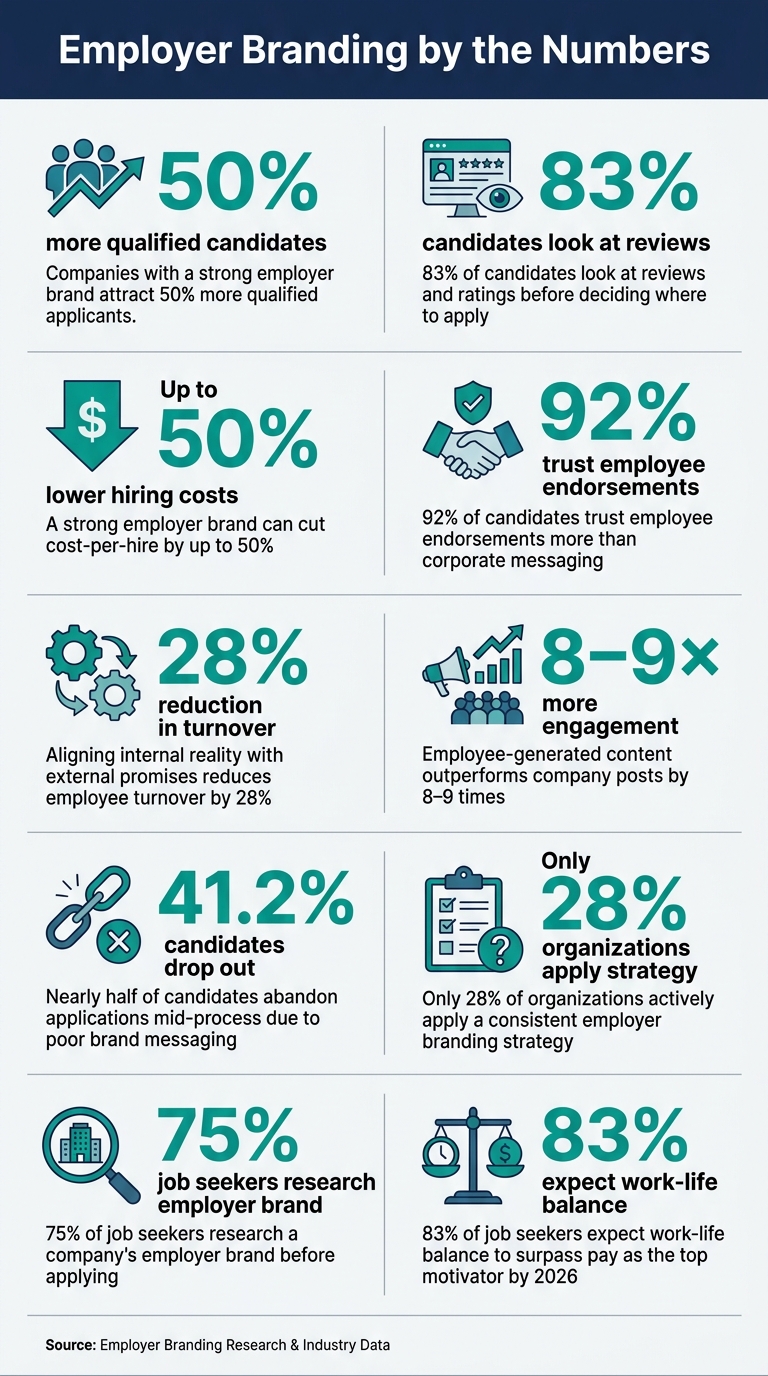
Employer Branding by the Numbers: Key Stats That Prove Its Impact
Create a Killer EMPLOYER BRAND Strategy for Your Small Business
sbb-itb-a23bd6a
Employer Branding Basics Your Team Needs to Know
Before diving into training, it’s crucial to establish a shared understanding of what employer branding means and why it matters.
What Is Employer Branding?
Employer branding is all about how your company is perceived as a place to work. It reflects the alignment – or sometimes the gap – between what candidates expect and what employees actually experience [2]. While corporate branding aims to attract customers, employer branding focuses on attracting and retaining talent. The objectives, messaging, and audiences for these two types of branding are distinct, as shown below:
| Brand Type | Target Audience | Core Focus |
|---|---|---|
| Employer Brand | Current & potential employees | Work culture & benefits |
| Corporate Brand | Customers & stakeholders | Products, innovation, service |
| Reputation | General public | Trust, reliability, values |
A strong employer brand does more than just enhance reputation – it speeds up hiring and cuts costs. With this foundation in place, you can now explore the essential elements that build a compelling employer brand.
Key Elements of Employer Branding
To craft an employer branding definition, benefits, and strategies, your team needs to understand these five critical components:
- Employer Value Proposition (EVP): This is the unique mix of benefits, opportunities, and cultural values your company offers in return for an employee’s contributions [2]. In simple terms, it answers the question, "Why should someone want to work here?"
- Mission and Values: These are the guiding principles that influence daily decisions and behaviors within your organization [3].
- Candidate Experience: Every touchpoint a candidate has with your company matters – from seeing a job ad to receiving an offer. For instance, 41.2% of candidates drop out of the application process midway [1], underscoring the importance of maintaining engagement through a strong and trustworthy brand.
- Target Candidate Personas: These are detailed profiles based on research, outlining the motivations, career aspirations, and preferences of the talent you’re trying to attract [1].
- Employer Messaging and Storytelling: This involves the tone, language, and narratives shared across platforms like job descriptions, social media, and your careers page [1].
Interestingly, by 2026, work-life balance is expected to surpass pay as the top motivator for 83% of job seekers worldwide [2]. This shift highlights the importance of aligning your employer brand with evolving candidate priorities.
How to Audit Your Current Employer Brand
Before equipping your teams with training or an embedded recruitment service, take a step back and assess your employer brand. This helps identify gaps between what you promise as an employer and what employees and candidates actually experience.
Gathering Internal Feedback
Start by listening to your employees – they’re your most valuable source of insight. Anonymous Employee Net Promoter Score (eNPS) surveys are an effective way to gauge how your team feels about working at your company. Run these surveys quarterly or keep anonymous feedback channels open year-round. Research shows that 60% of employees want more chances to share feedback with their employers [2].
Exit interviews are another goldmine for understanding why employees leave. When paired with stay interviews, you can uncover both the pain points and the positives of working at your company. Companies that act to align their internal reality with their external promises see a 28% reduction in turnover [2]. You can see how this works in practice through our embedded recruitment case studies.
"It always starts with connecting the company’s challenge and opportunity with the recruitment challenge and opportunity." – Karim Gharsallah, former Head of Talent, Tellent Recruitee [1]
Evaluating External Feedback
Your external reputation is just as important as your internal one. Platforms like Glassdoor and Indeed offer a snapshot of what current and former employees think about your company. Instead of fixating on individual comments, focus on recurring themes in reviews from the past 12–24 months.
Another tool to leverage is the Candidate Net Promoter Score (cNPS). This short survey, sent to candidates after the hiring process, highlights how outsiders view your company. It matters more than you might think – 75% of job seekers research a company’s employer brand before applying [2][3], and 83% specifically look at reviews and ratings when deciding where to submit their application [2].
Here’s a simple structure to guide your audit:
| Audit Area | What to Review | Key Metrics |
|---|---|---|
| Internal Experience | eNPS, pulse surveys, exit interviews | Top satisfaction vs. attrition drivers |
| External Reputation | Glassdoor, Indeed, social mentions | Rating trends over 12–24 months, recurring themes |
| Candidate Journey | Application drop-off, cNPS, offer acceptance rate | Highest drop-off points, hiring funnel velocity |
One actionable tip? Respond to negative reviews on platforms like Glassdoor or Indeed. A thoughtful, non-defensive reply shows accountability and can help improve how your company is perceived.
How to Build a Training Framework for Employer Branding
Once you’ve completed your audit, you’ve got the foundation to create a training framework that sticks. The key is to use those insights to design focused training programs tailored to different internal teams. The aim isn’t to rely on one-off workshops; it’s to ensure every group has a clear, repeatable way to represent your employer brand consistently.
Identifying Training Audiences and Objectives
Different roles need different training. A recruiter crafting job descriptions won’t need the same guidance as a CEO preparing for a conference keynote. Before you create any materials, outline who needs training and what each group should take away.
| Training Audience | Key Learning Objectives | Resources |
|---|---|---|
| Leadership | Representing company values, public advocacy, strategic alignment | Internal comms templates, town hall playbooks [1][2] |
| Recruiters/HR | Crafting on-brand job descriptions, enhancing candidate experience, communicating EVP | Messaging templates, structured interview guides [1][2] |
| Employees | Sharing authentic stories, engaging on social media | Pre-made captions, visuals, and social media prompts [1][7] |
Involving a cross-functional team – with members from HR, recruitment, marketing, and leadership – ensures the training reflects diverse perspectives and avoids becoming isolated within one department [1][3].
Standardizing Employer Brand Messaging
Inconsistent messaging between teams can confuse candidates. For instance, a recruiter might focus on career advancement, while a hiring manager highlights perks. That disconnect doesn’t go unnoticed.
Your EVP’s 3–5 core pillars (like growth, impact, or flexibility) should guide all messaging. Audit materials like job descriptions, career site content, and interview scripts to ensure they align with your EVP’s tone and promises [2][3]. As Sera Mbaraka, Recruiter at Die Görgens Gruppe, advises:
"Always be sure to keep relevant information concise to avoid information overload, ensure a clear and consistent structure across all pages, and promote usability, simplicity, and flexibility in the application process." [1]
A useful exercise is to compare your job descriptions with anonymous employee survey feedback. Any gaps between what you promise and what employees experience highlight areas where your training should focus [4].
Once messaging is consistent, give your teams the tools they need to execute it effectively.
Tools and Resources to Support Training
Provide tools that make it easy for teams to stay on-brand without overthinking. Employer brand guidelines should outline your EVP pillars, approved language, tone of voice, and examples of what’s on-brand versus off-brand. Include ready-made templates for job ads, LinkedIn updates, and candidate outreach emails.
For employee advocacy, offer optional social media content – like pre-written captions, visuals, and conversation starters – so participation feels effortless rather than forced [3][1]. This is important because content shared by employees generates 8–9 times more engagement than posts directly from the company [4].
To keep the training alive beyond the initial rollout, consider internal workshops, short on-demand video modules, and quarterly refreshers. These small but regular updates ensure the training remains relevant and top of mind.
Training Teams to Communicate the Employee Value Proposition (EVP)
What Is an EVP and Why Does It Matter?
An Employee Value Proposition (EVP) is essentially your company’s answer to the question every candidate is silently asking: "Why should I work here – and stay?" It’s the unique combination of what you offer across five key areas: culture and values, flexibility, growth, compensation, and purpose.
A clear and compelling EVP does more than attract attention – it drives action. Companies with a well-communicated EVP attract up to 50% more qualified applicants [3]. On the flip side, around 41.2% of candidates abandon applications mid-process because the messaging fails to connect or convince [1]. When the EVP is consistently communicated by everyone involved in hiring, it not only reduces drop-offs but also builds long-term trust and commitment.
As Remo Aeschbacher, Head of Group Employer Branding & Talent Acquisition at Accelleron, puts it:
"Our EVP not only guides our HR marketing content and visuals but also serves as a training tool for recruiters, hiring managers, and HR stakeholders during candidate interviews." [8]
How to Embed the EVP in Day-to-Day Interactions
Once your EVP is clearly defined, the next challenge is ensuring it’s part of every interaction with candidates through flexible embedded recruitment. This means training recruiters and hiring managers to weave specific EVP elements into their conversations, always aligning with your brand’s messaging. For instance, if a candidate asks about career growth, a recruiter should highlight tangible initiatives like mentorship programs or learning budgets, rather than vague promises like "we support development." Charlène Hemery, Founder of TalentCatcher, emphasizes this approach:
"Stories, immersive behind-the-scenes content, and clear job insights [to] build trust, engage candidates, and increase [your career site’s] conversions." [1]
To bring the EVP to life, here’s how teams can communicate each element effectively:
| EVP Element | How Teams Can Communicate It |
|---|---|
| Culture & Values | Share employee-led stories and behind-the-scenes moments during interviews and on social media. |
| Growth & Development | Discuss structured programs like mentorship opportunities or dedicated learning budgets. |
| Flexibility | Clearly outline hybrid/remote work options and any flexible arrangements early in the process. |
| Purpose & Impact | Connect daily roles to the company’s broader mission, especially during interviews or onboarding. |
| Compensation | Be upfront about salary ranges and total rewards packages. |
It’s not just about HR teams. Employees outside of recruitment can also play a role. Equip them with simple prompts like, "What surprised you most after joining?" to encourage authentic social media engagement. Peer stories build trust in ways no corporate messaging can.
Leadership must also walk the talk. When executives actively embody the EVP – whether through transparent town halls, volunteering, or open discussions about company strategy – it sends a powerful message. It shows candidates and employees alike that the EVP isn’t just a marketing tool; it’s a lived reality. And that kind of authenticity resonates far beyond the hiring process.
Building Team Behaviors That Reflect the Employer Brand
Aligning Recruitment Practices with the Employer Brand
Every step of the candidate journey – whether it’s reading a job posting or getting feedback after an interview – shapes how they view your company as an employer. Research highlights that most candidates actively evaluate employer brands and reviews before applying [4]. This means your recruitment process isn’t just about filling roles; it’s a direct reflection of your company’s identity.
Take a close look at all recruitment materials, from job descriptions to onboarding documents, to ensure they align with your Employer Value Proposition (EVP) [1][4]. Details like job titles, timely feedback, and upfront salary information all signal what kind of workplace you offer. These practices reinforce the EVP framework you’ve built.
Two core behaviors can make a big impact. First, be transparent: include salary ranges, work location policies, and clear performance expectations in every job posting [6]. Second, prioritize responsiveness: aim to acknowledge applications within 24 hours and provide interview feedback within three business days. Why? Because 66% of candidates say a positive experience during the hiring process influences their decision to accept an offer [6].
"Always be sure to keep relevant information concise to avoid information overload, ensure a clear and consistent structure across all pages, and promote usability, simplicity, and flexibility in the application process." – Sera Mbaraka, Recruiter, Die Görgens Gruppe [1]
Consistency is key. Standardized interviews not only ensure fairness but also help align candidate experiences with your employer brand [6]. Encourage hiring managers to treat interviews as conversations, not interrogations, tying each question back to the company’s values. Beyond these practices, empowering employees to act as brand ambassadors can amplify your EVP even further.
Encouraging Employees to Act as Brand Ambassadors
Once recruitment practices reflect your brand, the next step is to empower employees to share that promise. Employees are your most trusted advocates – 92% of candidates trust employee endorsements more than corporate messaging, and employee-generated content gets 8–9× more engagement than posts from company accounts [4]. On average, their personal networks are 10× the size of your official pages [4].
Instead of giving employees a script, encourage them to share their experiences naturally. Simple prompts can inspire them to create content like "day-in-the-life" posts, celebrate career milestones, or record short, unscripted video testimonials. Authenticity drives engagement [4]. While providing high-quality visuals can help, the story should always feel personal.
Netflix, for example, showcases its "Freedom & Responsibility" culture through the WeAreNetflix podcast, where employees share candid stories that help candidates self-assess their fit [1]. Similarly, HubSpot’s Culture Code deck, which has been viewed over 5 million times since 2013, outlines its HEART values (Humble, Empathetic, Adaptable, Remarkable, Transparent) and sets clear expectations for both employees and applicants [2]. These aren’t one-off campaigns – they’re long-term commitments to authenticity.
Internally, consider launching a regular spotlight program to showcase employee stories about growth, flexibility, or making an impact. Pair this with a peer-nominated recognition system that rewards behaviors aligned with your brand values, like mentoring others or demonstrating inclusive leadership. When employees see these actions celebrated, they’re more likely to embody and share them, making your employer brand an integral part of your company culture.
Measuring Training Results and Improving Over Time
Key Metrics for Tracking Employer Branding Adoption
After your team completes training, the next step is figuring out if it’s making a difference. The answer lies in your data, which you can evaluate using a recruitment health check. Break your metrics into two types: leading indicators (e.g., career site traffic, application volume) and lagging indicators (e.g., 90-day retention, cost-per-hire).
| Metric Category | Leading Indicators | Lagging Indicators |
|---|---|---|
| Attraction | Career site conversion, application volume | Quality-of-hire, cost-per-hire |
| Candidate Experience | Candidate NPS (cNPS), drop-off rates | Offer acceptance rate, time-to-hire |
| Internal Adoption | Employee content engagement, referral volume | eNPS, 6- and 12-month retention |
| Growth | Internal mobility applications | First-year turnover, regretted attrition |
When these metrics reveal trends, use the insights to refine your training materials and keep your employer brand aligned. By closely monitoring these indicators, you can see how well your adjustments are working and pinpoint areas where your messaging still needs fine-tuning.
One metric worth spotlighting is Candidate Net Promoter Score (cNPS). This measures how candidates feel about their hiring experience, regardless of whether they were offered the job. It’s an excellent way to gauge if your training is translating into real-world results [3]. Combine this with data from exit interviews to uncover any disconnect between the brand you promote and the actual employee experience [2].
Maintaining Standards Through Regular Feedback
Metrics only matter if you act on them. Review platforms like Glassdoor, social media engagement, and survey results every quarter. Use the findings to update your training materials and fine-tune your messaging [1][5]. A full review of your strategy once a year ensures your efforts stay aligned with evolving business goals and candidate expectations.
Short, anonymous pulse surveys focusing on EVP themes – like growth, flexibility, and recognition – can quickly uncover shifts in sentiment. Share the results with your team through updates like "You said, we did" in newsletters or town halls. Showing how employee feedback drives real changes keeps your team motivated and engaged as ambassadors for your brand [2][5].
Take these insights a step further by equipping managers with consistent playbooks for one-on-one conversations. Tie these discussions back to your EVP pillars – growth, impact, and culture – so your employer brand is reflected not just during hiring but in everyday interactions [2]. When managers reinforce these values consistently, employer branding becomes more than a program; it becomes part of your company’s DNA. This cycle of training, feedback, and continuous improvement is what builds and sustains a strong employer brand.
Conclusion and Next Steps
Building a strong employer brand isn’t a one-and-done task. It’s an ongoing effort, and with only 28% of organizations actively applying a consistent employer branding strategy [9], there’s a real chance to differentiate your company if you act with purpose.
Start by conducting an honest audit. Use up-to-date data, such as anonymous eNPS surveys, to uncover gaps between the promises made to candidates and the actual employee experience. This will help pinpoint areas that need immediate attention and deliver the most impact.
From there, strengthen your employer branding fundamentals. Use your audit findings to create a clear Employee Value Proposition (EVP) with 3–5 core pillars. Ensure messaging is consistent, and encourage employees to share genuine stories about their experiences. As Adway explains:
"Your employer brand is what candidates, employees, and the market think and feel about you as a place to work. It’s not something you control. It’s something you influence." [4]
The benefits of a strong employer brand are undeniable: it can cut cost-per-hire by up to 50%, reduce turnover by 28%, and attract 2.5× more applicants per job post [9]. These outcomes directly impact your hiring budget, team stability, and overall growth.
With Rent a Recruiter, you can take this to the next level. By embedding experienced recruiters into your team, you’ll gain the structure and consistency needed to accelerate hiring while ensuring your employer brand investments deliver measurable results.
FAQs
How do I define an EVP that’s actually believable?
To build a credible Employer Value Proposition (EVP), focus on being genuine and aligning it with your company’s actual strengths and the experiences of your employees. Begin by talking to your top-performing team members to understand why they choose to stay and what aspects of the company they appreciate most. Look for common themes, back them up with specific examples, and cross-check them with broader employee feedback. Make sure your EVP highlights tangible benefits and connects with the priorities of the candidates you want to attract.
What should I include in an employer brand training playbook?
An effective employer brand training playbook should cover the essentials to ensure your message resonates both internally and externally. Here’s what it should include:
- A well-defined Employer Value Proposition (EVP) backed by real examples and genuine employee stories that bring it to life.
- Clear guidelines for weaving the EVP into hiring processes and internal programs, such as employee advocacy efforts.
- Key metrics to measure success, helping you track progress and fine-tune your approach over time.
- A step-by-step process to align the EVP with broader business objectives, ensuring consistency in all communication channels.
By focusing on these elements, your playbook becomes a practical tool for building a cohesive and impactful employer brand.
How can I prove employer branding training is working?
To understand how your employer brand and hiring outcomes are evolving, focus on metrics that matter. Start with Candidate Net Promoter Score (cNPS) to gauge candidate experience and Employee Net Promoter Score (eNPS) to assess employee advocacy. Keep an eye on referral rates, offer acceptance rates, time-to-fill, and retention rates at both 6 and 12 months.
Beyond internal data, check Glassdoor and LinkedIn feedback for insights into how your company is perceived externally. Monitor engagement on your careers page and track social media activity to measure interest in your brand. By comparing these metrics over time, you’ll see whether your efforts are driving real progress.