
If your hiring process is slow, unclear, or uneven, your employer brand is already taking a hit, and that costs you applicants, accepted offers, and team time.
I’d boil this down to a simple point: candidate experience is not a brand project, it is a hiring performance issue. When response times slip, interviews vary by manager, and feedback goes missing, you lose control of hiring outcomes. That means more drop-off, lower reapply rates, and more hours spent fixing process gaps.
Here’s the short version:
- Your brand is shaped by process, not slogans
- Clear job ads, response SLAs, and structured interviews cut friction
- Manager consistency matters because candidates judge how your business runs
- Measurement matters because what gets tracked gets fixed
- When internal capacity is stretched, <a href="https://rentarecruiter.com/embedded-recruitment-service/">embedded recruitment</a> can help keep standards in place
A few numbers make the business case clear:
- Application drop-off can reach 92%
- Candidates left without status updates are 3.5x less likely to reapply
- Candidates with a positive experience are 38% more likely to accept an offer
- The right support model can cut hiring costs by up to 70% and save 80+ hours per month
If you are scaling in SaaS, Technology, IT, Fintech, Engineering, Security, Insurance, or Professional Services, this comes down to one thing: build a hiring process that protects your brand and improves hiring results at the same time.
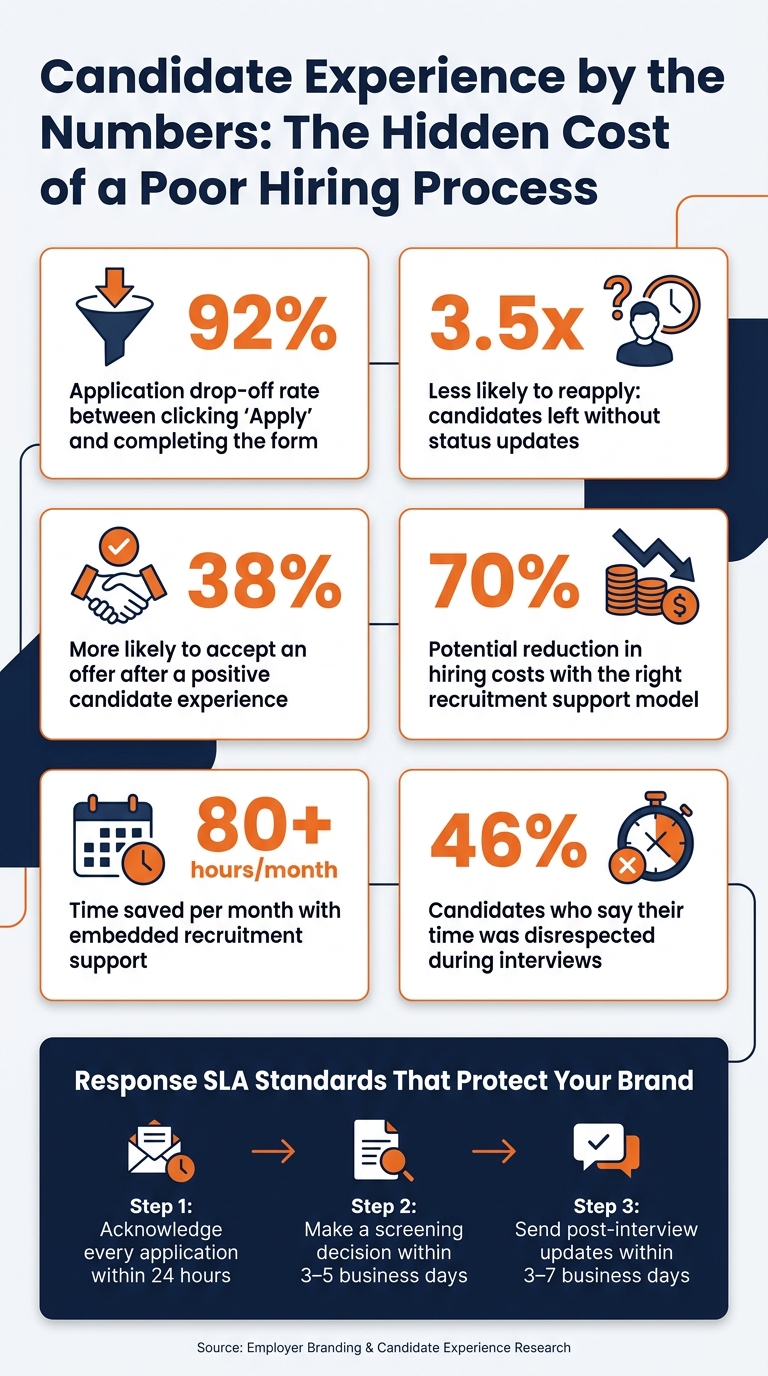
Candidate Experience by the Numbers: The Hidden Cost of a Poor Hiring Process
Revealing the Employer Branding Secret to Amazing Candidate Experience
Where Employer Brand Breaks Down Along the Candidate Journey
Employer brand starts to crack when your hiring process fails to live up to what you say about the business. That gap shows up at every stage, from application to rejection.
For hiring leaders, this is not just a brand issue. It’s a hiring performance issue. If the process feels messy, slow, or careless, people make a judgment about how your company runs.
The Touchpoints That Shape Candidate Perception Most
The biggest signals come from the moments people remember.
A job description with vague responsibilities suggests a business with weak internal alignment. A mobile-unfriendly application, or a form that asks people to enter the same data twice, tells them your process is disorganised and that their time does not matter.
In the U.S., candidates expect clear timelines and direct communication. When updates do not come, they assume the process is not under control.
Silence rarely gets read kindly. Candidates tend to see it as disorganisation or indifference. When you’re hiring at scale, response speed and follow-up discipline become part of your brand. They either back up what you say about the business, or they quietly undermine it.
Common SME Pain Points and Their Brand Impact
These are process problems, and they can be fixed. The pattern is usually easy to spot.
| Candidate Journey Stage | Common SME Issue | Brand Signal | Business Impact |
|---|---|---|---|
| Application | Duplicate data entry; mobile-unfriendly application | Disorganized and disrespectful of time | High drop-off rates; weaker market reputation |
| Post-Application | No acknowledgment of receipt | Indifference; lack of internal structure | Damage to talent reputation; loss of candidate interest |
| Interview | No structured feedback after rejection | Transactional culture; lack of respect | Negative word-of-mouth; fewer referrals and weaker talent pipelines |
| Communication | Inconsistent status updates | Unreliable; poor internal communication | Lower trust in the brand; increased withdrawal from process |
The cost builds over time. Poor experiences get shared. Respectful rejections help protect your brand.
The point is simple: these breakdowns do not happen by accident. They come from weak process, unclear ownership, and patchy follow-through.
Candidate experience is what people remember when they talk about your company later.
How to Build a Hiring Process That Supports Your Employer Brand at Scale
Fix the parts candidates experience first: the job ad, response speed, interview format, and manager behaviour.
Start with the visible parts of the process. What candidates read, how fast you respond, and how interviews are run all shape how your company is judged.
Standardize Job Ads, Response SLAs, and Interview Structure
A job ad is often the first real interaction a candidate has with your company. If pay, scope, or expectations are vague, people drop off early or enter interviews with the wrong picture in mind. Your job ads should spell out the growth story, USD compensation, 6 to 12 month success criteria, and how the team works.
Application forms need the same attention. Candidate drop-off between clicking "Apply" and finishing an application can reach 92%[2]. In many cases, the problem is simple: the form is too long, not mobile-friendly, or asks for details already sitting on the resume. Short, mobile-friendly applications help cut that drop-off.
Response SLAs are another place where SMEs lose momentum without noticing. A solid standard looks like this:
- Acknowledge every application within 24 hours
- Make a screening decision within 3 to 5 business days
- Send post-interview updates within 3 to 7 business days
If candidates are left in the dark, the cost shows up later. Candidates who are not told their status are 3.5x less likely to reapply to that employer[5].
Use structured interviews with the same questions and scorecards for every candidate. That gives you a more consistent process and makes hiring decisions easier to back up. It also has a direct effect on outcomes. Candidates with a positive experience are 38% more likely to accept an offer[3].
Train Hiring Managers to Represent the Brand Consistently
Hiring managers are your employer brand in the room. A well-built process means little if managers deliver it in different ways.
How they show up matters. Did they read the resume? Did they start on time? Can they explain the role clearly? Those small moments shape how candidates see your company. 46% of candidates say their time was disrespected during interviews[4]. In tight U.S. talent markets, one disorganised or unprepared interview can be enough to lose someone to another offer.
Your interviewer playbook should give managers clear guidance on:
- Role narratives and common questions
- Structured interviewing and U.S. employment law guardrails
- Scorecards tied to predefined competencies, not gut feel
A short post-interview survey can also help you spot weak points early, before they turn into offer declines or poor reviews.
Use Embedded Recruitment Support When Internal Capacity Is the Bottleneck
When internal teams get stretched, consistency is usually the first thing to slip.
That tends to happen after funding, a product launch, or market expansion. Hiring volume goes up, but internal capacity does not. An embedded recruiter can join your team within days and run hiring end to end. Rent a Recruiter places experienced recruiters inside scaling SMEs across technology, SaaS, fintech, engineering, and professional services. The goal is simple: standardise job ads, enforce SLAs, and keep candidate communication steady.
For high-growth SMEs, this can cut hiring costs by up to 70% and save more than 80 hours a month in hiring and admin time. You get hiring capacity that can grow with demand, without losing the consistency that shapes candidate experience.
sbb-itb-a23bd6a
How Communication, Feedback, and Measurement Build a Stronger Employer Brand
A well-structured hiring process gets you halfway there. What turns candidate experience into a repeatable brand asset is how you communicate at each step, and whether you’re tracking the signals that show where the process is working, or where it’s letting you down.
Set Clear Communication Standards at Every Hiring Stage
Each stage of the hiring process needs a clear communication point. That means automated acknowledgments when someone applies, clear interview confirmations, honest delay notices if timelines slip, and respectful rejection messages that explain what happens next.
Silence sends a message too. Most candidates read it as indifference or disorganisation[1].
Keep your tone short, clear, and steady across the process. If someone reaches interview stage and doesn’t move forward, structured feedback helps protect your brand. It also supports positive word-of-mouth and future referrals[1].
This isn’t just about being polite. It’s about reducing drop-off, protecting your reputation, and making sure good people don’t walk away with the wrong impression of your business.
Collect Candidate Feedback and Track the Right Metrics
If you don’t measure candidate experience, you’re left guessing. The metrics worth checking each month or quarter include response times, application completion rate, candidate feedback scores, and referral rate[1].
Not every feedback method gives you the same level of detail. Some are good for trend tracking. Others help you spot where the hiring process breaks down.
| Feedback Method | Ease of Use | Insight Depth | SME Suitability |
|---|---|---|---|
| Candidate NPS (cNPS) | High (Single question) | Low (General sentiment) | Excellent for high-level monthly tracking |
| Short Pulse Surveys | Medium | Medium | Best for specific stages like application or scheduling |
| Post-Interview Follow-ups | Low (Requires manual/structured effort) | High (Specific process/manager feedback) | Critical for identifying interview stage bottlenecks |
Start with cNPS if you want a quick view of overall sentiment. Then add pulse surveys at points like application or scheduling, where friction often shows up first. Post-interview follow-ups are best when you need detailed feedback on the process itself or on hiring manager performance.
Think of it like this: cNPS tells you how people felt. Stage-based feedback helps show you why.
Turn Hiring Data Into Process Improvements
Data on its own doesn’t fix anything. Someone has to review it, spot the patterns, and act on them.
Use the feedback you collect to find the parts of the hiring process that are creating unintended negative impressions[1]. Then tighten the communication standards, fix clunky application flows, and deal with bottlenecks before they start costing you referrals, time, or trust.
For teams that need extra support, Rent a Recruiter offers recruitment health checks, employer branding assessments, and talent mapping support to help SMEs benchmark their current candidate experience.
Conclusion: Make Candidate Experience a Measurable Hiring Advantage
The practices above work because they turn candidate experience into a repeatable hiring system. Your employer brand is shaped in the process itself, not in polished marketing copy. When job ads, response SLAs, structured interviews, manager consistency, and candidate feedback all line up, the payoff shows up across speed, trust, and referrals.
That has a direct business impact. A clear process helps you hire faster, cuts drop-offs, and leaves unsuccessful candidates with a fair impression that strengthens your employer reputation over time.
This is usually where things start to slip. When internal hiring capacity can’t keep up, response times slow, feedback gets delayed, and interview quality becomes uneven. That’s where embedded recruitment support helps. It keeps SLAs, feedback loops, and hiring consistency in place without overloading your team.
If hiring volume is rising faster than your team can handle, external embedded support helps keep the process steady. If you’re scaling and your hiring process isn’t keeping pace, Rent a Recruiter can embed an experienced recruiter directly into your team. Book a call at https://rentarecruiter.com/contact-us/ to discuss embedded support or request a free Recruitment Health Check.
FAQs
How do I audit candidate experience quickly?
Start with your external reputation on sites like Glassdoor and Indeed. Look for repeat themes in reviews, because patterns tell you where trust breaks down and where your employer brand is helping or hurting hiring outcomes.
Then test your own application process. It should be mobile-friendly, take under 15 minutes, and explain your culture and open roles within 30 seconds. If it feels slow, clunky, or vague, you’re likely losing good people before a recruiter ever speaks to them. That means wasted spend, lower conversion, and more time spent refilling the same pipeline.
Map the candidate journey from first click to final decision. This helps you spot bottlenecks, handoff issues, and communication gaps that drag out time-to-hire.
For direct feedback, use a post-interview Candidate Net Promoter Score (cNPS) survey. It’s a simple way to see how people rate the experience and where your process is costing you goodwill, referrals, and future applicants.
Which hiring metrics matter most first?
Start with the metrics that show early interest and how easy your process feels to applicants: application volume and job description click-through rates. These tell you if your role ads are clear, appealing, and doing their job.
Then track application completion rate. That shows whether your application process is simple or whether people are dropping off partway through.
These early-stage metrics give you a clear baseline. Before you look at later hiring stages, you need to know whether your employer brand is driving action at the top of the funnel.
When should we use embedded recruitment support?
Use embedded recruitment support when fast growth starts to strain your hiring team and you need more consistency, better hiring quality, and closer alignment with your employer brand.
It makes sense when your process feels slow, disorganised, or stretched thin. It also helps when candidates are slipping through the cracks, or when you’re dealing with hiring spikes and the extra load that comes with hybrid recruitment.