
If your employer brand is vague, you pay for it in slower hiring, more sourcing time, and weak-fit applicants.
I’d boil this down to five moves: research by role, build a proof-based EVP, use it across every hiring step, track hiring results, and assign clear ownership. Done well, this cuts wasted recruiter time, improves applicant quality, and helps you fill hard tech roles with less drag on the business.
For scaling teams in SaaS, Technology, IT, Fintech, Engineering, Security, Insurance, and Professional Services, the point is simple. Employer branding should help you hire faster, spend less, and give hiring teams more control. It should not sit as a side project that looks good but changes nothing.
Here’s the short version:
- Start with the market, not a slogan
- Segment by role, because a QA Engineer and a Senior Software Developer do not buy roles the same way
- Use proof, not broad claims about growth, flexibility, or impact
- Keep the message aligned from careers page to offer stage
- Measure hiring output, not just clicks or impressions
- Give ownership to named teams, so the message does not drift when hiring volume goes up
A few numbers stand out. Around 75% of tech professionals review employer brand and reputation before applying, and referrals often lead to 40% higher retention than job board hires. That means brand work affects more than awareness. It affects cost-per-hire, time-to-hire, and retention.
If internal hiring capacity is stretched, this is also where embedded recruitment can help. It gives you added recruiter capacity while keeping messaging and process aligned. If you want to review hiring economics, use this ROI calculator. If you want a direct process review, speak to Rent a Recruiter.
The article below lays out how to turn employer branding into a hiring system that supports better outcomes, not just better copy.
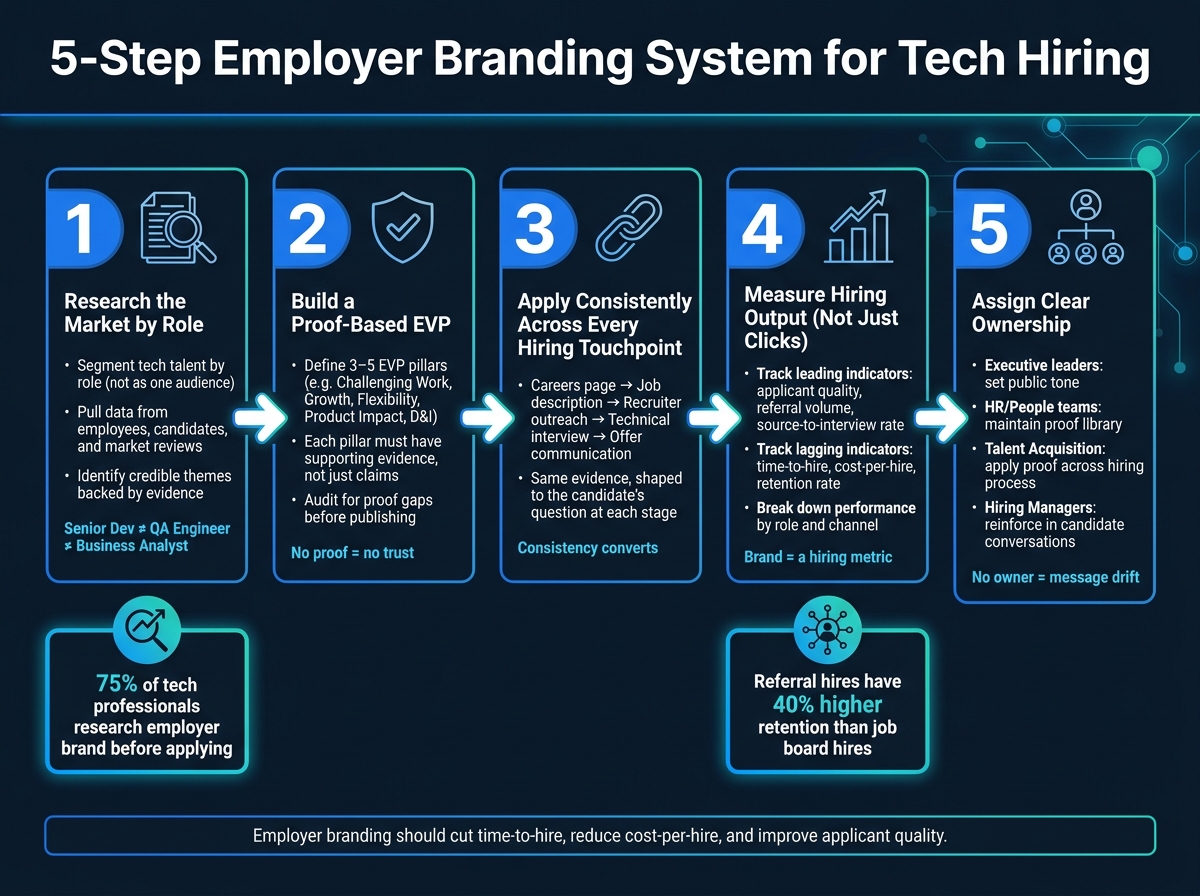
5-Step Employer Branding System for Tech Hiring
CTO Craft Bytes – Engineering Employer Branding: Be a Talent Magnet
sbb-itb-a23bd6a
Research the talent market before writing your message
Before you write employer brand copy, do the homework.
If you skip research, your message turns into guesswork. And in hiring, guesswork costs time, slows response rates, and leads to poor-fit applicants.
Segment tech talent by role, not as one audience
Tech talent is not one audience. Treating it that way is where a lot of employer branding goes off track.
A Senior Software Developer does not weigh a role the same way a Project Coordinator does. The same goes for a QA Engineer and a Business Systems Analyst. Their day-to-day work is different, the signals they look for are different, and the proof they trust is different.
Role-based segmentation fixes that. Use the table below as a starting point for role-specific messaging:
| Tech Role | Primary Motivations | Proof Points That Persuade |
|---|---|---|
| Senior Software Developer | Tech stack, architecture, problem-solving | Evidence of high-quality delivery, opportunities to lead diverse teams |
| QA Engineer | Automation tools, domain expertise | Testing environments, Jira, SQL, SDLC involvement |
| Business Systems Analyst | Data-driven decisions, stakeholder work | SDLC coverage, Agile/Waterfall, SQL, Confluence |
| Project Coordinator | Large-scale delivery, process improvement | Consumer-facing platforms, digital transformation projects managed |
Seniority adds another layer. One EVP message will not fit both groups.
That matters because broad messaging tends to say a lot without saying much. You end up with copy that sounds polished but gives decision-makers little confidence that the right people will respond. Better targeting usually means better applicant quality.
Use employee, candidate, and market data to find credible themes
Once you know which engineering recruitment solutions or roles you want, use research to find the themes those candidates will believe.
That means pulling data from three places: current employees, active candidates, and the market.
Start with your own team. Anonymous surveys and short interviews can show clear patterns around why people joined, why they stay, and what they care about most. This is often where the most useful messaging comes from, not because it sounds nice, but because it reflects what people inside the business already say.
Candidate decline reasons matter just as much. They show where your message, process, or offer is missing the mark. If people keep dropping out for the same reasons, that is not just a hiring issue. It is a brand signal.
Review-site themes often match those private concerns, so look at them together rather than in isolation. When the same point shows up across employee feedback, candidate feedback, and market sentiment, you have something you can actually use.
Then move from preferences to proof points.
If your research shows return-to-office friction, say what your working model is and how it works in practice. If stability is a concern, show the business case: funding position, client base, growth plan, or delivery track record. Claims alone will not carry the message. Evidence will.
Use those themes to build an EVP backed by proof, not promises.
Build a proof-based EVP and turn it into content tech talent trusts
Your EVP should come from what your research shows, not from nice-sounding brand lines.
Take the role-specific themes you found and turn them into 3 to 5 EVP pillars that tech talent will spot as real. If your research points to challenging work, growth, flexibility, product impact, and inclusion, those are the kinds of pillars to build around.
Create 3 to 5 EVP pillars backed by proof
Keep it tight. Three to five pillars is enough. Any more, and the message starts to drift.
Each pillar should be backed by proof from your research, not marketing language. Before you publish anything, test every pillar against a simple audit. That helps you spot weak claims before candidates do.
| EVP Pillar | Supporting Evidence | Proof Gap | Owner |
|---|---|---|---|
| Challenging Work | Case studies on refactoring legacy apps into microservices | Vague "fast-paced environment" claims without project examples | Engineering Lead |
| Learning & Growth | Budget for certifications (e.g., Azure Solutions Architect Expert), internal mentorship program | No dedicated time or training resources mentioned | HR / Dept. Head |
| Flexibility | Documented remote-first policy, async work options | "Flexible" in the job posting but mandatory 5-day office presence in practice | Leadership |
| Product Impact | Metrics showing how a specific feature reduced costs or improved user experience | Dev tasks described with no connection to business outcomes | Product Manager |
| Diversity & Inclusion | Published diversity metrics, inclusive hiring training logs | No diverse representation visible in leadership | DE&I Committee / TA |
If a pillar shows a gap in the Proof Gap column, you have two choices: fix it or drop it.
That matters because weak EVP claims don’t just hurt trust. They slow hiring, create friction in interviews, and can lead to offer drop-off later in the process.
Show the real work, team practices, and career paths
Once your pillars are set, the next step is simple. Prove them with real work and real people.
The employer brand content tech talent trusts most usually comes from current employees and actual project stories. Employee profiles, project write-ups, and team narratives help people picture the day-to-day work before they ever speak to your team.
For a challenging work pillar, a short case study on a real migration, the technical choices behind it, and the result will do far more than broad claims about complexity.
For a learning and growth pillar, show an internal mobility story. Add examples of certifications and mentorship. That gives candidates something solid to judge, and it helps your hiring team answer the same questions with confidence.
This is where many scaling companies miss the mark. They talk about growth, but don’t show what growth looks like in practice. They talk about impact, but don’t connect engineering work to product or business results. If you want trust, spell it out.
Apply the same message across the full hiring journey
The same proof needs to show up across the whole hiring journey, not just on the careers page.
Every touchpoint your team owns should carry the same evidence, shaped around the question the candidate is asking at that stage. That kind of consistency saves time for hiring teams, cuts mixed messaging, and makes your process feel far more joined up.
| Candidate Touchpoint | Candidate Questions | Evidence Provided | Owner | Quality Check |
|---|---|---|---|---|
| Careers Page | "What is the culture actually like?" | Employee success stories, team videos, D&I policy summaries | Employer Brand Manager | Ensure stories are less than 12 months old |
| Job Description | "What will I actually build?" | Specific tech stack (e.g., .NET Core, Azure), project goals, clear benefits list | Hiring Manager | Verify the tech stack listed is current |
| Recruiter Outreach | "Why should I leave my current role?" | EVP pillars tailored to the candidate’s career stage and role | Talent Acquisition | Check for personalization before sending |
| Technical Interview | "How does the team solve problems?" | Real-world architectural discussion or coding challenge reflecting daily work | Engineering Team | Does it reflect what the role actually involves? |
| Offer Communication | "Is the culture what they described?" | Testimonials from future peers, detailed benefits summary | HR / Recruiter | Does it match the EVP communicated earlier? |
The goal is consistency. If your careers page says one thing, your recruiter says another, and the interview tells a third story, trust drops fast.
Carry the same proof from offer acceptance through pre-onboarding to reduce drop-off and ghosting.
Distribute the brand through the right channels and measure business impact
A proof-based EVP only works if the right people actually see it. Once your EVP is clear, put it in the places niche candidates already trust and use.
Reach niche tech communities with role-specific channels
Generic platforms like LinkedIn often don’t give you enough precision for niche tech hiring. Around 75% of tech professionals research an employer’s brand and reputation before they even think about applying. That changes the job for hiring teams. You can’t just post and hope. You need to show up where these people already spend time.
For niche roles, that usually means places like Slack groups, Discord servers, and Subreddits tied to the work itself.
Use technical content, open-source work, and direct outreach to build trust over time and support live hiring needs. This matters because niche candidates don’t respond well to broad employer branding. They look for proof.
Employee voices carry more weight than company copy. Let engineers share project work, technical write-ups, and lessons learned in their own words. That tends to land better than polished brand messaging because it feels closer to the day-to-day reality of the job.
The table below maps common niche tech roles to the communities and content formats they tend to trust most:
| Role | Trusted Community | Content Format |
|---|---|---|
| AI / ML Engineer | Kaggle, niche Slack or Discord communities | Research write-ups, model benchmarks, open-source contributions |
| DevOps / Platform Engineer | DevOps Slack communities, Subreddits | Architecture deep-dives, internal workflow write-ups, failure post-mortems |
| Frontend Developer | Reactiflux Discord, other developer communities | UI case studies, component showcases, accessibility write-ups |
| Data Scientist | Kaggle, data-focused communities | Model or pipeline write-ups, stack comparisons |
| Security Engineer | Niche Slack or Discord communities | Technical write-ups, research summaries, tool releases |
Start small. Low-cost newsletters and meetup sponsorships are often a smart place to begin. Then put more budget into the channels that bring in qualified applicants, not just clicks or impressions.
The next job is simple: measure which channels lead to actual hiring progress, or rate your recruitment process to identify other gaps.
Track leading and lagging indicators that show hiring return
Track early signals and hiring outcomes separately. That’s how you connect brand activity to hiring performance, instead of treating employer brand as a soft metric.
Employee referrals deserve their own view. Referrals usually lead to a 40% higher retention rate than candidates sourced through job boards. That makes referral volume a useful signal for brand health inside the business, not just outside it. If referral numbers are low, your team may not fully back the story you’re putting into market.
Track performance by role so you can see which channels bring in:
- qualified applicants
- interviews
- offers
- hires
This gives you a clearer read on what is working, where spend is paying off, and where hiring friction is slowing results. Use that data to keep your brand, channel mix, and hiring process pointed in the same direction.
Then adjust ownership and execution before the next hiring cycle, while there is still time to change the outcome.
Make employer branding a repeatable part of your hiring process
Once your message is clear, the next step is ownership.
This is where many hiring teams slip. Employer branding breaks down when no one owns it. And as hiring volume grows, the gap between what you say and what people experience gets bigger.
Assign ownership across leadership, HR, talent acquisition, and hiring managers
Each team has a different job to do if you want your employer brand to hold up under pressure.
Executive leaders set the tone. They show what the company stands for, and they do it in public.
HR and people teams keep a shared library of proof. That includes real examples of how teams work, what career paths look like, and how day-to-day life actually feels inside the business.
Talent acquisition uses that proof across the hiring process, from job descriptions and outreach to interview stages.
Hiring managers and engineers make it real in candidate conversations. They either back up the message or weaken it.
A few simple habits help keep this tight:
- Refresh role messaging when teams, tools, or hiring priorities change
- Train interviewers to use the same proof points candidates already see in your content
That kind of consistency matters. It cuts confusion, saves time in the process, and helps you convert the right people without overselling the role.
Use embedded recruitment support when internal capacity is stretched
When hiring demand starts to outrun internal capacity, consistency is usually the first thing to go.
That’s when an embedded recruiter can help. They keep hiring moving, keep messaging aligned, and reduce the drift that often shows up when teams are stretched thin.
For scaling companies, that means you protect more than speed. You protect the quality of the hiring experience, which has a direct effect on conversion, time-to-hire, and cost-per-hire.
Conclusion: Turn employer branding into faster, lower-cost tech hiring
The five moves are clear: research by role, build a proof-based EVP, apply it with consistency, measure the impact, and assign ownership. Together, they make employer branding a working part of your hiring system.
If you want a quick view of where gaps still exist, start with a process check. For a baseline, Rent a Recruiter’s free Recruitment Health Check shows where your employer brand and hiring process stand.
FAQs
How do I define an EVP for different tech roles?
Avoid a one-size-fits-all message. Different talent groups care about different things, and if you pitch everyone the same way, your EVP starts to feel vague.
Segment by function and seniority. A senior engineer may care more about ownership, autonomy, and scope. A junior hire is more likely to focus on mentorship, learning, and career growth. Same company, different priorities.
A good way to get this right is simple: talk to your top performers in each role. Find the patterns. What made them join? What keeps them there? Which parts of the job do they speak about with conviction, and which claims fall flat?
From there, keep your core EVP steady across the business, but shift the emphasis by audience. The message stays aligned. The proof changes.
Use specific, verifiable examples for each function. For engineering, that might be decision-making freedom, product influence, or ownership of systems. For junior teams, it could be manager support, promotion paths, or structured development. That level of detail helps people trust what you’re saying, and it gives hiring teams a sharper story to tell.
What proof makes an employer brand credible to tech talent?
Credibility comes from proof people can check, not vague claims.
Show the specifics. That might be your internal promotion rate, a $2,000 annual learning budget, or how fast new engineers start shipping code. Details like these make your employer story more believable, and they help hiring leaders cut through doubt early.
It also helps to share real employee experiences, technical content, and plain details on salary ranges, remote work policies, and leadership. If you’re hiring in SaaS, Technology, IT, Fintech, Engineering, Security, Insurance, or Professional Services, this matters even more. Senior talent will look for substance, not polished slogans.
The key point is simple: your message has to match what employees actually live day to day. If it doesn’t, you’ll pay for it later through slower hiring, lower acceptance rates, and early attrition.
How do I measure employer branding ROI in hiring?
Measure employer branding ROI by tying it to business outcomes, not vanity metrics.
That means tracking performance across the full hiring funnel, from first touch to long-term retention.
At the top of the funnel, look at career site traffic and social engagement. These show whether more of the right people are noticing your brand.
In the middle, focus on application completion rates and candidate satisfaction. If people drop off halfway through the process, or leave with a poor impression, brand spend is leaking value.
Further down, track offer acceptance and cost per hire. This is where employer branding starts to show clear commercial impact. A stronger brand can help you convert more offers and reduce reliance on paid channels.
Then look at what happens after the hire. Retention and eNPS help you see whether the brand promise matches the employee experience. If it does, people tend to stay longer and speak more positively about the business.
To calculate ROI, use your annual hire volume and any drop in cost per hire driven by organic traffic and referrals. That gives you a more grounded view of return than surface-level engagement numbers alone.
Key metrics to track include:
- cNPS
- eNPS
- Cost per hire
- Offer acceptance
- Retention