If your hiring story is weak, you pay for it in slower hiring, lower offer acceptance, and more agency spend.
I see the same pattern across scaling firms in SaaS, Technology, IT, Fintech, Engineering, Security, Insurance, and Professional Services. When employer branding is built into job ads, outreach, interviews, and offers, teams tend to fill roles faster, cut waste, and get more direct applicants. In the examples here, time-to-hire fell from 62 to 38 days and 50 to 32 days, offer acceptance moved from 55% to 74% and 58% to 78%, and cost-per-hire dropped from $9,500 to $5,800.
The main point is simple: employer branding is not a marketing side project. It is a hiring tool that affects cost, speed, and control.
Here’s the short version:
- Clear EVP messaging helps you bring in better-fit applicants
- Employee advocacy helps reduce doubt about joining a smaller firm
- A better hiring process cuts drop-off and improves conversion
- Consistent messaging across every touchpoint helps improve trust
- Direct hiring growth can reduce spend on traditional recruitment agencies
For CEOs, CFOs, HR leaders, and Talent Leaders, the commercial link is clear. If you want lower hiring costs and less strain on internal teams, you need the same message to show up from first contact to signed offer. That is also why many scaling firms look at embedded recruitment or support from Rent a Recruiter when internal capacity is tight.
Below, I break down what the article shows, what changed in each case, and where the business impact came from.
You can also rate your recruitment process to identify specific gaps in your current strategy.
The Hiring Problem High-Growth SMEs Need to Solve
Why Smaller Firms Lose Talent in Competitive Markets
Around 66% of U.S. employers say recruiting and hiring is "somewhat" or "very" challenging [4]. For SMEs in SaaS, fintech, engineering, and professional services, that pressure hits harder. You are competing for the same specialist talent as larger firms, but with smaller budgets, leaner talent teams, and less brand recognition.
In many SMEs, hiring sits with founders, department heads, or operations staff who are already stretched. So the process becomes reactive. Pipeline-building slips. Roles open, pressure builds, and the business scrambles to catch up. For high-growth SMEs, the problem is not only filling roles. It is making the shortlist in the first place.
Low visibility makes that tougher. If your business does not show up in the places candidates already trust and use, you will likely be missed. That means visibility and credibility matter almost as much as pay. When hiring demand jumps, many SMEs fall back on agencies, and cost-per-hire climbs fast.
You usually see the cracks in three places:
- The job ad
- The careers site
- The interview process
What Weak Employer Branding Looks Like in Practice
The signs are usually easy to spot. Job posts open with a wall of requirements and finish with "competitive salary." Careers pages look thin or out of date. Interviewers give different answers about culture, growth, or team structure. There are no employee voices online, no proof points, and no clear story about why someone should join.
That has a direct business cost. Generic job posts bring in broad, low-fit applicant pools, which means more time spent screening resumes that go nowhere. Outdated careers pages chip away at trust before someone even clicks "apply." Mixed messages in interviews hurt offer acceptance because candidates start to doubt how the company is run. And without employee advocacy, there is little social proof behind the employer story.
This gets expensive quickly. When applicant quality is low and internal bandwidth is tight, SMEs depend more on external agencies to plug the gap. That pushes cost-per-hire up at the exact point growth needs it to come down.
The case studies below show how SMEs used employer branding to improve speed, trust, and application volume, closing these gaps through clearer messaging, stronger advocacy, and a better candidate experience.
sbb-itb-a23bd6a
Employer Branding Explained: Attracting Top Talent Strategy
Case Studies: How SMEs Use Employer Branding to Attract Talent
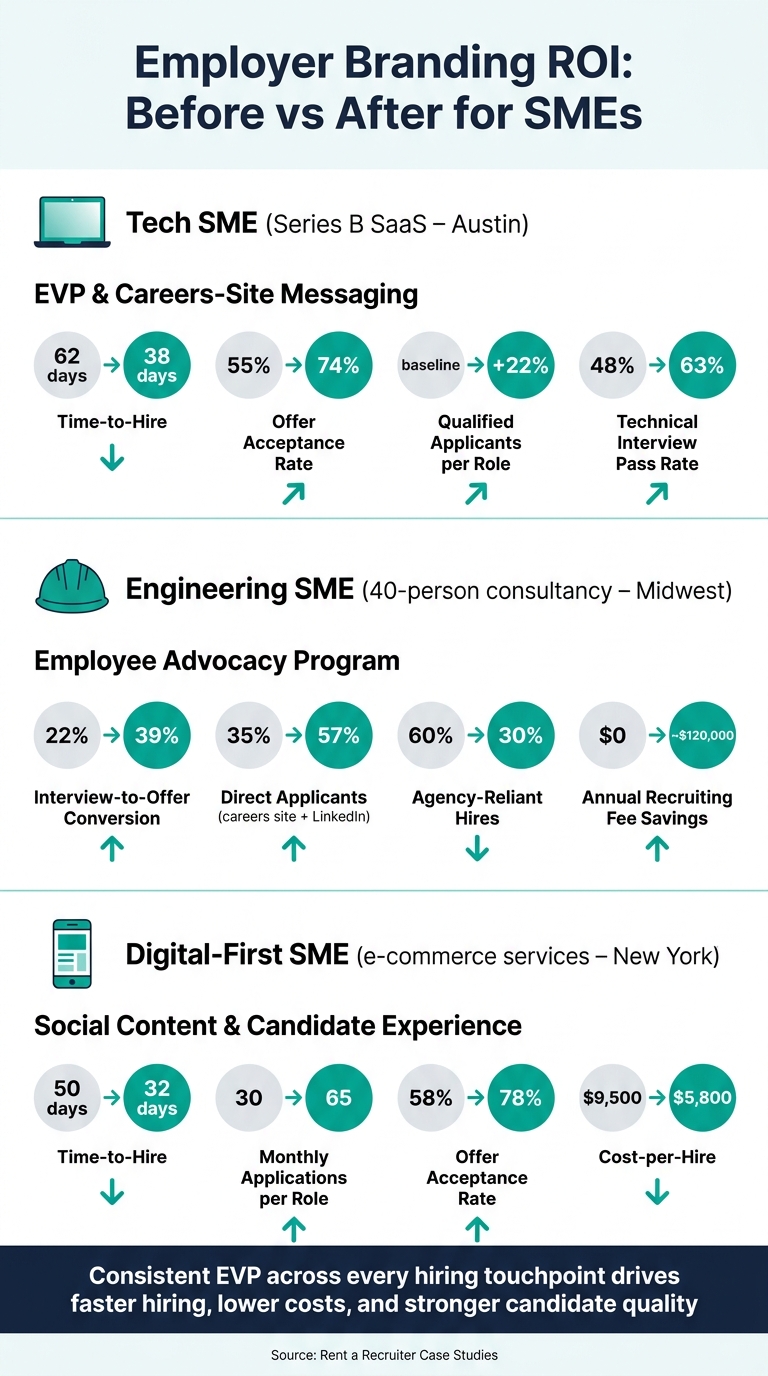
Employer Branding ROI: Before vs After for SMEs
These scenarios reflect common hiring patterns in high-growth U.S. SMEs. Each one shows how employer branding strategies can change a different part of the hiring funnel: attraction, trust, and conversion.
Tech SME: How EVP and Careers-Site Messaging Improved Hiring Speed
A Series B SaaS company in Austin was struggling to hire mid-level software engineers and product managers. Candidates were making it through the early stages, then dropping out. Offer acceptance was sitting at 55%, and average time-to-hire had stretched to 62 days. Feedback kept landing on the same point: the roles felt generic and looked too similar to other tech jobs.
The company rebuilt its EVP around three pillars: career growth, flexible work, and meaningful work.
Career growth meant a $2,000 annual learning budget for each employee, plus clear progression frameworks. Flexible work included hybrid schedules and work-from-anywhere options within the U.S. Meaningful work showed up in direct access to users and a clear link between day-to-day projects and business results.
They then pushed that message into every candidate-facing touchpoint.
Job descriptions stopped leading with task lists. Instead, they opened with what someone could grow into over the next 12 to 24 months. The careers site added a Day in the Life section for engineers and real examples of how small product teams shipped features used by 100,000+ users. Recruiter outreach also changed. Rather than sending generic role summaries, recruiters highlighted EVP-led messages, including the fact that engineers spent roughly 70% of their time on new feature development rather than maintenance.
After six months, the shift showed up in the numbers. Time-to-hire dropped from 62 to 38 days, qualified applicants per role increased by 22%, and offer acceptance rose to 74%. More candidates also passed onsite technical interviews, moving from 48% to 63%. That matters because it points to a stronger top-of-funnel fit, not just more volume.
Once a clear EVP brings people in, employee voices help them believe what they’re hearing.
Engineering SME: How Employee Advocacy Built Candidate Trust
A 40-person engineering consultancy in the Midwest had a different issue. Their interview-to-offer conversion rate was just 22%, and candidates were dropping off after panel interviews. The message from feedback was blunt: candidates saw risk in joining a smaller firm. They did not have a clear picture of what working there would actually feel like.
The company picked 10 internal ambassadors across different tenures and disciplines. Those employees shared 2 to 3 minute videos, Q&As, and project posts based on real work. That included examples like reducing construction issues on a $10 million infrastructure project and showing how working in small teams sped up professional development.
To keep participation high, the business tied advocacy to things employees cared about:
- Public recognition in all-hands meetings
- Support for conference attendance
- Inclusion of advocacy work in performance reviews under talent-brand impact
At the same time, hiring managers joined alignment workshops with recruiters. The goal was simple: get everyone using the same talking points on career progression, project pipeline, and workload expectations. Candidates also met at least one ambassador during the interview process and received realistic project previews.
Within two quarters, interview-to-offer conversion increased from 22% to 39%. The share of direct applicants through the careers site and LinkedIn Easy Apply climbed from 35% to 57%. Agency-reliant hires fell from 60% to 30% of total roles filled. For a smaller engineering firm, that kind of shift has a direct finance impact, cutting external recruiting fees by about $120,000 per year based on typical 20% to 25% commission rates for specialised engineering roles in the U.S.
When candidates trust what they see, the next issue is friction. If the process feels clunky, interest still leaks out.
Digital-First SME: How Social Content and Candidate Experience Increased Applications
A digital marketing and e-commerce services SME in New York had almost no organic talent flow. The business leaned heavily on referrals and agencies, averaged only 30 applications per key role per month, and had a time-to-hire of 50 days. The application form took more than 20 minutes to finish and was not mobile-friendly. In many cases, candidates only heard about the company through agency outreach.
The company introduced a structured LinkedIn content plan built around weekly themes. Posts covered how the team ran remote creative sprints, career paths in performance marketing, and behind-the-scenes client wins. At the same time, they cleaned up the application process: fewer required fields, mobile optimisation, and optional questions after resume upload.
Candidate communication got a reset too. Confirmation emails, interview invites, and the FAQ page all used the same branding and tone. That sounds small, but it reduced confusion and made the process feel more joined up.
Within four months, the results were clear.
| Metric | Before | After |
|---|---|---|
| Time-to-hire (days) | 50 | 32 |
| Monthly applications per key role | 30 | 65 |
| Offer acceptance rate | 58% | 78% |
| Cost-per-hire (USD) | $9,500 | $5,800 |
Candidates started mentioning LinkedIn posts during screening calls, which showed the content was reaching the right people. Application drop-off fell after the UX changes, and post-interview candidate surveys reported stronger scores for professionalism and communication clarity.
How to Build Employer Branding Into the Recruitment Process
The next step is to build that brand story into the hiring process itself. The case studies show a clear pattern: employer branding works when it sits inside day-to-day hiring, not when it runs as a standalone campaign.
Where Employer Branding Shows Up Across the Hiring Funnel
Employer branding should shape every stage of hiring: role design, sourcing, interviews, offers, and onboarding. In the tech, engineering, and digital-first examples above, each result came from improving one of these stages.
At role design, job descriptions should lead with growth, scope, and real impact. If your EVP is built around career development, that message should appear before the first bullet point. During sourcing, outreach and job ads should use the same EVP language as your careers site. If the message changes from one channel to another, candidates often read that as a sign your hiring process lacks control.
Screening and interviews are where many SMEs slip. Reply within 24 to 48 hours to keep candidates engaged. Research shows that 26% of job seekers decline offers due to a poor hiring experience [1], so slow or vague communication is a conversion issue, not just a manners issue. Interviewers also need to tell the same story. If a recruiter describes one role and the hiring manager describes another, trust starts to crack.
At the offer stage, branded offer documents make a difference. A clear offer letter that sets out base pay, bonus, equity, benefits, and growth path reinforces your EVP at the point where decisions get made. In onboarding, structured 30/60/90-day plans, mentorship pairings, and meaningful first-week projects help prove that the promise matches the day-to-day job. That has a direct link to retention.
A comparative study found that companies with strong employer brands achieved an offer acceptance rate of 82% versus 54% for weak brands, and 90-day retention of 91% versus 67% [2]. Those gaps usually come from a more consistent experience across each touchpoint.
The takeaway is simple: the same EVP should show up in role design, outreach, interviews, offers, and onboarding.
The Operating Model SMEs Use to Scale This Work
Consistency rarely happens by accident. Someone needs to own it. Scaling SMEs tend to need one internal owner for EVP and process standards, plus embedded recruiting support for delivery.
Rent a Recruiter fits this model by placing recruiters inside your team to manage sourcing, candidate communication, interview coordination, and offer support using your EVP standards. Kingspan‘s HR leader said the support added market insight, employer branding, and better candidate experience.
SMEs using this approach typically cut hiring costs by up to 70% and save over 80 hours per month in internal hiring and admin time [3].
How to Measure the ROI of Employer Branding
Employer branding only matters if you can measure what it changes. These six metrics give you a clear view of whether the work is paying off:
| Metric | What it shows |
|---|---|
| Time-to-hire | How well your process turns interest into accepted offers |
| Cost-per-hire | Whether branded sourcing is cutting recruiting spend |
| Qualified applicants per opening | Whether your EVP is bringing in the right people, not just more applications |
| Offer acceptance rate | How well your brand, pay, and process line up with candidate expectations |
| First-year retention | Whether your EVP matches the actual employee experience, with oversold messaging often showing up as early attrition |
| Direct-hire rate | The share of hires made without agency support |
Track these monthly and tie them back to specific changes, such as updated job descriptions, a new outreach sequence, faster response SLAs, or a refreshed careers site. When offer acceptance drops, look at candidate feedback from that stage. When qualified applicants per role go up, check which sourcing channel or content type drove the shift. Use the first table to connect each tactic to the metric it should move.
Conclusion: What Hiring Leaders Should Do Next
The case studies point to one clear theme: employer branding only improves hiring when it shows up inside the hiring process itself, not as a separate marketing exercise.
When your EVP shapes job descriptions, outreach, interviews, and offer letters, the impact is clear: faster hiring, lower cost per hire, and stronger candidate quality.
For high-growth U.S. SMEs competing with larger employers for the same talent, that consistency matters. A lot. Candidates notice when the message on your careers page lines up with what they hear in interviews. They notice when it does not, too, and that is often where trust drops and drop-off starts.
If you want to close the gap between employer branding and hiring delivery, start with a straight audit of your hiring touchpoints:
- Job descriptions
- Outreach templates
- Interview guides
- Offer letters
Look for where the EVP disappears, gets watered down, or changes tone. Once you can see those gaps, you can fix them. The next move is to align the message across every hiring touchpoint so your team tells the same story from first contact to signed offer.
If you need support, Rent a Recruiter places experienced recruiters directly into your team to run hiring end-to-end. Book a Call to talk through your hiring goals and build a hiring process that scales with you.
FAQs
What is an EVP?
EVP stands for Employee Value Proposition. It’s the core promise you make to employees in return for their skills, time, and commitment.
It sits at the centre of your employer brand and answers a simple business question: why should someone choose to work for you?
A strong EVP reflects the actual employee experience, not just what sounds good on a careers page. That includes pay, benefits, growth opportunities, and what day-to-day work is like inside your business.
Where should employer branding show up first?
Your careers page should come first. In many cases, it’s the first place people visit when they want to check out your business.
Lead with your culture, values, and mission before job listings. That way, visitors get a clear sense of who you are before they look at open roles. This matters because stronger brand connection can lift application quality and cut wasted hiring time.
Your branding should also stay consistent across social media, especially LinkedIn. If your message feels mixed, trust drops fast. If it’s clear and aligned, you build visibility and stay in front of potential hires where they already spend time.
For scaling teams, this isn’t just a brand exercise. It helps you attract the right people faster, with less friction in the hiring process.
How can an SME measure employer branding ROI?
To measure employer branding ROI, track the numbers that tie your brand work to business results.
Start by setting baselines for cost per hire, time to fill, turnover, and application volume. Without a clear starting point, it’s hard to show what changed and what that change was worth.
Then calculate ROI using this formula:
(gain from investment – cost of investment) / cost of investment x 100
That gives you a simple way to judge whether your employer branding spend is paying off in lower hiring costs, less time spent filling roles, or better retention.
You should also watch the signals behind the headline numbers. Candidate sentiment, employee advocacy, and retention quality can show whether your employer brand is helping you attract better-fit hires and keep them for longer.
Over time, that matters. A stronger employer brand doesn’t just bring in more applicants. It can help you hire with less friction, cut waste in the process, and improve the quality of each hire.