If your remote employer brand is unclear, you pay for it in slower hiring, lower offer acceptance, and early attrition.
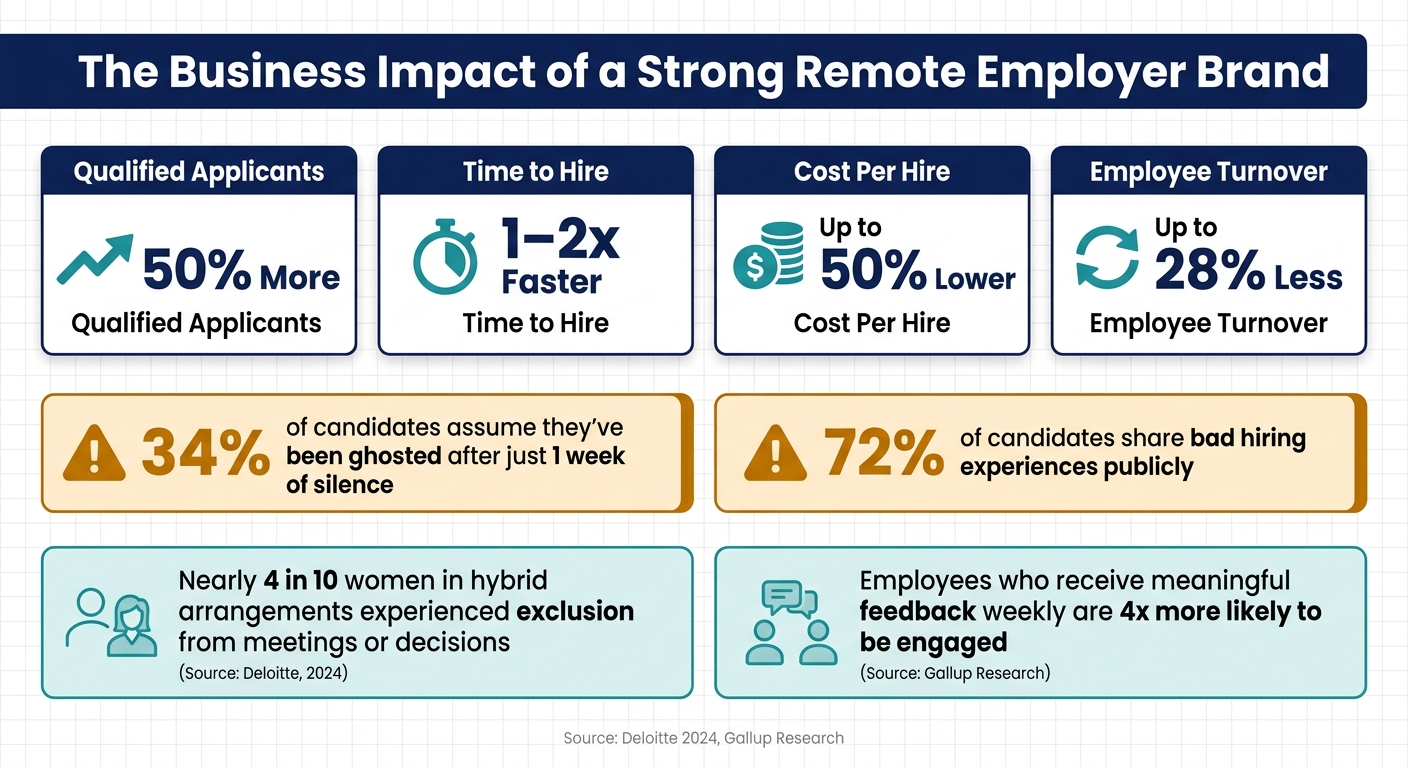
I’d sum it up like this: remote employer branding is not a marketing project. It is a hiring and retention system. When your message matches how work actually happens, you can attract (see our hiring resources) up to 50% more qualified applicants, hire 1 to 2 times faster, cut cost per hire by up to 50%, and reduce turnover by as much as 28%.
If I were leading hiring at a scaling SaaS, IT, fintech, engineering, security, insurance, or professional services company, I’d focus on five things first:
- Define the remote work model clearly, including location limits, core hours, tools, and manager expectations
- Set an EVP based on what employees actually get, not what leadership wants to say
- Make managers follow the same rules, especially around feedback, growth, communication, and visibility
- Keep hiring messages consistent across the careers page, job ads, recruiter outreach, and interviews
- Track business metrics, such as time to fill, offer acceptance, 90-day attrition, and cost per hire
This is the core idea: your promise, proof, and employee experience need to match. If they do not, your brand weakens, hiring gets more expensive, and retention suffers.
Below, I’ll break down what matters most, what to fix first, and how to turn remote employer branding into a hiring advantage instead of a cost problem.
Remote Employer Branding: Key Stats & Business Impact
Mastering a Global Employer Brand for Remote-First Hiring
sbb-itb-a23bd6a
Define the Remote Employer Brand Before You Promote It
Set the operating model first. Promote the brand after policies, manager habits, and day-to-day work all line up.
That definition should become the standard for every hiring message and every manager practice. If the experience doesn’t hold up inside the business, it shouldn’t appear in your hiring content.
Build a remote employee value proposition grounded in real experience
A remote EVP is the plain-English answer to two things: what people get and what they’re expected to deliver.
That goes well beyond values on a slide deck. You need to spell out the day-to-day reality, including flexibility, control over schedules, async and live collaboration norms, access to managers and senior leaders, mentorship, learning budgets, recognition, home office or coworking support, and how performance is measured.
Test every EVP claim against what your people actually experience. Use surveys, interviews, exit data, and retention patterns. Keep the claims that hold up across teams and across tenure levels.
If a benefit comes up often and the data backs it, it can become a core EVP pillar. For example, schedule flexibility paired with strong engagement scores is something you can stand behind. If employees want a benefit but the business can’t deliver it in a steady way, don’t promote it yet. Fix the operating model first.
Once the EVP is clear, review the full employee journey against it.
Audit the full remote employee lifecycle for gaps between promise and reality
A useful audit looks at every stage of the journey: job description, careers page, recruiter outreach, interview process, offer, onboarding, day-to-day collaboration, performance reviews, development, promotion, recognition, and offboarding.
At each stage, note three things:
- What the company promises
- What candidates and employees actually experience
- Who owns the gap
This is where many teams get caught out. You might advertise "work from anywhere" while still requiring employees to live in certain states. Or you might talk about "strong career growth" when promotion criteria aren’t published anywhere.
Those aren’t messaging issues. They’re operating issues.
Use offer acceptance rates, voluntary turnover by team, referral volume, and employee review themes as warning signs. Then break the data down by manager, role, and location. A healthy company average can hide a poor experience for one team, one office pattern, or one manager.
Document the remote work model with clear operational detail
Before any hiring content goes live, write the remote work model down in plain language.
Be clear about whether the company is remote-first, hybrid, or remote-friendly. Then define what that label means in practice, not just in theory.
| Remote-work approach | What it means operationally | Key details to document |
|---|---|---|
| Remote-first | Remote is the default for communication, meetings, and decisions | Async norms, decision rights, meeting standards, remote onboarding |
| Hybrid | Employees split time between remote and on-site on a defined schedule | Office cadence, required days, location eligibility, scheduling rules |
| Remote-friendly | Some roles permit remote work, but office-based processes remain central | Role eligibility, location limits, manager discretion, exceptions |
For U.S.-based teams, the documentation should also cover eligible states, required time-zone overlap, core collaboration hours, such as 10:00 a.m. to 2:00 p.m. Eastern Time, expected response times by channel, travel needs, company-provided equipment, internet or coworking reimbursement, and how performance is judged.
The key point is simple: measure people on outcomes and deliverables, not hours online or chat status. That document then becomes the reference point for recruiters, managers, and candidates.
Build a Remote Employee Experience That Supports the Brand
Once your EVP and remote model are set, the next step is simple in theory and hard in practice: make them real in day-to-day work.
Your employer brand only holds up when daily operations match what you promise. If your EVP says people have flexibility, clarity, and support, employees need to feel that in how managers run meetings, how teams share information, and how decisions get made.
That means turning policy into day-to-day rules. Not more paperwork. Just clear habits around communication, management, and support.
Set clear digital collaboration and communication standards
One of the fastest ways to weaken a remote employer brand is confusion.
If people don’t know where to ask questions, where decisions are recorded, or who owns a piece of work, frustration builds fast. Productivity drops. So does trust.
A simple communication guide can fix a lot of this. It should set async-first rules: which channel to use for which purpose, how fast people should reply, and where records should live.
A practical setup looks like this:
- Use your project management tool for owners, deadlines, dependencies, and status
- Use your knowledge base for policies, processes, onboarding content, and decision records
- Use chat for short-term coordination only
Every key decision should include the context, the options considered, the decision lead, the date, and next actions.
Meetings need rules too. They should have an agenda before they start and written notes after they end, with actions assigned. GitLab‘s all-remote handbook recommends questioning whether a meeting is necessary, reviewing participants’ time zones before scheduling, sharing materials in advance, and documenting outcomes afterward.[1] That’s how flexibility works across time zones, instead of turning into delay or confusion.
Once those standards are in place, managers have something clear to follow in feedback, meetings, and recognition.
Make belonging, inclusion, and well-being part of daily management
Remote work can lift engagement and stress at the same time. That’s why well-being needs to be managed as its own priority.
In most companies, managers are where this lives or dies. Optional social events are fine, but they won’t fix poor day-to-day management. The better move is to set practical standards: avoid routine messages outside local working hours, protect focus time, share meeting materials in advance, and make recognition visible in shared channels based on results, not online presence.
That last point matters more than many leaders think. If praise goes to the people who are most visible on chat rather than the people driving outcomes, remote culture starts to drift.
A 2024 Deloitte survey found that nearly 4 in 10 women in hybrid arrangements experienced exclusion from meetings, decisions, or informal interactions.[2] That’s not just a people issue. It affects retention, trust, and who gets access to work that leads to promotion.
A monthly audit can help you catch these patterns early. Compare project assignments, recognition, and meeting invitations by location and team. If one group is being left out, you want to know before it turns into attrition.
That kind of consistency also shapes how fair performance and promotion decisions feel.
Define clear paths for performance, growth, and promotion
If you want your remote employer brand to feel credible, publish the rules for growth.
A clear career framework sends a strong signal. Publish level criteria, promotion rules, and who makes the decision. When people can see how progression works, trust goes up. Without that, remote employees are left reading between the lines, and those informal signals often favor people who are physically closer to leadership.
Feedback should be timely, specific, and two-way. Not vague. Not saved for review cycles.
Mentorship and sponsorship should also be structured. Match people by career goals, not office proximity. If access to senior leaders and big projects quietly goes to the people in the room, your remote model starts to break from the inside.[3]
Gallup‘s research shows that employees who receive meaningful feedback in the past week are four times more likely to be engaged.[4] That’s a retention lever hidden inside a management habit.
When these internal standards are clear, recruiters and managers can communicate one consistent message externally.
Communicate the Brand Through Hiring Channels and Manager Behavior
Once your internal standards are clear, the next step is making sure the market sees the same thing.
If your careers page says one thing and your interview team says another, trust drops fast. So do conversion rates. For scaling companies, that usually means more drop-off, more wasted interview time, and fewer qualified applicants making it through the process.
Publish a clear careers page and remote-specific job descriptions
Your external brand should reflect the operating model you’ve already set.
Loose phrases like "work from anywhere" or "flexible culture" sound good, but they create confusion. They slow self-selection and pull in people who may not fit how your team actually works. Your careers page should answer the questions serious applicants are already thinking about:
- Which states can you hire in?
- What are the core collaboration hours?
- How does onboarding work?
- What equipment do you provide?
A short "How remote work works here" section can do a lot of heavy lifting. Spell out location rules, working hours, and communication norms in plain English.
Job descriptions need the same level of clarity. Show how work gets done. Show what success looks like. Keep it measurable.
Compensation matters too. U.S. employers should publish a good-faith salary range in dollars, for example $95,000 to $115,000 per year, along with any bonus or equity details. Before anything goes live, HR or legal should review pay ranges and location-based rules.[5][6]
Use employee stories and candidate communication to back up the brand
Your brand lands better when people can see it in action.
Use short, specific employee stories. Think day-one setup, time-zone handoffs, or what manager support looks like in practice. Keep it grounded. Interview volunteers with a simple prompt list around onboarding, collaboration, and manager support. Participation should stay voluntary, and employees should be guided, not scripted.[7]
Then use those same proof points in recruiter emails and interview prep.
Candidate communication has to match the brand too. 34% of candidates assume they’ve been ghosted after only one week,[9] and 72% say they share bad hiring experiences publicly.[8] That’s not just a brand issue. It affects pipeline health, offer acceptance, and future hiring costs.
A few small process steps can prevent that:
- Confirm receipt straight away
- Name a point of contact
- Explain each stage before it begins
- Send an update even if the decision is delayed
For virtual interviews, send the meeting link, agenda, interviewer names, and accessibility options in advance. Include a backup plan as well in case the connection drops. It sounds basic, but these details shape how people judge your company.
Give managers and recruiters a shared message framework
Turn your proof points into a standard script for recruiters and hiring managers.
The main risk here is inconsistency between what recruiters say and what hiring managers say. That gap creates doubt. A shared messaging matrix helps close it. Each employer-brand claim should link to a clear proof point, such as a written policy, a survey result, an onboarding process, or an employee story.
| Employer-brand claim | Evidence to provide | What to say in an interview |
|---|---|---|
| Flexibility | Core-hours policy and team agreement | "Employees set their schedules around shared hours from 11 a.m. to 2 p.m. Eastern Time." |
| Accountability | Goal-setting process and review cadence | "We measure outcomes, not online presence, and review goals on a regular cadence." |
| Collaboration | Team charter and documentation norms | "Decisions are recorded in our team workspace so no one misses context across time zones." |
| Development | Promotion framework and learning budget | "Employees receive a quarterly development conversation and an annual learning budget." |
Recruiters should cover the EVP and process logistics. Hiring managers should bring role-specific examples and explain the team’s actual working rhythm, including any hard limits like fixed hours or travel needs.
Everyone involved in hiring should use the same proof points in interviews, referrals, and candidate calls. And no one should promise exceptions they do not have the authority to approve.
Measure Results and Build a Scalable Hiring Model
Once your team uses a steady remote-brand message, the next step is simple: measure whether it changes hiring and retention.
That means looking past traffic and impressions. What matters is whether your brand helps you hire faster, earn candidate trust, and keep people longer.
Track metrics that show both reach and brand credibility
| Category | What to track | What it tells you |
|---|---|---|
| Awareness | Careers-page sessions, remote-job-page traffic, social reach, content engagement, talent-community growth | Whether target candidates can find and recognise the company |
| Candidate experience | Application completion rate, candidate response time, interview scheduling time, candidate satisfaction, withdrawal rate | Whether your process supports or weakens the brand |
| Hiring effectiveness | Qualified applications, offer-acceptance rate, time to fill, cost per hire, quality of hire | Whether branding improves hiring efficiency and outcomes |
| Employee experience | Engagement, belonging, clarity of expectations, development access, manager effectiveness | Whether the promised remote experience exists after hire |
| Retention | 90-day and 12-month attrition, regretted attrition, internal mobility, referral hiring | Whether employees stay, grow, and recommend the company |
| Reputation | Employee-review rating trends, recurring review themes, review-response time, external recognition, sentiment in public channels | How employees and candidates see the organisation from the outside |
Define each metric before you start reporting on it. Time to fill, for example, should always run from approved requisition to accepted offer, not from the day a job is posted.[10][11] If teams use different definitions, quarter-on-quarter comparisons fall apart. So do manager comparisons.
One metric on its own rarely tells you much. A low offer-acceptance rate might point to pay, slow decision-making, unclear remote-work expectations, or weak candidate communication. You need the surrounding data to see what’s actually going wrong.
Segment performance data and run a practical improvement cycle
Company-wide averages can make weak spots look fine. Segment your data by remote model, function, tenure, manager, time zone, and location so you can see where the brand starts to slip.
For example, compare offer acceptance across Pacific, Central, and Eastern time zones. Look at 90-day attrition for fully remote employees versus hybrid teams. That’s where the pattern starts to show.
Then use the data to fix one issue at a time. A simple cycle works well on a monthly cadence for recruiting operations and a quarterly cadence for broader employee-experience metrics:
- Audit funnel data, surveys, exit interviews, and employee reviews.
- Find the one gap with the clearest evidence and the biggest business impact.
- Fix that issue. Assign an owner, define the action, and set a measurable target.
- Update messaging so careers content, recruiter scripts, and manager talking points match the change.
- Measure the result against the baseline, then repeat.
This stops remote employer branding from turning into a one-off campaign. You’re not launching a brand and walking away. You’re testing it, tightening it, and making it work harder for hiring.
Assign ownership, get execution support, and take next steps
Once you know what to measure, assign clear ownership. If no one owns the number, it usually doesn’t move.
| Owner | Primary responsibility |
|---|---|
| HR / People Operations | Employee-experience data, engagement, belonging, retention, policy alignment, privacy |
| Talent Acquisition | Funnel metrics, candidate experience, sourcing performance, time to fill, cost per hire, offer acceptance |
| Leadership | Strategic priorities, investment decisions, visible modelling of remote-work standards, accountability |
| Internal Communications | Careers content, employee stories, review responses, message consistency, internal feedback loops |
| Hiring Managers | Accurate role expectations, timely decisions, structured interviews, candidate communication, team-level experience |
| Employees | Authentic stories, referrals, feedback, participation in improvement activities |
For each metric, define:
- Who is accountable
- Who contributes
- How often it’s reported
- Where the data comes from
- What threshold triggers action
When internal hiring capacity is stretched, an embedded recruiter can help you keep process quality high while your employer brand grows.
The goal is simple: build a remote employer brand that matches how your team actually works, communicate it the same way across every hiring channel and manager interaction, and track whether it leads to better hiring results and stronger retention. Start with the biggest gap. Fix it. Then do the next one.
FAQs
How do I know if our remote EVP is credible?
Check whether your external EVP matches what employees actually live day to day.
The simplest way to do that is to compare your EVP pillars with feedback from anonymous eNPS surveys, stay interviews, and exit interview themes. If your public message says one thing, but employee feedback says another, you have a gap. And that gap can cost you, in trust, hiring speed, and retention.
If the feedback conflicts with your public messaging, your EVP isn’t credible.
You can pressure-test it further with your top performers. Ask them a simple question: does this reflect what it’s like to work here, or is it just marketing copy? That check matters. High performers often spot weak claims fast.
Each EVP claim should also be backed by specific, measurable proof points. Not vague company slogans. Not polished statements that sound good on a careers page.
Think in terms of proof like:
- Promotion rates
- Internal mobility data
- Manager effectiveness scores
- Learning and development usage
- Flexibility policy adoption
- Retention by team or tenure
The goal is simple: if you say it publicly, you should be able to prove it internally.
What should we fix first if our remote brand and employee experience don’t match?
Fix the internal reality first, not the external messaging. If your branding promises more than people actually get, trust drops fast. And when that happens, early turnover usually follows.
Use listening sessions, pulse surveys, or 30/60/90-day new-hire check-ins to spot the gaps. If employees are flagging issues like micromanagement or a lack of transparency, deal with those first. Then update your messaging so it matches the day-to-day experience people actually have.
Which metrics best show whether remote employer branding is working?
Track the metrics that show whether hiring is working, and what it’s costing you.
Start with recruitment efficiency: time-to-hire and cost-per-hire. These tell you how fast your team can fill roles and how much each hire is costing the business.
Then look at candidate sentiment and conversion. That includes cNPS and offer acceptance rate. If strong candidates are dropping off or turning down offers, that usually points to friction in your process, weak positioning, or slow decision-making.
Employee advocacy matters too. Watch eNPS and referral rate. If your own people are willing to recommend the business, that tends to feed a stronger hiring pipeline at a lower cost.
Retention is where the picture gets sharper. Review 6- and 12-month retention or attrition, along with quality of hire. Hiring fast means very little if people leave early or fail to perform.
You should also check how the market sees you and how your funnel is performing. That includes:
- Glassdoor sentiment
- Career site traffic and engagement
- Application volume
- Application completion rate
Taken together, these metrics show where you’re losing time, where you’re losing money, and where your hiring process needs work.