If what you say about your workplace does not match how you hire, you pay for it in slower hiring, lower trust, and weaker applicant quality.
I’d boil this down to four moves: set clear inclusion targets tied to hiring outcomes, audit your brand and hiring process for gaps, standardise messaging and interview habits, and track results every quarter. The upside is commercial, not just reputational. Inclusive job ads can bring in 42% more applications, strong employer branding can cut hiring costs by up to 43%, and public DEI data can lift applicant quality by 12%.
If you’re leading hiring in SaaS, Technology, IT, Fintech, Engineering, Security, Insurance, or Professional Services, here’s the simple test:
- Does your careers messaging match day-to-day hiring?
- Do hiring managers use the same standards across roles?
- Can you track where representation drops in the funnel?
- Do your public claims have proof behind them?
If the answer is no to any of those, the problem is not brand alone or HR alone. It is a systems gap, and it costs time, money, and hiring control.
What follows is the short version of how I’d fix it.
Your employer brand and your inclusion goals should work as one system. If they do not, your hiring funnel leaks. If they do, you get better applicant flow, lower cost per hire, and more control as headcount grows.
The first step is to stop using broad statements and start using business targets. Instead of vague claims, set measurable goals tied to representation, belonging, hiring consistency, and access to talent pools. Then assign ownership across leadership, HR, and Talent so each team knows what it owns.
Next, review your careers site, EVP, job ads, and hiring flow against those targets. A lot of scaling companies say the right things on the website but lose people in the process. Common issues include:
- job ads with extra requirements that screen people out
- interview panels that change from team to team
- no proof behind DEI claims
- poor accessibility across the application flow
- mixed messages between marketing and recruitment
That gap matters because candidates do not separate the message from the process. They judge both at once. 67% of job seekers say a diverse workforce is a key factor when looking at offers, and 87% of underrepresented candidates look for DEI content when checking out an employer.
From there, the work is simple in theory and harder in practice. Rewrite your employer messaging with proof, not polish. Use employee stories, ERG input, policy details, and published progress data. Then lock in repeatable hiring habits:
- structured role intake
- plain-language job ads
- standard interview questions
- shared scoring criteria
- mixed interview panels
- bias training for hiring managers and recruiters
This is where process discipline matters. In scaling teams, small inconsistencies turn into expensive hiring drift. That is one reason many firms use embedded recruitment support, especially when hiring plans move faster than internal capacity. A dedicated recruiter inside your team can keep intake, messaging, and interview standards aligned across functions and geographies.
Measurement is the last part, and it is the part many teams skip. Track the full funnel, from impressions and clicks through applications, interviews, offers, and hires. Then compare that with retention, engagement, promotion speed, and ERG feedback. If representation is steady at application stage but drops after first interview, you likely have a process issue, not a top-of-funnel issue.
That is the core point: align the message, the process, and the metrics. If one part drifts, the whole hiring system gets weaker.
For leaders who need more control over hiring consistency without adding agency fees role by role, Rent a Recruiter can support that model directly inside your team. If you want to compare cost impact, the ROI calculator is a useful starting point.
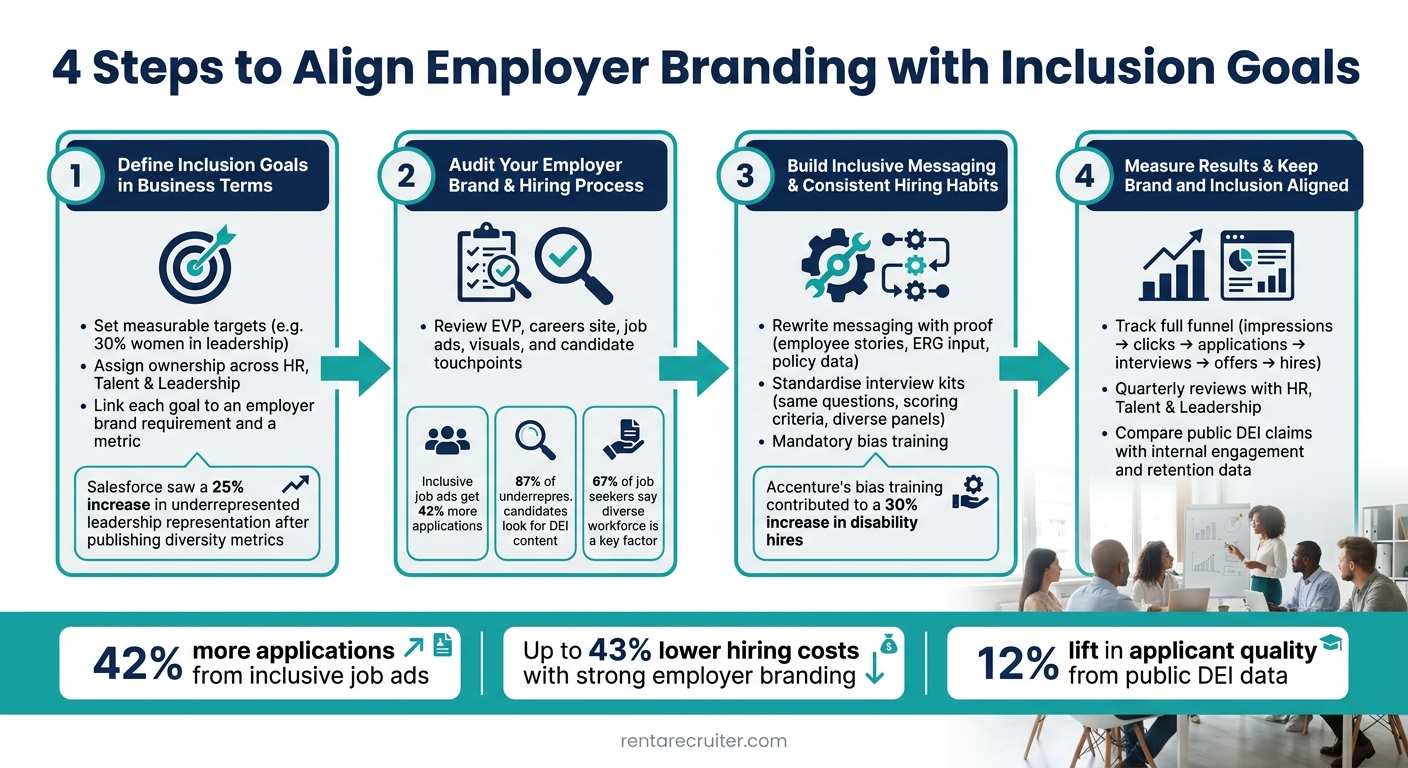
4-Step Framework: Align Employer Branding with Inclusion Goals
Authenticity Over Optics: Creating Inclusive EVP with Heart | Employer Branding Unplugged EP 02
sbb-itb-a23bd6a
Step 1: Define inclusion goals in business terms
Generic lines like "we value diversity" sound fine, but they don’t help your hiring team make better decisions. Before you change job ads or update your careers site, you need inclusion goals that are specific, time-bound, and linked to growth. Set those goals first, then measure your employer brand and hiring process against the same standard.
Set measurable inclusion priorities
Start with the gaps, not assumptions. Use quarterly hiring dashboards to track representation in technical and leadership roles. Run regular belonging surveys to see where employees feel left out.
Then set clear targets. That could mean 30% women in leadership by a set year, or a measured lift in belonging scores among underrepresented groups.
Salesforce publicly reports its diversity metrics, and that transparency contributed to a 25% increase in representation of underrepresented groups within leadership roles [3].
Assign ownership across HR, Talent, and leadership
This only works when ownership is clear.
Leadership owns the business case and the targets. HR owns policies and employee experience. Talent owns job ads, sourcing, and candidate touchpoints.
ERGs should be involved early as advisors, not added in at the end. They bring lived employee insight, which helps keep your messaging honest. More importantly, it ties what you say in the market to what people experience inside the business.
Translate goals into employer brand requirements
Each inclusion goal should link to one employer brand requirement and one metric your recruiters and leaders can track. That’s how you move from good intent to hiring outcomes.
| Inclusion Goal | Employer Brand Requirement | Measurement Metric |
|---|---|---|
| Improve leadership representation | Feature diverse leaders in "Day in the Life" content | % increase in diverse applicants for senior roles |
| Increase belonging scores | Highlight ERG activities and community partnerships | Annual employee engagement/belonging score |
| Widen access to talent pools | Use inclusive language and ADA-compliant job ads | Application volume |
| Reduce recruitment bias | Standardise recruiter talking points on D&I | Candidate feedback scores on "fairness" |
Once those standards are set, audit your careers page, job content, and candidate experience against them.
Step 2: Audit your employer brand and hiring process for gaps
If your brand promise and hiring experience don’t line up, this audit will show you where the cracks are. Review your EVP, visuals, and hiring process against the same inclusion goals. Start with the EVP, because it’s the first promise candidates judge.
Review the EVP, careers site, and job content
At least 70% of your EVP should reflect current reality, and no more than 30% should point to where you’re heading. That keeps your message grounded in what people will actually find when they join.
"At least 70 percent of your EVP should correctly reflect your organization’s offering, and 30 percent of your EVP should reflect your organization’s aspirations." – Cielo Guide [6]
Read your careers page and live job ads the way a candidate would. Watch for broad culture claims with no proof behind them. Go through each job requirement and ask a simple question: is this needed for success in the role, or is it screening out strong people from less standard backgrounds?
This matters more than many teams think. Job ads that use inclusive language get 42% more applications [2]. A few wording changes can improve applicant volume without sacrificing hiring quality.
You should also check ADA compliance across the careers site and application flow. If someone with a disability can’t use your portal or can’t find out how to request accommodations, your inclusion message falls apart before the application even starts [5].
Next, look at whether your stories and imagery back up what you’re saying.
Check visuals, stories, and proof points
Review culture pages for real employees, real workplaces, and representation that matches your team, including leadership.
87% of candidates from underrepresented groups look for diversity and inclusion content when researching a company [5]. If your imagery doesn’t reflect the team people are likely to join, that’s a trust problem, not just a branding issue.
Employee Resource Groups can help here. Ask ERG members to review recruitment content and point out anything that feels scripted, polished to the point of disbelief, or staged [5]. Use employee quotes tied to clear support, policies, or lived experience. Specifics land better than broad claims every time.
"Inclusive employer branding isn’t just about saying the right things – it creates a feedback loop where your business is constantly learning, adapting, and evolving." – Richard Blamire, ThinkinCircles [2]
Then pressure-test the full candidate journey against the story your brand is telling.
Compare brand promises with every candidate touchpoint, from application to offer
This is often the part companies miss. You can have a strong careers page and still lose good people halfway through the process because the interview experience tells a different story.
"Nobody wants a bait-and-switch scenario… It is the [organizations] that do not communicate where they are at and where they are going who are having the most challenges engaging candidates." – Jacquese Brown, Cielo Talent [6]
Use this checklist to find the most common gaps and link them back to hiring outcomes.
| Hiring Stage | Current State | Desired Inclusive State | Business Risk | Priority Action |
|---|---|---|---|---|
| Job Descriptions | Gendered language, jargon, or rigid experience requirements | Neutral, competency-based language with inclusive benefits noted | 42% fewer applications from diverse talent [2] | Run all active ads through a bias-check tool |
| Careers Site | No DEI section, no ERG info, no diversity data | Dedicated section with real employee stories and progress goals | 87% of candidates value D&I content [5] | Add a values page with employee testimonials |
| EVP | Brand promises don’t match internal employee experience | 70% reality-based, 30% aspirational [6] | Higher turnover and weaker trust | Conduct internal surveys to verify EVP claims |
| Hiring Process | Inconsistent interview structures or lack of feedback | Standardized questions and clear timelines | Unconscious bias in selection; poor candidate experience | Train hiring managers in cultural competence |
Step 3: Build inclusive messaging and consistent hiring habits
Turn your audit findings into repeatable messaging and clear hiring standards. The goal is simple: make inclusion part of day-to-day recruiting, not something that only shows up in a slide deck.
Rewrite employer brand messaging with current proof
Your employer brand should be backed by proof, not polish.
Use employee stories, ERG input, clear policies, and public progress data. Ask ERG members and recent hires to share what the experience is actually like. That gives your message weight and helps you avoid saying one thing in the market while doing another inside the hiring process.
"A strong employer brand does more than attract candidates – it communicates your values, culture, and purpose. When built intentionally, it becomes a powerful tool for promoting inclusion, challenging bias, and building belonging." – Richard Blamire, ThinkinCircles [2]
If your brand promise says one thing but your hiring process delivers another, trust drops fast. For scaling companies, that has a direct cost: weaker response rates, slower hiring, and more time spent fixing avoidable process issues.
Standardize inclusive recruitment workflows
When interview standards change from team to team, inclusion tends to fall apart at the point of hire. Each hiring standard should link back to one inclusion goal and one metric from Step 1. That gives you a clear way to track what is working, what is not, and where process drift is costing you time.
Start with structured job intake. Before a role goes live, confirm that every requirement is needed for success in the role. Strip out gendered language, heavy industry jargon, and extra requirements that may put off qualified people. Where it makes sense, use blind screening to remove names, addresses, and other identifiers.
Then build standardised interview kits so every role follows the same playbook. That means:
- The same interview questions
- The same scoring criteria
- Diverse interview panels across roles
Pair this with mandatory training for hiring managers and recruiters on cultural competence, antiracism, and unconscious bias. Accenture‘s mandatory antiracism and unconscious bias training contributed to a 30% increase in disability hires over several years [7][3].
"Equity communication is not a campaign. It’s a system." – Jerrica Thurman, President & CEO, Elation Communications [1]
This matters even more when you’re hiring across SaaS, Technology, Fintech, Engineering, or Professional Services. As headcount plans grow, small gaps in process turn into expensive hiring inconsistency.
Use embedded recruitment support to scale consistency
As hiring volume rises, consistency gets harder to hold. That’s where embedded recruitment support can help.
Embedded recruiters keep messaging, intake, and interview standards aligned across the business. Rent a Recruiter places experienced recruiters directly inside your team within days, helping you keep hiring workflows consistent and inclusive when demand spikes.
Track whether those standards improve reach, fairness, and hiring outcomes.
Step 4: Measure results and keep brand and inclusion aligned
Measurement stops inclusion from slipping as hiring grows. Once your messaging and hiring process are in sync, you need a way to spot drift early, before it turns into a bigger hiring problem.
Track metrics from brand reach to hiring outcomes
Start with the top of the funnel. Track which content types drive the most impressions and clicks. Then follow the full path through impressions, clicks, applications, interview conversion, offer acceptance, and representation at each stage.
This is where the pattern shows up.
If representation stays steady through applications but drops after the first interview, that usually points to a process issue, not a brand issue.
In other words, these numbers show you what candidates are doing. The next step is checking whether your employer brand still lines up with what people experience inside the business.
Review credibility, retention signals, and process drift
Look at whether your public claims match internal results. If your careers site shows diverse teams but your Glassdoor reviews tell a different story, people will spot the gap fast, and current employees will too.
Compare your public DEI claims with internal data like:
- Engagement scores
- ERG feedback
- Promotion speed for underrepresented groups
- Retention signals
Run a quarterly review with HR, Talent, and leadership in the same room. Compare top-of-funnel reach with actual pipeline representation so you can catch slippage early, before it chips away at months of hiring work [4].
Conclusion: Align the message, the process, and the metrics
The goal is not better reporting for its own sake. It’s a tighter link between what you say, how you hire, and what results you get.
Align the message, the process, and the metrics. If you’re scaling and need help keeping hiring consistent while you build this out, Rent a Recruiter embeds experienced recruiters directly into your team, helping maintain inclusive hiring best practices end-to-end as demand grows. Book a call to learn more.
FAQs
How do I set inclusion goals hiring teams can actually use?
Set inclusion goals by moving from broad ideals to measurable, data-led targets. Start with a clear audit of your current workforce demographics. From there, spot representation gaps and turn those findings into benchmarks your team can track.
This matters because vague aims don’t change hiring outcomes. Clear targets do. They give you a way to measure progress, focus recruiter effort, and show leadership where hiring is improving, or where it’s stalled.
Then tie those goals to your recruitment strategy. Update candidate personas on a regular basis so they match the roles you need to fill and the markets you hire in. Train hiring managers in inclusive hiring practices and unconscious bias so decision-making is more consistent. Report progress in a clear, open way so accountability doesn’t slip once hiring pressure builds.
In practice, that often means:
- reviewing workforce and hiring data at set intervals
- adjusting candidate personas as teams, markets, and role needs shift
- giving hiring managers practical training they can use in live recruitment
- sharing progress with leadership against agreed hiring benchmarks
When you treat inclusion goals like any other business target, they become far easier to manage, measure, and improve.
What should I audit first in our employer brand and hiring process?
Start with your current Employer Value Proposition (EVP) and pressure-test it. Does it speak to the kind of talent you want to attract across different backgrounds, experiences, and perspectives? If the message looks good on paper but falls flat in practice, candidates will spot the gap.
Get direct feedback from employees. Not polished internal talking points, but honest input on what it’s like to work in your business day to day. That helps you see whether your employer brand matches the actual employee experience, which matters if you want to attract the right people and keep them.
At the same time, review your brand assets and hiring process through a DEI lens. Look for bias in the way roles are written, assessed, and approved. Use inclusive language in job descriptions, and check that your imagery and messaging reflect a broad mix of people.
This work is not just about brand perception. It affects who applies, who progresses, and how well your hiring process supports growth.
Which metrics show if inclusion is improving hiring outcomes?
Track metrics across the candidate lifecycle, including:
- diversity sourcing ratio
- pass-through rates during screening and interviews
- diversity hiring rates
- offer acceptance rates
That gives you a clearer view of where representation improves, and where it drops off. If one group enters the funnel at healthy levels but falls away during interviews, that’s a process issue worth fixing. If offer acceptance is lower for certain groups, the problem may sit with employer brand, compensation, or interview experience.
You should also track promotion velocity, attrition, and demographic-specific retention. Hiring is only part of the picture. What happens after someone joins tells you whether your approach is working.
A business impact view matters here. Better retention cuts repeat hiring costs. Stronger promotion rates point to a healthier internal pipeline. And demographic-level data helps you see whether inclusive hiring is leading to long-term success and belonging, not just short-term hiring numbers.