
When deciding how to handle hiring, companies often face two main options: embedded recruitment and recruitment agencies. Here’s a quick breakdown to help you choose the right fit:
- Embedded Recruitment: Works as part of your team, charges a flat monthly fee, and focuses on building efficient hiring systems. Ideal for scaling businesses with ongoing hiring needs.
- Recruitment Agencies: Operates as an external partner, charges per hire (17%-25% of salary), and prioritizes speed. Best for one-time or specialized roles.
Quick Comparison
| Feature | Embedded Recruitment | Recruitment Agencies |
|---|---|---|
| Cost Structure | Flat monthly fee | Per hire commission (17%-25%) |
| Best For | Scaling, multiple hires | One-off or niche roles |
| Integration | Internal team member | External partner |
| Focus | Long-term hiring systems | Filling positions quickly |
Key Takeaway: Use embedded recruitment to improve hiring processes and reduce turnover. Opt for agencies when you need to fill specific roles fast.
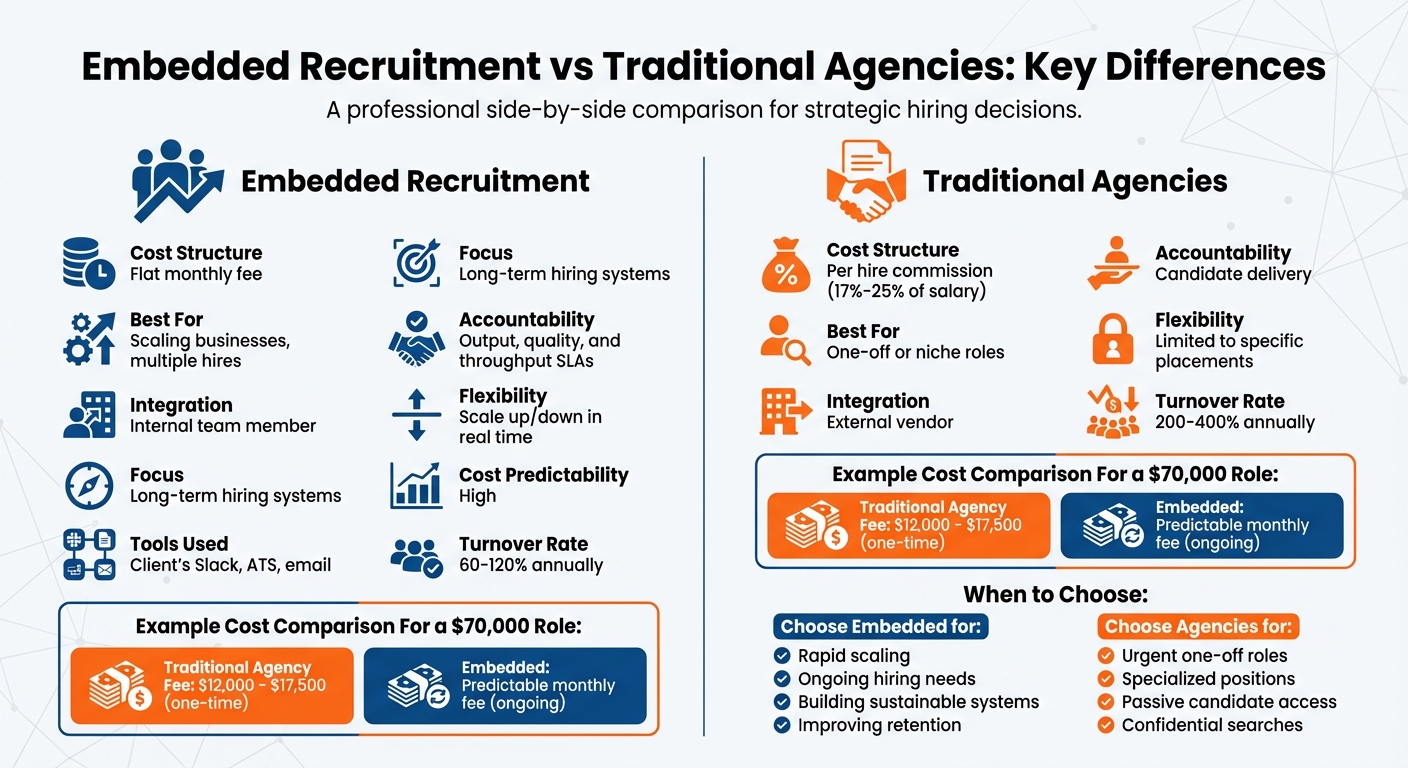
Embedded Recruitment vs Traditional Agencies Comparison Chart
AGENCY VS IN-HOUSE RECRUITMENT | What is a BETTER option for you? (2021)
sbb-itb-a23bd6a
What is Embedded Recruitment?
Embedded recruitment places a specialist recruiter directly within your team, functioning almost like a full-time employee. These recruiters use your existing tools, participate in daily operations, and report to your internal leadership, making them an integral part of your hiring process.
What sets this approach apart is the level of integration. Instead of simply forwarding resumes from an external database, embedded recruiters actively join team meetings, immerse themselves in your company culture, and help shape hiring strategies with a long-term perspective. As Olga Fedoseeva, Founder of UnitiQ, puts it: “Embedded recruiting works inside the company hiring process – aligning founders, clarifying role outcomes, structuring interviews, and improving decision-making quality”.
This method is about building robust hiring systems rather than just filling positions. Embedded recruiters work closely with hiring managers to define success for each role, pinpoint critical performance indicators, and create repeatable processes that enhance both retention and the quality of hires.
Unlike traditional agencies, which often charge steep commissions ranging from $12,000 to $17,500 per hire, embedded recruitment operates on a flat monthly fee. This makes budgeting more predictable while fostering a more flexible and efficient in-house hiring process.
In dynamic industries like B2B SaaS, e-commerce, and AI, this model allows for quick adjustments to hiring strategies without the delays of traditional contracts. Plus, by keeping knowledge within your organization, your team gains the tools to continue hiring effectively long after the engagement concludes.
What are Traditional Recruitment Agencies?
Traditional recruitment agencies work as external partners, connecting companies with candidates without becoming part of the organization’s daily operations. Think of them as matchmakers – they rely on their own networks and databases to pair businesses with potential hires. This is a sharp contrast to embedded recruitment, where recruiters integrate directly into a company’s internal processes.
These agencies take on tasks like posting job ads, sourcing candidates, screening resumes, conducting initial interviews, and performing background checks. One of their standout strengths is their ability to access passive talent – professionals who aren’t actively job hunting but could be persuaded by the right opportunity. Internal hiring teams often find it challenging to reach this group.
Traditional agencies operate on a transactional fee structure. They typically charge a one-time placement fee, which can range from 17% to 30% of a new hire’s first-year salary. For example, hiring someone for a $70,000 role could cost a company between $12,000 and $17,500 in fees. Once the candidate is placed and the fee is paid, the agency’s involvement usually ends.
This model is particularly effective for addressing immediate hiring needs rather than crafting long-term talent strategies. Agencies excel at filling urgent roles, with some able to deliver three qualified candidates in as little as three business days. They can also significantly shorten the hiring timeline, reducing the average time-to-hire from over 68 days to around 14 days. These qualities make them especially useful for one-time placements, highly specialized roles, or situations where quick hiring is essential.
Because agencies work with multiple clients, their focus is often on speed and efficiency. As Ross Summers, Founder and Talent Acquisition Leader, points out:
“Percentage-based fees incentivize higher salaries and expeditious placements, not long-term retention”.
This focus on rapid placements makes traditional agencies ideal for roles with clear, standardized job descriptions. However, they might not be the best fit for companies looking to build sustainable hiring systems or develop broader workforce strategies.
Key Differences Between Embedded Recruitment and Traditional Agencies
The two models differ significantly in how they operate. As Olga Fedoseeva, Founder of UnitiQ, explains:
“Agencies operate as a transaction. Embedded recruiting operates as a system.”
Traditional recruitment agencies are focused on filling specific roles and moving on, while embedded recruiters work within your company to create a sustainable hiring process. This distinction affects everything from cost structures to how they integrate with your team. Let’s break it down further.
Cost Structures
When it comes to costs, traditional agencies and embedded recruitment take very different approaches. Agencies typically charge a one-time commission based on the new hire’s first-year salary – usually between 17% and 25%. This model can make costs unpredictable, especially during periods of rapid hiring.
On the other hand, embedded recruitment uses a fixed monthly fee, regardless of how many hires are made or their salary levels. This setup offers more predictable budgeting, which is particularly helpful for high-growth SMEs managing cash flow and planning long-term hiring strategies. Additionally, embedded recruitment helps reduce the “turnover tax” – the hidden costs of hiring candidates who quickly leave due to poor alignment.
| Feature | Embedded Recruitment | Traditional Agencies |
|---|---|---|
| Pricing Model | Fixed monthly fee | Per placement commission (17%–25% of salary) |
| Cost Predictability | High | Low |
| Best For | Multiple hires, ongoing needs | One-off placements |
Integration and Control
Embedded recruiters don’t just work for your company – they become part of your team. They join daily stand-ups, work closely with hiring managers, and adapt recruitment strategies as needed. This hands-on approach allows them to deeply understand your company culture and hiring needs.
In contrast, traditional agencies operate as external vendors, using their own systems and working independently. The difference is clear:
“An embedded team member is woven into your daily workflow… Their success is tied to your team’s success. In contrast, an agency’s work is transactional.”
| Feature | Embedded Recruitment | Traditional Agencies |
|---|---|---|
| Team Integration | Internal team member | External vendor |
| Tools Used | Client’s Slack, ATS, email | Agency’s own systems |
| Accountability | Based on output, quality, and throughput SLAs | Focused on candidate delivery |
Speed and Scalability
Traditional agencies are great for quickly filling one or two urgent roles, especially for standardized positions. Their large candidate databases allow them to move fast on niche placements.
Embedded recruitment, however, is ideal for companies that need to scale their hiring efforts or frequently adjust the number of hires. Embedded recruiters can quickly adapt to new roles without renegotiating contracts or incurring extra fees. This flexibility is a game-changer for high-growth SMEs with fluctuating hiring needs. For example, in industries like manufacturing and fulfillment, embedded teams achieve far lower turnover rates – typically 60% to 120% annually compared to 200% to 400% for agency-sourced labor. This difference has a major impact on retention and training costs.
| Feature | Embedded Recruitment | Traditional Agencies |
|---|---|---|
| Best Use Case | Rapid scaling, multiple hires | One-off or niche roles |
| Flexibility | Scale up/down in real time | Limited to specific placements |
| Focus | Building hiring systems | Filling individual vacancies |
Benefits and Challenges of Embedded Recruitment
Embedded recruitment brings predictable monthly costs and a deeper connection to your company’s day-to-day operations. By becoming part of your team, embedded recruiters help ensure consistent budgeting and identify candidates who align well with your company culture. This approach often leads to better hires who are more likely to stick around.
Another advantage is flexibility. Embedded recruiters can quickly adapt to changing hiring needs, making them a great fit for businesses that are scaling. Plus, they contribute to institutional knowledge within your organization, ensuring valuable insights stay in-house rather than leaving when a project wraps up. These elements combine to create a hiring process that’s not just effective but also sustainable. As Ross Summers, a Talent Acquisition Leader, explains:
“Hiring should be treated the same way you treat customer acquisition. Just as you define your ideal customer profile, plan your funnel and invest ahead of demand, the same thinking needs to apply to talent.”
That said, this model isn’t without its challenges. To make it work, you need an internal manager to oversee and support the embedded recruiter. This requires an upfront time investment to set the system up for success. Additionally, while embedded recruitment shines for ongoing hiring needs, it’s less suited for one-off, highly specialized roles. The focus shifts from simply filling positions to creating a repeatable, efficient hiring system.
The upfront effort pays off, though. Embedded recruiters help streamline your hiring by standardizing evaluation processes and crafting role-specific interview frameworks. These tools speed up decision-making and improve hiring quality. Instead of just increasing the number of candidates, this method addresses deeper structural issues in your recruitment process.
Benefits and Challenges of Traditional Agencies
Traditional recruitment agencies have a knack for finding talent that’s not easily accessible. They leverage vast networks of passive candidates – professionals who aren’t actively job hunting but could be persuaded by the right opportunity. This ability is especially useful for filling niche roles in fields like cybersecurity, biotechnology, or data science. In these cases, agencies often employ industry experts who understand the complexities of the job requirements and have a clear grasp of competitive salary expectations.
Another advantage is their speed. Traditional agencies can significantly cut down hiring timelines. While internal hiring processes average around 68 days, agencies can reduce this to about 14 days. Some even promise to deliver three qualified, interview-ready candidates within three business days. This quick turnaround is ideal for urgent hiring needs or confidential executive searches where discretion is key. However, this efficiency comes at a financial cost.
The pricing structure can be a hurdle, especially for growing small-to-medium enterprises (SMEs). For a role with a salary of $70,000, placement fees typically fall between $12,000 and $17,500. These fees usually increase with the number of hires, as discounts for high-volume hiring are uncommon.
Ross Summers highlights a key drawback of this model:
“Percentage-based fees reward higher salaries and faster placements, not long-term retention”.
This transactional approach often limits the focus on cultural fit and long-term employee retention. Agencies operate externally, using their own systems, which can feel like a “black box” to clients. Companies may have little insight into how candidates are sourced or vetted. Additionally, once a placement is made, the agency’s involvement usually ends, taking any knowledge gained during the process with them. With some agencies managing 40 to 60 roles at once, their ability to deeply understand an SME’s unique culture may be limited.
Statistics further highlight the challenges. Less than 20% of the roles handled by traditional contingent agencies are ultimately filled. While these agencies are strong in one-off placements and specialized searches, their external approach and commission-driven incentives can result in prioritizing speed over aligning candidates with the company’s culture and long-term goals.
Choosing the Right Recruitment Model for Your SME
When it comes to picking the right recruitment model, your decision should align with your business’s growth stage, hiring needs, and budget. As Ross Summers puts it:
“The hiring model you choose should be dictated by your growth plan, not by habit or short-term pressure.”
If your hiring process is pulling you away from core business activities or if candidates are dropping out frequently, it might be time to adopt a more structured approach. Let’s examine specific scenarios to help you determine which model fits your business goals.
When to Choose Embedded Recruitment
Embedded recruitment works best when your business is scaling quickly and requires consistent hiring. If you’re onboarding several new team members every quarter, building a repeatable system is far more efficient than negotiating individual contracts for each role. For example, in a growing SaaS company, an embedded recruiter often delivers two to three quality hires per month. They use your existing tools – like Slack, your ATS, and email – ensuring seamless communication and minimal disruption.
This model is particularly effective when roles are new or still evolving. Early-stage companies often struggle to define positions clearly because the roles are being created for the first time. Embedded recruiters become part of your team, adapting to these changing needs while establishing a hiring framework that supports long-term growth.
Financially, the flat monthly fee structure offers predictability, which is crucial when budgets are tight. Think of it as treating recruitment like customer acquisition: it’s a planned, resourced process measured by clear outcomes.
When to Choose Traditional Agencies
While embedded recruitment focuses on long-term systems, traditional agencies are ideal for short-term, specialized hiring needs. Agencies excel at filling one or two highly specific roles, especially when deep industry connections are required. For example, if you’re looking for cybersecurity experts or biotech researchers, agencies can tap into networks that your internal team might not have access to. They’re also a good choice for handling temporary hiring spikes in standardized roles.
To decide if an agency is the right fit, consider whether your main challenge is a lack of candidates or poor hiring processes. As Olga Fedoseeva, Founder of UnitiQ, explains:
“The real question is much simpler: Do you need more candidates, or do you need better hiring decisions?”
If your pipeline lacks qualified candidates, agencies can help fill that gap. However, if the problem lies within your internal processes – such as unclear role definitions, slow decision-making, or inconsistent interview criteria – an agency won’t solve those issues. They might deliver candidates, but the underlying problems will persist, emphasizing the need for sustainable hiring practices.
For SMEs with fewer than 20 employees, agencies can be a useful stopgap when founder networks are no longer sufficient. They’re particularly effective for well-defined roles within established structures. However, their transactional nature often prioritizes speed over long-term retention. If you notice new hires leaving within six months, it may be time to consider a model that focuses more on alignment than quick placements.
Conclusion: Which Model is Right for Your Business?
Deciding between embedded recruitment and traditional agencies depends on the specific challenges your business is facing. If your main obstacle is finding candidates for a one-off, specialized role, a traditional agency might be the better choice. However, if the root of your hiring struggles lies in issues like unclear job definitions, slow decision-making, or high turnover, simply increasing the candidate pool won’t solve the underlying problems.
Here’s a quick comparison: Traditional agencies work externally, charging commission-based fees and focusing on speed. Their involvement typically ends once a hire is made. On the other hand, embedded recruitment operates as an internal extension of your team, helping to build a long-term hiring framework. This model integrates with your tools, aligns with your company’s values, and emphasizes finding candidates who are a strong fit for the long haul.
For fast-growing small and medium-sized businesses (SMEs), embedded recruitment offers predictable monthly fees, making budgeting easier and avoiding surprise costs. This option works best when you’re hiring regularly, creating new roles, or building a repeatable recruitment process. Meanwhile, traditional agencies are better suited for short-term hiring spikes or filling standardized roles quickly.
To put it all together: Rent a Recruiter’s embedded recruitment service scales to meet your needs through fixed-term engagements that integrate seamlessly into your team. By using your existing tools – like Slack, email, and your ATS – you get the benefits of an in-house recruiter without the expense of hiring one full-time. This approach reduces time-to-hire, protects your company culture during periods of growth, and improves your hiring process with every new role.
Ultimately, your decision comes down to whether you need to build a sustainable hiring system or address immediate recruitment needs. Align your recruitment strategy with your long-term growth goals, rather than reacting to short-term challenges.
FAQs
How do I know if I need more candidates or a better hiring process?
If you’re seeing a flood of applications but only a handful of qualified candidates, it’s time to revisit how you’re sourcing talent. On the flip side, if you’re attracting strong candidates but your hiring process feels sluggish or clunky, focus on streamlining steps like interviews or decision-making.
Too many unqualified applicants? Revamp your sourcing strategy. Strong candidates but a slow process? Fine-tune your hiring workflow. Both areas are crucial to get right if you want to scale efficiently.
What does an embedded recruiter actually do day to day?
An embedded recruiter becomes an integral part of a company’s internal team, fully immersing themselves in its day-to-day operations. Their role goes beyond just filling positions – they invest time in understanding the company’s hiring needs, workplace culture, and overall priorities to attract the best-fit talent.
On a typical day, they might review candidate pipelines, conduct interviews, fine-tune sourcing strategies, and work on streamlining hiring processes. Unlike traditional recruitment agencies, embedded recruiters are aligned with the company’s long-term hiring goals. They also actively participate in internal meetings and strategic planning sessions, making them a true extension of the team.
How long does it take to see results with embedded recruitment?
Embedded recruitment focuses on creating hiring systems that align with your company’s long-term goals. Instead of just filling positions quickly, this approach builds a foundation for sustainable talent acquisition. While the exact timeline can differ, businesses usually start seeing results within a few months, with benefits that extend well beyond immediate hires.