
If your hiring team keeps using the same channels, you will keep hiring from the same pool, and that costs time, money, and missed talent—unless you rate your recruitment process to find the gaps.
I’d boil this down to five features that matter most: multi-source search, bias controls, team workflow tools, pipeline analytics, and ATS/HRIS sync. Together, they help you find more qualified people, cut manual admin, and spot where underrepresented talent drops out before the problem gets expensive. For scaling firms in SaaS, IT, fintech, engineering, security, insurance, and professional services, that means lower cost-per-hire, less wasted recruiter time, and more control over hiring output.
In plain terms, I’d look for platforms that help you:
- Search across more sources instead of relying on referrals or one job board
- Reduce bias early with anonymised review and structured scorecards
- Keep hiring teams aligned with shared notes, approvals, and audit trails
- Track funnel drop-off by demographic group and source
- Sync data both ways with your ATS and HRIS to cut manual updates
Here’s the short version: the best platforms do not just give you more profiles, they give you a better hiring system. That is what this article is about.
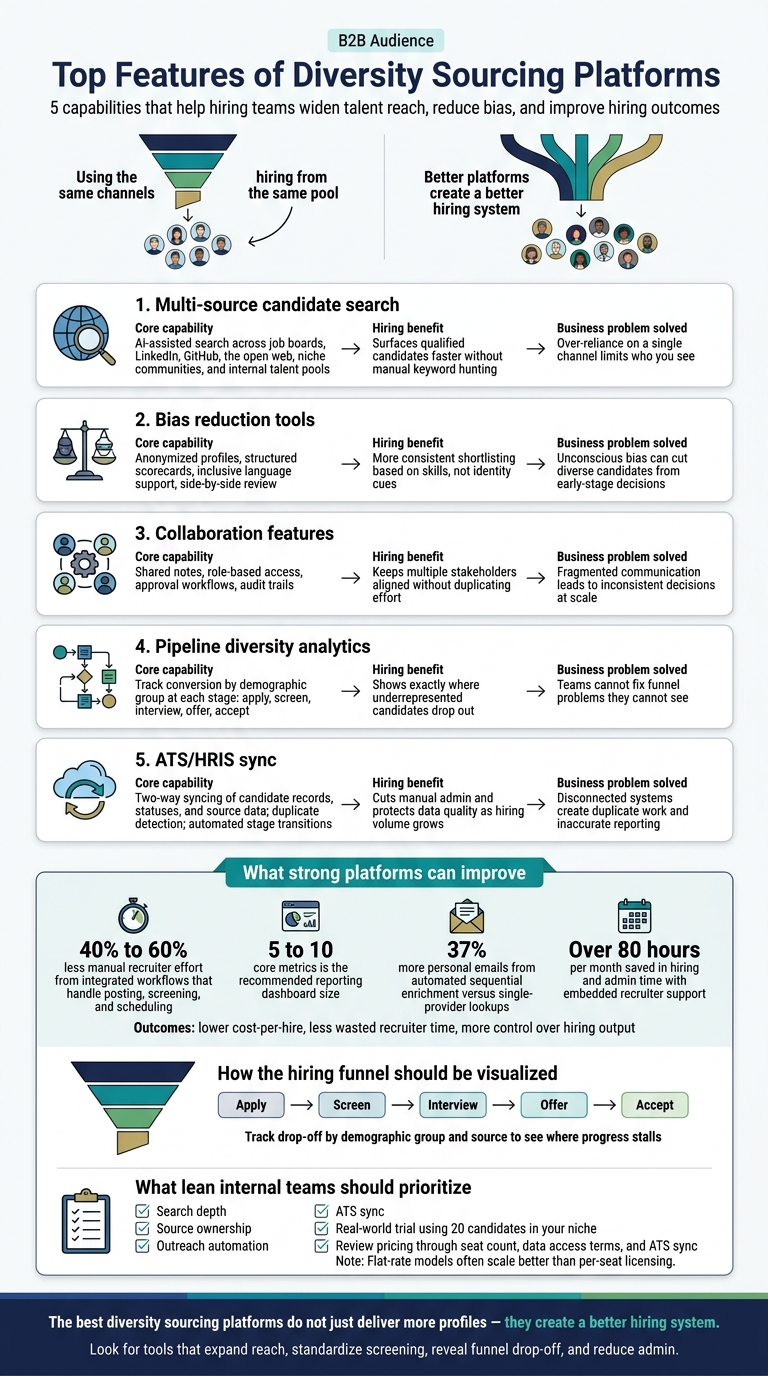
Top Features of Diversity Sourcing Platforms
Core Features That Expand Reach and Improve Candidate Quality
Start with the features that broaden reach, cut bias, and keep your team in sync. When hiring ramps up, these are the tools that stop sourcing from turning into a mess.
| Feature Category | Core Capability | Hiring Benefit | Business Problem It Solves |
|---|---|---|---|
| Multi-source candidate search | AI-assisted search across job boards, LinkedIn, GitHub, the open web, niche communities, and internal talent pools | Surfaces qualified candidates faster without manual keyword hunting | Over-reliance on a single channel limits who you see |
| Bias reduction tools | Anonymized profiles, structured scorecards, inclusive language support, side-by-side review | More consistent shortlisting based on skills, not identity cues | Unconscious bias can cut diverse candidates from early-stage decisions |
| Collaboration features | Shared notes, role-based access, approval workflows, audit trails | Keeps multiple stakeholders aligned without duplicating effort | Fragmented communication leads to inconsistent decisions at scale |
Candidate Search Across Multiple Talent Sources
Broader search is what helps these platforms widen representation without piling more work onto your team. AI-assisted search matches role requirements to related skills and titles across LinkedIn, GitHub, job boards, niche communities, and internal talent pools.
For a lean recruitment team, that matters. Instead of searching each channel one by one, the platform does the heavy lifting. A data scientist search, for example, can surface people with Python, machine learning, and statistics backgrounds, even if those exact words do not appear in their current job title.
Platforms that pull from both internal and external sources, including employees, alumni, and past ATS candidates, give small teams a strong head start. Some also offer anonymized sourcing mode, hiding gender, race, and ethnicity data during sourcing so the focus stays on experience and skills at the top of the funnel.
This is not just about seeing more profiles. It is about finding more qualified candidates from places your team would otherwise miss, which can save hours of manual search time and improve shortlist quality.
Bias Reduction Tools That Standardize Early-Stage Decisions
Blind screening removes names, photos, schools, and other identifiers from early profile reviews. Structured scorecards then set clear rating criteria tied to the role, so each reviewer scores candidates on the same factors instead of relying on instinct.
Side-by-side review workflows add another layer of control. Hiring managers compare candidates against the same criteria in the same layout, which reduces the pull of first impressions.
Inclusive language support checks job descriptions and outreach messages for exclusionary terms. It can flag phrases like "rockstar" and suggest neutral options instead. That matters early, because the wording in your job post shapes who applies before screening even starts.
For hiring leaders, the business upside is clear: more consistent shortlisting, fewer subjective decisions, and a fairer process without slowing the team down.
Collaboration Features That Keep Sourcing Work Aligned
Shared notes and approval workflows keep candidate decisions in one place. Role-based access controls who can see sensitive data and keeps reviews focused on the job. Audit trails record each action for later review.
These features become far more important when hiring demand jumps. Without them, teams slip into email chains and spreadsheets. That is where feedback gets scattered, decisions lose structure, and bias can creep back in.
Consistent, documented workflows cut down on ad hoc decision-making, and that is often where diverse candidates are most likely to lose out. They also make reporting and handoffs much cleaner as hiring volume grows, which helps you keep control as the process gets busier.
sbb-itb-a23bd6a
Analytics, Reporting, and Workflow Integration
Analytics, reporting, and integrations show whether diversity sourcing is improving hiring outcomes or just creating more activity. The first job is simple: see where diverse candidates enter the funnel, and where they fall out.
Pipeline Diversity Analytics That Show Where Progress Stalls
Track conversion by demographic group at each stage, apply, screen, interview, offer, accept, so you can see exactly where underrepresented candidates drop out. Use role-, team-, recruiter-, and source-level filters, along with alerts for low-diversity slates or sudden drop-off, so you can step in before small gaps turn into bigger hiring issues.
Broader sourcing brings more candidate flow. Analytics show where that flow breaks. The next tools deal with the process behind it.
Once you can see where drop-off happens, syncing those findings into your ATS keeps hiring moving without manual clean-up.
ATS and HRIS Integrations That Cut Manual Admin
Two-way syncing keeps candidate records, statuses, and source data aligned across systems, which protects data quality as hiring volume grows. Duplicate detection by email or LinkedIn URL stops duplicate records and repeat outreach. Automated stage transitions move candidates forward when they respond to outreach or finish a screening step, without a recruiter needing to update fields by hand.
Integrated workflows that handle posting, screening, and scheduling cut manual recruiter effort by 40% to 60%, which you can estimate using an ROI calculator, which gives your team more time for interviews and relationship-building. [6]
When a hire is made, HRIS sync carries demographic and sourcing data into the employee record. That keeps workforce reporting accurate long after the hiring process ends. [3]
With clean data moving between systems, reporting becomes a live management tool instead of a manual admin job.
Reporting That Supports Accountability Without Slowing Hiring
The setups that work best keep reporting tight. In most cases, that means a concise dashboard with 5 to 10 core metrics built into the tools your team already uses, then reviewed in weekly or biweekly hiring standups instead of separate reporting cycles. [1] [2] [5]
For a growing SME, audit-ready records help with leadership accountability and compliance reviews. Timestamped activity logs and structured rejection reasons give leaders a clear trail of how decisions were made. That matters during investor due diligence or compliance reviews, where a fair, consistent process carries as much weight as the numbers. [4] [5] [7]
Use exception-based reviews so leaders only step in when metrics move outside the target range. That keeps oversight tight and hiring moving.
How to Evaluate These Features in a Scaling Hiring Environment
Once reporting and integrations are in place, the next step is simple: work out which features will still perform when hiring volume climbs.
Which Features Matter Most for Lean Internal Teams
For lean teams, search depth, source ownership, and outreach automation should come first.
Data ownership is a big one. Make sure sourced candidate data belongs to your company, not the person holding the licence. If someone leaves or moves role, you still need your database to stay usable [8].
Automated sequential enrichment can make a clear difference here. It queries multiple providers in sequence and can surface 37% more personal emails than single-provider lookups [8]. More valid contact data means your team can reach more of the market, with less wasted effort.
When hiring ramps up fast, the tools that cut manual work tend to matter most. Start with the features that have the biggest effect on output:
- Search that helps recruiters find the right people fast
- Outreach automation that keeps follow-up moving
- ATS sync that cuts duplicate admin
How Feature Strength Affects Cost, Speed, and Scalability
Price matters, but pricing structure matters just as much.
Per-seat licensing can get expensive as your team grows. Flat-rate models tend to keep costs easier to plan for. If you’re hiring at volume, an all-in-one platform can often make more sense than stitching together several point solutions.
Look at pricing through three lenses: seat count, data access terms, and ATS sync. In most scaling environments, flat-rate models handle growth better than per-seat licensing.
Before you commit, run a trial using 20 real candidates in your niche. Test verified email hit rates against the roles and sectors you actually hire for, because vendor accuracy claims can vary by industry [8].
Two-way ATS integrations matter too. If the platform pushes and pulls data cleanly, your team spends less time on manual entry. For lean internal teams with limited admin capacity, that time saving has a direct effect on hiring speed [8].
At that point, the bottleneck usually is not feature depth. It’s whether your team has enough bandwidth to use the platform properly, every day.
Where Embedded Recruiter Support Can Strengthen Platform Outcomes
A platform only delivers if someone has the capacity to run it well.
Rent a Recruiter places experienced recruiters inside your team within days, managing hiring end-to-end and adding structure without permanent headcount. Companies can save over 80 hours per month in hiring and admin time [8].
That matters because it keeps sourcing, outreach, and ATS activity moving inside one workflow, instead of leaving your team with a good platform they don’t have time to use.
Conclusion: The Features That Make Diversity Sourcing More Effective
When search, screening, and reporting work together, the next step is simple: pick the features that drive hiring results.
The features that tend to matter most are broader search, bias reduction, pipeline diversity analytics, ATS/HRIS integrations, and a clear reporting cadence. Put together, they help your team find stronger candidates faster and show you exactly where diverse talent is dropping out of the process.
The right mix depends on your team size, hiring volume, and growth stage. If you’re a lean team hiring at scale, focus on tools that work out of the box and don’t need heavy setup or constant admin.
If your internal team is stretched, support matters just as much as software. Tech only works when someone has the time and discipline to use it well, every week. Rent a Recruiter places experienced recruiters into your team within days to run hiring end to end through a structured process. Book a call to review your hiring setup.
FAQs
How do I choose the right platform for my team size?
Choose a diversity sourcing platform based on where hiring is getting stuck and how much internal capacity you have.
If your team is lean, usually fewer than 5 people, focus on lightweight, low-admin tools that plug into your ATS fast. You do not need a bloated system that takes weeks to set up and adds more work to an already stretched team.
If you’re hiring again and again across teams, say 10+ hires per year, or demand is starting to strain capacity, it may make sense to invest in stronger search, automation, and bi-directional ATS integration. That usually means less manual work, better pipeline control, and more time back for your team.
If the main issue is capacity, not tooling, it may be time to look at embedded recruitment support.
Which features improve diversity hiring fastest?
The fastest gains usually come from features that do three things well.
- Expand your reach beyond basic keyword matching with context-aware or semantic search, plus skills-based mapping
- Improve early screening with masked review and skills-based scoring, rather than relying on pedigree
- Speed up execution through ATS/CRM integration and automated, personalised outreach and follow-ups
Put together, these features help diverse candidates move through the funnel faster while giving your team more consistent standards at the top of the hiring process.
How can I tell if the platform is actually working?
Track the full funnel against your baseline: time-to-fill, time-to-hire, source-to-hire conversion, and recruiter hours saved.
For diversity, monitor shortlist diversity, selection rates, and stage-by-stage drop-off by demographic. Make sure data flows back into your ATS so reporting stays accurate, and run a 30 to 60 day pilot on live roles.
If adoption is low and your team drifts back to spreadsheets, it is not working as intended.