
Building a diverse talent pipeline isn’t just a nice-to-have – it’s a business advantage. Companies with higher diversity outperform their peers by up to 39% financially and generate 45% more revenue from innovation. But without tracking the right data, your hiring process could unintentionally exclude underrepresented talent.
Key metrics to focus on:
- Candidate Representation: Are your applicant pools reflecting the diversity of the market?
- Sourcing Effectiveness: Which channels deliver the most diverse candidates?
- Stage-to-Stage Conversion: Where are diverse candidates dropping out of your hiring funnel?
- Leadership Demographics: Does your leadership team reflect the diversity of your workforce?
- Offer Acceptance Rates: Are diverse candidates declining offers more often, and why?
Why it matters:
Tracking these metrics helps you identify gaps, reduce bias, and improve hiring outcomes. For scaling companies, this means lower turnover, better talent retention, and stronger employer branding.
Next steps:
Use tools like an ATS to automate data collection, review your hiring funnel quarterly, and ensure your DEI recruitment best practices align with measurable goals.
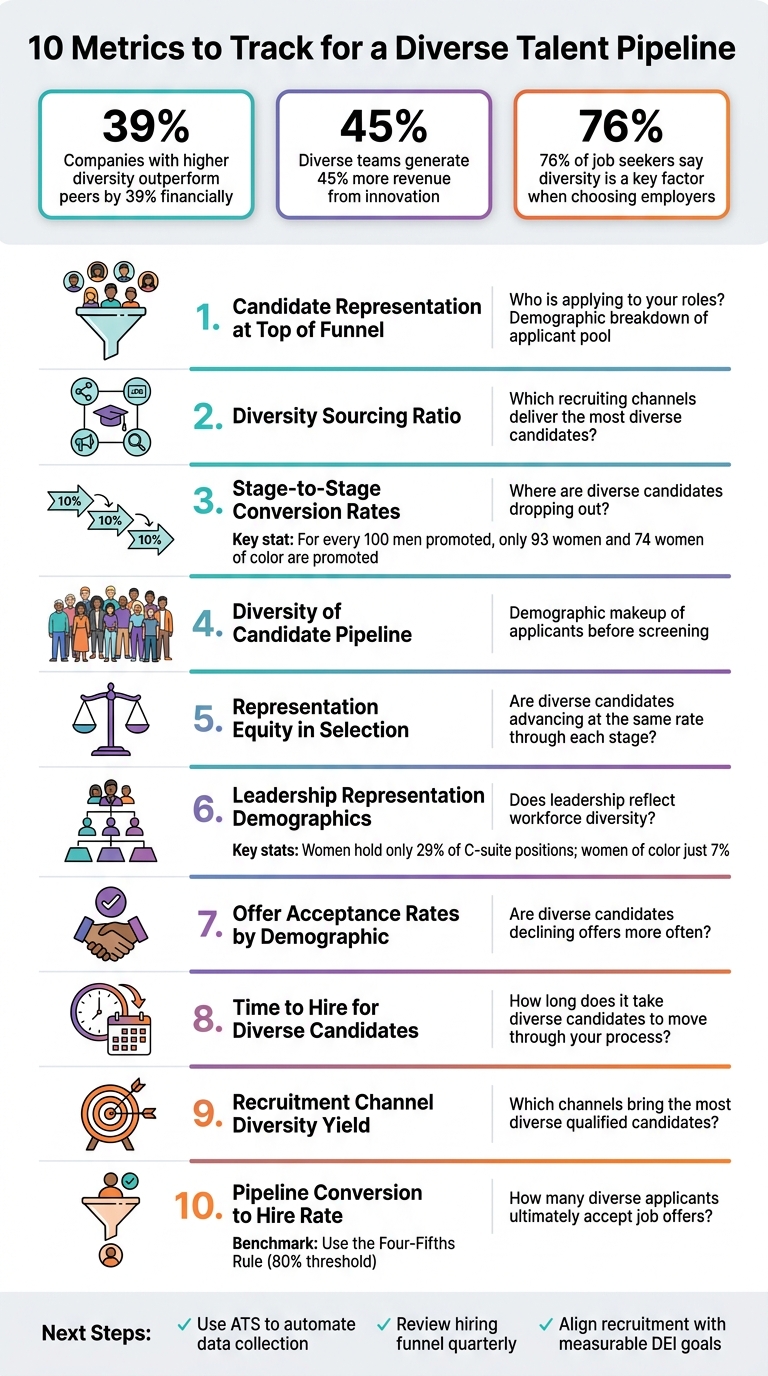
10 Essential Metrics for Building a Diverse Talent Pipeline
Top 4 DEI (Diversity, Equity, Inclusion) Metrics Every HR Leader Should Track| greytInsights
sbb-itb-a23bd6a
1. Candidate Representation at the Top of the Funnel
This metric measures who is applying to your roles – essentially, the demographic breakdown of your applicant pool. It sets the stage for understanding whether your recruitment strategies are successfully reaching underrepresented groups before any biases can influence the process.
Rod Danan, Founder of Prentus, describes this as "the foundational metric", noting:
"Diversity of candidate sources measures which recruiting channels are generating applicants from underrepresented groups – and in what proportions" [1].
If your applicant pool lacks diversity compared to the broader local talent market, it points to a sourcing issue. Without diverse representation at this stage, achieving diversity in your final hires becomes nearly impossible.
Measuring Diversity Effectively
This metric does more than just track outreach – it helps pinpoint whether the sourcing strategy is working independently of bias in later hiring stages. By isolating sourcing performance, it ensures you can identify gaps in outreach without conflating them with other factors [1].
Strengthening the Talent Pipeline
Improving representation starts with broadening your sourcing efforts. Collaborate with HBCUs, community colleges, veteran hiring initiatives, and coding bootcamps to attract a wider range of candidates [1]. Use bias-check tools to review job descriptions and ensure they’re inclusive [2]. Monitor which channels bring in diverse applicants and adjust your approach accordingly. You can also explore our recruitment webinars for more expert insights on sourcing strategies. Additionally, consider implementing automated feedback surveys at the application stage to understand how candidates from different backgrounds experience your process [1].
2. Diversity Sourcing Ratio
After understanding candidate representation, the next step is evaluating the effectiveness of your sourcing channels. The Diversity Sourcing Ratio measures how well different recruiting channels – like job boards, social media, HBCUs, niche talent partners, or referrals – contribute to attracting diverse candidates. It provides a clear breakdown of applicant demographics by source, helping you pinpoint which channels consistently deliver underrepresented talent.
Rod Danan, Founder of Prentus, highlights the importance of this metric:
"If the sources you use are not targeted towards underrepresented groups, it will be nearly impossible to achieve meaningful diversity downstream" [1].
Measuring Diversity Effectively
This metric goes beyond just tracking where candidates come from; it helps uncover potential bottlenecks in the hiring process. For instance, if a channel brings in 50% diverse candidates but only 5% make it to interviews, the issue likely lies in the screening process, not sourcing. This distinction allows you to focus your efforts where they’re needed most.
Improving the Talent Pipeline
The Diversity Sourcing Ratio provides actionable insights into where your recruiting budget will have the greatest impact. Regularly auditing each channel’s performance – looking at both conversion rates and candidate quality – helps you identify the sources that yield the best results. If traditional job boards aren’t working, shift resources to specialized programs like bootcamps, veteran hiring initiatives, or professional groups supporting underrepresented communities. By tracking the return on investment for diversity-focused sourcing, you can ensure your budget is allocated to the most effective channels.
Supporting DEI Goals
This metric transforms broad diversity goals into measurable, actionable steps. By identifying and prioritizing the most effective channels for sourcing underrepresented talent, you can set clear internal targets and monitor progress. Over time, this data-driven approach ensures your diversity initiatives are grounded in results, not just intentions.
3. Stage-to-Stage Conversion Rates
Tracking conversion rates at each stage of your hiring process is essential to understanding where diversity may be slipping through the cracks. These rates measure how candidates from different demographic groups move through the hiring funnel – from application to interview, interview to shortlist, and shortlist to offer. By identifying where underrepresented talent is being filtered out, you can determine whether your hiring process is fair or unintentionally biased.
Why This Matters for Fair Hiring
Here’s a striking data point: for every 100 men promoted, only 93 women and 74 women of color are promoted [1]. These disparities often stem from hiring processes, where small gaps in conversion rates can snowball over time. For example, if 40% of your applicants are from diverse backgrounds but only 10% make it to the interview stage, the issue likely lies in how resumes are being screened rather than in sourcing.
Metrics like these provide visibility into specific stages where bias may be affecting outcomes. They allow you to move beyond assumptions and take concrete action to fix bottlenecks.
Turning Metrics Into Action
Conversion rates are more than just numbers – they’re a roadmap for improving your hiring process. If diverse candidates are disproportionately eliminated during resume reviews or interviews, consider implementing tools like blind recruitment or structured scorecards to make evaluations more objective [1]. Tracking the time candidates spend in each stage, broken down by demographic, can also highlight delays or areas where hiring managers might need extra training or support [5].
The Four-Fifths Rule serves as a practical benchmark: the selection rate for any protected group should be at least 80% of the rate for the group with the highest selection rate [3]. Falling below this threshold is a red flag that requires immediate attention to avoid potential adverse impacts.
Supporting Broader DEI Goals
Focusing on stage-to-stage conversion rates doesn’t just improve fairness – it also aligns directly with broader diversity, equity, and inclusion (DEI) objectives. Instead of simply tracking diversity numbers, this metric shifts the focus to inclusion and progression outcomes. As Richa Sarna, a Tech Talent Solutions Expert, puts it:
"Tracking diversity alone is easy. Tracking whether diverse talent thrives and advances is the real leadership challenge" [5].
4. Diversity of Candidate Pipeline
Pipeline diversity provides a clear view of how inclusive your recruitment efforts are from the start. By tracking the demographic makeup of applicants before screening or interviews, it sets a baseline for understanding representation. Without diversity at this stage, achieving it later in the hiring process becomes far more challenging.
Measuring Diversity Effectively
This metric highlights whether your recruitment strategies are reaching underrepresented groups. It’s a starting point for assessing if your hiring process has the potential to create a more inclusive workplace.
Using Data to Strengthen Your Talent Pipeline
Pipeline diversity data can expose gaps in your sourcing strategies. If your applicant pool doesn’t align with the diversity goals you’ve set, it’s time to rethink your approach. Expanding beyond traditional recruitment channels can help you reach untapped talent pools [1].
Job descriptions are another critical factor. Tools now exist to flag gendered or exclusionary language that may discourage diverse candidates from applying [2]. Even small adjustments – like removing unnecessary qualifications or softening overly formal language – can make a big difference in attracting a wider range of applicants.
Connecting Metrics to DEI Goals
Tracking pipeline diversity transforms general DEI goals into actionable insights. Rod Danan, Founder of Prentus, puts it well:
"Diversity recruiting metrics are quantitative measurements that let organizations track, analyze, and improve DEI hiring initiatives – turning vague commitments into concrete, actionable data" [1].
This transparency matters. A significant 76% of job seekers say workforce diversity is a key factor when considering employers [1]. By focusing on pipeline diversity, you’re not just meeting metrics – you’re aligning your hiring process with what candidates value most.
5. Representation Equity in Selection Processes
Representation equity measures how candidates from diverse backgrounds progress through each stage of your hiring process – from initial screening to interviews and final offers. By tracking this, you can identify whether diverse candidates are advancing at the same rate as others or dropping out at specific points. This helps pinpoint potential biases that might otherwise remain unnoticed, offering a foundation for further analysis and action.
Measuring Diversity Effectively
By comparing demographic data across hiring stages (such as interviewed, shortlisted, and offered), you can spot patterns where underrepresented candidates may be disproportionately filtered out. For instance, if a diverse applicant pool does not translate into a similarly diverse group of interviewees, it may indicate that bias is influencing early decisions [1]. These comparisons are crucial for identifying areas where interventions can make a difference.
Supporting Fair Hiring Practices
This metric sheds light on the "broken rung" issue, where diverse candidates encounter obstacles early in their careers [1]. Using tools like structured scorecards and anonymized application reviews can help minimize subjective judgments and lessen the impact of unconscious bias [1]. Additionally, involving diverse hiring panels reduces groupthink and fosters a more inclusive and supportive environment for candidates [2].
Taking Action to Strengthen the Talent Pipeline
To create a more equitable hiring process, consider these steps:
- Use asynchronous video interviews to address scheduling challenges and reduce biases present in early-stage evaluations [1].
- Implement standardized scorecards to ensure candidates are assessed consistently against the same criteria [1].
- Build diverse interview panels with members of different genders, ages, and backgrounds [2].
- Gather candidate feedback through automated surveys after each stage to uncover any perceived barriers or unfair practices.
6. Leadership Representation Demographics
Leadership representation is a key indicator of whether your DEI initiatives are translating into meaningful change at the top. By examining the demographic makeup of your executive team, senior management, and C-suite, you can assess whether diverse candidates are advancing into leadership roles or encountering barriers along the way.
Effectiveness in Measuring Diversity
Looking at who holds leadership roles gives you a clear sense of whether diversity efforts are creating real opportunities for decision-making authority. The data often highlights systemic issues, like the "broken rung" phenomenon [1]. For instance, women hold just 29% of C-suite positions, and women of color account for only 7% [1]. Meanwhile, only 8% of Fortune 500 CEOs are women, and as of February 2021, just four Fortune 500 companies had Black CEOs [2]. These numbers reveal that while entry-level diversity may be improving, many organizations struggle to maintain that progress as employees move up the ladder.
Alignment with DEI Goals
Diverse leadership teams do more than improve optics – they deliver measurable business benefits. Companies in the top quartile for ethnic diversity are 39% more likely to outperform their industry peers [1]. Additionally, leadership teams with higher diversity generate 45% of their revenue from innovation, compared to just 26% for less diverse teams [1]. Beyond financial gains, visible representation at the top sends a powerful message: career advancement is achievable for everyone, regardless of their background. These insights highlight the importance of addressing gaps to ensure leadership reflects the diversity of the workforce.
Actionability for Improving the Talent Pipeline
To close leadership gaps, start by calculating promotion rates across demographic groups (promotions divided by total headcount) [3]. For example, for every 100 men promoted to manager, only 93 women and 74 women of color receive similar opportunities [1]. Once gaps are identified, take targeted steps to address them:
- Introduce sponsorship programs to guide underrepresented employees toward senior roles.
- Reassess executive sourcing strategies to ensure diverse candidate pools, avoiding reliance on traditional networks [1].
- Focus on potential and leadership qualities when evaluating candidates, rather than limiting criteria to tenure or conventional experience markers [1].
These actions can help create a more equitable path to leadership, ensuring your DEI efforts lead to lasting change at all levels.
7. Offer Acceptance Rates by Demographic
After examining leadership representation, the next critical step is evaluating the offer process.
Measuring Diversity in Action
Tracking offer acceptance rates by demographic is a key way to see if your DEI efforts are leading to actual hires. If underrepresented candidates are declining offers at a higher rate than others, it could point to bias or missteps during the offer stage, even if earlier parts of the hiring process appeared inclusive.
Connecting Acceptance Rates to DEI Goals
Research shows that 76% of job seekers prioritize diversity in the workplace [1][2]. However, higher offer decline rates among certain groups often highlight deeper issues, such as unequal pay or concerns about company culture. Persistent pay gaps – where women and minority groups earn less than white men – can leave candidates feeling undervalued and hesitant to accept offers [2].
Steps to Strengthen Your Talent Pipeline
Addressing these gaps requires proactive steps:
- Review pay equity regularly to ensure competitive and fair offers.
- Share salary ranges upfront to reduce negotiation bias and build trust with candidates.
- Collect feedback through offer-stage surveys to understand why candidates decline.
- Showcase diversity through inclusive branding and diverse interview panels. When candidates see representation throughout the hiring process, they’re more likely to see themselves thriving in your organization.
8. Time to Hire for Diverse Candidates
Evaluating how long it takes candidates to move through your hiring process reveals more than just operational efficiency – it highlights your commitment to equitable hiring.
Why It Matters for Inclusive Hiring
Tracking time to hire by demographic can uncover where underrepresented candidates face delays. These bottlenecks can discourage candidates who cannot afford to wait weeks for a start date. A slow or chaotic process doesn’t just frustrate applicants; it sends a clear message about how much – or how little – your company values diversity and inclusion.
Steps to Streamline the Process
To shorten hiring timelines for diverse candidates, start by identifying where delays occur. For example:
- Asynchronous video interviews can eliminate scheduling conflicts, especially for candidates balancing work, caregiving, or other responsibilities.
- Structured interview scorecards ensure decisions are made quickly and fairly, focusing on objective criteria rather than subjective debates over "culture fit."
- Anonymized resumes during the initial screening phase reduce unconscious bias, helping qualified candidates move through the process faster.
These targeted adjustments speed up hiring while ensuring fairness at every stage.
Reinforcing DEI Commitments
"Diversity recruiting metrics allow you to fine-tune your approach to make sure you’re reaching diverse talent, engaging diverse talent, hiring diverse talent, and retaining diverse talent long-term." – Rod Danan, Founder, Prentus [1]
A hiring process that respects candidates’ time reflects your dedication to fairness and inclusion. This matters because research shows 76% of job seekers view workforce diversity as a key factor when considering potential employers [1][2]. If your process is slow or inefficient, it can undermine your DEI messaging before candidates even reach the offer stage.
9. Recruitment Channel Diversity Yield
Evaluating recruitment channel yield is a focused way to identify where your resources can make the biggest impact, especially when it comes to improving diversity in hiring.
This metric examines which channels – whether job boards, university partnerships, non-profits, or referral programs – are bringing in diverse candidates and at what scale.
Effectiveness in Measuring Diversity
Are your recruitment efforts reaching the right talent pools? This is the key question recruitment channel diversity yield aims to answer. As Rod Danan, Founder of Prentus, explains, understanding which channels attract applicants from underrepresented groups is essential for any diversity strategy [1]. Without tapping into diverse talent sources, achieving meaningful diversity in hiring becomes a steep challenge.
Actionable Insights for Your Hiring Strategy
The data from this metric helps you allocate your recruiting budget where it matters most. For many, this involves transitioning to on-demand recruitment models that offer more flexibility than traditional agencies. Instead of relying on broad, generic job boards, you can target partnerships that consistently deliver diverse and qualified candidates. Collaborations with Historically Black Colleges and Universities (HBCUs), bootcamps for first-generation learners, veteran hiring programs, and non-profits can provide access to talent pools you might not reach otherwise. To gauge cost efficiency, divide each channel’s ad spend by the number of diverse applicants it generates [6].
Connecting Yield Data to DEI Goals
Recruitment yield data bridges the gap between diversity goals and measurable results. Companies in the top quartile for ethnic diversity are 39% more likely to outperform their competitors financially [1]. By integrating yield data into your broader DEI strategy, you can turn intentions into actionable outcomes. Automated dashboards tracking representation in real time allow for swift adjustments if certain channels fall short. Use this data to focus spending on channels that deliver both cost-effective results and meaningful progress toward diversity goals.
10. Pipeline Conversion to Hire Rate
Pipeline conversion to hire rate provides a clear picture of how successful your diversity recruiting efforts are. It tracks how many diverse candidates progress through your hiring process and ultimately accept job offers, turning early-stage data into measurable hiring results.
Identifying Gaps in the Hiring Process
This metric pinpoints where qualified diverse candidates may be dropping out. Comparing the number of diverse applicants to the number of hires offers a clear view of how effective your diversity strategies are. If candidates make it to final interviews but aren’t offered roles, it could signal bias in the selection process. On the other hand, if offers are extended but declined, it may reflect concerns about pay equity or workplace culture.
Ensuring Fair Hiring Practices
The four-fifths rule serves as a useful benchmark to detect bias: underrepresented groups should have a selection rate at least 80% of the highest-performing group’s rate [3]. If your conversion rates fall below this, it could indicate unintentional barriers in your screening or offer stages. Addressing these issues is essential for building an equitable hiring process.
Steps to Strengthen the Talent Pipeline
- Use standardized interview scorecards to ensure every candidate is assessed consistently and fairly [1].
- Conduct pay equity audits to confirm compensation is both competitive and unbiased.
- Implement automated surveys to gather feedback from candidates who decline offers, helping you identify areas for improvement.
- Simplify job descriptions by removing unnecessary "nice-to-have" qualifications, encouraging more underrepresented candidates to stay engaged [1].
Connecting DEI to Business Performance
Tracking conversion rates turns diversity, equity, and inclusion (DEI) goals into actionable business metrics. Research shows that companies in the top quartile for ethnic diversity are 39% more likely to see stronger financial performance, while diverse leadership teams generate 45% of revenue from innovation compared to 26% for less diverse teams [1].
Set clear hiring targets for underrepresented groups based on your qualified pipeline and hold your team accountable for achieving them. With 76% of job seekers prioritizing diversity when evaluating potential employers [1], improving your conversion rates not only drives DEI progress but also strengthens your ability to attract top talent.
How to Put These Metrics into Practice
Start by defining your current state. Analyze your workforce demographics to establish a clear starting point for your DEI efforts [4]. This step helps you identify gaps and measure progress effectively.
Use your ATS and HRIS to automate data collection and monitor DEI metrics in real time. Tools like digital scorecards can standardize shortlisting and minimize subjective decision-making [1].
Examine diversity at each stage of the hiring process to identify where underrepresented candidates drop off. Tracking your funnel step by step is critical for improving DEI outcomes. Set realistic targets based on local labor market data or the profile of your candidate pipeline, and review these metrics quarterly to make timely adjustments [1][4].
Incorporate practices like anonymized screening, regular pay equity audits, and standardized assessments to ensure an unbiased and equitable recruitment process [1][4].
Finally, compare your results to industry benchmarks. Use tools such as Rent a Recruiter‘s free Recruitment Health Check (https://rentarecruiter.com) to gain insights into your employer branding, hiring processes, and DEI performance. These actions turn metrics into tangible improvements in your hiring strategy.
Conclusion
Tracking these ten metrics transforms DEI efforts from abstract goals into actionable strategies. As Rod Danan, Founder of Prentus, puts it, "Without [metrics], bias is invisible. With them, organizations can identify exactly which stage of their process is losing diverse talent and make targeted improvements" [1].
The numbers speak for themselves. Companies in the top quartile for ethnic diversity are 39% more likely to achieve stronger financial performance. Additionally, diverse leadership teams generate 45% of their revenue from innovation, compared to just 26% for less diverse teams [1].
These metrics don’t just improve diversity – they also enhance business outcomes. They identify which recruitment channels attract high-quality, diverse candidates, reduce turnover costs by addressing cultural mismatches early, and boost employer branding. In fact, 76% of job seekers say workforce diversity is a key factor when choosing an employer [1]. On the flip side, 52% of employees dissatisfied with their company’s DEI progress are more likely to leave within two years [1].
The move from symbolic gestures to data-driven DEI strategies is gaining momentum. Diversity is no longer just a compliance issue; it’s now seen as a critical driver of business performance [1]. By integrating these metrics into your hiring processes, you’re not only building a more inclusive workforce but also gaining a competitive edge that fuels innovation and sustainable growth.
FAQs
How do I choose which demographic categories to track?
When defining demographic categories, align them with your DEI objectives, legal obligations, and the context of your workforce. Common categories to consider include ethnicity, gender, age, and disability status.
In the U.S., it’s critical to adhere to EEOC (Equal Employment Opportunity Commission) guidelines. These standards ensure your approach is both compliant and reflective of your company’s unique needs. Tailor categories to capture meaningful data about your team, focusing on areas that offer actionable insights into representation and inclusion.
By identifying the right groups, you can better track hiring progress and work towards creating a workplace that is genuinely inclusive for everyone.
What’s the easiest way to identify where diverse candidates drop out of our hiring funnel?
Tracking diversity metrics at every stage of your hiring process, from sourcing to retention, is key to identifying where diverse candidates may disengage. By analyzing this data, you can uncover specific points where underrepresented groups drop out and take focused steps to create a more inclusive hiring experience.
How can we use ATS/HRIS data to set realistic DEI hiring targets?
Tap into your ATS or HRIS to break down diversity data across your hiring funnel. Look at key points like candidate sources, interviewees, shortlisted candidates, and hires by demographic group. This analysis helps you uncover where underrepresented groups might be falling through the cracks.
By tracking progression at each stage, you can spot patterns, identify potential biases, and take action. For example, if certain groups aren’t making it past initial screenings, it might be time to review your criteria or adjust how roles are presented.
From there, set clear, measurable DEI goals. This could mean improving outreach to diverse candidate pools or refining sourcing strategies. Keep an eye on hiring rates to ensure they align with your diversity targets, and adjust as needed to stay on track.