Hiring reactively is costing SMEs time and money. Workforce forecasting can change that by predicting hiring needs, aligning recruitment with business goals, and reducing costly mis-hires. SMEs using data-driven models see faster scaling, lower costs, and better retention.
Key Takeaways:
- Cost Savings: Avoid bad hires, which can cost 1–2x an employee’s annual salary.
- Faster Hiring: Data models reduce time-to-fill by 20%.
- Efficiency Gains: Predictive analytics save SMEs up to $570,000 annually in lost efficiency.
- Retention Boost: Proactive planning improves first-year retention by 23%.
SMEs often struggle with poor data quality (as seen in our recruitment reports), limited resources, and skill gaps. Starting small, focusing on high-impact roles, and using tools like predictive models can deliver quick wins. For businesses lacking internal capacity, embedded recruitment offers immediate expertise to bridge the gap.
Bottom line? Data-driven forecasting turns hiring into a growth engine, cutting costs while improving outcomes.
What Research Says About Data-Driven Workforce Forecasting
HR Analytics and Workforce Outcomes in SMEs
For small and medium enterprises (SMEs), accurate workforce forecasting is essential to align hiring strategies with growth goals. Yet, many SMEs are missing out on the benefits of HR analytics. Research reveals that SMEs are 138% less likely than larger companies to implement robust people analytics, which can cost mid-sized firms up to $570,000 annually in lost efficiency (based on UK research converted to US dollars) [13].
The challenge often lies in timing. As Matthew Crook, SMB General Manager at Access People, explains:
"When 78% of firms only notice a retention problem after a resignation has been handed in, it’s already too late." [13]
By leveraging HR analytics, SMEs can shift from reactive to proactive. Tools that analyze attendance, payroll, and performance data can help identify early signs of disengagement or turnover risk, allowing companies to address issues before they escalate into vacancies.
Predictive Models in Workforce Forecasting
Advanced predictive models are transforming workforce forecasting. For instance, ensemble models like XGBoost, equipped with automated hyperparameter tuning, have achieved 98.72% accuracy in predicting employee attrition on benchmark datasets [9]. Similarly, deep learning models trained on over 90,000 anonymized resumes have demonstrated an R² score of 0.9877, effectively predicting how long candidates are likely to stay in a role [12].
What makes these models particularly valuable for SMEs is their ability to incorporate Organizational Lifecycle (OLC) features – metrics that reflect a company’s stage of growth, such as start-up or rapid expansion. Including these variables has been shown to boost human capital forecast accuracy by over 17% [8]. This is especially important for early-stage SMEs, where workforce needs can change rapidly. For these businesses, embedded recruitment for startups provides the agility needed to scale teams alongside these data-driven forecasts.
Dr. Emeka Santos, Principal Scientist at Knowledge Discovery AI, highlights the importance of transparency in these tools:
"Interpretable ML methods enhanced stakeholder trust and decision-making utility in HR strategic planning." [8]
This growing focus on Explainable AI (XAI) tools, like SHAP and LIME, is helping HR managers understand the factors behind predictions, making it easier to act on insights. These tools demystify machine learning outputs, breaking down what drives predictions in straightforward terms.
Barriers and Opportunities for SMEs
Despite the potential of these high-accuracy models, SMEs face several barriers to implementation. Research consistently points to four key challenges: poor data quality, limited internal analytical skills, risks of algorithmic bias, and concerns around privacy and ethics [7][10]. Compounding these issues, only 23% of SMEs have a dedicated AI budget, and it typically takes 24 to 30 months for an organization to fully integrate HR technology [13].
That said, starting small can make a big difference. A pilot project for workforce forecasting can deliver a baseline model and initial validation within 4 to 8 weeks [11]. Focusing on a single high-impact area – such as a contact center or operational team – allows SMEs to demonstrate quick ROI before scaling up. Predictive models often highlight actionable factors like promotion history, tenure, job satisfaction, workload, and financial incentives [9], giving SME leaders clear areas to address once they have access to the data.
sbb-itb-a23bd6a
Workforce Planning, Optimization and Demand Forecasting
Data Sources and Techniques for Accurate Forecasting
Standard vs. Data-Driven Workforce Forecasting for SMEs
Accurate forecasting hinges on using the right mix of data sources and analytical methods. Here’s how businesses can make it work.
Internal and External Data Sources
The foundation of accurate forecasting lies in solid data inputs. On the internal side, this includes headcount history, turnover rates by role type, skills inventories, and metrics like time-to-fill and cost-per-hire. Business-specific data, such as revenue targets, ARR pipeline, product roadmaps, and customer growth trends, also provide vital clues about upcoming hiring needs [2][6].
External data fills in the blanks where internal metrics fall short. Labor market insights, such as talent availability, salary benchmarks, and graduation rates in key fields, are critical. Broader economic trends and industry-specific growth data give businesses an edge in anticipating workforce demands. Additionally, regulatory changes – like OSHA staffing requirements or new labor laws – can influence headcount planning, often catching unprepared companies off guard.
"Hiring capacity modeling is not just about filling roles; it’s about aligning talent acquisition with business goals and financial projections." [2]
- Lori Goler, VP of People at Meta
Once the data is in place, the next step is applying techniques that turn raw numbers into actionable hiring forecasts.
Analytical Techniques: Descriptive to Predictive
Most businesses start with descriptive analytics, which examine past headcount and turnover trends. While useful for establishing a baseline, this approach only provides a view of the past.
Predictive analytics take things further by connecting business drivers directly to staffing needs. For instance, regression analysis can link metrics like ticket volume for support teams or ARR pipeline for sales to precise headcount requirements. Time-series decomposition uncovers seasonal trends that simple flat-rate assumptions often miss. Companies using these data-driven models report a 20% reduction in time-to-fill [2].
Advanced scenario planning offers even more flexibility. By tying decisions to specific trigger events – like hitting a revenue milestone – businesses can seamlessly shift from a base hiring plan to an expanded one. This eliminates delays between recognising a need and acting on it, a gap where many companies fall behind [15].
"The goal is not a perfect prediction. It is a data-driven starting point that makes workforce planning a strategic conversation instead of a spreadsheet exercise."
- Superdots Team [5]
These techniques lay the groundwork for comparing traditional and data-driven forecasting approaches.
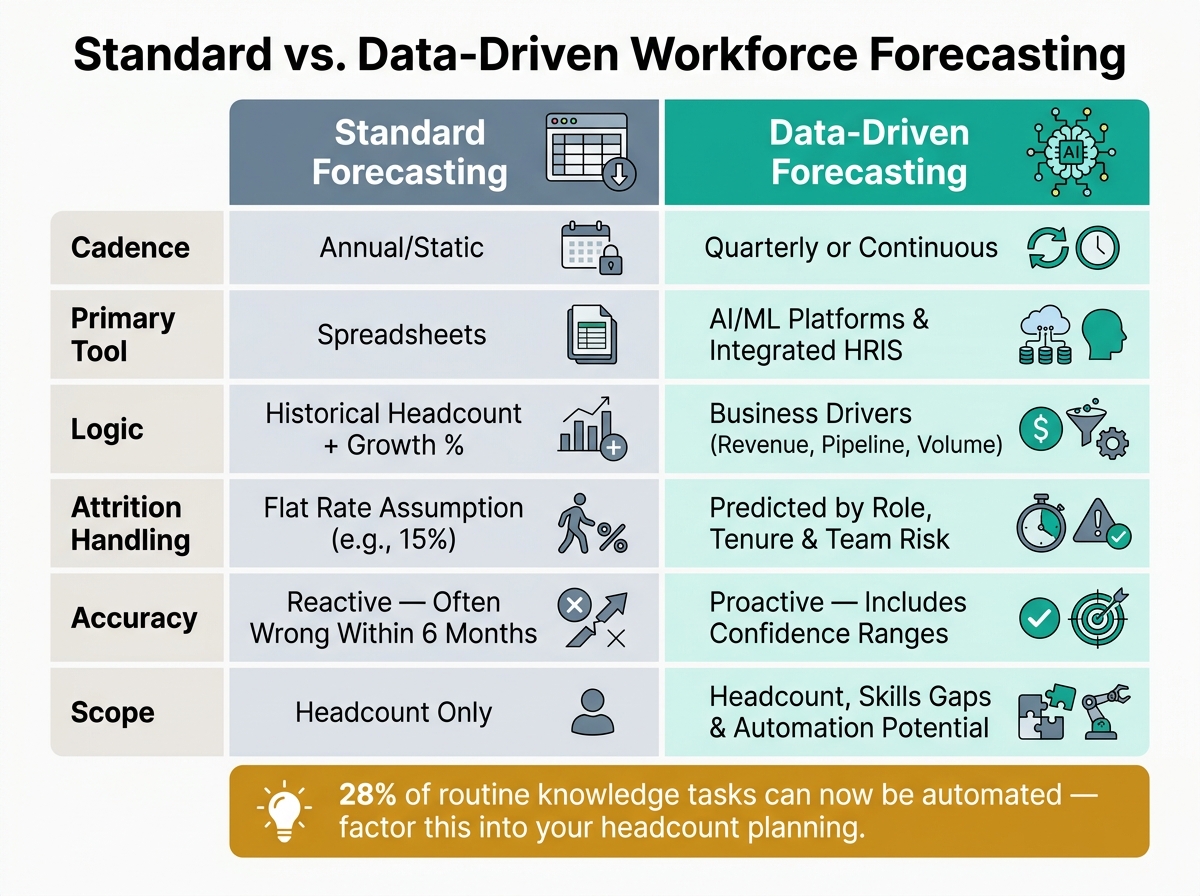
Comparison Table: Standard vs. Data-Driven Forecasting
The table below highlights the differences between standard and data-driven forecasting methods.
| Feature | Standard Forecasting | Data-Driven Forecasting |
|---|---|---|
| Cadence | Annual/static [5] | Quarterly or continuous [1][15] |
| Primary tool | Spreadsheets [5] | AI/ML platforms and integrated HRIS [5][2] |
| Logic | Historical headcount + growth % [5] | Business drivers (revenue, pipeline, volume) [5][14] |
| Attrition handling | Flat rate assumption (e.g., 15%) [5] | Predicted by role, tenure, and team risk [5][15] |
| Accuracy | Reactive; often wrong within 6 months [5] | Proactive; includes confidence ranges [5] |
| Scope | Headcount only [5] | Headcount, skills gaps, and automation potential [15][14] |
An emerging trend is the inclusion of a "Bot" column in workforce planning. This accounts for tasks that AI or automation can handle, reducing the need for additional hires. Studies show that about 28% of routine knowledge tasks can now be automated [15][14]. Ignoring this factor could lead to inflated hiring projections.
This comparison underscores the advantages of shifting to data-driven forecasting models, helping businesses streamline and optimise hiring strategies effectively.
How SMEs Can Start Using Data-Driven Forecasting
Getting started with data-driven forecasting can feel daunting for SMEs. The challenge isn’t convincing teams of its value – it’s knowing how to take those first steps while staying within budget.
A 3-Phase Adoption Model
A step-by-step approach can help SMEs gradually build their forecasting capabilities without overwhelming resources or teams:
| Phase | Focus | What to Do |
|---|---|---|
| Phase 1: Audit | Data Consolidation | Centralize data from your HRIS, ATS, and payroll systems. Gather 6–12 months of historical hiring and termination data. Define a minimum viable dataset (MVD) that includes key fields like employee ID, hire/termination dates, role, and salary [4]. |
| Phase 2: Pilot | Rapid Validation | Test forecasting on 1–2 high-volume roles over 30–90 days. Focus on 3–5 key metrics (e.g., time-to-fill, 90-day attrition) and use simple models like logistic regression to validate results [4]. |
| Phase 3: Scale | Predictive Modeling | Expand forecasting to all roles. Automate model updates and incorporate scenario planning to prepare for growth triggers like funding rounds or new product launches [4][5]. |
By building trust in the data during the audit phase, SMEs can gain leadership support for scaling efforts. This phased approach also addresses common obstacles like data quality issues and skill gaps.
Overcoming Common Barriers
Once the model is in place, SMEs often face challenges in implementation. For smaller teams, tools like spreadsheets or basic HRIS platforms may suffice initially. Instead of trying to forecast for every role, focus on the 5% of positions that drive the majority of business impact [3]. For example, presenting a hiring range (e.g., 6–10 engineers) demonstrates analytical rigor while avoiding overprecision [5].
To combat internal resistance, use models that are easy to interpret. Build trust by testing each hire with questions like, "What happens if this role remains unfilled for three months?" [1].
How Embedded Recruitment Expertise Helps
Partnering with external experts can make a significant difference, especially for SMEs with limited internal capacity. Embedded recruitment offers a way to accelerate progress by bringing in experienced recruiters who integrate directly into your team.
"Workforce planning for SMEs has shifted from an annual budgeting exercise to a continuous leadership discipline." – Mark Loughnane, Lead of Rent a Recruiter [1]
With Rent a Recruiter, businesses can gain structured hiring processes and actionable data insights – like source-of-hire effectiveness and candidate-fit metrics – that improve forecasting and align hiring with strategic goals [1][4]. Rather than treating recruitment as a one-off task, the embedded model ensures hiring remains commercially aligned with your business needs.
The impact is clear. MasterTech worked with Rent a Recruiter for 27 months, embedding a dedicated Talent Partner who delivered 29 placements with a 4:1 CV-to-interview ratio. This saved the company $123,000 compared to traditional agency fees [1]. Similarly, Unique saw success when an embedded recruiter coordinated 291 interviews across global offices (Berlin, Zurich, New York, London, and Singapore), leading to 17 offers and 10 hires in just a few months [1].
Measuring Results and What Comes Next
Measurable Business Outcomes
The numbers behind data-driven forecasting are hard to ignore. Companies with a structured workforce plan see revenue growth 2.4 times faster than those hiring reactively [15]. On the expense side, forecasting can trim hiring costs by 25% to 40%, primarily by avoiding the "emergency hire" premium. This premium often includes a 19% markup in agency fees and sign-on bonuses [15]. And let’s not forget the cost of bad hires. Replacing an employee can range from 50% to 200% of their annual salary, with averages hitting $17,000 per hire and soaring to $240,000 for executive roles [6].
Retention also gets a boost. Companies leveraging active workforce plans report a 23% improvement in first-year retention compared to reactive hiring [15]. Proactive forecasting speeds up hiring too, with time-to-fill reductions across all roles. For critical positions, these reductions can reach up to 50% [15].
Take Angi, for example. In early 2026, this home services platform implemented automated workforce forecasting and management. Within just four months, they achieved a 30% reduction in per-FTE costs, saving $213,120 overall [16].
Emerging Trends in Workforce Forecasting
Workforce forecasting continues to evolve, bringing sharper strategies to the table. For SMEs, three major trends are shaping the future: skills-focused planning, scenario modeling, and early attrition prediction.
First, the focus is shifting from headcount to skills. Teams are now identifying "skills clusters" and spotting capability gaps 6 to 12 months in advance – essential when 39% of core job skills are expected to change by 2030 [5][6][16].
Second, scenario modeling is becoming a must-have. SMEs are crafting "what-if" models – covering base, upside, and downside scenarios – with pre-set triggers that allow hiring decisions to happen ahead of market shifts [5][15]. This eliminates delays caused by waiting for executive alignment during periods of rapid growth.
Finally, AI-powered attrition prediction is giving HR teams a head start. Machine learning tools can flag employees at risk of leaving 3 to 6 months before they resign [5][17]. This allows for proactive sourcing instead of last-minute scrambling. Gartner has even ranked workforce planning as the second most critical HR capability for 2026, just behind AI literacy [15].
"The goal is not a perfect prediction. It is a data-driven starting point that makes workforce planning a strategic conversation instead of a spreadsheet exercise." – Superdots Team [5]
Scale Your Hiring with Rent a Recruiter
While forecasting pinpoints hiring needs, actually meeting those needs requires scalable recruitment solutions. Many SMEs struggle to bridge this gap, which is where Rent a Recruiter steps in. Within just five days, Rent a Recruiter embeds experienced recruiters directly into your team, providing immediate hiring capacity without the overhead of traditional agencies [1].
"Workforce planning only works when HR is aligned with commercial decision-making." – Mark Loughnane, Lead of Rent a Recruiter [1]
Whether you’re tackling short-term hiring goals or building a long-term recruitment function, Rent a Recruiter provides the expertise and structure to turn your workforce plan into action. Book a call to see how embedded recruitment can help you hire smarter.
FAQs
What’s the smallest dataset I need to start workforce forecasting?
To begin workforce forecasting, establish a solid understanding of where your organization stands today and how it has evolved over time. Start by compiling a detailed headcount report that includes key details like department, role, level, location, hire date, and compensation.
Next, gather at least two years of recruitment data, covering metrics such as hiring rates, departure rates, time-to-fill, and offer acceptance rates. Align this data with your revenue targets and upcoming business goals to pinpoint any talent gaps that could impact your ability to meet those objectives.
How do I connect revenue or pipeline targets to a hiring plan?
To ensure your hiring strategy aligns with revenue and pipeline goals, consider adopting a capacity-driven approach. Begin by establishing clear role-specific ratios, such as one sales rep for every $1.2M in revenue. Then, work backward from your ARR and pipeline targets, factoring in ramp-up times – typically 90 to 180 days.
Implement trigger-based hiring by tying new roles to specific, measurable milestones. For instance, open positions only when you hit defined revenue benchmarks or reach a certain number of customers. This approach keeps your hiring aligned with growth, ensuring you scale efficiently without overextending resources.
How can I reduce bias and protect employee privacy in HR forecasting models?
To reduce bias, focus on transparency by anonymizing sensitive information during training and performing thorough fairness checks. Implement strategies like holdout periods and back-testing to uncover bias and keep an eye on model drift over time.
When it comes to privacy, enforce strict data governance and ensure your data sources are clean and well-integrated. Steer clear of over-relying on subjective judgment, as this can introduce bias – especially in situations where historical data is scarce or unique cases emerge.