
If your recruiting team lacks clear ownership, clean process control, and hard numbers, hiring costs climb and delivery slips.
I’d boil this down to five jobs: control recruiter capacity, run a tight hiring process, track the right KPIs, keep leaders aligned, and fix bottlenecks before they hit headcount plans. For scaling companies, that means fewer delayed hires, less wasted spend, and more control over time-to-fill, offer acceptance, and recruiter workload.
In plain terms, I’d focus on:
- Team capacity, who owns each role, how many reqs each recruiter carries, and where work is getting stuck
- Process control, from intake meetings to offers and HR handoff
- KPI ownership, including time-to-fill, funnel conversion, cost-per-hire, and ageing requisitions
- Stakeholder alignment, so hiring managers, HR, finance, and leadership work from the same plan
- Continuous improvement, using data to cut delays, trim admin, and plan for hiring spikes
One useful benchmark: many teams start to strain when recruiters carry 20 to 30 active roles, and a common planning rule is 1 recruiter for every 25 hires per year. If demand jumps past that point, extra support through embedded recruitment can add delivery capacity without losing process visibility.
If I were leading hiring in SaaS, IT, Fintech, Engineering, Security, Insurance, or Professional Services, this is the checklist I’d use to keep recruitment measurable, controlled, and ready for growth.
Job description of Recruiting Manager – Role, Responsibilities & Skills
Checklist 1: Lead the team and manage recruiting capacity
Strong recruiting leadership starts with clear ownership, clean workload planning, and early risk spotting.
If you don’t know who owns each role, how stretched each recruiter is, or where work is slowing down, small issues turn into missed hires fast. For CEOs, CFOs, and hiring leaders, that usually means delayed projects, more pressure on managers, and extra spend to fix avoidable gaps.
Define roles, priorities, and workload allocation
Set clear owners for each requisition. Balance workload across the team, and review capacity every week.
Track open requisitions per recruiter so you can see whether work is spread properly and still fits team capacity. If one recruiter is carrying too many roles, shift work early before delays pile up. When hiring demand jumps, move sourcers or coordinators onto the highest-priority roles and rebalance before the process slips.
Watch aging requisitions closely. They often point to blockages in sourcing or interview stages. During busy periods, check team well-being too. If people are stretched, redistribute tasks before burnout starts to hit output.
When capacity is under control, coaching becomes far more useful. Instead of constant firefighting, you can deal with the issues that are slowing delivery.
Run one-on-ones, coaching, and KPI reviews
Weekly one-on-ones should not be status meetings.
Use them for direct search coaching. That might mean helping a recruiter unblock a stuck role, reset unrealistic hiring manager expectations on scope or pay, or review interview feedback that isn’t helping decision-making. That’s where recruiter growth happens, and where delivery problems often get fixed before they spread.
Track leading indicators such as pipeline health and interview-to-offer conversion. Then track lagging indicators such as 90-day quality of hire. Together, these metrics help you spot delivery risk early and keep performance reviews tied to facts rather than opinion.
Keep process discipline and team standards in place
Process discipline slips fast during hiring spikes if standards are vague.
Set a clear rule that interview feedback must be submitted within 24 to 48 hours [1]. Slow feedback stalls the pipeline and hurts candidate experience. It also slows hiring manager decision-making, which adds more time and cost to every hire.
Keep ATS records complete and up to date. Every candidate interaction, status change, and feedback note should be logged in real time [1]. If records are patchy, reporting becomes unreliable and compliance risk goes up. Audit the ATS on a regular basis, not only when something breaks.
Candidate communication standards matter here as well. Every recruiter should use the same messaging and follow the same response timelines. When that starts to slip, it’s often a sign the team is overloaded, which takes you straight back to capacity planning and workload control.
Once capacity and standards are stable, the next priority is end-to-end process control.
Checklist 2: Own the end-to-end recruitment process
Once hiring capacity is stable, you need to run the process end to end. That’s how you keep hiring fast, consistent, and visible as volume grows.
In practice, that means every search follows the same path. Every stage has a clear owner. Every hiring manager works from a clear, approved brief. The main control point is the intake meeting, then every step that follows.
Set up strong intake meetings and hiring plans
A weak intake meeting causes trouble for the whole search.
Before sourcing starts, align with the hiring manager on role scope, must-have criteria, budget, and whether expectations line up with the market. If that part is fuzzy, the rest of the process gets messy fast.
Use a defined intake checklist so scope, must-haves, budget, interview stages, and decision dates are agreed before sourcing begins. A clean intake cuts rework later. It also saves time that would otherwise be lost on role resets, re-briefs, and pipeline clean-up.
Push back early if the brief is unrealistic. If you don’t, you can lose weeks working on a role that was off track from day one.
Monitor sourcing, screening, interviews, and offers
Once a search is live, your role shifts. Now you need to keep the pipeline moving and spot where it’s slowing down.
Track time-to-first-qualified-screen and source-of-hire results so you can see weak or slow channels early. That matters because slow channels don’t just waste recruiter time. They drag out hiring timelines and increase the risk of missed headcount targets.
On the interview side, make sure scorecards are being used and that feedback is based on evidence, not gut feel. Without that, decisions drift, interview quality drops, and hiring managers start pulling in different directions.
For offers, watch acceptance rates closely. Remove approval bottlenecks before top candidates drop out. A slow approval chain can kill good hires at the last minute, which means more backfill work, more delay, and more cost.
Then protect the handoff so the process stays measurable from start to finish.
Protect candidate experience and ATS data quality
Weak communication and incomplete records are usually signs of a broken process, not one-off mistakes.
When scheduling drags, communication becomes patchy, or ATS records are incomplete, you lose candidates. You also lose the data you need to report on what went wrong and fix it.
Set clear ownership across intake, screening, interviewing, offers, and HR handoff. Log every stage in real time. Keep response times and scheduling consistent.
Every candidate record should be accurate and complete before handoff to HR. That keeps reporting reliable, protects handoffs, and gives you a clear view of hiring performance as volume grows.
With the process under control, track whether it is actually delivering.
sbb-itb-a23bd6a
Checklist 3: Track metrics, report performance, and align stakeholders
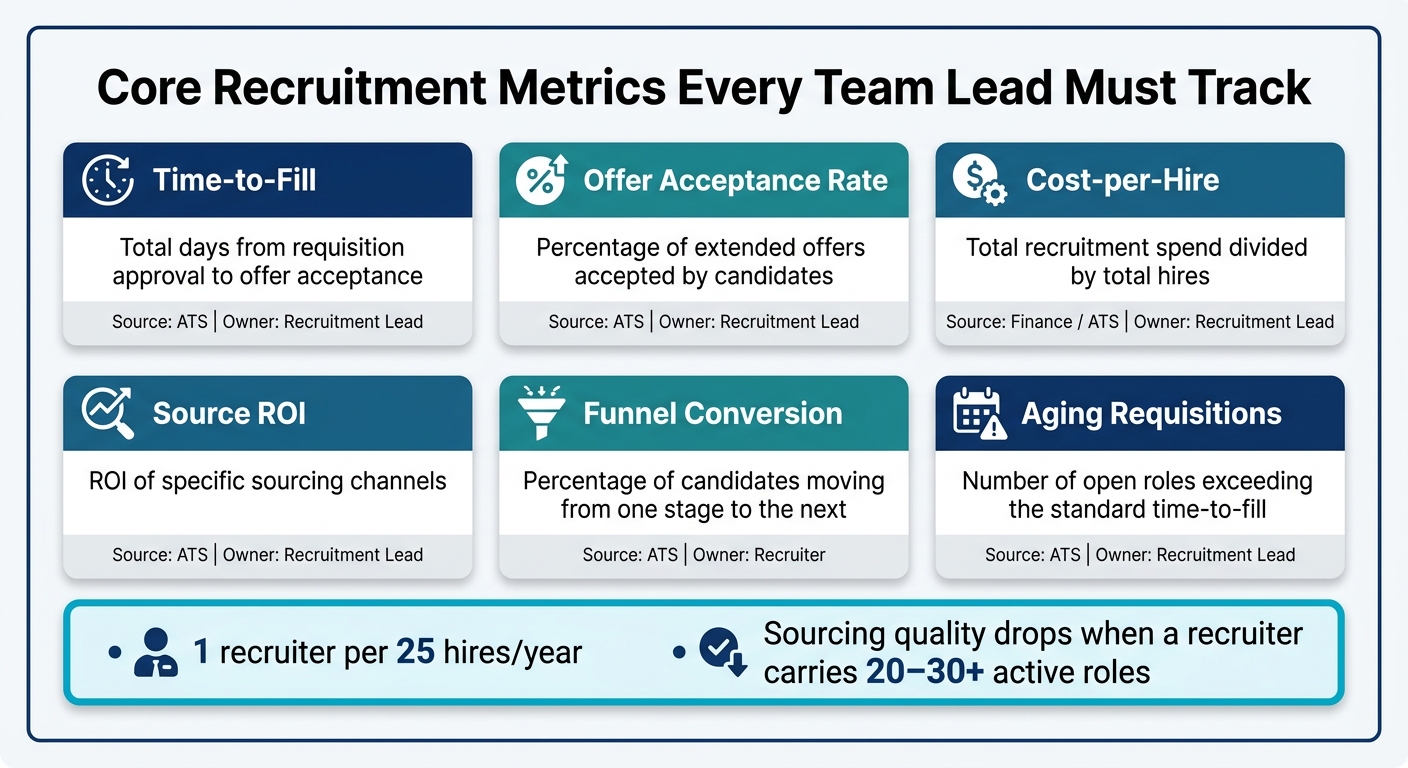
Recruitment Team Leader KPIs: Metrics, Sources & Ownership
Once the process is running well, the next step is simple: make it measurable.
Good data shows you where hiring starts to slow before one missed hire turns into a missed hiring plan. That matters because by the time the problem shows up in the final numbers, you’ve already lost time.
Track the recruiting metrics that flag delivery risk early
Don’t just track end results. Track the signals that show risk early.
Focus on time-to-fill, time-to-offer, offer acceptance rate, funnel conversion, cost-per-hire, and source ROI. Use aging requisitions as a warning sign for roles that are drifting.
The point isn’t to build a huge dashboard for the sake of it. Track the measures that lead to action. If a metric doesn’t help you fix a bottleneck, it doesn’t need your attention.
Report clearly to hiring managers, HR, and leadership
Use weekly check-ins with hiring managers to review role risk. Then use monthly or quarterly reviews to show trends, pipeline health, and delivery issues over time.
The table below shows the core metrics every recruitment team lead should track, where the data sits, and who owns it:
| Metric | Definition | Data Source | Ownership |
|---|---|---|---|
| Time-to-Fill | Total days from requisition approval to offer acceptance | ATS | Recruitment Lead |
| Offer Acceptance Rate | Percentage of extended offers that are accepted by candidates | ATS | Recruitment Lead |
| Cost-per-Hire | Total recruitment spend divided by total hires | Finance / ATS | Recruitment Lead |
| Source ROI | ROI of specific channels | ATS | Recruitment Lead |
| Funnel Conversion | Percentage of candidates moving from one stage to the next | ATS | Recruiter |
| Aging Requisitions | Number of open roles exceeding the standard time-to-fill | ATS | Recruitment Lead |
When you report to leadership, keep it tight. They want to know if hiring is on track, where the risks are, and what decisions need to be made. They do not need a step-by-step tour of the process.
Be clear about trade-offs. If interview delays are pushing out start dates, say so. If recruiter capacity is stretched, show the effect on delivery. That gives leadership what they need to act.
Build alignment with business leaders and functional teams
Alignment is not a one-off meeting. It’s a steady rhythm between recruiting, HR, finance, and the business leaders who control headcount.
In practice, that means:
- Calibrating with hiring managers after each search
- Working with HR and finance to forecast headcount before it becomes urgent
- Giving executives a clear view of hiring capacity, including where the team is stretched and how that affects delivery
If embedded recruiters support delivery, tie their output to your internal KPIs, reporting standards, and hiring manager expectations. That way, stakeholder alignment feeds straight into the workflow and capacity review that comes next.
Checklist 4: Improve the function and scale hiring without losing control
Use metrics and stakeholder feedback to fix bottlenecks before they slow hiring.
Review workflows, tools, and interview design regularly
Use the bottlenecks from your metrics review to decide what to fix next.
Start with your funnel. Look at where candidates drop off most often, then work out whether the issue sits in the process or in candidate quality. Review intake forms, interview scorecards, and approval flows to check the process still holds up as headcount grows.
Audit system data monthly so your reporting stays reliable.
Automate scheduling, ATS updates, and initial screening to cut admin time.
Make one process change at a time, and explain why it matters. When hiring managers understand the reason behind a change, they’re more likely to use it properly and flag the next issue before it turns into a bigger problem.
Plan future capacity and handle growth spikes
Once the process is stable, shift your focus to future demand spikes.
A standard rule of thumb is one recruiter per 25 hires per year [2], with a healthy individual workload sitting at 15 to 20 open requisitions. Once a recruiter crosses 20 to 30 active roles, sourcing quality drops and intake meetings get skipped [2].
Hiring demand rarely shows up in a straight line. Funding rounds, product launches, and team expansion plans can create sharp spikes that internal teams aren’t built to absorb. When that happens, delivery slips fast. Roles stay open longer, hiring managers lose time, and pipeline quality falls.
Use embedded recruitment support when hiring spikes go beyond internal capacity. It gives you extra delivery power without handing over control of process, data, or hiring standards.
Conclusion: Turn this checklist into a repeatable operating rhythm
These responsibilities reinforce each other. Better intake improves data. Better data sharpens reporting. Clearer reporting gives you more control as hiring grows.
If your team needs structured hiring capacity to keep pace with growth, talk to Rent a Recruiter about what embedded support could look like for your business.
FAQs
How do I know when my recruiters are overloaded?
Watch the warning signs before hiring starts to drag.
Most recruiters hit capacity at 13.4 active requisitions for standard roles, or just 4 to 5 for niche technical roles.
Once you push past that point, the cracks usually show fast. Hiring quality can slip. Candidate follow-up slows. Processes get messy. And when that happens, the cost isn’t just internal stress. It’s slower hiring, missed talent, and more time lost from your team.
Another red flag is admin load. If more than 25% of a recruiter’s time is going into scheduling, admin, or ATS upkeep, they’re not spending enough time on the work that moves hiring forward.
That usually means your hiring team is stuck in process instead of driving outcomes.
Which recruiting KPIs matter most first?
Start with bottleneck metrics that show where your hiring process slows down. Focus on hiring flow, not just total output.
Track:
- stage-to-stage timing
- feedback lag
- drop-off rates
For a recruitment team leader, the key top-line KPIs are cost-per-hire, quality-of-hire, and team productivity. Together, these show where delays happen and whether hiring is helping or hurting business growth.
When should I add embedded recruiting support?
Consider adding embedded recruitment support when hiring demand goes past what your internal team can handle, or when a sudden hiring spike hits.
It gives you extra recruiting capacity without adding permanent headcount. Just as important, you keep control of your hiring process, systems, and candidate experience.
For scaling companies, that matters. You can keep hiring moving, protect team time, and avoid the cost of building a full in-house talent function too early.
It can also act as a practical bridge during rapid growth, or while you work out which long-term talent acquisition roles your business should build next.