
We recommend starting with one hiring task, not a software purchase, and proving it saves time without weakening hiring decisions. For your SaaS, IT, or Fintech team, that means using natural language processing (NLP) to extract skills or summarise interview notes while people stay in charge of selection.
We would build your stack around four checks:
- Process: Set role criteria, connect hiring systems, and name who reviews each output.
- Quality: Test accuracy before launch. Example targets include 90%+ recall for stated must-have skills and zero unsupported employment facts in summaries.
- Control: Protect candidate data, check for bias and understand the impact of AI on recruitment, and give recruiters the right to correct or reject recommendations.
- Return: Measure shortlist time, recruiter hours saved, and total cost per candidate, including human review. Saved hours are not automatically cash savings.
Our approach is simple: <u>test without affecting selection first</u>, expand only when agreed targets are met, and keep a tested route back to your previous process.
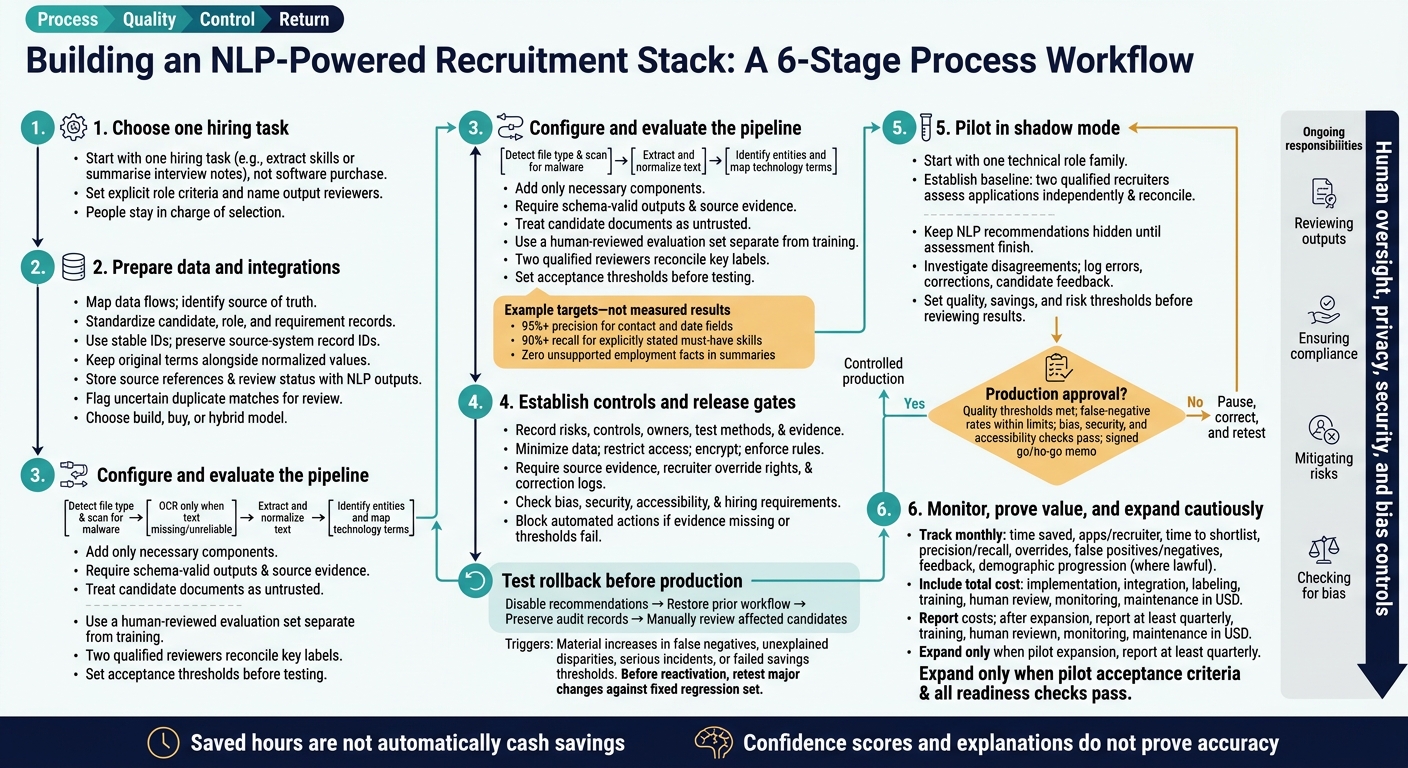
NLP Recruitment Stack: From Task to Safe Rollout
How to Build an AI Resume Screening System for Recruiters with n8n – Part 01 | n8n Full Course
sbb-itb-a23bd6a
Prepare Hiring Data and Plan Integrations
Once you’ve agreed on the workflow, align the data and systems that support it. Use the approved workflow to map how data moves between systems, including which tools track candidate flow and which assess fit.
Identify the source of truth for each record type, what each system sends and receives, and where candidate data is stored. This keeps the workflow consistent and gives your team clear rules to follow.
Connect Systems and Standardize Data
For each connection, document the data flow, system of record, and fields that must stay aligned. Set rules for handling updates and conflicts. Flag uncertain duplicate matches for review, rather than merging them automatically.
Create a standard data schema with separate records for candidates, roles, and requirements. Give each candidate a stable internal ID, and retain each system’s record ID so you can link records across tools.
Normalize job titles, technical skills, and job requirements, but keep the original source terms alongside the normalized values. Make criteria explicit and scorable. Include only the information needed for evaluation to keep technical screening consistent across roles.
Store NLP outputs with their source references and review status so your team can trace the results. Version the schema, skill taxonomy, and scoring rules to track changes.
Compare Build, Buy, and Hybrid Options
With data flows and schemas mapped, choose a build, buy, or hybrid model your team can run. It should support one hiring data model, clear ownership, and standardized processes, without adding unnecessary complexity or splitting the workflow across disconnected tools.
Configure and Test NLP Components
Build the Document Processing Pipeline
Start with the standardized candidate, role, and requirement records you’ve already mapped. Add only the components your workflow needs to avoid unnecessary processing costs and delays.
Detect file types and scan for malware. Use OCR only when text is missing or unreliable. Extract and normalize the text, identify relevant entities, and map technology terms to a maintained taxonomy with explicit non-match rules. Resume parsing may end at extraction. Recruiter search may also need passage embeddings and exact-match filters.
Document each component’s fallback, latency target, and review requirement. Connect APIs with limited permissions, bounded retries, logging, and failure monitoring. For LLM extraction or summaries, require schema-valid outputs and source evidence for material claims.
Treat candidate documents as untrusted content. Embedded instructions must never override system instructions, access permissions, or workflow rules. Use prompt-injection testing and security review for retrieval and tool-using systems.[4][5]
Compare NLP Methods and Costs
Choose each method by its task, evidence requirements, and operating cost, not its model label.
| Approach | Suitable tasks | Strengths | Limitations | Explainability | Operating cost |
|---|---|---|---|---|---|
| Rules-based NLP | Explicit terms and known formats | Predictable behavior | Brittle when formats or wording vary | High | Low runtime cost; rules need upkeep |
| Supervised machine learning | Defined classification tasks | Efficient inference | Requires labeled examples | Model-dependent | Training and maintenance costs |
| Task-specific transformer models | Entity extraction and semantic search | Context-sensitive processing | Requires domain validation | Evidence layers needed | Compute-dependent |
| General-purpose large language models | Source-grounded summaries and structured extraction | Flexible text handling | Hallucination and variability | Explanations need verification | Usage- and deployment-dependent |
Measure Output Quality, Speed, and Cost
Build a human-reviewed evaluation set of technical resumes. Include PDFs, DOCX files, scans, varied layouts, relevant languages, uncommon technologies, technical stack terms, and nonstandard career paths.
Have two qualified reviewers reconcile key labels. Keep the evaluation set separate from training and tuning data, and set acceptance thresholds before testing.
Example targets: 95%+ precision for contact and date fields, 90%+ recall for explicitly stated must-have skills, and zero unsupported employment facts in summaries.
Use the NIST AI Risk Management Framework to guide documented testing.[2][6]
Report entity precision and recall by field, search relevance against recruiter judgments, and summary accuracy against source text. Measure end-to-end p50 and p95 latency separately from component-level latency. Track peak throughput, retries, and total cost per document or candidate, including review time, so you can assess both processing speed and hiring administration costs with a recruitment health check.
Confidence scores and explanations do not prove accuracy. Deliver the configured pipeline alongside an evaluation report covering versions, thresholds, results, failure cases, and remediation owners. Block automated actions wherever evidence is missing or thresholds fail.[6][7]
Use these results to set the controls and human review points in the next section.
Set Oversight, Privacy, and Bias Controls
Turn the NLP pipeline’s evaluation results into a control register for the resume parser, summary generator, and scoring logic. Use the NIST AI Risk Management Framework to govern the workflow. Log each risk, control, owner, review schedule, evidence, and approval status so your team can track who is responsible and what is ready for use.[8][9]
Before deployment, record the purpose, inputs, outputs, model or vendor version, data sources, intended users, prohibited uses, and limitations. Include test results, privacy and security reviews, accessibility notes, approvers, and the next review date.
Protect Candidate Data and Require Review
Send only the candidate fields each task needs. Apply role-based access, least-privilege service accounts, encryption in transit and at rest, and retention and deletion rules for workflow artifacts.
Review provider contracts for subprocessors, breach notification, deletion commitments, data residency, and whether candidate data may train shared models. Give notice and obtain consent where required by law. Have legal counsel review requirements in the jurisdictions where candidates apply.
Keep demographic and self-identification data separate from selection inputs. Restrict access and set minimum group-size thresholds for reporting. Put these safeguards in place before the pilot so your team can review how data moves through the workflow.
Human review must be able to change the decision. Before recommendations affect selection, require source evidence, recruiter override rights, and a correction log. Give candidates a usable channel to request corrections and accommodations.
Retain only the audit trail needed to reconstruct the process: relevant input and output versions, reviewer actions, decisions, timestamps, and the policy or model version.
Match Automation Risks to Controls
For the same parsing, summarization, and scoring workflow, assign each risk a named owner, control, test method, and evidence requirement. This gives your team a clear basis for checking results and deciding whether the workflow can proceed.
| Automation risk | Required control | Owner | Evidence required |
|---|---|---|---|
| Biased training data | Review how well the data represents relevant groups and test outcomes across those groups | AI-risk owner | Dataset documentation and subgroup test results |
| Proxy discrimination | Review features and prompts for proxies such as names, ZIP codes, schools, employment gaps, or language patterns | Recruiting and compliance owners | Feature-approval record and job-related rationale |
| Hallucinated summaries | Require source-linked claims and recruiter verification | Recruiting owner | Original document, generated summary, and correction history |
| Inconsistent scoring | Use versioned evaluation sets, fixed test cases, threshold monitoring, and change logs | Engineering owner | Regression results and change logs |
| Privacy exposure | Minimize fields, restrict access, encrypt data, and enforce deletion schedules | Privacy and security owners | Access logs and deletion records |
| Document-based prompt injection | Treat resumes and attachments as untrusted input, isolate instructions from document content, disable unnecessary tool permissions, and test malicious files | Security owner | Adversarial test results and permission reviews |
| Overreliance on rankings | Require documented human review, independent evidence checks, and override tracking | Recruiting owner | Review decisions and override reasons |
Set escalation triggers for unsupported claims, unexplained scoring changes, material disparities, data exposure, candidate complaints, and vendor model updates. Specify who can pause the affected workflow, who investigates, and the response deadline for each severity level.
Keep the workflow paused until corrective action has been tested, approved, and logged. Reassess controls whenever models, prompts, data sources, or job criteria change.
Check U.S. Hiring Requirements
Once privacy and review controls are in place, make adverse-impact checks under applicable U.S. rules a release gate before the pilot and broader rollout. Where permitted, measure selection rates at each hiring stage and compare demographic groups.
The four-fifths rule flags potential adverse impact when a group’s selection rate falls below 80% of the highest group’s rate. It is a screening tool, not proof.[13][15] Investigate disparities and document corrective action. Procedures with adverse impact may require job-related validation under the Uniform Guidelines on Employee Selection Procedures.[10][11][12]
Maintain a federal, state, and local requirements matrix covering automated-hiring rules and disability accommodations. For covered tools, New York City Local Law 144 requires a bias audit no more than one year before use, a published summary, and candidate notices.[14][16]
Pilot the Workflow and Track Results
Once controls are in place, test the workflow in shadow mode before changing selection decisions.
Run a Pilot Without Affecting Selection
Start with one technical role family that has stable requirements and enough application volume for reliable results. Establish a baseline: two qualified recruiters independently assess applications against documented job criteria, then reconcile disagreements. Record review time, shortlist time, and progression rates.
Run NLP in shadow mode to extract skills or rank search results. Keep its recommendations hidden until recruiters finish their assessments. Investigate disagreements rather than assuming either assessment is correct. Log parsing errors, recruiter corrections, and candidate feedback about barriers.
Set quality, savings, and risk thresholds before reviewing results. Approve production only when quality thresholds are met, false-negative rates stay within limits, and bias, security, and accessibility checks pass.
Produce a signed go/no-go memo and a phased plan covering baseline measurement, shadow testing, controlled production, and expansion to additional roles. Once the shadow pilot is running, track its impact on work and error patterns monthly.
Track Savings and Changes in Performance
Use a monthly dashboard to track:
- Time saved per requisition, applications per recruiter, and time to shortlist.
- Extraction precision and recall, shortlist-cutoff precision, overrides, and false-positive and false-negative rates.
- Demographic progression where lawful and permitted, candidate feedback, sample sizes, and baseline comparisons.
Report cost per candidate and total costs in U.S. dollars. Include implementation, integration, labeling, training, human review, monitoring, and maintenance. Separate released staff time from realized financial savings so you can see whether saved hours translate into lower spending.
Assign recurring model, data, security, and bias reviews. After expansion, report at least quarterly.
Test the rollback runbook before production. It must cover disabling recommendations, restoring the prior workflow, preserving audit records, and manually reviewing affected candidates. Trigger rollback for material increases in false negatives, unexplained disparities, serious incidents, or failed savings thresholds.
Before reactivation, retest major changes to the model, prompts, parser, integrations, or job templates against a fixed regression set.
Once pilot metrics are set, assign ownership for monitoring, rollback, and approval.
Assign Technical and Recruitment Owners
Name an accountable owner and backup for each area: integrations and rollback, security and privacy, model evaluation, recruiter training, and workflow adoption.
Recruiters own evidence checks and corrections. Designated hiring managers retain responsibility for hiring decisions, and a hiring leader signs the go/no-go memo.
Specify dashboard owners, review schedules, and escalation deadlines. Keep NLP engineering and system controls with internal technical and security owners.
Conclusion: Check Readiness Before Scaling
After the pilot, make readiness the final gate before scaling. Use it as an evidence check, not a launch trigger. Confirm that the approved low-risk, high-volume workflow has standardized role criteria and tested data flows. Set screening criteria before posting the role so the model does not infer them from a generic scorecard.
Keep the approval record in one place to support the scaling decision. Mark each checklist item ready only when evidence supports it.
Once the record is complete, verify review rights and decision ownership. Before expanding, confirm that recruiters can review recommendations and make final selection decisions. After launch, use regular post-hire calibration reviews to spot weaknesses in evaluation logic and improve the workflow.
Expand only when the pilot meets its acceptance criteria and every readiness check passes. Pause if privacy controls are incomplete, your AI policy for ethical recruitment is unfinalized, ownership is unclear, or reviewers are untrained.
FAQs
How do I choose my first NLP hiring task?
Start with your biggest recruitment bottleneck, not a feature checklist. Pick a task that costs your team the most time and is straightforward to implement, such as candidate sourcing or resume screening.
Before introducing NLP, standardise your hiring stages, clarify who owns each step, and clean your data. Then run a 30-day pilot on one or two hard-to-fill roles.
Keep people in control. NLP should help your team filter candidates, not make hiring decisions on its own.
How much pilot data do I need?
Test AI sourcing with a 2 to 4 week pilot on one or two hard-to-fill roles. Have your team approve every shortlist so you can assess results before expanding its use.
For predictive hiring, predictive and descriptive models need about 12 to 24 months of clean, structured historical data. Start simple, with as few as 100 past hiring outcomes.
For a resume parser pilot, record a baseline first. Then audit roughly 100 resumes to assess parsing success. [1][2][3]
How do I validate skills implied by a resume?
Look beyond keyword matching. Context-aware tools can infer capabilities from projects, public contributions, and career data. AI-powered semantic search helps you find equivalent skills and related expertise, so you don’t miss suitable candidates simply because their wording differs from your job description.
Use structured, skills-based scorecards to assess candidates consistently, rather than judging them by job title. Verify their skills through objective assessments or asynchronous interviews, giving your team more evidence for hiring decisions than a resume alone.