
If agency hiring is growing faster than your controls, you are adding cost and risk at the same time.
If you want a recruitment vendor checklist that works, keep it tight. Set scope, sort vendors by risk, assign owners, collect proof, and review on a fixed schedule. That gives you more control over spend, less admin drift, and fewer contract or process issues after a vendor starts work.
Here’s the short version:
- List every vendor in scope, including staffing agencies, RPO providers, tech tools, and any embedded recruitment support tied to hiring
- Tier vendors by risk based on data access, hiring volume, system access, and regulated role exposure
- Check the basics first, legal entity, W-9, insurance, contracts, and state licences where needed
- Review hiring process risk, worker classification, payroll process, I-9 ownership, EEO standards, and background screening workflow
- Check data controls, MFA, encryption, breach notice terms, and third-party data handling
- Track dates and owners in one place, so renewals, audits, and missing documents do not slip
- Audit high-risk vendors on a set cycle, then fix gaps with a named owner and due date
The business case is simple. Many companies still run vendor reviews in spreadsheets, while agency use stays high. That is where wasted time, poor handoffs, and fee leakage start. A clear checklist helps you cut that down before it turns into a hiring delay or a clean-up job.
If your team is scaling across SaaS, tech, fintech, engineering, security, insurance, or professional services, this is the baseline process I would put in place first.
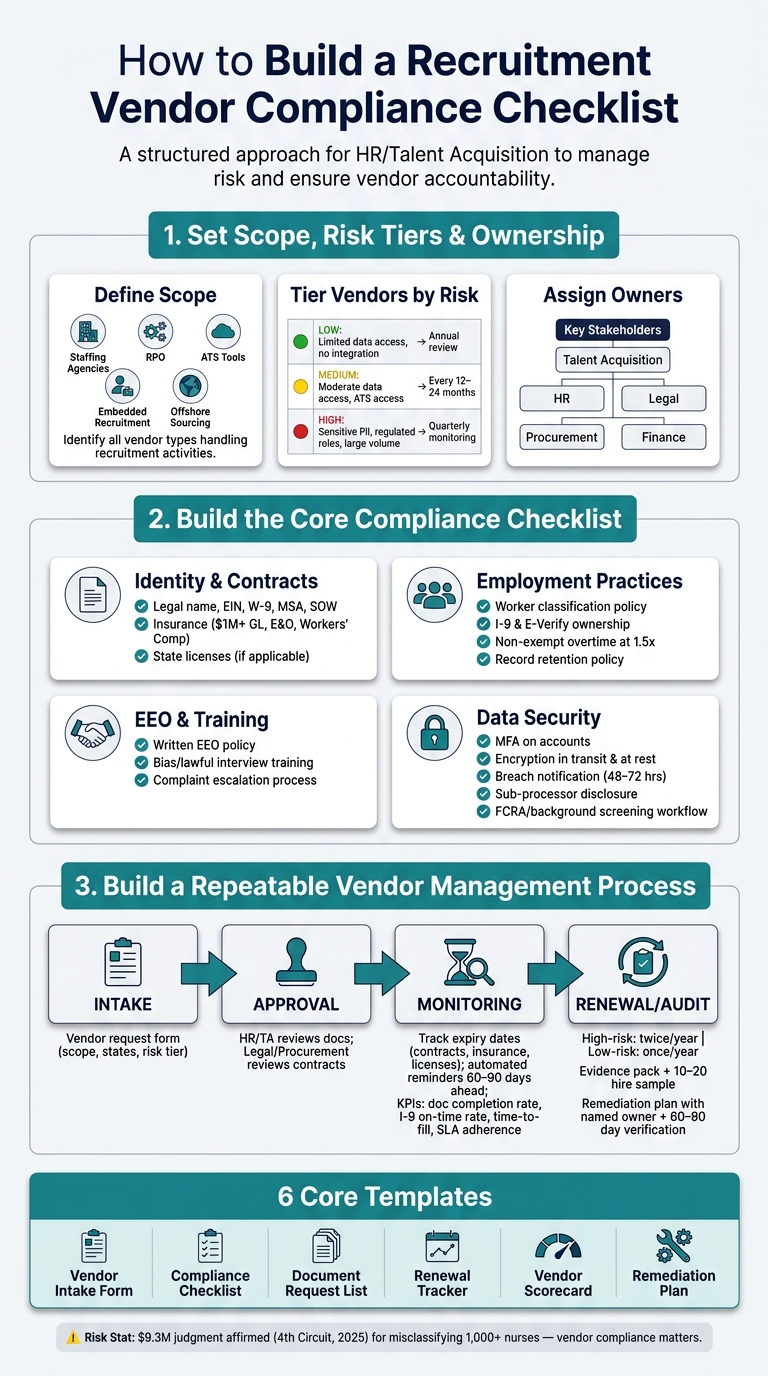
Recruitment Vendor Compliance Checklist: 3-Step Process
5 Hidden Gems to Boost Your Vendor Compliance Management
Explore our full library of recruitment videos for more expert insights.
sbb-itb-a23bd6a
Step 1: Set Compliance Scope, Risk Tiers, and Internal Ownership
Set scope, risk tiers, and owners before you write a single checklist item.
Define which vendors and hiring activities the checklist covers
Start with three questions for every vendor relationship: What services do they provide? What data do they access? What hiring decisions can they affect? If a vendor touches even one of those areas, include them in scope.
For a scaling U.S. company, that usually includes permanent search firms, contract staffing agencies, embedded recruitment models, high-volume hourly staffing providers, and any tech platform, ATS, background screening, or assessment tools, that processes or stores candidate data. It also includes offshore sourcing support if those vendors handle U.S. candidate information. Even if they are not placing workers directly, cross-border data handling can increase privacy risk.
Start with a vendor inventory. Keep it simple, but make it useful. Track:
- Vendor type
- Hiring activity
- Data access
- Integrations
That inventory drives every inclusion and tiering call that comes next.
Use a low-, medium-, and high-risk tiering model
Assign each vendor a risk tier based on data sensitivity, system access, hiring volume, and role-specific regulation exposure. This matters for any vendor working on roles tied to healthcare, financial services, defense, transportation, or government contracting.
| Tier | Typical profile | Review depth | Cadence |
|---|---|---|---|
| Low | Limited data access, no integration, low hiring volume | Basic questionnaire, contract review | Annual or at renewal |
| Medium | Moderate data access, ATS or scheduling tool access | Legal/privacy review, evidence of controls | Every 12 to 24 months |
| High | Sensitive PII, regulated roles, large volume, classification exposure | Full due diligence, insurance, classification, controls review | Quarterly or ongoing monitoring |
Use the inventory and tier score to set review depth. Not every vendor needs the same level of scrutiny. That’s the point.
The cost of getting this wrong is not small. In July 2025, the Fourth Circuit affirmed a $9.3 million judgment against a staffing agency that had misclassified more than 1,000 nurses under the FLSA.[1]
That kind of exposure starts with a vendor relationship that was never properly scoped or reviewed.
Assign owners across HR, talent acquisition, legal, procurement, and finance
Assign clear owners across the business. If nobody owns a step, it usually doesn’t happen.
- Talent acquisition owns vendor scope and interview standards
- HR owns EEO, accommodation, I-9, and background-screening policy alignment
- Legal owns MSAs, DPAs, indemnities, and state staffing-law clauses
- Procurement owns intake, documents, and renewals
- Finance owns tax and insurance records
Once scope, tier, and ownership are in place, the checklist items in Step 2 can follow the same structure.
Step 2: Build the Core Recruitment Vendor Compliance Checklist
Once scope, tiers, and owners are in place, you can build the checklist. Keep it simple. Every item should have evidence, an internal owner, and a review date. The risk tier from Step 1 should decide how much proof each vendor needs to provide.
Vendor identity, contracts, insurance, and state licensing
Start with the basics. Request the legal business name, DBA names, EIN, W-9, and state registration. Then check that they all match the entity signing the contract. If they do not line up, you create risk before work even starts.
On contracts, each recruitment vendor relationship should include a signed Master Service Agreement (MSA) and a Statement of Work (SOW). The SOW should spell out scope, fees in U.S. dollars, SLAs, audit rights, confidentiality, and termination terms. If those terms are missing, your leverage drops when problems show up.
You should also check whether the vendor holds any staffing or employment agency license and bond needed in each state where it places workers. This matters more than many teams think. A vendor can look fine on paper and still fail a state-level requirement.
| Checklist item | Required evidence | Internal owner | Review/renewal date |
|---|---|---|---|
| Legal business name, EIN, W-9 | IRS EIN letter, completed W-9, Secretary of State registration | Procurement | At onboarding; every 2 to 3 years |
| Signed MSA and SOW | Fully executed agreements with scope, fees, SLAs, termination terms | Legal | At onboarding; before each renewal |
| General liability insurance ($1 million+ per occurrence) | Certificate of Insurance with coverage amounts and expiration | Legal / Risk | Annually, tied to policy expiration |
| Professional liability / E&O ($1 million to $2 million) | Certificate of Insurance | Legal / Risk | Annually |
| Workers’ compensation coverage | Certificate of Insurance | Legal / HR | Annually |
| Required state staffing or employment agency license | License copy and bond confirmation by state | Legal / Procurement | At onboarding; at each renewal |
Employment practices, worker classification, and required records
This is where cost risk can build fast.
For W-2 workers, verify classification controls and complete I-9 records. Ask each vendor for a written classification policy that shows how it separates W-2 employees from 1099 independent contractors, in line with IRS and Department of Labor guidance.[4]
You also need clarity on ownership. Confirm who handles I-9 and E-Verify, and whether E-Verify is used where required. If that line of responsibility is blurry, mistakes tend to follow.
For non-exempt pay compliance, vendors placing non-exempt workers should have written timesheet processes and correct overtime calculations at 1.5x the regular rate, with state-specific rules applied where needed.[2][3] This is not admin for admin’s sake. Wage errors can lead to claims, back pay, and time-consuming clean-up.
| Practice area | Compliant example | Non-compliant example | Evidence to request |
|---|---|---|---|
| Worker classification | Vendor documents control, tools, and schedule analysis; uses employee status for supervised, full-time roles | Vendor labels all workers as contractors to avoid payroll taxes | Written classification policy and completed assessment samples |
| Non-exempt pay compliance | Non-exempt workers use daily timesheets; overtime calculated at 1.5x; state-specific rules applied | Workers paid flat daily rates with no overtime tracking | Sample timesheets and pay stubs; payroll policy |
| I-9 and E-Verify | Clear agreement that vendor completes I-9s within 3 business days and stores records securely; E-Verify used in enrolled states | No documented I-9 process; responsibility unclear between vendor and client | I-9/E-Verify policy; proof of system and training |
| Record retention | Payroll and I-9 records retained for required federal and state periods | I-9 and payroll records discarded early to save storage | Retention schedule and sample anonymized records |
EEO standards, data security controls, and role-specific checks
Every vendor should have a written EEO and anti-harassment policy that covers federally protected characteristics. That is the baseline. You should also ask for proof that recruiters are trained on lawful interview questions, bias awareness, and ADA accommodations. A policy alone is not enough. Request training completion records and a clear outline of the complaint escalation process.
A policy sitting in a folder will not protect your business. The proof is in how the vendor trains people, logs issues, and closes them out.
Data security needs the same level of discipline. Confirm that candidate data is protected with role-based access controls, multi-factor authentication (MFA) on recruiter and admin accounts, and encryption in transit and at rest. Your contract should also set a breach notification timeline. 48 to 72 hours is a sensible standard to include.
Ask for a vendor security summary or questionnaire response. Also request a sub-processor list that shows which third-party tools handle candidate data, along with the data protection terms tied to them. If a vendor cannot explain where data goes, that is a red flag.
| Checklist item | Required evidence | Internal owner | Review/renewal date |
|---|---|---|---|
| Written EEO and anti-harassment policy | Policy document; proof communicated to staff | HR / Legal | Annually; after major regulatory changes |
| Recruiter training on bias and lawful interviewing | Training curriculum; completion records | HR / DEI | Annually |
| Complaint escalation process | Written procedure; description of how issues are logged and closed | HR / Legal | Annually |
| MFA on recruiter and admin accounts | Security policy; vendor attestation or screenshot | IT / Security | At onboarding; annually |
| Encryption in transit and at rest | Technical overview; SOC 2 report if available | IT / Security | At onboarding; annually |
| Breach notification timeline in contract | Contract clause specifying notification window (e.g., 48 to 72 hours) | Legal | At contract execution; before renewal |
| Sub-processor disclosure | Sub-processor list with data protection terms | Legal / IT | At onboarding; when sub-processors change |
| Background-screening and FCRA workflow | Stand-alone disclosure, written authorization, and a documented adverse action workflow with consistent criteria by role | Legal / HR | At onboarding; when screening criteria change |
Next, turn these checks into onboarding, review, and renewal workflows.
Step 3: Turn the Checklist Into a Repeatable Vendor Management Process
A checklist sitting in a shared drive, reviewed once a year, is just paperwork. To make it useful, build it into the workflow your team already uses to onboard, monitor, and renew vendors.
Connect vendor onboarding, review dates, and document storage in one workflow
Set up one workflow that runs from intake through renewal: intake, approval, monitoring, and renewal or audit. Give each step one clear owner.
At intake, the hiring manager should submit a standard vendor request form. That form should capture vendor details, scope of work, the states where hiring will happen, and the vendor’s risk tier.
At approval, HR or talent acquisition reviews the core documents. Legal and procurement review contract terms before any requisitions go to the vendor. This matters because late checks create downstream risk, and that usually means wasted time, hiring delays, or spend you could have avoided.
During monitoring, track key dates in one place. That includes contract end dates, insurance expiry dates, and state license expiry dates. Set automated reminders 60 to 90 days ahead so your team has time to act, not scramble.
At renewal, the same owner should review performance and any compliance gaps before deciding whether to renew, renegotiate, or exit.
Use one secure source of truth for documents, dates, and audit notes. For most teams, a secure shared drive or document repository with role-based access is enough. Create a main Recruitment Vendors folder, then add subfolders for each vendor. Limit access to HR, legal, and finance.
A shared tracking spreadsheet can also work well at the start. Include fields for:
- Vendor name
- Risk tier
- Key expiry dates
- Owner
- Status
Conditional formatting can flag anything expiring within 60 days. If you already use an ATS or HRIS, create a vendor record that links job requisitions to each vendor and stores key documents there too. That way, recruiter activity and compliance status sit in the same place.
USCIS says employers must be able to present retained Forms I-9 within 3 business days of a request, so organised, retrievable document storage matters.[5]
Track a small set of compliance and performance KPIs
Keep your KPI list short. A bloated scorecard that nobody reviews is worse than a tight set of numbers checked every quarter.
Track document completion rate, on-time I-9 completion, audit-gap closure time, time-to-fill, offer acceptance rate, and SLA adherence.[7][6]
Review these KPIs quarterly. In the first one or two quarters, use the numbers as a baseline instead of a hard benchmark. Once you have live data, tighten the targets.
This gives you a cleaner read on vendor performance. You can spot who needs a closer review before the next audit, and you can do it before weak process turns into cost, delay, or compliance trouble.
Run periodic audits and close gaps with remediation plans
After the KPI review, move each vendor into a fixed audit cycle and remediation track. For most teams, a sensible rhythm is twice a year for high-risk vendors and once a year for lower-risk vendors.
Collect a standard evidence pack from each vendor. That should include updated insurance certificates, state staffing licenses, I-9 process attestations, EEO reporting summaries, data security attestations, and background check documentation. Then sample 10 to 20 hires from the review period and check that each required step was completed on time.
Log every finding in a simple audit log. Record the issue type, severity level, vendor name, date found, owner, and remediation due date.
For each major finding, build a short remediation plan with:
- A clear problem statement
- Root cause
- Specific corrective actions
- A named owner
- A verification step after 60 to 90 days
Store remediation plans and closure evidence in the same vendor folder as documents, licenses, insurance records, and past audit notes. Then reference those files in the next audit cycle.
High-severity findings, such as systematic I-9 non-compliance or missing state licenses, should trigger a process change, not a one-off clean-up. If the same problem keeps showing up, the issue is not the file. It’s the workflow.
For smaller teams, one owner can run the process and keep reviews on schedule.
Templates, Final Checklist Summary, and Next Steps
Templates to include in your checklist pack
Turn the process into a reusable template pack. Six core templates are enough to cover the full vendor lifecycle without adding admin for the sake of it.
| Template | Primary Owner | When to Use |
|---|---|---|
| Vendor intake form | HR / Talent Acquisition | Before any new vendor is approved |
| Compliance checklist | HR, Legal, Procurement | At onboarding and each review cycle |
| Document request list | HR / Legal | Sent to vendor at intake |
| Renewal tracker | HR / Procurement | Ongoing; reviewed 60 to 90 days before expiry |
| Vendor scorecard | HR / Talent Acquisition | Quarterly or semi-annual review |
| Remediation plan | Legal / HR | After any audit finding |
Keep the format simple and consistent across every file.
- Use MM/DD/YYYY for all dates
- Use USD ($) fields for all cost entries
- Name files
VendorName_DocumentType_MMDDYYYYso records stay easy to find - In the compliance checklist, include status, owner, due date, and evidence location
- Use only three status labels: Not Started, In Progress, Complete
That last point matters more than it seems. If a reviewer opens the file and can tell the status in seconds, your review cycle moves faster and handoffs get cleaner.
What a good first version looks like in a scaling company
The goal is not to build a huge system on day one. The goal is to make the checklist repeatable across vendors.
A solid first version usually means one checklist, one owner per task, one evidence repository, and review dates based on vendor tier. That gives you enough structure to keep control without slowing the business down.
A staged rollout works well:
- Finalize templates in weeks 1 and 2
- Pilot with one or two vendors in week 3
- Revise in week 4
In most scaling companies, that can be put in place in 2 to 4 weeks using tools you already have.
For teams using embedded recruitment support, such as Rent a Recruiter, an embedded recruiter can help keep documentation tidy, ownership clear, and review timing on track. That matters when hiring teams are busy and vendor admin keeps slipping down the list.
Conclusion and next steps
A working recruitment vendor compliance program usually comes down to a few early decisions: set the scope, tier vendors by risk, collect the right evidence, assign clear owners, and review on a fixed schedule. You do not need a large team or heavy software to get this in place.
If you do not have a formal vendor review process today, start with your two or three highest-risk vendors and run a basic checklist this quarter. That one exercise will expose gaps, make ownership clearer, and give you a draft process you can use again.
FAQs
Which vendors should be treated as high risk?
Treat vendors as high risk when a failure on their side would hit your hiring operation straight away, or leave you open to legal or financial damage.
Start with the vendors that matter most to business continuity and compliance:
- Role sensitivity. If the vendor supports senior, regulated, or hard-to-fill hiring, the risk is higher.
- Access to data. Give extra scrutiny to vendors handling candidate PII, screening records, or right-to-work documents.
- Hiring volume or revenue-linked hiring. If the vendor supports a large share of your hiring, or roles tied closely to growth, delays can cost you time and money fast.
- Multi-state operations. Risk goes up when hiring spans several states with different privacy and employment rules.
In simple terms, if a vendor touches high-stakes hiring, sensitive data, or compliance-heavy workflows, they should move to the top of your review list.
What documents should we collect first?
Start by confirming the vendor’s legal and tax standing. Collect:
- EIN
- W-9 or W-8BEN/E
- business licence
- Certificate of Incorporation
You should also secure an MSA and SOW, along with proof of insurance and financial stability. That may include valid COIs, financial statements, or credit reports if needed.
This step is simple, but it matters. If these basics are missing, you risk delays in onboarding, payment issues, and legal headaches later. Get the paperwork right early, and the rest of the process runs far more smoothly.
How often should recruitment vendors be audited?
Audit frequency should match the vendor’s risk profile, hiring volume, level of data access, and how much your business depends on them. A fixed annual audit for every supplier rarely makes sense.
A low-volume specialist agency with limited system access does not carry the same risk as an embedded partner handling core hiring activity across multiple teams. Treating both the same wastes time, or worse, leaves gaps where risk is higher.
A practical audit schedule usually looks like this:
- Critical vendors: full audit every 12 months, with quarterly check-ins
- High-risk vendors: every 12 to 18 months, with reviews twice a year
- Medium-risk vendors: every 18 to 24 months
- Low-risk vendors: every 24 to 36 months, or at contract renewal
You should also bring audits forward when something changes in a material way. That includes major SLA misses, data issues, ownership changes, or steep fee increases.
The point is simple: audit effort should follow business risk. If a recruitment partner affects cost, hiring speed, data handling, or delivery across key roles, you need closer oversight.