
I recommend starting with one priority role and a 30-day pilot, not a bigger candidate database. Build a pool of qualified people before you need to hire, then measure whether it reduces sourcing time, hiring costs, and recruitment challenges like delays.
My approach is simple:
- Define the role and hiring window so sourcing supports your business plans.
- Find and check suitable people, then organise their records in your ATS or CRM.
- Personalise contact and track confirmed interest, rather than assuming someone is ready to move.
- Assign an owner and review results, using qualified conversations, interview conversions, and time to fill.
The goal? Less repeated sourcing and a clearer path to your next hire. Here’s how I’d build, maintain, and test that pool before expanding it.
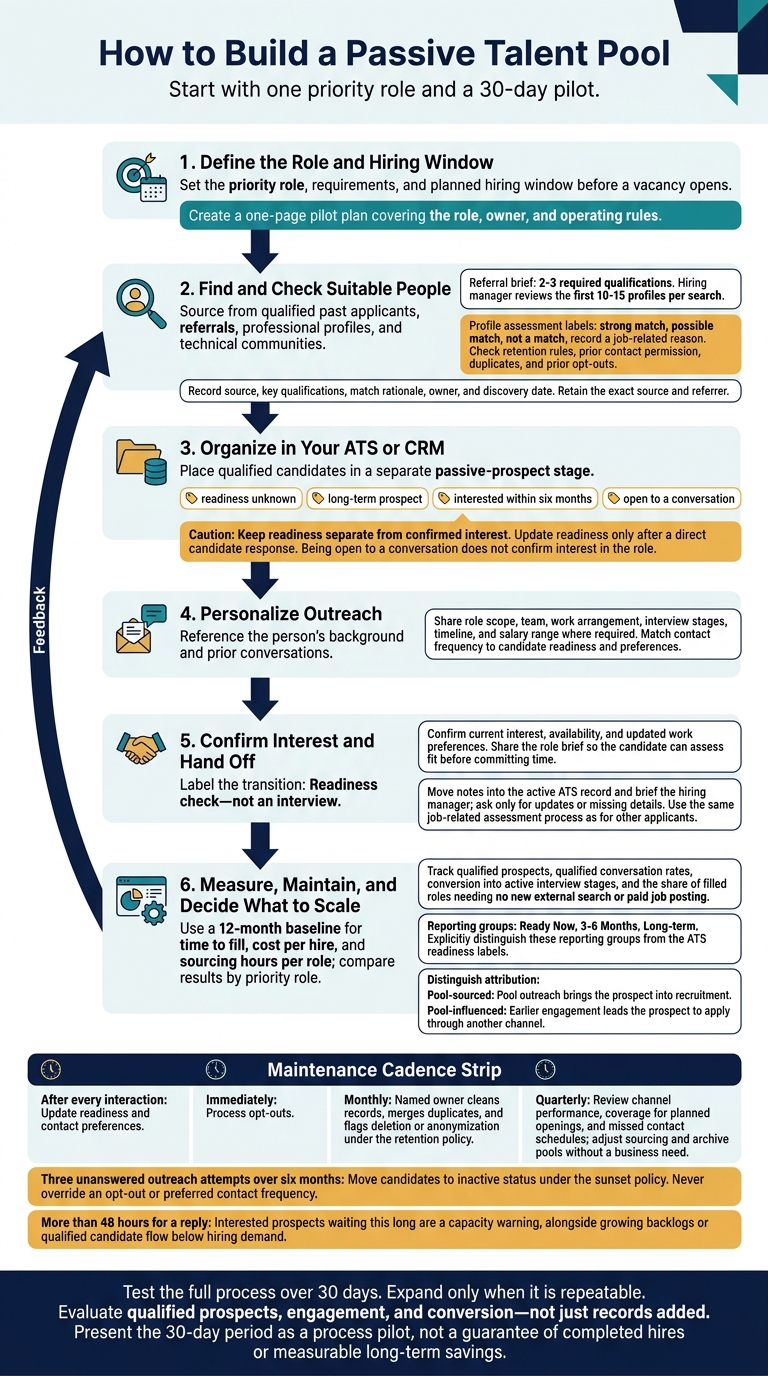
How to Build a Passive Talent Pool
Building Talent Pools and keeping them engaged
sbb-itb-a23bd6a
Find Qualified Passive Candidates
Use the role-planning worksheet to set a sourcing cycle for each priority role before a vacancy opens. Review existing contacts, request referrals, run targeted searches, and screen for fit.
Prioritize fit over volume. A public profile does not confirm availability, interest, or permission for repeated outreach.
Use Past Applicants, Referrals, and Targeted Searches
Start with qualified past applicants, especially late-stage finalists. Review their interview feedback and work samples. Before reusing those records, check retention rules and prior permission to contact them.
Ask employees, alumni, professional networks, industry associations, and technical communities for referrals. Give them a short brief with 2-3 required qualifications. Ask how they know the person and which qualifications they can support. Assess referrals against the same criteria as every other candidate.
Search professional profiles and technical communities using equivalent job titles, required skills, and acceptable adjacent backgrounds. Titles alone aren’t enough. Where relevant, review public work on GitHub as evidence of skills, not willingness to change jobs.
Check Qualifications and Record Sources
Have the hiring manager review the first 10-15 profiles per search before you expand it. They should label each profile as a strong match, possible match, or not a match, with a job-related reason. Use that feedback to refine search terms and the evidence you need, reducing time spent on unsuitable profiles.
Keep confirmed facts separate from unknowns. Do not infer availability, work authorization, or interest.
For each person, record their source, key qualifications, match rationale, owner, and discovery date (Oct 4, 2026). Keep the exact source and referrer rather than grouping them under “online.” Check for duplicates and prior opt-outs before adding anyone.
Use these records to track which channels lead to qualified conversations and hires. Once candidates are qualified, move them into your ATS or CRM for outreach and tracking.
Organize Candidates in Your ATS or CRM
Once you’ve qualified a candidate, move them into a separate passive-prospect stage in your ATS or CRM. This keeps your pipeline organized and helps your team plan follow-ups.
Set Standard Candidate Fields
Use consistent labels for readiness and interest. Standardize readiness with these four labels:
- readiness unknown
- long-term prospect
- interested within six months
- open to a conversation
Use each label to decide the next action, so your team knows how to follow up.
Track Readiness and Confirmed Interest
Keep readiness separate from confirmed interest. Update readiness only when the candidate responds directly, not based on profile changes or social activity.
A candidate who is open to a conversation is still a passive prospect. That label alone does not confirm interest.
Plan Personalized Candidate Outreach
Once a candidate is open to a conversation, move from tracking to engagement. Use CRM or ATS notes to pick up where you left off, rather than starting again. This helps you move qualified passive prospects toward active interest without losing context.
Write Introductions and Follow-Ups
Reference the candidate’s background and how it fits the role. In the first active conversation, share a brief role summary covering scope, team, work arrangement, interview stages, timeline, and salary range where required.
Build follow-ups around previous conversations and recorded notes. Candidates shouldn’t have to repeat their history or career goals, and your team shouldn’t spend time gathering information it already holds.
After the first message, timing matters as much as content.
Match Contact Frequency to Candidate Preferences
Match your contact frequency to the candidate’s readiness and preferences. Don’t push someone into a hiring process before they’re interested.
When they show interest, move from light contact to a readiness check.
Move Interested Candidates Into Active Recruitment
Treat the next step as a readiness check, not an interview. Confirm their current interest, availability, and updated work preferences. Then share the role brief so they can assess the fit before committing time.
Move your notes into the active ATS record and brief the hiring manager on the candidate’s motivations and previous contact. Ask only for updates or missing details to avoid duplicate work. Keep the handoff personal, and use the same job-related assessment process you use for other applicants.
Measure Results and Maintain Your Pool
Once your pool is active, check whether it delivers qualified conversations and faster hires, not just a larger database.
Track Engagement, Conversions, and Hiring Time
Start with a 12-month baseline for time to fill, cost per hire, and sourcing hours per role. Compare results by priority role, and count qualified prospects against that role’s requirements.
Group prospects by readiness for reporting: Ready Now, 3-6 Months, and Long-term. These categories help you report on the pool. They do not change your qualification criteria. Track qualified conversation rates and conversion into active interview stages, keeping denominators consistent.
Measure the share of filled roles that needed no new external search or paid job posting. Keep these two sourcing labels separate:
- Pool-sourced: Pool outreach brings the prospect into recruitment.
- Pool-influenced: Earlier engagement leads the prospect to apply through another channel.
Use the results to decide which pools need pruning, updated records, or more sourcing effort.
Schedule Monthly Cleanup and Quarterly Reviews
Give each priority-role pool a named owner and schedule monthly cleanup. Merge duplicates, update records, and flag records for deletion or anonymization under your retention policy. Process opt-outs immediately, and update readiness and contact preferences after every interaction. This keeps outreach accurate and reporting reliable.
Each quarter, review which sourcing channels deliver the best qualified conversations and hires. Check whether each pool has enough interested prospects for planned openings and which segments have missed their agreed contact schedule. Shift sourcing effort to close those gaps, and archive pools that no longer serve a business need.
Use a sunset policy to move candidates to inactive status after three unanswered outreach attempts over six months. Never let that policy override an opt-out or someone’s preferred contact frequency.
Address Recruitment Capacity Gaps
Check your team’s capacity before adding more names. Review the time spent on sourcing, segmentation, outreach, cleanup, and reporting.
Look for growing backlogs, qualified candidate flow falling below hiring demand, or interested prospects waiting more than 48 hours for a reply. These signals show where extra support is needed to keep hiring on track.
Agree on ownership and reporting responsibilities so pool maintenance stays part of your hiring plan.
Conclusion: Start With One Priority Role
Once you’ve defined your sourcing and nurturing process, start with one priority role. Before adding candidates, create a one-page pilot plan covering the role, owner, and operating rules.
Test the full process over 30 days. Run sourcing, screening, segmentation, and outreach, then move interested candidates into active recruitment.
Expand only when you can repeat the process reliably. After the first cycle, assess qualified prospects, engagement, and conversion, not just the number of records added. Use those results to decide what to scale, fix, or stop.
If your team lacks capacity, contact Rent a Recruiter for embedded recruitment service to build and maintain the pool.
FAQs
How many passive candidates should I keep per role?
There’s no fixed number for a talent pool. Quality and engagement matter more than volume [1].
For smaller businesses, 20 to 50 candidates generally gives you room to build meaningful relationships without stretching your team’s time [2]. For an active pipeline linked to a specific open role, 3 to 8 candidates is typically enough [2].
Let your hiring plan guide the size of your pool. A smaller, engaged group often delivers better hiring results than a large database that has gone cold [1].
How can I nurture candidates without an open role?
Build long-term candidate relationships through regular, useful contact, not repeated hiring pitches. Segment candidates by readiness and role so your outreach matches future hiring needs.
Send brief monthly newsletters or automated check-ins every 90 days. For priority prospects, such as past finalists, schedule one-to-one check-ins twice a year.
Share relevant industry updates, company milestones, or career resources such as salary benchmarks. Keep each message personal, respect candidates’ time, and make opting out easy.
What privacy rules apply to passive candidate data?
Document sourcing criteria for every role to stay audit-ready under EEOC requirements [1]. Record consent status clearly in candidate records to support appropriate data management [2].
Assign clear ownership and audit records regularly to keep them clean and structured. This supports your hiring plans and helps maintain an auditable, equitable recruitment process [1].