If you are still paying 15% to 25% agency fees on every hire, weak employer branding is costing you more than you think.
I’d cut through this fast. For scaling SMEs in SaaS, fintech, engineering, security, insurance, and professional services, the low-cost wins are clear: tighten your employer message, fix your careers page, use employee proof, improve candidate communication, and track what cuts cost-per-hire and time-to-fill. Done well, employer branding can cut cost-per-hire by up to 50%, reduce turnover by 28%, and push offer acceptance to 85% to 95%.
Here’s the short version:
- Start with message control so hiring managers, recruiters, and leaders all say the same thing
- Use low-cost proof like employee stories, reviews, referrals, and clear job ads
- Fix process gaps like slow offers, weak follow-up, and poor onboarding
- Measure business impact through cost-per-hire, time-to-fill, offer acceptance, source mix, and 90-day turnover
- Scale with structure when internal bandwidth starts to slip, including embedded recruitment if hiring demand keeps climbing
For an $80,000 role, a traditional recruitment agency fee can hit $20,000. That is before vacancy cost, team time, and delivery drag. So the point is simple: before you spend more on hiring channels, fix the parts of employer branding that lower spend and improve hiring output.
Below, I’ll break down the parts that matter most, where SMEs usually waste time, and how to build a hiring model that stays clear and cost-aware as volume grows.
Create a Killer EMPLOYER BRAND Strategy for Your Small Business
sbb-itb-a23bd6a
Set the foundation before investing time in channels
Before you put money or time into channels, get the message right first. When leaders and hiring managers say different things, trust starts to slip across the hiring process.[3] One clear message makes every hiring dollar work harder. It also makes lower-cost channels easier to run well.
Define 3 to 5 employer value proposition pillars
Build your EVP around 3 to 5 clear themes that match the day-to-day employee experience. For SMEs, common pillars include learning and career progression, flexibility, ownership and autonomy, mission impact, and compensation transparency.[1]
These pillars give your team a shared script for job ads, outreach, and interviews. They also help cut expectation shock in the first 90 days, when voluntary departure risk is at its highest.[1] The aim is consistency, not polish.
Create a simple messaging guide for hiring teams
A one-page messaging guide can keep everyone aligned. Include your tone of voice, the main points of your company story, and proof points hiring managers can repeat in interviews and outreach.[1]
Once that guide is in place, you can reuse the same language across each hiring touchpoint. That means less rework for recruiters and managers, and a smoother process as hiring volume grows. For companies needing more hands-on support, talent acquisition services for SMEs can help implement these foundations at scale.
10 budget-friendly employer branding tactics that scale
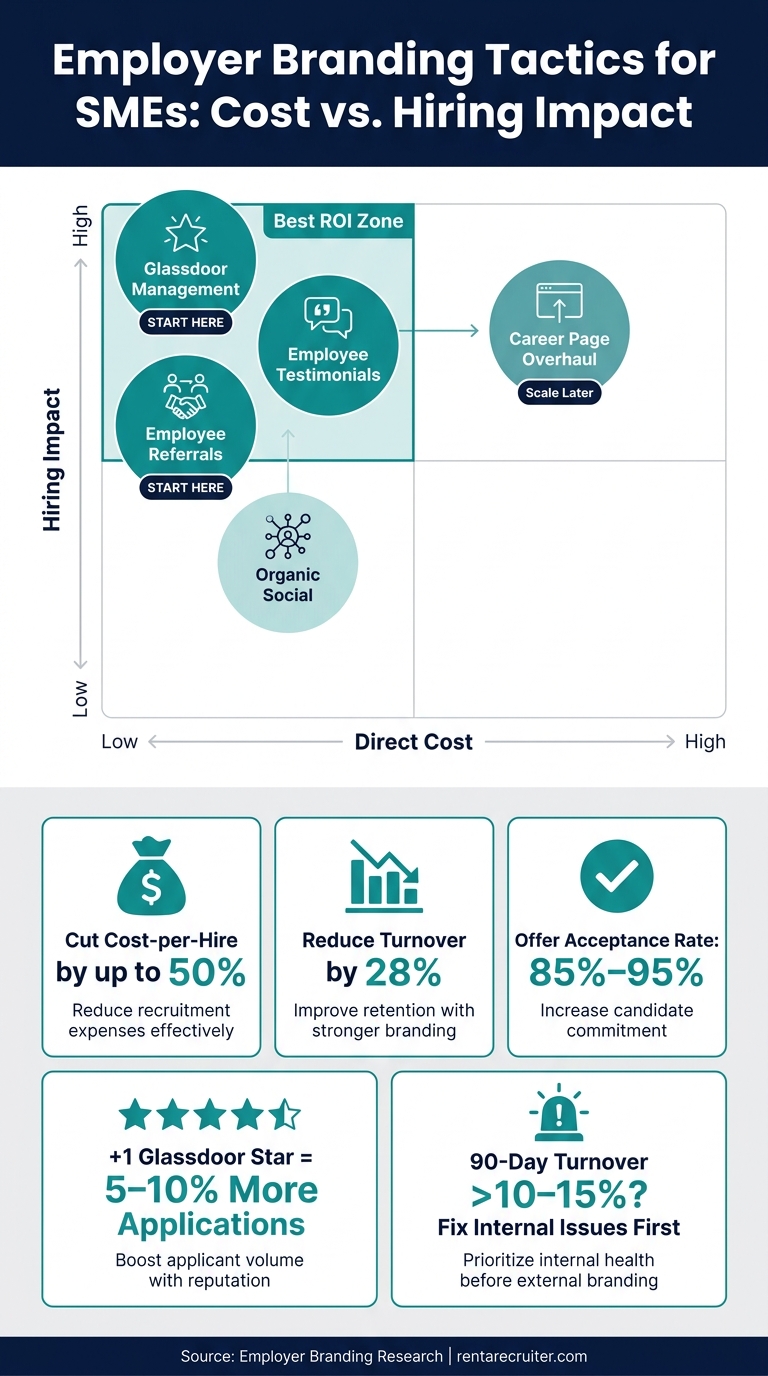
Employer Branding Tactics for SMEs: Cost vs. Hiring Impact
Once your EVP pillars are set and your messaging guide is ready, the next job is simple: put them to work in the places you control.
These tactics sit across three areas: internal, external, and process. Start with low-cost channels and simple steps you can manage without adding headcount, or by using fractional recruitment services. The aim is repeatable proof that helps you hire well as the business grows.
Internal tactics: employee stories, recognition, and manager alignment
Some of the strongest employer brand content comes from your own team.
Written employee spotlights and short smartphone video testimonials are low-cost, easy to produce, and far more useful than polished corporate copy. They show candidates what working at your company actually looks like, day to day.
That matters because people don’t join slogans. They join what they can see and believe.
Manager alignment matters just as much. If one hiring manager describes the business one way and another tells a different story in interview, trust starts to slip before the person even joins. A short manager briefing can keep the message clear and steady across interviews.
What happens after offer acceptance matters too. Structured onboarding, day-one readiness, and written 30/60/90-day plans all back up the promise made during recruitment. In practice, your employer brand is not just what you say in the market. It’s what people experience from offer through the first 90 days.
Use those same proof points again on your careers page and in job ads. One strong story should do more than one job.
External tactics: careers page, job ads, organic social, reviews, and community presence
Your careers page is one of the main assets you fully control. If it reflects your EVP pillars clearly, it makes it easier for the right people to apply and easier for the wrong people to opt out early. That’s good for brand clarity and good for hiring efficiency.
Job ads matter just as much. Honest, specific job descriptions tend to bring in better-fit applicants than polished versions of an imaginary role. Be clear about the job, the team, and the trade-offs. If the role is fast-moving, say so. If the business is still building structure, say that too. Clear messaging saves time on both sides.
For SMEs, this is also a chance to lean into strengths larger employers often struggle to offer at the same level, such as:
- Direct access to leadership
- Clear individual impact
- Faster career progression
Review management is another low-cost lever. A one-star increase in a Glassdoor rating correlates with a 5% to 10% increase in application volume [1]. That is not a small shift. Encourage honest reviews and respond with care. You’re not trying to look perfect. You’re showing that the business listens and takes feedback seriously.
Organic social content and employee advocacy can stretch your reach without paid media spend. When employees share job posts and company updates through their own networks, you gain extra visibility at little cost.
Then the same message needs to show up in every candidate touchpoint.
Process tactics: candidate experience, content reuse, and basic automation
Candidate communication is where employer brand stops being theory and starts becoming experience.
Sending an offer letter within 24 hours of verbal acceptance [2], keeping candidates updated at each stage, and using consistent, professional communication all show that your business is organised and respects people’s time. That has a direct effect on drop-off, acceptance rates, and how your company is talked about in the market.
Basic automation helps here. E-signatures and automated onboarding workflows keep things moving without extra headcount, a common benefit of embedded IT recruitment models. You save time, cut admin, and reduce the odds of things falling through the cracks.
Content reuse is another area where SMEs often lose time. The employee story you filmed for LinkedIn can also become a careers page feature, an interview prep resource, and a social post. One piece of work can support several hiring touchpoints if you plan it well.
Reusable ATS or HRIS templates help keep output consistent. Then track source of hire, keep the channels that bring in qualified applicants, and cut the ones that don’t. If a channel is producing noise instead of hires, it should not keep getting time or budget.
A simple 90-day check-in with new hires can also show whether there is any gap between what was promised and what they actually experienced. That feedback is useful because it helps you fix messaging, tighten process, and protect trust before small issues turn into hiring drag.
Measure what reduces cost and supports growth
Once your tactics are live, track the ones that cut cost and lift hiring quality.
Treat employer branding like an operating lever, not a once-off project. If you can’t measure it, you can’t manage it.
Track metrics linked to hiring efficiency
Track two types of metrics: leading indicators and lagging indicators. Leading indicators show what’s likely to happen next, so review them monthly. Lagging indicators show what already happened, so check them quarterly.
| Metric | What It Measures | Frequency |
|---|---|---|
| Career-page conversion rate | Whether brand messaging turns visitors into applicants | Monthly |
| Glassdoor Rating | Public perception and candidate trust | Monthly |
| Cost-per-Hire (CPH) | recruitment efficiency | Quarterly |
| Time-to-Fill (TTF) | How quickly roles are filled | Quarterly |
| Offer Acceptance Rate | Brand strength at the decision stage | Quarterly |
| 90-Day Turnover | Alignment between brand promise and actual experience | Quarterly |
| Referral Hire Rate | Internal brand health and employee advocacy | Quarterly |
These metrics tell you if employee stories, career-page updates, reviews, and referrals are doing their job.
Before you change anything, set a baseline for cost-per-hire, time-to-fill, offer acceptance, and source mix. That’s your "before" view. Without it, it’s hard to show progress to leadership or make a solid case for more budget. This data is essential when considering a flexible hiring model that scales with your needs.
Use a simple prioritization table for budget decisions
Use these metrics to decide where to keep spending, where to cut back, and where to scale.
When budgets get tight, the issue isn’t what should we do. It’s what should we do first. This table helps you rank the main tactics by time, cost, and likely hiring impact so you can make that call fast.
| Tactic | Time Required | Direct Cost | Likely Hiring Impact |
|---|---|---|---|
| Glassdoor | Low | Low to Medium | High (Volume & Quality) |
| Employee Referrals | Medium | Low | High (Retention/CPH) |
| Employee Testimonials | Medium | Low | High (Trust/Quality) |
| Career page | High | Medium | Very High (Conversion) |
| Organic social | High | Low | Medium (Awareness) |
Start with the lowest-cost, highest-return tactics. Glassdoor management and employee referrals are among the most efficient lower-cost options [1]. Hold off on a full career page update until you have a clearer read on which messages are landing.
Then use the data to tighten the message and put more budget behind the tactics that move the funnel.
The 90-day voluntary turnover rate is one of the clearest checks for any SME running a lean brand effort. If it goes above 10 to 15%, pause the external push and fix the internal issue first [2]. More applications won’t solve a gap between what you promise and what people actually experience.
Build employer branding into a scalable recruitment model
Once you know what works, build it into every stage of hiring. That’s how you keep your message steady as hiring volume grows.
Integrate brand messaging into every hiring touchpoint
Keep your brand message consistent across outreach, interviews, offers, rejections, and onboarding. That consistency matters, because your employer brand is shaped in the first 90 days on the job [2].
Make this easy for your team. Build your EVP pillars into recruiter outreach templates, interview guides, offer language, and onboarding plans, so hiring managers aren’t making it up as they go.
Then back up the message with action. Ready-to-use accounts, working equipment, and clear 30/60/90-day plans show new hires that what you promised during the process matches what they get on day one.
Use embedded recruitment support to scale efficiently
As hiring demand grows, consistency usually slips first. Internal teams get stretched. Messaging starts to vary. Hiring managers fill gaps in their own way. That’s when process drift creeps in.
Embedded recruitment support helps you scale without losing control. It adds structure, keeps hiring aligned, and gives you recruiter capacity inside your team when demand starts to outpace internal bandwidth. You get experienced recruiters working across outreach, interviews, and offers, with one message and one process.
embedded recruitment also makes scaling easier without adding permanent headcount. For CEOs, CFOs, and HR leaders, that means better hiring output without the long-term cost of building a larger in-house team too early.
Rent a Recruiter helps high-growth SMEs keep the recruitment process consistent and repeatable. By placing experienced recruiters directly into your team within days, the service manages hiring end-to-end while bringing structure, visibility, and consistency to how you hire.
Conclusion: start small, measure results, and take the next step
Track the metrics that show whether your model is working:
- Time-to-fill
- Cost-per-hire
- Offer acceptance rate
- Source of hire
- 90-day turnover
If hiring demand keeps climbing, embedded recruitment support can help you keep the process repeatable, on-brand, and easier to manage at scale.
FAQs
What should we fix first?
Start with the candidate and new-hire experience, especially across recruiting and onboarding.
The biggest problem is often the gap between what gets promised during hiring and what people face once they join. When that gap is too wide, early turnover climbs, team time gets wasted, and your employer brand takes a hit.
Your first priorities should be simple and direct:
- Clear role expectations from the start
- A structured onboarding process
- Consistent management once the person joins
- Responsive candidate communication that feels honest and human
Get those basics right, and you cut down on mis-hires, save manager time, and give new hires a better shot at succeeding early.
How soon can we see results?
SMBs often start seeing measurable employer brand results within 3 months, especially in application quality.
With steady effort, the bigger wins, like stronger retention and faster hiring, tend to build over about 12 months.
Simple, low-cost actions can make a clear difference:
- Responding to reviews
- Sharing real stories from your team
- Communicating with consistency
Done well, these steps can help you improve candidate quality and shorten hiring timelines.
When do we need embedded recruitment support?
You typically need embedded recruitment support when your internal hiring capacity can’t keep up with growth.
The signs usually show up fast. Candidate engagement drops. Offer acceptance rates start to slip. The experience candidates get no longer matches the employer brand you’re selling in the market.
That gap costs you.
It can slow hiring, put more pressure on your team, and make it harder to land the people you want, especially in SaaS, Technology, IT, Fintech, Engineering, Security, Insurance, and Professional Services.
This tends to happen during rapid scaling, market expansion, or leadership changes. In those moments, hiring gets messy unless someone owns the process end to end.
An embedded recruiter steps into your team and helps keep things steady. They bring consistency to the process, improve the candidate experience, and keep hiring tied to your company values.
For hiring leaders, that means less drift, better conversion, and more control over hiring outcomes.