
If your employer brand is not helping you fill priority roles, it is adding cost, slowing hiring, and putting growth targets at risk.
I see the fix as simple. You start with business goals, turn them into hiring priorities, shape your employer message around those roles, and track whether it cuts cost-per-hire, improves offer acceptance, and shortens time-to-fill. The article makes one point clear: employer branding should support hiring plans for the next 3 to 12 months, not sit off to the side as a marketing task.
Here is the short version:
- Tie branding to headcount plans, role types, locations, and hiring timelines
- Focus first on hard-to-fill or high-impact roles in SaaS, IT, fintech, engineering, security, insurance, and professional services
- Build EVP pillars around what target hires want, then back them with proof
- Keep messaging steady across job ads, outreach, interviews, offers, and onboarding
- Rate your recruitment process and measure hiring outcomes, including time-to-fill, cost-per-hire, quality of hire, and retention
- Use embedded recruitment if you need more hiring capacity without losing process control
A few numbers stand out. Strong employer brands can cut cost-per-hire by up to 50% and lift qualified applicants by 50%. The article also notes that companies working with Rent a Recruiter can reduce hiring costs by up to 70% and save 80+ hours per month in hiring admin time. For scaling firms, that is not a brand exercise. It is a hiring and cost issue.
If you are hiring against growth targets in the US, Ireland, Australia, or the Middle East, the takeaway is direct: your hiring brand should be built around the roles you need to fill next, and judged by hiring results.
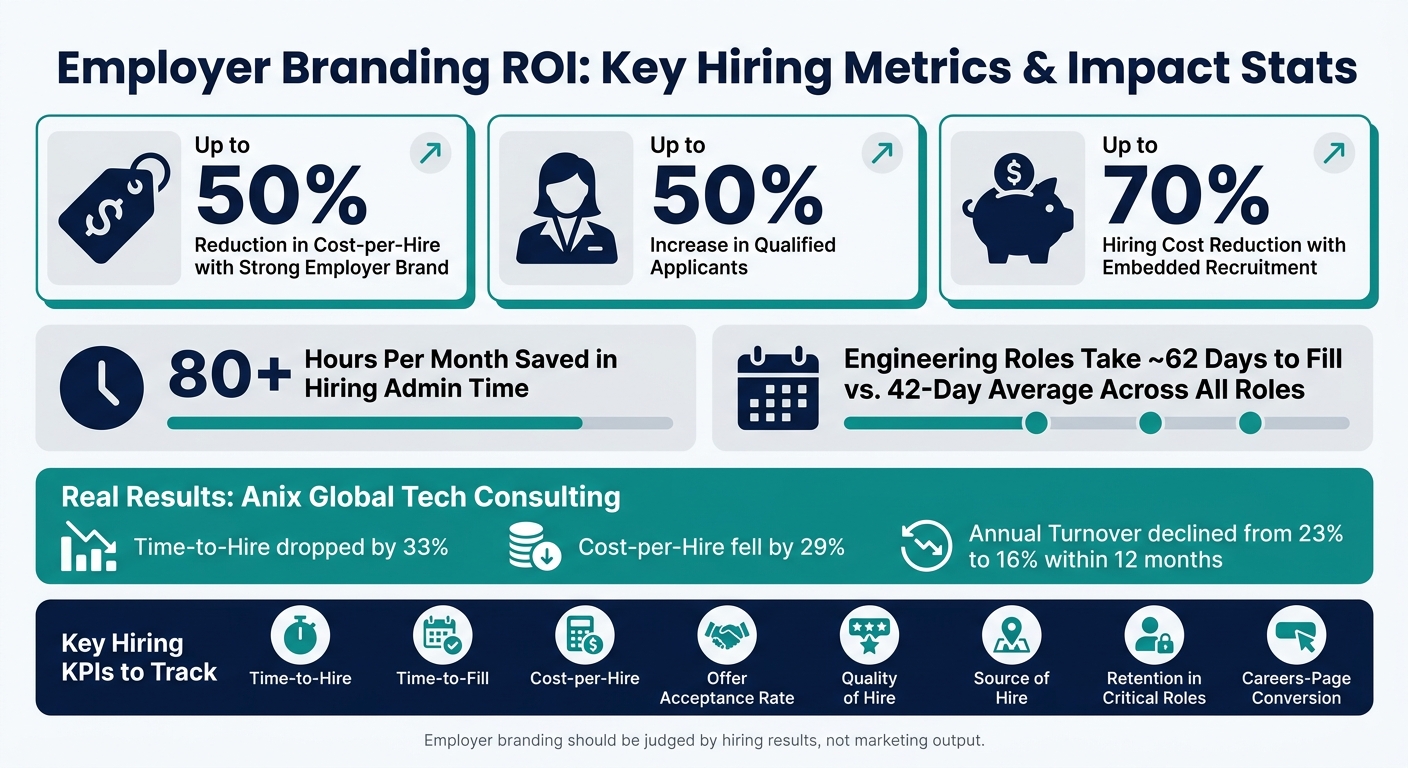
Employer Branding ROI: Key Hiring Metrics & Impact Stats
Build a Winning Employer Brand & Recruitment Marketing Strategy
sbb-itb-a23bd6a
Start with Business Goals and Turn Them into Hiring Priorities
Turn each business goal into the roles, skills, and start dates needed to hit it. Then turn that into a hiring plan your team can use.
Translate Growth Targets into Role, Skill, and Timing Needs
Start by working backward from each business goal. If you want to add $2 million in new ARR, you may need a set number of AEs, SDRs, and customer success managers. If you have a product launch coming up, you may need engineers, a product manager, QA, and UX designers 3 to 6 months in advance.
Break your annual headcount plan into three tracks: sales and marketing, product and engineering, and general and administrative (G&A). For each role, note the seniority level, target start quarter, whether it is a backfill or net-new hire, and which business goal it supports.
That simple step changes the conversation. Instead of a loose headcount list, you get a hiring case your recruitment and brand teams can act on.
Timing matters more than many teams expect. Some roles take longer to fill. Engineering roles can take closer to 62 days to fill, compared with a 42-day benchmark across roles.[3] So if you need a senior engineer fully up to speed by Q3, sourcing and employer brand activity needs to begin well before the role is formally approved.
Identify Which Roles Need Brand Support First
Not every role should get the same level of brand support. Put your effort behind the roles that have the biggest effect on revenue or product delivery. For most scaling SMEs, that usually means software engineers, sales leaders, product managers, and operations leaders.
Use hiring data to decide where to focus first. Watch for patterns like:
- Long time-to-fill
- Low offer acceptance rates
- Heavy reliance on paid job boards for a certain role type
These are signs your employer brand is not pulling enough weight in that part of the market.
As Mark Loughnane, COO of Rent a Recruiter, puts it:
"If EB isn’t on the board agenda, it’s a missed commercial opportunity. Talent attraction today is brand-led, not just process-led." [2]
Choose the two or three talent segments that have the biggest effect on your growth plan. Build messaging around what those people care about. Then track results through pipeline quality and offer acceptance rate for those roles.
Once you know where the pressure points are, you can shape your EVP and candidate messaging around the roles that matter most.
Build an Employer Brand That Matches Your Growth Needs
Audit your current brand against the roles and skills your growth plan needs.
Audit your employer branding strategy and Find the Gaps
Start with the data you already have: employee survey results, exit themes, recruiter notes, offer-decline reasons, careers page analytics, drop-off points, and review site feedback. Look first at the functions that matter most for growth. Then compare what leadership says the company offers with what employees say they live day to day.
The gaps that matter most are the ones tied to hiring outcomes.
If strong candidates apply but only a few move through the process, your messaging may be too broad or too vague. If offers are turned down, your EVP may be weak on flexibility, compensation, manager quality, or growth. If new hires leave in the first six months, your brand may be promising more than the job or company can deliver.
| Audit Input | Current Perception | Desired Perception | Hiring Outcome |
|---|---|---|---|
| Exit interviews | Lack of clear career pathing | High-growth, meritocratic environment | Improved retention of high-performers |
| Online reviews | Perceived as old-fashioned | Tech-forward and flexible | Higher quality of senior engineering applicants |
| Recruiter feedback | Salary is the only talking point | Mission-driven and impactful work | Increased offer acceptance for sales talent |
| Careers page analytics | Low engagement, high bounce rate | Clear EVP with employee testimonials and day-in-the-life content | Higher application rate from passive candidates |
This kind of audit gives you something far more useful than a brand exercise. It shows where hiring friction is costing you time, slowing headcount plans, or hurting retention.
Build EVP Pillars Around the People You Need to Hire
Your EVP should reflect what your target talent values, and you need proof to back it up. In most cases, four to six pillars are enough. Focus on areas like growth and progression, mission and impact, flexibility, manager quality, career development, and ownership and autonomy. Pick pillars you can support with real examples, not wishful copy.
Different functions care about different proof points.
Senior engineers often want technical challenge, autonomy, and strong peers. Sales talent tends to look for market opportunity, clear growth targets, and a believable path to commission or promotion. Operations hires want to see process ownership and cross-functional impact. A single EVP can still work across the business, but the proof and emphasis should shift by function.
| EVP Pillar | Target Talent Group | Hiring Goal Supported |
|---|---|---|
| Growth & progression | Senior engineers, product managers | Attract candidates who want leadership tracks |
| Mission & impact | Sales, marketing | Appeal to purpose-driven, high-performing candidates |
| Flexibility | Tech, admin, remote-eligible roles | Expand the talent pool beyond local geography |
| Manager quality | Junior to mid-level hires | Reduce early turnover and build candidate trust |
| Ownership & autonomy | Operations, product | Attract candidates who want to build, not just execute |
A mid-sized tech consulting firm, Anix Global, built its EVP around innovation, accelerated growth, and global opportunity. The result: time-to-hire dropped by 33%, cost-per-hire fell by 29%, and annual turnover declined from 23% to 16% within 12 months.[4]
That kind of result starts with choosing pillars that match the talent you need to reach, not just the people already on your team.
Keep Employer Messaging Consistent Across the Candidate Journey
Those pillars only work if every candidate touchpoint reinforces the same story. Mixed messaging chips away at trust, especially when candidates are weighing up more than one offer.
Define three to five core messages and repeat them through the full hiring journey. If your brand promise is high impact, fast growth, and supportive leadership, those themes should show up in job ads, outreach, interviews, offers, and onboarding. Keep the message framework simple. Use approved language that recruiters and hiring managers can use without sounding scripted.
| Candidate Journey Stage | Core Employer Message | Hiring Objective |
|---|---|---|
| Job ad | Role impact and growth path | Increase qualified applications |
| Recruiter outreach | Why this opportunity fits the candidate | Improve response rates from target talent |
| Interview | Team culture, manager style, expectations | Build candidate trust and alignment |
| Offer | EVP proof points most relevant to the candidate | Improve offer acceptance rate |
| Onboarding | Deliver on what was promised | Reduce early attrition |
If your company says it offers real ownership, the hiring process has to prove it. Show where people make decisions, shape projects, or influence direction. A slogan on the careers page is not enough.
This matters even more in tight talent markets, where candidates compare role details, manager quality, and growth paths side by side.
Build these messages into hiring briefs, job ads, interviews, and offer conversations so they can scale beyond the brand team. Once the EVP is clear, it should appear everywhere hiring happens.
Embed Branding into a Scalable Recruitment Process
A clear EVP only works when it shows up in day-to-day hiring, not when it sits in a slide deck no one uses.
Standardize Hiring Briefs, Job Ads, Interviews, and Communication
Every role should start with a shared hiring brief. That brief gets everyone on the same page before sourcing begins. It should turn your business plan into a role-specific hiring plan, covering role purpose, 6 and 12-month success metrics, priority EVP pillars, interview structure, and communication standards.
When teams use the same brief, they cut rework, make decisions faster, and stay aligned from the start.
Job ads should follow a set structure for the talent segment your headcount plan targets. That usually means:
- A brand-aligned intro
- Role impact
- Outcome-based responsibilities
- Must-have versus nice-to-have requirements
- A clear USD salary range
- Key benefits like healthcare coverage, 401(k), and remote or hybrid policies
Adjust the emphasis by role, but keep the core message steady. That matters more than many teams think. If each hiring manager rewrites the story from scratch, your market message gets messy fast.
The same goes for interviews and candidate communication. Set clear stages. Build question banks tied to your values. Put response-time standards in place, such as acknowledging applications within 24 hours and sharing final decisions within a set timeframe.
That does two things. It keeps candidates engaged, and it gives your team a hiring process people can trust.
Once those standards are set, the hard part is keeping them steady as hiring volume climbs.
Use Embedded Recruitment to Scale Without Losing Brand Consistency
When internal teams run out of bandwidth, execution is usually the first thing to slip. Briefs get skipped. Messaging drifts. Interview quality drops. Communication slows down.
This is where many SMEs hit trouble during a hiring spike.
An embedded recruitment model deals with that head-on by placing recruiters inside your team. Embedded recruiters keep process discipline in place as hiring volume rises. They use your briefs, messaging, interview framework, and communication standards from day one.
That means the candidate experience stays consistent whether you’re hiring two people or twenty.
Rent a Recruiter embeds experienced recruiters directly into your team within days, managing hiring end-to-end across functions like technology, SaaS, fintech, engineering, and professional services. They also conduct employer branding assessments and recruitment health checks, reviews that spot hiring friction before you scale. Companies working with Rent a Recruiter typically reduce hiring costs by up to 70% while saving over 80 hours per month in internal hiring and admin time [1].
"If EB isn’t on the board agenda, it’s a missed commercial opportunity. Talent attraction today is brand-led, not just process-led." – Mark Loughnane, COO, Rent a Recruiter [2]
That discipline gives you the metrics you need to show whether the process is improving hiring outcomes. For more insights on optimizing your talent strategy, explore The Talent Fix recruitment blog.
Measure Results and Refine the Strategy Over Time
Track a small set of KPIs. Define them once, then review them on a fixed cadence.
Keep your focus on the roles and channels you prioritised earlier, not every hiring metric at the same time. Start with the roles that have the biggest effect on revenue or product delivery.
Track the KPIs That Connect Branding to Hiring Outcomes
| KPI | Definition | Business Goal Supported |
|---|---|---|
| Time-to-hire | Days from first contact to accepted offer | Move qualified candidates through the process faster |
| Time-to-fill | Days from requisition approval to the accepted offer | Accelerate scaling by filling revenue-generating roles faster |
| Cost-per-hire ($) | Total recruiting and branding spend ÷ hires | Reduce hiring cost as a percentage of revenue and free budget for growth |
| Offer acceptance rate (%) | Offers accepted divided by total offers made | Confirm your EVP resonates with target talent |
| Quality of hire | Performance, ramp speed, manager feedback, and 6- to 12-month retention | Improve productivity and long-term value in critical roles |
| Source of hire | Which channel produced each hire, such as the careers page, referrals, or LinkedIn | Identify which branded channels deliver the best ROI |
| Retention in critical roles (%) | Percentage of employees in defined growth roles who stay beyond 12 or 24 months | Validate that your brand reflects the actual employee experience |
| Careers-page conversion (%) | Applications ÷ unique careers-page visitors | Measure whether owned channels are pulling their weight |
Review funnel metrics monthly. Review brand, quality-of-hire, and retention metrics quarterly.
What should you look for? Patterns across KPIs.
A rising time-to-fill paired with a falling offer acceptance rate usually means your messaging is missing the mark with the people you want to hire. Poor quality-of-hire scores, along with early turnover, often point to a brand story that sells the role or culture too hard. That gap costs you twice, first in hiring spend, then in lost time when the role needs to be filled again.
This is why a steady review cycle matters. When you check the data each month and quarter, you spot issues early. You can fix the role pitch, tighten channel mix, or adjust your EVP before a hiring problem turns into a delivery problem.
These KPIs show whether employer branding is improving speed, quality, and cost.
Use the results to double down on the roles, messages, and channels that convert.
Conclusion: Turn Employer Branding into a Measurable Growth Lever
Start with business goals. Build an EVP that matches them. Align your messaging to priority roles. Embed the process into how your team hires. Then review the numbers monthly and quarterly.
Done well, employer branding is not a communications exercise. It’s a growth lever that helps you hire faster, spend smarter, and improve hiring outcomes where they matter most.
If you want a clearer view of your hiring practices and employer branding, Rent a Recruiter’s free Recruitment Health Check provides a personalised PDF report with practical insights.
FAQs
How do I connect employer branding to hiring goals?
Treat employer branding as a core business function, not a last-minute marketing job.
If you want better hiring outcomes, your message to the market has to match what people actually experience once they join. That starts with a clear Employee Value Proposition. It should reflect the real day-to-day employee experience and support your business goals, not just sound good on a careers page.
Then carry that message through every hiring touchpoint. That includes job descriptions, career pages, and candidate communications. When your story is consistent, candidates know what they’re signing up for. That usually leads to better-fit hires, fewer drop-offs, and stronger offer acceptance.
You also need to measure whether it’s working. Track employer branding through hiring metrics that link back to business results, including:
- Offer acceptance rates
- Candidate Net Promoter Score
- New-hire retention
Which roles should get employer brand support first?
Prioritise roles by their direct impact on business commitments and growth.
- Tier 1: must-have roles tied to business success, such as revenue-driving sales hires, engineers needed for key product launches, and compliance roles
- Tier 2 and Tier 3: efficiency-focused roles or positions where short-term workarounds exist
This matters because it keeps your hiring effort focused on business-critical delivery, not noise. When you put the highest-impact roles first, you stay proactive instead of scrambling when pressure builds.
What metrics show if employer branding is working?
Track the metrics that show whether your brand promise is turning into hiring results and business growth.
Focus on:
- Cost-per-hire and time-to-fill
- cNPS and offer acceptance rates
- eNPS and employee referral rates
- Quality of hire and retention at 6 and 12 months
Review these KPIs every quarter.
If candidate or employee scores drop, pay attention. It can point to a gap between what you say externally and what people actually experience during hiring or once they join.
That gap costs you. It can slow hiring, hurt acceptance rates, and push up replacement costs.