
Hiring compliance isn’t optional. For SMEs, getting background checks wrong can lead to fines, lawsuits, and reputational damage.
Here’s the challenge: federal, state, and local laws often conflict. From "ban-the-box" rules to record-sealing laws, staying compliant means navigating a legal maze. And mistakes cost more than you think – defending a single FCRA lawsuit can set you back $50,000 to $150,000, even if you win.
The solution? Structured, repeatable processes. By standardizing your background check workflows, you reduce legal risks, speed up hiring, and prepare your business to scale.
Key Takeaways:
- FCRA compliance: Provide standalone disclosures, written consent, and follow a two-step adverse action process.
- Local laws: Comply with the candidate’s work location laws, not your HQ’s.
- Documentation: Retain records for five years and securely destroy them when no longer needed.
- Tailored checks: Align screening types with job roles to avoid discrimination claims.
If your hiring is ramping up, consider embedded recruitment to manage compliance while cutting costs by up to 70%. Prevention costs less than fixing compliance errors later.
Background Check Disclosure And Consent: What Growing Small Businesses Should Standardize In 2026
sbb-itb-a23bd6a
The Legal and Regulatory Framework for Background Checks
Understanding the laws that govern background checks is the cornerstone of a compliant hiring process. For small and medium-sized enterprises (SMEs) in the U.S., this means navigating a mix of federal, state, and local regulations.
Federal Regulations: FCRA and EEOC Guidelines
The Fair Credit Reporting Act (FCRA) is the leading federal law regulating background checks conducted through third-party Consumer Reporting Agencies (CRAs). It outlines specific employer obligations, including the requirement to provide candidates with a standalone written disclosure before ordering a report. This disclosure must be a separate document, free from liability waivers or unrelated text. Even minor errors, like adding extra lines or skipping steps in the adverse action process, can lead to compliance issues.
"FCRA errors typically stem from minor mistakes, such as an extra line in a disclosure or a skipped adverse action step." – Michael Kendrick, Senior Manager of Corporate Compliance, Cisive [4]
Additionally, Title VII of the Civil Rights Act, enforced by the EEOC, mandates that background screening practices do not unfairly impact protected groups. Employers are advised to apply the "Nature-Time-Nature" test, which considers the nature of the offense, the time elapsed, and its relevance to the job before rejecting a candidate based on a criminal record. Even when using third-party vendors, employers must ensure their processes meet these standards.
"If an employer administers a selection procedure, it may be responsible under Title VII if the procedure has a disparate impact, even if the procedure was designed or administered by an outside vendor." – U.S. Equal Employment Opportunity Commission [11]
Other federal laws also come into play:
- The Americans with Disabilities Act (ADA) prohibits pre-offer medical inquiries.
- The Genetic Information Nondiscrimination Act (GINA) bars employers from requesting genetic or family medical history.
- The Immigration Reform and Control Act (IRCA) requires employers to complete Form I-9 within three business days of a new hire’s start date.
| Federal Law | Key SME Obligation |
|---|---|
| FCRA | Provide standalone disclosure, obtain written consent, and follow a two-step adverse action process |
| Title VII | Ensure screening criteria are job-related and applied consistently |
| ADA | Avoid pre-offer medical inquiries |
| GINA | Do not request or use genetic or family medical history |
| IRCA | Verify Form I-9 within three business days of hire |
These federal requirements form the foundation of compliance, but SMEs also need to navigate state and local laws, which often add more complexity.
State and Local Compliance Considerations
While federal laws set the baseline, states and cities frequently impose their own rules. Importantly, compliance is based on where the employee works, not where the company is headquartered [8]. This is especially relevant for SMEs with remote teams spread across the U.S.
Take "ban-the-box" laws as an example. Over 37 states and 150 municipalities have restrictions on when employers can ask about criminal history [4]. In Maryland, employers can ask about criminal records only after an interview, while in California and New York City, inquiries must wait until a conditional job offer is made [10]. Texas recently joined the movement, enacting its first statewide ban-the-box law in September 2025. This law applies to employers with 15 or more employees and delays criminal history inquiries until after a candidate is deemed qualified [8].
Jurisdictions also vary on lookback periods – the timeframe during which criminal convictions can be reported. While federal law allows indefinite reporting of most convictions, states like California, Massachusetts, and Washington limit reporting to seven years [4]. Philadelphia has gone further, reducing the lookback period for misdemeanors to four years starting in January 2026, while also giving candidates 10 business days to respond to pre-adverse action notices [4][8].
"Clean Slate" laws are another emerging trend. States like Virginia, Pennsylvania, and Michigan now automatically seal certain criminal records, making them inaccessible to background checks even if they exist in databases [8]. Employers must ensure their screening providers comply with these laws by excluding sealed records.
"If you have remote employees, you must follow the background check laws of the state and city where those employees physically work – not where your company is headquartered." – Caitlin Kapolas, Content Creator, Lift HCM [8]
Candidate Privacy and Data Security Obligations
Protecting candidate data is just as important as complying with screening criteria. The FCRA includes specific rules for handling and disposing of background check information. Under the FCRA Disposal Rule, employers must securely destroy sensitive consumer report data, whether by shredding paper documents or permanently deleting electronic files [9][7].
In addition, EEOC rules require SMEs to retain personnel and employment records – including background check results – for at least one year after the record is created or a personnel action is taken, whichever is later [9]. Many experts recommend retaining FCRA-related documents for five years to align with the statute of limitations for certain claims [11]. If a candidate files a discrimination charge, all related records must be preserved until the case is resolved.
Candidates also have rights during the process. If they dispute information in their report, the CRA must reinvestigate within 30 days [7]. These obligations aren’t optional; they are legal requirements with serious consequences for non-compliance.
Types of Background Checks and Their Compliance Requirements
When it comes to background checks, the rules aren’t one-size-fits-all. What’s required depends on the type of check, the role you’re hiring for, and where the candidate will work. Here’s a breakdown of the most common checks and the compliance considerations that come with them.
Identity, Employment, and Credential Verification
I-9 verification is the first step for every new hire. Governed by the Immigration Reform and Control Act (IRCA) rather than the Fair Credit Reporting Act (FCRA), it’s a common area where compliance issues arise. Employers must complete Form I-9 within three business days of a new hire’s start date. While E-Verify is optional for most private employers, it’s mandatory for federal contractors and adds an extra layer of work authorization confirmation.
Employment verification involves confirming job titles, employment dates, and rehire eligibility. If a vendor conducts interviews for this purpose, the resulting investigative consumer report triggers additional FCRA requirements, including providing a separate candidate disclosure within three days [5].
Education and license verification is particularly critical in regulated industries. For example, in sectors like healthcare, it’s essential to confirm licenses directly with the issuing boards rather than relying solely on résumés.
Criminal, Civil, and Credit Checks
Criminal background checks come with strict legal requirements. Under the FCRA, arrests or non-convictions older than seven years cannot be reported for roles paying less than $75,000 annually [4]. State laws add another layer of complexity, with varying lookback periods. For instance, Philadelphia limits misdemeanor reporting to four years [4].
Credit checks are even more restricted. At least 13 states, including California, Colorado, Maryland, and New York, heavily limit or prohibit their use for most hiring purposes [4][3]. New York will introduce additional restrictions starting April 18, 2026 [4]. If your hiring spans multiple states, it’s safest to avoid credit checks unless the role involves clear financial responsibilities.
"A blanket ‘no criminal history’ policy violates EEOC guidance and may violate Title VII through disparate impact." – FirstHR [3]
Civil record checks, which reveal bankruptcies, liens, and civil judgments, must adhere to FCRA disclosure and adverse action procedures. These checks should only be used when directly relevant to the role.
| Check Type | FCRA Triggered? | Key Compliance Risk |
|---|---|---|
| Criminal search (via vendor) | Yes | Ban-the-Box timing; lookback limits |
| Credit report | Yes | Prohibited in 13+ states for most roles |
| Civil records | Yes | Standard disclosure and adverse action process |
| I-9 / E-Verify | No (Federal Law) | Must be completed within 3 days of hire |
| Education/License verification | Yes | Investigative report rules if references are interviewed |
Role-Specific and Industry-Specific Checks
Certain checks are only defensible when they align closely with the role’s requirements. Motor Vehicle Record (MVR) checks are a prime example. For roles involving driving or fleet management, MVR checks are often required under Department of Transportation regulations [4]. However, running an MVR check on a software developer could lead to claims of discrimination.
In healthcare, verifying professional licenses and running sanctions checks are non-negotiable. Employers must check databases like the OIG’s List of Excluded Individuals and Entities, maintained by the Centers for Medicare & Medicaid Services (CMS) [12]. Hiring a sanctioned provider, even by mistake, can result in severe penalties.
As background checks evolve, new technologies bring their own compliance challenges. AI-assisted screening tools must comply with strict regulations, including audits for bias and data retention for four years under laws like Illinois House Bill 3773 (effective January 1, 2026) and similar rules in California and Colorado [1][2]. Employers are responsible for the outcomes of their vendor’s AI tools, not just their internal decisions.
"If a background check is relevant to a role, apply it consistently to every candidate for that role. This helps reduce bias risk and ensures your process is easier to defend." – Jenna Phipps, Author, Checkr [1]
The key takeaway? Define a clear, standardised set of checks for each role before you start hiring. Inconsistent application – like running credit checks for some candidates but not others in the same role – can quickly lead to legal trouble, even if each individual check complies with regulations. A tailored, consistent approach ensures your screening process aligns with broader compliance requirements.
Building a Compliant Background Check Policy for SMEs
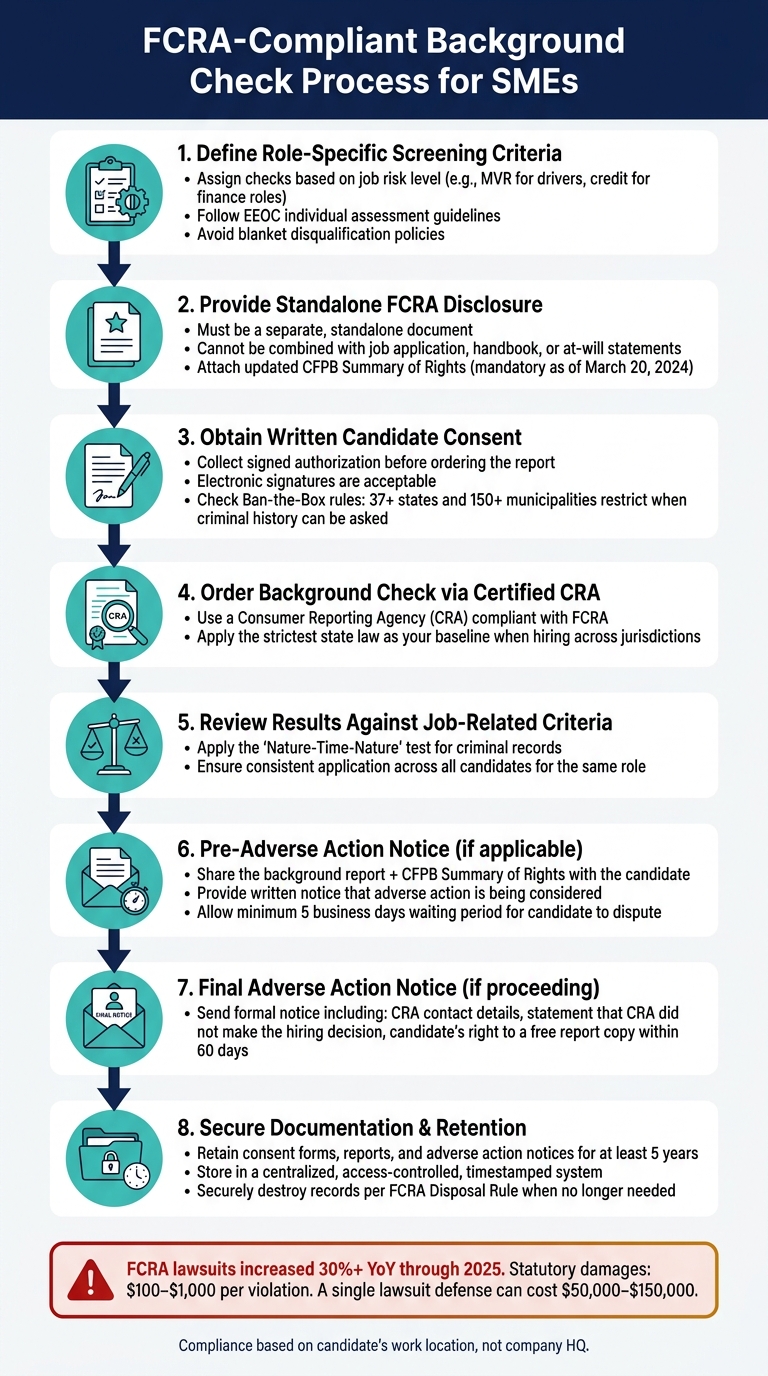
FCRA-Compliant Background Check Process for SMEs
A written screening policy helps reduce risks and ensures consistency in hiring decisions. Developing this policy involves turning legal requirements into practical steps.
Defining Screening Criteria by Role
Organize roles by their associated risks and assign specific background checks to each. Consistency is key to avoiding legal issues. For instance, a financial analyst might require a credit check (if allowed by state law) and employment verification. A delivery driver may need a Motor Vehicle Report (MVR) check, while a software engineer might only need identity, employment, and criminal history verification.
Avoid blanket disqualification policies. Instead, follow the Equal Employment Opportunity Commission (EEOC) guidelines by conducting individual assessments for criminal history findings. Consider factors such as the nature of the offense, the time since it occurred, and its relevance to the job before making a hiring decision [13].
Candidate Communication and Consent
Before requesting a background report from a Consumer Reporting Agency (CRA), provide the candidate with a standalone disclosure and obtain written consent. This disclosure must be a separate document, not part of a job application, employee handbook, or at-will employment statement. Even a single extra sentence can cause compliance problems.
To stay compliant, avoid combining Fair Credit Reporting Act (FCRA) disclosure language with other text. Use a one-page standalone form, which can include an electronic signature, and attach the current Consumer Financial Protection Bureau (CFPB) Summary of Rights. As of March 20, 2024, this updated document is mandatory [13]. Additionally, if hiring in one of the over 180 jurisdictions with Ban-the-Box laws, delay any criminal history inquiries until after an initial interview or a conditional offer [2][14].
Once you have the candidate’s consent, follow the required steps for adverse action to remain compliant.
Adverse Action Procedures and Documentation
The adverse action process is one of the most overlooked parts of FCRA compliance, but skipping it can be costly. FCRA-related lawsuits increased by more than 30% year-over-year through 2025, with statutory damages ranging from $100 to $1,000 per violation – even when no actual harm is proven [2].
Here’s what the adverse action process requires:
- Pre-adverse action notice: Share the candidate’s background report, the CFPB Summary of Rights, and a notice explaining that adverse action is being considered.
- Waiting period: Allow at least five business days for the candidate to dispute inaccuracies or provide additional context before making a final decision.
- Final adverse action notice: Send a formal notice that includes the CRA’s contact details, a statement clarifying that the CRA did not make the hiring decision, and information about the candidate’s right to request a free copy of their report within 60 days.
For example, one auto parts supplier faced a $950,000 settlement for using disclosure forms with unnecessary language [4]. This highlights the financial risks of cutting corners in compliance.
"The most commonly skipped duties are numbers 3 through 5: the adverse action sequence. Small businesses that run background checks but skip the adverse action process when they find negative results are violating FCRA every single time." – FirstHR [3]
To protect against discrimination claims, document the job-related reasons for rejecting any candidate. Retain consent forms, background reports, and adverse action notices for at least five years in a secure, access-controlled system. When these records are no longer needed, dispose of them securely by shredding paper copies or permanently deleting digital files, as outlined in the FCRA Disposal Rule [6][7].
Scaling Background Check Compliance as Hiring Grows
As your hiring volume increases, ensuring compliance in background checks becomes more complex. While manual checks might work for a small team, they quickly become a liability when you’re hiring across multiple locations, roles, and recruiters. To scale effectively, you need a system that combines automation with expert oversight.
Building a Repeatable Background Check Workflow
To stay compliant, your background check process must be seamless and integrated into your hiring workflow. The ideal setup? Automated triggers that initiate checks without relying on someone to remember. Embedding these checks into your Applicant Tracking System (ATS) or HRIS ensures they happen at the right stage, eliminating manual errors.
Start by creating role-specific screening packages. Instead of applying the same checks to every hire, tailor them to the role and document the business rationale for each. This approach not only speeds up hiring but also strengthens your audit readiness. When hiring across jurisdictions, use the strictest state law as your baseline to ensure compliance everywhere.
Centralized documentation is another must. Store all authorizations, disclosures, and adverse action notices in a single, timestamped system. This way, if a compliance issue arises, your team can quickly access the necessary records without scrambling.
Once automation is in place, make sure your team understands the compliance rules they’re working within.
Training Hiring Teams on Compliance Basics
Compliance can falter when hiring managers operate without a clear understanding of the rules. As Mitratech aptly put it: "Compliance breaks down when hiring speed outpaces the system supporting it." [15]. Training your team on the most error-prone compliance steps is critical.
Focus on key areas like when to ask about criminal history, how to handle standalone FCRA disclosures, and the proper sequence for adverse actions. Real-world examples highlight the risks of skipping training. For instance, in 2026, a major online retailer faced a $5 million settlement for bundling background check disclosures with other application materials – a mistake that basic training could have prevented [5]. Similarly, The Salvation Army settled for $1.87 million due to improper language in disclosure forms [5].
Regular training updates are equally important. For example, the Illinois Clean Slate Act, effective June 30, 2026, will automatically seal around 1.74 million criminal records [2], impacting what appears on background checks. Annual refreshers ensure your team stays informed on such changes.
While training and automation are vital, having recruitment experts on hand can take compliance to the next level.
Using Recruitment Expertise to Support Compliance
When hiring ramps up, keeping every step compliant can overwhelm internal teams. It’s not just about knowing the rules – it’s about having the capacity to apply them consistently across all hires. This is where expert recruiters come in.
Rent a Recruiter embeds experienced recruiters into your team to manage hiring end-to-end, ensuring compliance at every stage. They build workflows that align with shifting regulations, such as New York State’s credit history restrictions (effective April 18, 2026) or updated ICE I-9 enforcement standards starting March 2026. By handling the administrative load, they free up your team while maintaining compliance standards.
As Mitratech noted: "Defensible background screening isn’t about reacting well in the moment. It’s about building a process that’s designed to be explained." [15]. With structured, audit-ready processes in place, your hiring can scale without compromising on compliance.
Conclusion: Staying Compliant While Scaling Your Hiring
Background check compliance isn’t a one-and-done task. It’s a continuous process that requires consistent effort, thorough documentation, and staying on top of evolving regulations. Recent FCRA lawsuits have made it clear: the cost of non-compliance is real, no matter your company’s size.
To stay on the right side of compliance, focus on the essentials: work with a certified Consumer Reporting Agency, ensure standalone disclosures and written consent, follow the two-step adverse action process, and apply screening criteria consistently. As Vetty explains, "Effective compliance hinges on proper sequencing, documentation, and handling exceptions." [6]
For many SMEs, it’s not the lack of knowledge but operational pressures that lead to compliance missteps. Annual audits of disclosure forms, tailored screening packages for specific roles, and centralized recordkeeping are key to building a defensible process. This not only reduces risk but also creates a strong foundation for scalable hiring.
If your hiring is ramping up and your team is feeling the strain, Rent a Recruiter can embed experienced recruiters directly into your team. They’ll manage hiring end-to-end, ensuring compliance at every step while helping you scale efficiently. By adopting this approach, you’ll achieve the structure and consistency compliance demands while cutting hiring costs by up to 70%.
"Prevention is dramatically cheaper than defense." – FirstHR [3]
This simple truth is a powerful reminder: addressing compliance now is far less expensive than dealing with the fallout of a misstep later.
FAQs
Which state or city’s background check laws apply for remote hires?
For remote hires, the laws governing background checks are typically based on the state and city where the employee will physically work. These regulations can differ significantly, so your HR team needs to follow the rules specific to the candidate’s location, rather than those of your company’s headquarters. To make compliance easier, many employers choose to align their processes with the most restrictive state laws within their operational reach. Rent a Recruiter can assist in simplifying and managing this process efficiently.
What’s the correct FCRA adverse action timeline, and how long should I wait?
Under the Fair Credit Reporting Act (FCRA), employers must follow a two-step notification process before taking any adverse action based on a background check. First, you need to send a pre-adverse action notice, which includes the background report and a copy of the Summary of Your Rights under the FCRA. After that, give the candidate a chance to review the report and dispute any errors. While the FCRA doesn’t set a specific timeframe, allowing at least five business days is a standard practice. Be sure to check if your state or local laws impose stricter requirements.
Which background checks should I run for each role without increasing discrimination risk?
Consistency is key when it comes to reducing discrimination risks during candidate screening. Tailor your screening practices to the specific requirements of each role:
- Office roles: Conduct criminal history and identity verification.
- Driving positions: Include motor vehicle record checks.
- Financial roles: Perform employment verification.
Steer clear of blanket policies, such as automatically disqualifying candidates with a criminal record. Instead, carry out individualized assessments for any negative findings. Evaluate the relevance of the issue to the job and document your decisions thoroughly to align with EEOC guidelines. This approach not only ensures fairness but also protects your organization from potential compliance issues.