Auditing job descriptions for bias isn’t just about fairness, it directly impacts your ability to attract top talent, reduce hiring costs, and avoid legal risks. Biased language and unnecessary barriers can shrink your applicant pool, discourage diverse candidates, and lead to costly turnover or lawsuits. For scaling companies, fixing this can mean faster hiring, better teams, and significant cost savings.
Key actions to remove bias:
- Build a diverse review team (HR, hiring managers, DEI specialists).
- Identify and replace problematic language (e.g., "rockstar", "native English speaker").
- Separate "required" and "preferred" qualifications to avoid discouraging applicants.
- Use tools like Gender Decoder or Textio to detect exclusionary phrases.
- Focus on skills and outcomes instead of physical or overly specific requirements.
Why it matters:
A study found that removing gender-coded language boosted application rates by 29% and cut cost-per-application by 41%. Companies like Google have faced multimillion-dollar lawsuits over biased hiring practices. Addressing these issues isn’t optional – it’s a competitive advantage.
To ensure your hiring process is bias-free, start with your job descriptions. If time or expertise is a challenge, consider external support like Rent a Recruiter for a free Recruitment Health Check. It’s a simple way to identify hidden bias and improve hiring outcomes.
Upgrade Your Job Descriptions: Bias-Free Recruiting with Diversity & Inclusion AI Tools!
sbb-itb-a23bd6a
Getting Ready to Audit Your Job Descriptions
Preparing properly before diving into a job description audit is key. Without a thorough approach, it’s easy to overlook subtle biases or apply inconsistent standards. A good starting point is assembling a team with varied perspectives to ensure no stone is left unturned.
Build a Review Team with Different Perspectives
It’s essential to have at least one other person review each job description [6]. A well-rounded review team should include HR professionals, hiring managers, and EEO-trained colleagues [6]. Each member brings a unique perspective: HR ensures legal compliance, hiring managers focus on the role’s practical needs, and DEI specialists can identify subtle, coded language that others might miss. For instance, one tech company discovered that using the term "hackers" in job titles led to fewer than 2% of applicants being women [6].
Establish a standardized approval process where each team member reviews postings for inclusivity and compliance. This approach ensures consistency across all job advertisements, whether you’re recruiting for a technical role or customer support [6].
Set Clear Standards for What Counts as Bias
Define clear and measurable criteria to identify biased language. Common categories include gender-coded terms (like "rockstar" or "dominant"), age-related phrases (such as "digital native" or "recent graduate"), ableist language, and phrases that exclude certain groups (e.g., "native English speaker") [5][3]. Additionally, distinguish between essential job functions and unnecessary physical requirements. For example, instead of asking, "Can someone lift 50 lbs.?" consider, "Does this role involve moving materials up to 50 lbs.?" [6].
Another crucial step is clearly separating "required" qualifications from "preferred" ones. Research shows that women are much less likely to apply for a job if they don’t meet 100% of the listed requirements [6]. Blurring the line between these categories can unintentionally discourage qualified candidates from applying.
Collect All Current Job Descriptions
Gather all active job descriptions to review them systematically. This includes listings on your careers page, postings on job boards, and any templates hiring managers use to draft new descriptions.
As you collect these documents, look for recurring patterns. Bias often creeps in through recycled templates, internal jargon, or vague phrases like "culture fit" [1]. You may notice that certain departments or roles tend to have more problematic language – this insight helps you prioritize your efforts.
Begin by reviewing job titles. Replace gendered terms like "Chairman" or "Salesman" with neutral alternatives such as "Chairperson" or "Sales Representative" [3]. Standardize pronouns across all descriptions, opting for "they/their" or "you" instead of "he/she" or "his/her" [3]. These small changes can result in immediate, noticeable improvements [3].
How to Find and Fix Bias in Job Descriptions
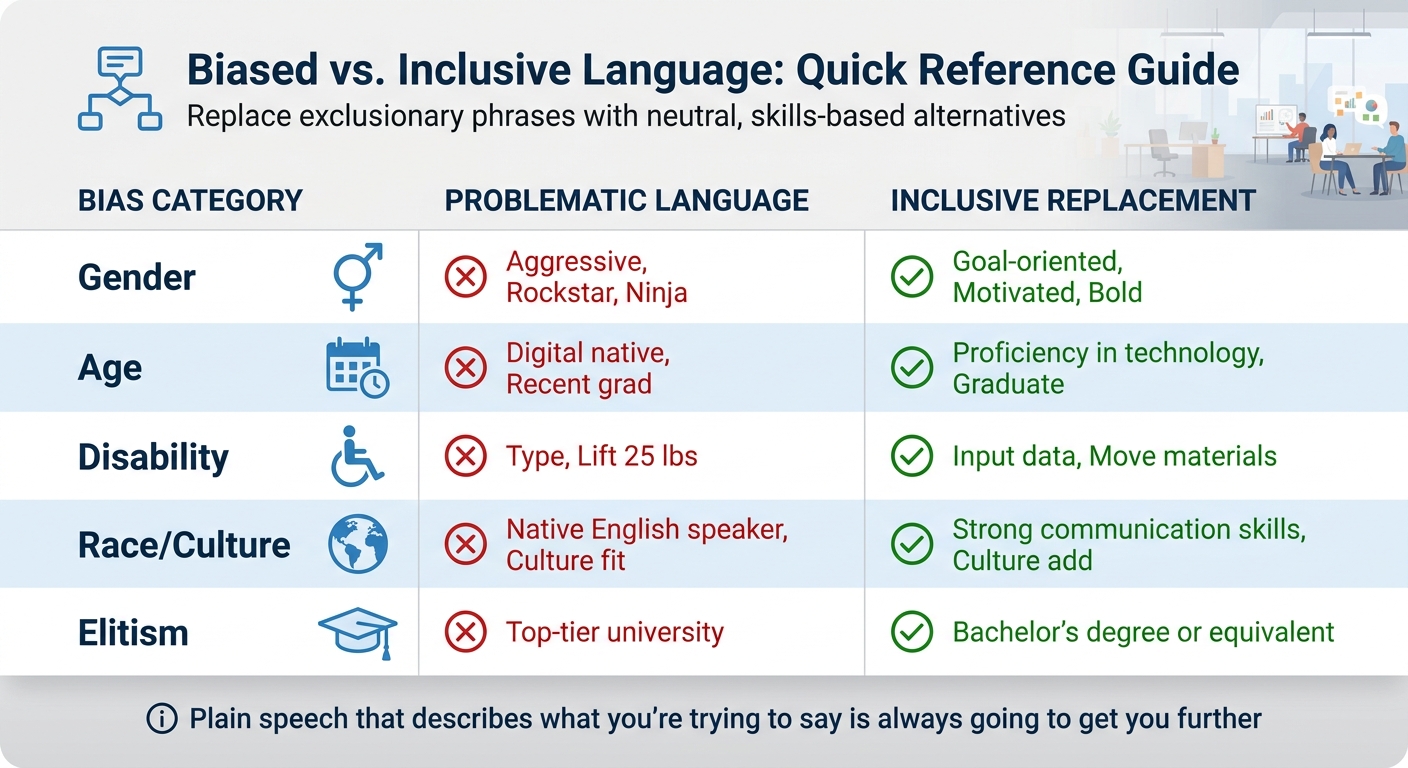
Biased vs Inclusive Job Description Language Guide
Once you’ve set clear standards and embraced diverse perspectives, the next step is to identify specific language issues. This involves spotting words, requirements, and signals that might unintentionally exclude qualified candidates.
Check for Biased Words and Phrases
Start by identifying gender-coded language. Words like "aggressive", "dominant", "rockstar", or "ninja" often discourage female candidates. Instead, use neutral terms such as "goal-oriented", "motivated", or "bold." Also, replace gendered job titles like "salesman" with "salesperson" and "chairman" with "chairperson."
Age-related bias can also creep in. Phrases like "digital native", "recent college grad", or "energetic" may suggest a preference for younger candidates. For example, in 2014, Dale E. Kleber sued CareFusion after not being interviewed due to a requirement limiting experience to "3 to 7 years (no more than 7 years)" – a restriction interpreted as age discrimination [3]. Instead of focusing on age, highlight the skills needed, such as "proficiency in current social media platforms."
Ableist language is another area to watch. Terms like "type", "speak", "see", "lift", and "carry" can exclude candidates who use assistive technologies. Replace these with outcome-focused alternatives like "input data" instead of "type", "communicate" instead of "speak", and "move materials" instead of "lift."
"An easy definition of unconscious bias is when you unintentionally exclude (and often offend) someone."
Be mindful of culturally insensitive language, too. Phrases such as "native English speaker", "culture fit", or technical terms like "master/slave" can alienate or offend. Instead, clarify the actual requirements – use "strong written and verbal communication skills" instead of "native English speaker", and consider "culture add" or "values fit" to highlight the value of diverse perspectives.
Here’s a summary of common biases and inclusive alternatives:
| Bias Category | Problematic Word/Phrase | Inclusive Replacement |
|---|---|---|
| Gender | Aggressive, Rockstar, Ninja | Goal-oriented, Motivated, Bold |
| Age | Digital native, Recent grad | Proficiency in technology, Graduate |
| Disability | Type, Lift 25 lbs | Input data, Move materials |
| Race/Culture | Native English speaker, Culture fit | Strong communication skills, Culture add |
| Elitism | Top-tier university | Bachelor’s degree or equivalent |
After addressing problematic words, focus on making job requirements more inclusive.
Review Job Requirements for Unnecessary Barriers
Examine qualifications to ensure only essential criteria are included. Separate "required" qualifications from "preferred" ones to avoid unintentionally narrowing your candidate pool.
Avoid elitist criteria that don’t directly impact job performance. For instance, requiring degrees from "top-tier universities" or high GPAs can exclude candidates from less privileged backgrounds or those who worked while studying. Similarly, imposing strict experience caps may discourage older applicants. Vague terms like "culture fit" can also reinforce bias.
"Plain speech, really describing what you’re trying to say, is always going to get you further" [2].
Research highlights another layer of bias: job applicants with Black-sounding names are 10% less likely to get callbacks compared to those with White-sounding names for the same roles [3].
Once you’ve refined job requirements, check if the way you describe work expectations supports inclusivity.
Look for Signals About Workplace Flexibility
How you frame work expectations can shape how candidates perceive the role. Avoid terms like "fast-paced", "fast-moving", or "constant high energy" unless you explain what they mean. If the role involves tight deadlines, provide specific examples of workflows instead of relying on vague buzzwords.
Use inclusive terms such as "parental leave" to reflect diverse family structures. For physical requirements, include flexibility. For example, instead of "must be able to lift 50 lbs", say "ability to move materials up to 50 lbs, with or without reasonable accommodation." Similarly, replace "seated at a desk" with "remain stationary for extended periods" to better accommodate different physical needs.
Using Data and Technology to Measure Bias
Once you’ve updated your language and qualifications, it’s crucial to evaluate the results. Data and technology can help you determine if your job postings are attracting a broader, more diverse pool of candidates and whether your hiring process is treating applicants equitably by adopting the future of recruitment services.
Run Blind Application Reviews
Blind reviews are a practical way to assess how certain requirements impact your hiring outcomes. By anonymizing applications, you can identify whether criteria like "years of experience" or "prestigious university" are unfairly excluding qualified candidates from diverse backgrounds.
One effective method is the "Substitution Test", where you create identical resumes with different names – like "James" and "Jennifer" – and evaluate them against your hiring criteria. If identical qualifications lead to different outcomes based on perceived identity, it’s a sign that bias may be embedded in your process.
You can also test for bias in your "ideal candidate" profile by prompting AI tools with gendered pronouns. For example, if the AI describes "he" as having "technical authority" but "she" as a "strong communicator", your job descriptions may need revision to focus more on skills and behaviors rather than stereotypes [9].
Technology can further enhance your ability to detect and address bias.
Use Software to Detect Biased Language
AI tools like Ongig and Textio are designed to scan job descriptions for thousands of exclusionary phrases related to gender, race, age, disability, and mental health. Even free tools like Gender Decoder can help identify gender-coded language patterns [7][8].
Consider these findings: a 2021 Appcast study of 473,742 job postings showed that removing gender-coded language led to a 29% increase in application rates and a 41% reduction in cost-per-application [8]. Gender-neutral job descriptions were also filled an average of two weeks faster than those with biased language [8].
Track key metrics like application completion rates, time-to-fill, and the demographic composition of your applicant pool to measure the impact of your changes. Additionally, ask your ATS vendors for bias audit reports. Some systems may unintentionally introduce bias by giving implicit weight to names, educational institutions, or career paths [9].
Documenting Results and Making Changes
Create a Table of Bias Findings
Once you’ve completed your audit, it’s time to organize your findings into a clear, actionable format. Create a structured report that categorizes each issue by job title, specific language used, and its severity. Break this down further into categories such as gender, age, race, disability, LGBTQ+, and neurodiversity. This helps identify recurring patterns across your organization’s hiring materials [5][8].
To track progress, document changes using a before-and-after approach. For each instance of biased language, include the original phrase alongside its neutral replacement. This makes it easy for hiring managers to see what has been improved. Add an inclusivity score for each job description to provide a measurable starting point for future comparisons [5][9].
Don’t stop at job descriptions – extend your audit to interview rubrics and evaluation scorecards. Look for areas where "requirements inflation" might be occurring, such as overly specific degree requirements or excessive years of experience, which could unintentionally exclude qualified candidates from diverse backgrounds [8].
This detailed documentation sets the stage for revising and testing your job descriptions effectively.
Rewrite Job Descriptions and Test the Results
With your findings in hand, focus on revising your job postings. Replace biased terms with neutral, skills-based alternatives. For example, swap out terms like "rockstar" or "ninja" for "skilled professional." Instead of "digital native", use "proficient with digital tools" to avoid age-related bias. Similarly, reframe physical requirements like "must be able to lift 25 lbs" into results-oriented language such as "move equipment as needed" [5][8].
After making these changes, monitor key metrics like application volume, demographic diversity, completion rates, and time-to-fill. This data will help you confirm whether your revisions are creating a more inclusive hiring process [8].
To maintain consistency, establish a quick review process for new job postings. Dedicate 20 minutes to tasks like running a gender decoder and applying a skills-based rubric. This ensures each posting uses inclusive, bias-free language before going live [9].
Getting Expert Help with Inclusive Hiring
Once you’ve completed your audit, bringing in expert support can help you move faster toward inclusive hiring practices.
Rent a Recruiter‘s Free Recruitment Health Check
Auditing for bias requires both time and expertise, which many growing companies simply don’t have. Even well-meaning managers can miss subtle biases hiding in plain sight[9].
External recruitment experts bring an impartial perspective and leverage advanced tools to identify 12 types of bias, including those related to gender, age, race, disability, LGBTQ+ status, and elitism. They also suggest neutral language updates, like swapping "salesman" for "salesperson" or "maternity leave" for "parental leave"[5][3].
Rent a Recruiter provides a free Recruitment Health Check to help you assess your hiring processes and employer branding. You’ll receive a tailored PDF report highlighting bias patterns and offering actionable recommendations to improve inclusivity[9].
For companies scaling in sectors like technology, SaaS, fintech, and professional services, this kind of external guidance can fast-track progress that might otherwise take months. Specialists stay on top of evolving language trends and help shift hiring conversations from subjective "culture fit" to objective, skills-based evaluations[9][3].
"Wouldn’t you prefer to find any bias before your candidates do!?" – Rob Kelly, CEO of Ongig[3]
Addressing bias isn’t just the right thing to do – it also sharpens your competitive edge in the hiring market. With expert advice, you can make your recruitment process both fairer and more effective.
Conclusion
Auditing job descriptions for bias is an ongoing effort that plays a key role in creating a fairer and more effective hiring process. The steps are clear: bring together a diverse review team, eliminate biased language and unnecessary barriers, and keep track of your progress. This approach doesn’t just promote fairness – it also gives your business a competitive edge.
By removing bias from job descriptions, you can widen your talent pool, enhance your employer brand, and attract top-tier candidates. Traditional metrics like years of experience or specific degrees often fail to predict job performance as effectively as structured interviews or work samples[2][4].
Start with your most frequently used job descriptions and apply the audit process outlined above. Focus on cutting out gendered language, inflated qualifications, and technical jargon that might deter qualified candidates. Use inclusive language for benefits and physical requirements, and consider including salary ranges to build trust with underrepresented groups. After refining your job descriptions and watching recruitment webinars, seeking external feedback or reading recruitment insights can help you make even faster progress.
For scaling companies, Rent a Recruiter provides a free Recruitment Health Check to help identify and address bias in your hiring process. This service offers tailored, actionable recommendations that can help you attract a diverse range of top talent, all while saving time and cutting costs.
FAQs
How often should we audit job descriptions for bias?
Job descriptions should be reviewed regularly to ensure they remain accurate, inclusive, and free from bias. While there’s no hard rule on how often to do this, aiming for at least an annual review – or whenever your business undergoes major changes – is a solid approach. These audits not only promote diversity and fairness but also ensure your hiring practices stay aligned with your company’s evolving goals and values.
What qualifications should be required vs preferred?
Required qualifications are the must-haves. These include essential skills, experience, or certifications that a candidate needs to perform the role effectively. Examples might be a specific technical certification, a set number of years in a relevant role, or proficiency in a particular programming language.
Preferred qualifications, on the other hand, are the nice-to-haves. These traits or skills can give candidates an edge but aren’t deal-breakers if missing. Think of things like familiarity with a specific software tool or strong interpersonal skills.
By clearly distinguishing between these two categories, you can create job descriptions that are more inclusive and reduce bias. This approach broadens your talent pool, making it easier to attract candidates from diverse backgrounds.
How do we measure if changes reduce bias?
To determine whether changes in job descriptions are reducing bias, start by using tools designed to identify gender-coded terms and other potentially exclusionary language. These tools can highlight areas where adjustments are needed.
Next, monitor metrics like adverse impact ratios, such as the Equal Employment Opportunity Commission‘s (EEOC) "80% rule". This helps you compare application or hiring rates across different demographic groups, ensuring fairness in the process.
Finally, make it a habit to regularly review these metrics. Use the insights to refine your language further, ensuring your efforts are actively minimizing bias and fostering inclusivity.