Hiring the right talent is no longer a guessing game. For scaling companies, analytics transforms recruitment into a precise, data-driven process. It reduces costs, speeds up hiring, and improves outcomes by using tools like predictive analytics and AI to identify top candidates, identify gaps and uncover inefficiencies, and eliminate bias.
Key Business Wins:
- Lower costs: Automating tasks like resume screening cuts cost-per-hire significantly.
- Faster hiring: Predictive tools identify bottlenecks and reduce time-to-fill by up to 60%.
- Better hires: Data-backed decisions improve quality of hire and retention rates.
- Bias reduction: standardized evaluations ensure fairer hiring processes, which you can evaluate with a recruitment health check.
The result? A recruitment process that scales with your business while delivering measurable ROI.
For companies looking to grow fast, analytics isn’t just an option – it’s the way forward. With tools like AI-driven assessments and advanced forecasting, you can hire smarter, faster, and with greater transparency.
Data-Driven Hiring: Key Statistics and Business Impact
Improving Quality of Hire with Data
Using Candidate Data for Better Decisions
Hiring decisions should go beyond just reviewing resumes. Predictive analytics leverages historical data to predict how candidates will perform and whether they’ll stick around. Instead of relying on intuition, hiring managers can evaluate objective data like assessment results, verified technical abilities, and actual work outcomes [1].
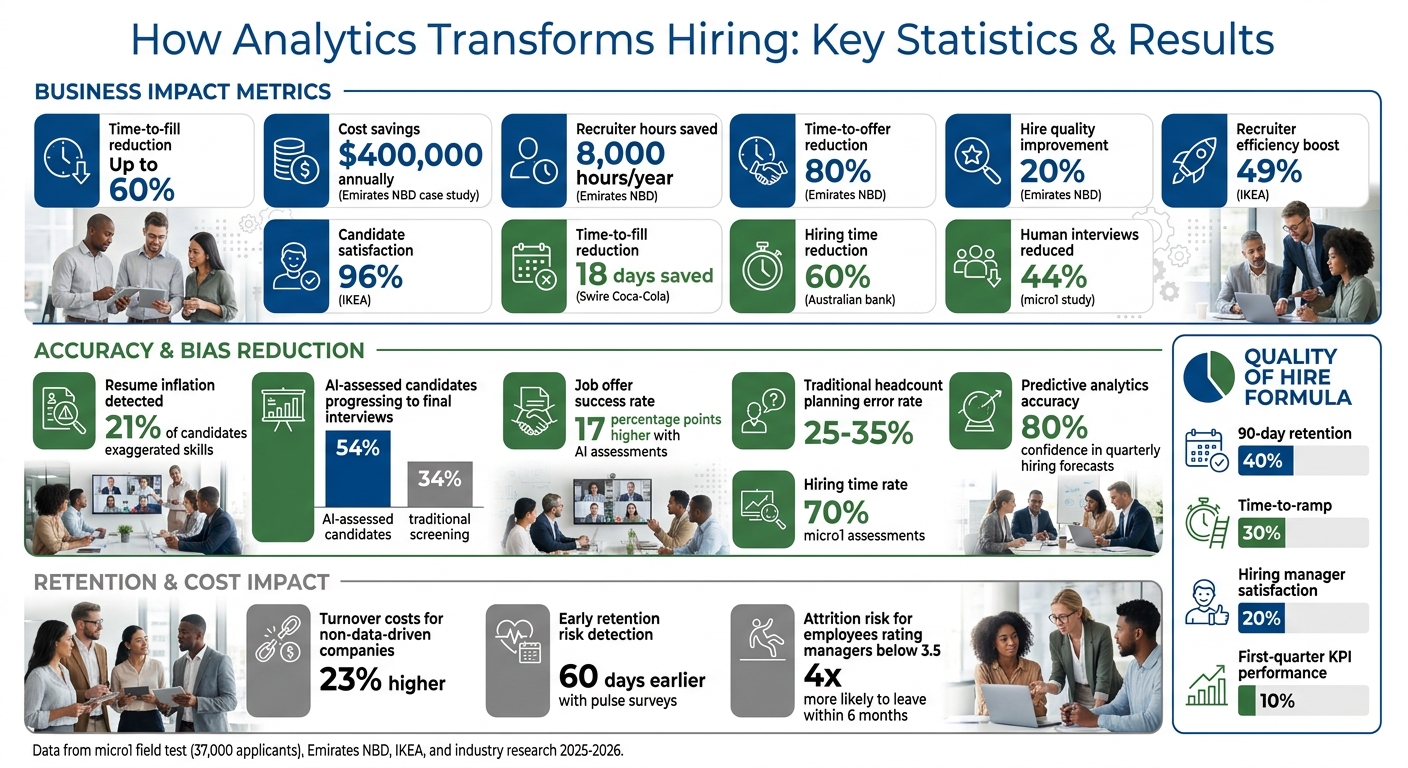
One standout advantage of data-driven hiring is its ability to uncover resume inflation – the gap between claimed and actual skills. In July 2025, tech company micro1 ran a randomized field test with about 37,000 junior developer applicants. They used an AI interviewer, "Zara", to conduct 40-minute structured video interviews focused on specific skills like React, JavaScript, and CSS. The results revealed that 21% of candidates exaggerated their abilities and couldn’t back up their claims [2]. Additionally, candidates who passed these AI-led interviews progressed to final human interviews 54% of the time, compared to just 34% for those screened through traditional resume reviews. As micro1 explained:
"For high-volume technical searches AI assessment is not just a faster filter; it is a smarter one" [2].
These findings highlight how data-driven approaches can lead to measurable hiring improvements.
Proven Results from Data-Driven Hiring
The micro1 study also showed that candidates chosen through AI-driven assessments were 17 percentage points more likely to secure new jobs within five months compared to those selected using traditional methods. The AI process also reduced the number of required human interviews by 44% [2].
Another example comes from Advanced Care Group, a healthcare staffing company. In 2026, they adopted Vitay‘s automated reference-checking and fraud detection tools. By switching from manual to data-driven reference checks, they cut reference turnaround time to just 24 hours. The system’s fraud detection even flagged a suspicious applicant, leading to further investigation and legal action [1].
These examples demonstrate how data-driven tools can streamline hiring processes while improving outcomes for both companies and candidates.
sbb-itb-a23bd6a
Streamlining Recruitment with Predictive Data
Automating Resume Screening and Candidate Ranking
Predictive analytics takes the guesswork out of resume screening by using historical data to predict which candidates are most likely to succeed. Instead of sifting through hundreds of resumes manually, hiring managers can rely on advanced AI-powered recruitment tools that score and rank candidates based on benchmarks set by top performers within the company [5].
This goes far beyond basic keyword searches. Predictive tools provide real-time analytics during the sourcing process, instantly showing how changes to criteria – like required experience or certifications – impact both the quality and quantity of candidates [3]. This allows you to refine your search criteria on the fly, ensuring a stronger pipeline.
These models also flag candidates who are likely to drop out before accepting an offer. By identifying these "at-risk" applicants early, hiring managers can take proactive steps, such as prioritizing interviews or offering personalized follow-ups [3]. Additionally, the system can detect unusual patterns, like sudden increases in candidate drop-off rates at specific hiring stages, and alert you before these issues disrupt timelines [3]. This predictive approach not only sharpens candidate selection but also speeds up the entire recruitment process.
Reducing Time-to-Hire with Data
By refining candidate ranking, predictive analytics helps shrink recruitment timelines dramatically. These insights allow hiring teams to pinpoint and address delays in the process.
Predictive analytics identifies bottlenecks – whether they stem from scheduling conflicts, delayed feedback, or lengthy assessments [3]. Marcos Junca from Taleva explains:
"The metric tells you that your engineering time to fill jumped… The analytics reveals that the spike correlates with a new technical assessment stage… That is the difference between reading a number and understanding a system" [3].
With this level of visibility, hiring managers can resolve the underlying issues instead of merely observing the delays.
Reducing Bias in Hiring Decisions
Standardizing Candidate Evaluations
Using data-driven tools brings consistency to the hiring process by ensuring all candidates are assessed using the same criteria. A field test conducted by micro1 in July 2025 with around 37,000 applicants for junior developer roles highlighted this. The study compared traditional resume screening with AI-led structured interviews. The results? The AI process uncovered that 21% of candidates exaggerated their skills on their resumes, showcasing how inconsistent evaluations can favor polished resumes over real abilities [2]. By sticking to uniform assessment criteria, hiring managers can zero in on candidates with verified skills rather than being swayed by subjective impressions. This not only sharpens the selection process but also helps uncover and address hidden biases.
Identifying and Correcting Bias Patterns
While equal treatment is important, it’s just as critical to identify and address bias patterns in past hiring data. However, data alone can’t solve the problem – it needs human oversight. As S. Thivnuja writes in the Journal of Management Matters:
"AI cannot be used as a stand-alone solution; rather, its ethical application depends on strict human oversight and a dedication to open standards" [6].
One of the biggest hurdles is the "black box" nature of certain automated tools. Without transparency, hiring managers might not realize if algorithms are unfairly filtering out candidates or missing key aspects like cultural fit and soft skills. Regular audits of hiring outcomes are essential to catch and correct these issues early. These audits ensure recruitment algorithms rely on diverse data sources and deliver fair results. Thivnuja further emphasizes:
"a purposeful blend of algorithmic speed and human ethical judgment is the only way to create a more equitable and inclusive workforce" [6].
This highlights the importance of maintaining human oversight as the final checkpoint in the evaluation process.
Forecasting Hiring Needs and Retention
Predicting Recruitment Demands
Traditional headcount planning often falls short, with errors ranging between 25% and 35% [7]. Predictive analytics offers a more accurate alternative by analyzing historical hiring trends. These trends consider variables like role type, seniority, location, salary benchmarks, and even the timing of job postings. Using this data, managers can predict with 80% confidence that 12–14 roles will be filled in the next quarter [7]. This approach transforms headcount planning into a strategic process, closely tied to business growth. For example, organizations can calculate budgets by multiplying the predicted time-to-fill by the daily recruiting costs, including advertising and tools [7].
Additionally, real-time pipeline health scoring acts as an early-warning system. By combining current application flow rates with predicted outcomes, it uses a traffic light system – green, yellow, or red – to flag potential delays before they impact growth plans [7]. These detailed forecasts not only streamline budgeting but also set the stage for more effective retention strategies. For more insights on optimizing your hiring process, explore our recruitment blog.
Retention Data for Workforce Stability
Retention analytics go hand-in-hand with hiring forecasts, offering deeper insights into workforce stability. Beyond simply filling roles, understanding why employees stay or leave is essential for long-term success. Advanced attrition risk models evaluate factors like historical tenure, competitive compensation, and the alignment of a candidate’s career goals with their role. These models can estimate the likelihood of a new hire leaving within 6 to 12 months [7]. Calvin Botez from Treegarden highlights this issue:
"High attrition is not just a retention problem; it is a hiring problem. If you consistently hire candidates who leave within a year, something about your selection process… is systematically failing" [7].
Companies relying on intuition rather than analytics for workforce decisions face turnover costs that are 23% higher [8]. Data also reveals that employees who rate their manager below 3.5 are four times more likely to leave within six months [8]. By using onboarding, pulse, and exit surveys, organizations can identify retention risks up to 60 days earlier than with annual surveys. This early detection provides a critical window to address potential issues before losing key talent [8].
Tools and Case Studies in Data-Driven Hiring
Case Studies of Data in Action
Companies leveraging analytics in hiring are achieving real, measurable outcomes. Take Emirates NBD, for example – they saved 8,000 recruiter hours and $400,000 in a single year by using AI-powered video assessments. This approach not only cut time-to-offer by 80% but also improved hire quality by 20%. IKEA saw impressive results too, boosting recruiter efficiency by 49% while maintaining a 96% candidate satisfaction rate through Virtual Job Tryouts. Swire Coca-Cola managed to cut 18 days from its time-to-fill by adopting OnDemand Text and structured interviews. Meanwhile, an Australian bank reduced hiring time by 60% and increased candidate satisfaction by 25% through games-based assessments [9].
Tools Supporting Data-Driven Recruitment
Modern tools are revolutionizing recruitment by offering real-time insights and predictive analytics. Applicant Tracking Systems (ATS) form the backbone of this approach, capturing critical data like pipeline metrics, timestamps, and reasons for candidate rejection. AI-powered sourcing tools, such as Taleva, can pull data from over 20 sources simultaneously, streamlining the search process. Platforms like HireVue take it a step further, using AI for video interviews and gamified assessments to identify top talent – particularly useful in high-volume hiring situations.
Some systems even feature automated anomaly detection, alerting recruiters to sudden drops in applications or spikes in candidate drop-off rates. The move toward "point-of-decision" analytics allows recruiters to instantly see how adjustments to search parameters impact the candidate pool, making the hiring process more agile and responsive [3].
These tools are paving the way for more structured and efficient recruitment strategies, as seen with Rent a Recruiter.
How Rent a Recruiter Supports Data-Driven Hiring
For analytics to be effective, structured data collection and consistent hiring practices are essential. Simple changes, like replacing free-text fields with dropdown menus for candidate rejection reasons (e.g., "lacks required Python experience" instead of "not qualified"), can significantly improve data quality [3]. Rent a Recruiter specializes in embedding experienced recruiters directly into scaling companies, ensuring the processes and systems are in place to collect and track candidate data effectively.
Key Hiring Metrics for Data-Driven Decisions
Core Metrics to Measure Success
Understanding the numbers behind your hiring process is critical. One standout metric is Quality of Hire. A recommended model combines several factors for a well-rounded view: 90-day retention (40%), time-to-ramp (30%), hiring manager satisfaction (20%), and first-quarter KPI performance (10%) [10]. This formula helps you determine if new hires are genuinely contributing to your business.
Other metrics, like time-to-fill, stage duration, and funnel conversion rates, reveal inefficiencies and show where candidates drop off in the process [3] [10]. Then there’s Cost of Vacancy, which puts a dollar amount on hiring delays. To calculate, take the role’s daily value (annual revenue contribution ÷ 260 workdays) and multiply it by the number of days the position remains unfilled. This calculation can help finance teams grasp the financial impact of slow hiring [10].
Another essential metric is source effectiveness. It’s not about the number of applications but about which channels bring in candidates who stay and perform. For example, a channel delivering 500 applications with no hires wastes time, while one yielding 50 applications and 3 strong hires deserves more focus and investment.
These metrics create the foundation for deeper insights through your ATS.
Using Applicant Tracking Systems for Metrics
To effectively track these metrics, your Applicant Tracking System (ATS) is indispensable. As Austin Braham from Everworker explains, an ATS captures "comprehensive recruitment data" – from applications and interviews to stage transitions and offers – turning raw data into actionable insights [4]. These insights are often compiled into recruitment reports to track progress over time. With event-level timestamps automatically logged, you can calculate time-to-hire accurately and identify bottlenecks in your process.
The value of these insights depends on maintaining data hygiene. For example, instead of free-text fields like "not qualified", use specific codes such as "lacks required Python experience" [3]. This standardization highlights trends: if 40% of candidates fail due to the same skill gap, it may signal a need to refine your job description or sourcing strategy. Modern ATS platforms also offer predictive analytics, flagging candidates likely to drop out and suggesting proactive steps, such as scheduling an onsite interview within 48 hours [4]. Regular monthly audits ensure that timestamps and reason codes are consistently logged, keeping your metrics accurate [3].
"Recruiting analytics takes those metrics and asks ‘why did it happen?’ and ‘what will happen next?’" – Marcos Junca, Taleva [3]
Conclusion: Turning Data into Action
Key Takeaways for Hiring Managers
Data can transform hiring from a reactive process into a proactive strategy. Metrics like a 34-day time-to-fill give you a snapshot of performance, but analytics go deeper, uncovering patterns and predicting outcomes. To make this work, your data must be clean – standardized fields and regular audits are essential. Without this, you risk "garbage in, garbage out."
For example, analytics might reveal a 40% candidate drop-off at a new technical assessment stage or show that engineering roles now take 47 days to fill instead of 32, all because of a flawed interview process. These insights highlight how data-driven decisions can reshape recruitment strategies [3]. As Taleva aptly states:
"Analytics without action is just intellectual entertainment" [3].
The key is to turn insights into action. Use your data to monitor demographic conversion rates, identify bias, and reallocate budgets from high-volume but low-quality sources to those delivering top candidates. This approach drives real, measurable improvements.
Next Steps
Start with a focused 30-day plan. In week one, audit your ATS data. In week two, create core reports like Funnel Conversion, Source Effectiveness, and Time-in-Stage. By week three, share your findings with leadership. Finally, in week four, act on one key insight [3]. This step-by-step process keeps things manageable while delivering tangible results.
For companies scaling quickly, balancing data-driven hiring with daily recruitment demands can be tough. Rent a Recruiter can help by embedding skilled recruiters into your team. These professionals handle hands-on hiring while implementing structured analytics, ensuring you meet immediate goals and build a strong data foundation for the future.
Data-Driven Recruitment: How to predict the success of your hires
FAQs
What data do I need to start using hiring analytics?
To make the most of hiring analytics, begin by collecting essential metrics such as time to fill, cost per hire, and quality of hire. These help you gauge how efficient and effective your recruitment efforts are. Beyond these, keep an eye on candidate sources, offer acceptance rates, and data from various interview stages. These insights can reveal patterns and pinpoint where delays or issues occur.
Using real-time tools for data collection and analysis can take this a step further. They not only simplify the process but also offer predictive insights, helping you refine your hiring strategies and achieve better results.
How can I use analytics without increasing bias?
When used carefully, analytics can play a big role in creating fairer hiring processes. AI tools, for example, are great for standardizing evaluations and maintaining consistency. But here’s the catch: if these tools are trained on biased data, they can unintentionally carry those biases forward.
To tackle this, it’s crucial to use diverse datasets and regularly audit the algorithms behind these tools. This ensures the systems are updated and less likely to perpetuate unfair patterns.
However, technology alone isn’t enough. Human oversight remains key, especially when assessing soft skills or determining how well a candidate might align with your team. These are areas where AI struggles to provide the full picture.
Another important piece? Transparency. Clearly communicating how AI-driven decisions are made builds trust and ensures fairness. By blending data-driven insights with human judgment, companies can create a hiring process that’s both efficient and equitable.
Which 3 hiring metrics should I track first?
The first three hiring metrics to monitor are time-to-hire, cost-per-hire, and quality of hire. These key metrics offer critical insights that can help refine your recruitment process, support better decision-making, and deliver stronger hiring results.