We start with your growth deadline, not your next vacancy. Before sourcing, give every role an approved budget, an owner, and a date when the hire needs to deliver results. Work backwards from that date to allow for recruitment and onboarding, so you avoid paying for capacity too early or missing a launch through late hiring.
We focus on three steps:
- Map the gaps: Identify the skills and capacity your growth plan needs, then compare hiring with training, transfers, contractors, or process changes.
- Set priorities: Put roles that block revenue or delivery first, and build pipelines around qualified people rather than profile counts.
- Track business results: Aim for 100% role approval before sourcing, then measure hiring costs, time to productivity, and retention against your milestones.
More hires are not the goal. Delivery is. We review the plan monthly, adjust when forecasts change, and add on-demand recruiting support when team capacity puts deadlines at risk.
Here’s how we turn your growth targets into <u>fractional recruitment services that provide a funded hiring plan with clear owners and dates</u>.
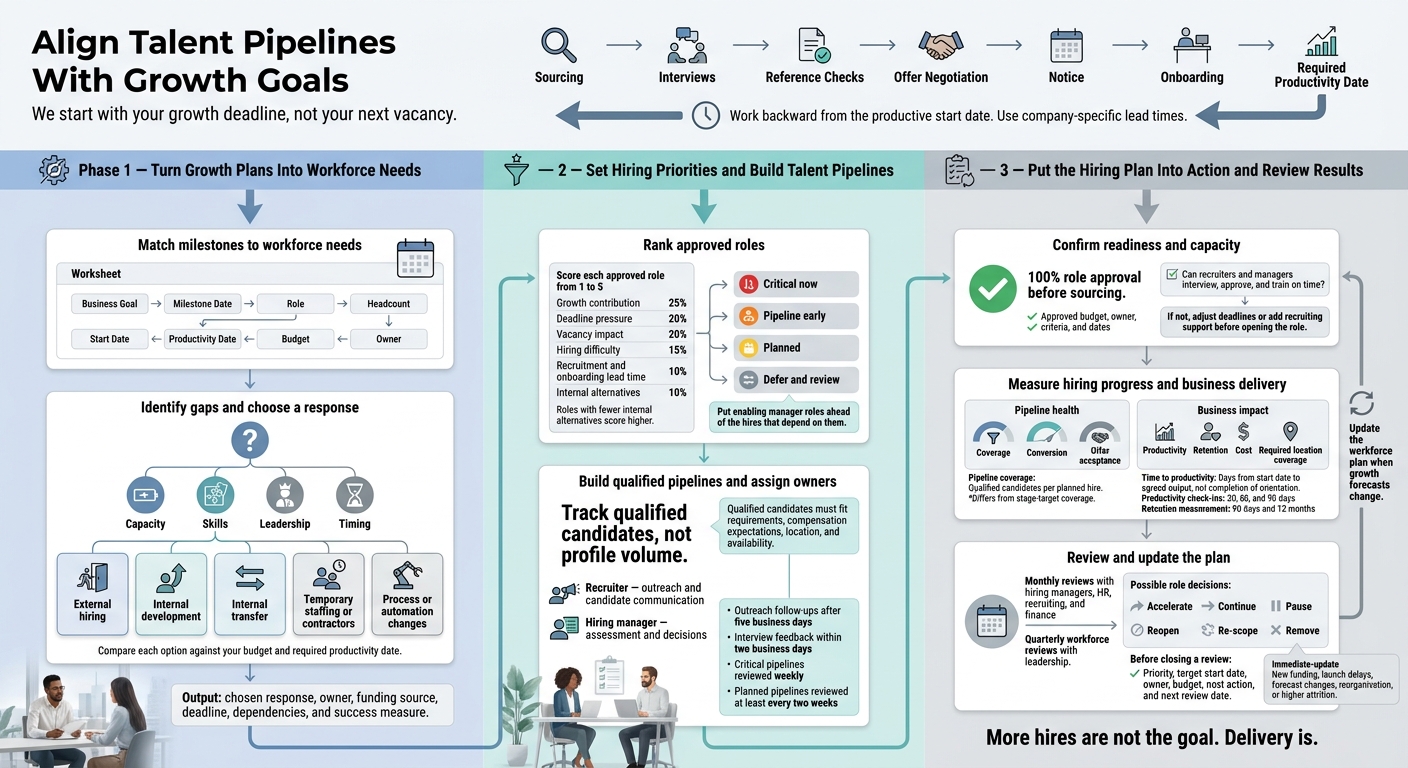
Align Talent Pipelines With Growth Goals
How Strategic Workforce Planning Saves Businesses (Analysis, Forecasting & Managing Talent Gaps)
sbb-itb-a23bd6a
Step 1: Turn Growth Plans Into Workforce Needs
Turn your operating plan into a clear view of the roles, skills, and capacity each business milestone needs. Go beyond headcount: include experience, coverage, workload, and the time people need to reach full productivity.[3][5] The worksheet below connects those needs to roles, dates, and funding decisions.
Match Business Milestones to Roles and Start Dates
Create a worksheet with one row per role tied to a business milestone. Record the business goal, milestone date, role, headcount, start date, productivity date, budget, and owner.
Before approval, have business, finance, HR, recruiting, and line managers check the assumptions. This gives each team a chance to confirm what’s needed, when it’s needed, and what it will cost.[4][5]
Check Workforce Capacity and Skills Gaps
A skills gap is the difference between what your team can do today and what future goals require. For each relevant role or team, review:
- Current and expected headcount, workload, expected attrition, internal mobility, and location or time-zone coverage.
- Technical and leadership skills, skill levels, experience, certifications, and development time.
Classify each shortfall as a capacity, skills, leadership, or timing gap.[3][6]
For critical roles, document backup coverage and replacement time. Stress-test the plan against higher attrition or slower hiring so you can see where delivery dates could slip.[3]
Then identify the fastest feasible way to close each gap.
Choose How to Close Each Workforce Gap
Compare each option against your budget and required productivity date. That comparison helps you decide which gaps need hiring priority and which can be addressed another way.
| Response | Suitable gaps | Benefit | Limit | Estimated lead time | Cost considerations |
|---|---|---|---|---|---|
| External hiring | Capacity, specialized skills, leadership, or long-term capability | Lasting capacity; new expertise | Market uncertainty; onboarding; compensation | Several weeks to several months | Salary, benefits, recruiting, onboarding, equipment, manager time |
| Internal development | Specialized skills, leadership, predictable future needs | Company knowledge; engagement | Training time; limited fit for urgent needs | Several weeks to many months | Training, coaching, reduced short-term productivity, backfill |
| Internal transfer | Timing or capacity; qualified employees available | Faster deployment; company knowledge | Gaps left elsewhere; possible reskilling | Days to several weeks | Transition, training, compensation changes, disruption |
| Temporary staffing or contractors | Immediate capacity, project surges, short-term specialized work | Flexibility; deadline coverage | Availability; knowledge; quality or compliance risks | Days to several weeks | Hourly or project fees, vendor charges, management time |
| Process or automation changes | Inefficient workflows or avoidable manual work | Lower recurring demand; ability to scale | Implementation; ownership; change management | Several weeks to many months | Technology, redesign, training, implementation |
Use company-specific lead times, not generic benchmarks. In a gap-resolution plan, record the chosen response, owner, funding source, deadline, dependencies, and success measure for each gap.[6]
Use these funded, owner-assigned gaps to set hiring priorities and build the pipeline.
Step 2: Set Hiring Priorities and Build Talent Pipelines
Turn the funded gaps from Step 1 into a ranked hiring plan tied to business goals and realistic hiring timelines.
Rank Roles by Business Impact and Hiring Lead Time
Score each approved role from 1 to 5 using these agreed weights: growth contribution 25%, deadline pressure 20%, vacancy impact 20%, hiring difficulty 15%, recruitment and onboarding lead time 10%, and internal alternatives 10%. Roles with fewer internal alternatives score higher.
Put enabling manager roles ahead of the hires that depend on them. Once you’ve set the order, define the candidate profile and sourcing channel for each role.
| Role | Linked growth goal | Urgency | Hiring difficulty | Vacancy impact | Planned start date | Priority tier |
|---|---|---|---|---|---|---|
| Manager needed before team expansion | Enable additional team capacity | High | High | Blocks dependent hires | Before dependent hires start | Critical now |
| Scarce specialist | Deliver a milestone requiring specialized skills | High | High | Threatens delivery if hiring starts late | Allow for extended recruitment and ramp time | Pipeline early |
| Role supporting predictable expansion | Meet approved growth demand | Moderate | Moderate | Capacity shortfall at planned growth level | Approved workforce-plan date | Planned |
| Role with workable internal coverage | Support a lower-priority need | Low | Low | Limited while coverage holds | Reconfirm after review | Defer and review |
Work backward from the productive start date, allowing time for sourcing, interviews, reference checks, offer negotiation, notice, and onboarding. Compare the sourcing deadline with today’s date, not just the employee’s planned start date. Record why each role received its tier.
Set Candidate Criteria and Choose Sourcing Channels
Define the required capabilities, evidence of performance, decision-making scope, location, work arrangement, approved compensation in U.S. dollars, and availability. Show base salary, bonus, and equity separately.
Use the same job-related questions and rating scale for comparable candidates. Structured interviews improve validity and reduce adverse impact.[7]
Match each sourcing channel to the candidate group, perhaps using recruitment as a service for cost-effective scaling. Use targeted postings for active candidates, reconnect with warm prospects, tailor outreach to passive prospects, and use internal postings for internal candidates. Obtain permission before contacting future talent.
Track qualified candidates, not profile volume. Divide the number who meet your requirements at a defined stage by the number needed at that stage. Only count people whose compensation expectations, location, and availability fit.
Track coverage and conversion by source. If coverage falls, check requirements that aren’t needed for the role, outreach, compensation, and timing before adding more profiles.
Assign Pipeline Owners and Follow-Up Dates
Keep one pipeline map for each priority role. Include its growth goal, tier, required start and productive-by dates, candidate profile, approved compensation, work arrangement, and candidate counts by stage. Also record sourcing risks, blocking issues, dependencies, owner, next action, and follow-up date.
The recruiter owns outreach and candidate communication. For teams lacking internal capacity, an embedded recruitment service can provide this dedicated support. The hiring manager owns assessment and decisions. Set outreach follow-ups after five business days and require interview feedback within two business days. Review critical pipelines weekly and planned pipelines at least every two weeks.
Tell future prospects that you’re building a talent community or assessing future needs, not offering a position. Keep records accurate, restrict access, and follow applicable privacy and retention rules. Keep voluntary demographic information separate from employment decisions.[8]
Step 3: Put the Hiring Plan Into Action and Review Results
Once priorities and pipelines are set, turn the plan into hiring decisions, deadlines, and regular reviews.
Set Hiring Deadlines, Team Capacity, and Decision Rules
Check recruiter and manager capacity before committing to hiring deadlines. If your team cannot interview, approve, or train on time, reset the deadline. Work backward from each role’s required productivity date, allowing time for requisition approval, notice periods, onboarding, and ramp-up.
Add budget owner, latest offer date, current risk, approval checkpoints, and escalation action to the approved plan. Require stage-gate approvals before sourcing, compensation exceptions, and offers. Escalate when feedback takes more than 48 hours.[10] Each escalation should name the decision-maker, the decision deadline, and the available options.
If capacity falls short, adjust deadlines or add recruiting support before opening the role.
Add Embedded Recruiters as Hiring Demand Grows
When hiring demand exceeds your internal capacity, Rent a Recruiter places recruiters inside your team to manage hiring end-to-end.
Measure Hiring Results Against Growth Milestones
Track progress against growth milestones, not just hiring activity. Hold monthly reviews with hiring managers, HR, recruiting, and finance to check delivery risks. Use quarterly workforce reviews with leadership to assess whether hiring supports your growth plan.
Keep pipeline health separate from business impact. Coverage, conversion, and offer acceptance show how hiring is progressing. Productivity, retention, cost, and required location coverage show what it delivers for the business.
Measure pipeline coverage as qualified candidates per planned hire. This demand-based ratio differs from Step 2’s stage-target coverage. Measure time to productivity from the start date to agreed output, not the completion of orientation.[9]
| Metric | Definition and target | Frequency and owner | Warning threshold and corrective action |
|---|---|---|---|
| Role readiness | Roles with approved budget, owner, criteria, and dates; target 100% before sourcing | Weekly; recruiting operations | Any missing approval: hold sourcing and resolve with finance or the manager |
| Pipeline coverage | Qualified candidates per planned hire; set stage-specific ratios | Weekly; recruiter | Below agreed ratio: add sourcing channels or revise criteria |
| Stage conversion | Percentage advancing between stages; target based on comparable roles | Monthly; recruiter and manager | Sharp drop: audit criteria, messaging, or interviewer consistency |
| Time to fill | Calendar days from requisition opening to accepted offer; role-specific historical target | Monthly; recruiting | Exceeds target by 10% to 15%: remove approval or scheduling bottlenecks |
| Time to productivity | Days from start date to agreed output; target tied to growth milestone | Quarterly; manager and HR | Ramp-up exceeds target: improve onboarding, training, or manager support |
| Offer acceptance | Accepted offers ÷ offers extended; role and market baseline target | Monthly; recruiter | Repeated declines: review compensation, speed, expectations, or candidate experience |
| Retention | Share remaining at 90 days and 12 months; internal baseline target | Quarterly; HR | Early departures exceed baseline: investigate selection, onboarding, or manager readiness |
| Cost per hire | Recruiting and onboarding costs ÷ hires; approved budget target | Monthly or quarterly; finance and HR | Over budget: review spending, scope, or capacity |
| Location coverage | Qualified candidates and hires in required locations or time zones; staffing-plan target | Monthly; recruiter and HR | Coverage falls short: revise sourcing or location constraints |
Use 30-, 60-, and 90-day check-ins to compare expected and actual productivity.[11] Review diversity data only when lawful and privacy-protective. Use aggregated indicators to identify process barriers, not to rank candidates by protected characteristics.
At each review, decide whether to accelerate, continue, pause, reopen, re-scope, or remove each role.
Conclusion: Update Hiring Priorities as Growth Changes
After each review, update your workforce plan to match the latest growth forecast. Check costs, pipeline coverage, and hiring speed against the business milestones those hires need to support.
Don’t wait for a scheduled review when the business changes. New funding, launch delays, forecast changes, reorganization, or higher attrition should trigger a plan update and guide the next sourcing cycle.
Before closing the review, confirm each role’s priority, target start date, owner, budget, next action, and next review date. Open the next review by checking which actions were completed and what changed in the forecast.
If recruiting capacity still limits delivery, contact Rent a Recruiter to match hiring support to your workforce plan, hiring volume, urgency, and budget.
FAQs
How do I plan hiring when growth forecasts are uncertain?
Replace rigid annual headcount plans with a rolling, data-driven forecast. Review your workforce plan every 90 days and update your assumptions as business conditions change.
Focus on 5 to 7 key capabilities your business will need over the next 12 to 24 months, rather than locking in fixed job titles.
Prioritize roles that directly affect revenue, product delivery, or team output. If delaying a hire won’t disrupt a critical business process, that role can wait.
How can I estimate ramp-up time for a new role?
Build a 3-to-4-month buffer for each hire into your workforce plan. Adding headcount doesn’t mean you get business output straight away [1].
Plan by role, not company-wide averages. Seniority and role complexity affect how long someone takes to become productive. Use at least three years of historical data to set a baseline for each role family and seniority level. Then track time-to-productivity metrics to refine your estimates based on when new hires start delivering value [2].
How do I resolve competing hiring priorities across teams?
Rank roles by their direct impact on revenue, product delivery, and customer retention. Group them as critical, important, or deferrable so you can protect priority hires when budgets or timelines are tight. Hold off on adding leadership layers or expansion hires until conditions allow.
Bring Finance and department heads into planning early to agree on salary ranges and constraints. Review your hiring plan every 90 days to keep spending and hiring priorities aligned with changing business needs and growth goals.