If your AI hiring process is not built around skills, scorecards, and human sign-off, it can scale bad decisions at volume.
I’d boil the article down to this: AI helps only when you control where it is used, what it scores, and who owns the final call. For scaling companies, that means lower rework, less recruiter time wasted on weak shortlists, and better hiring outcomes across high-volume roles.
Here’s the short version:
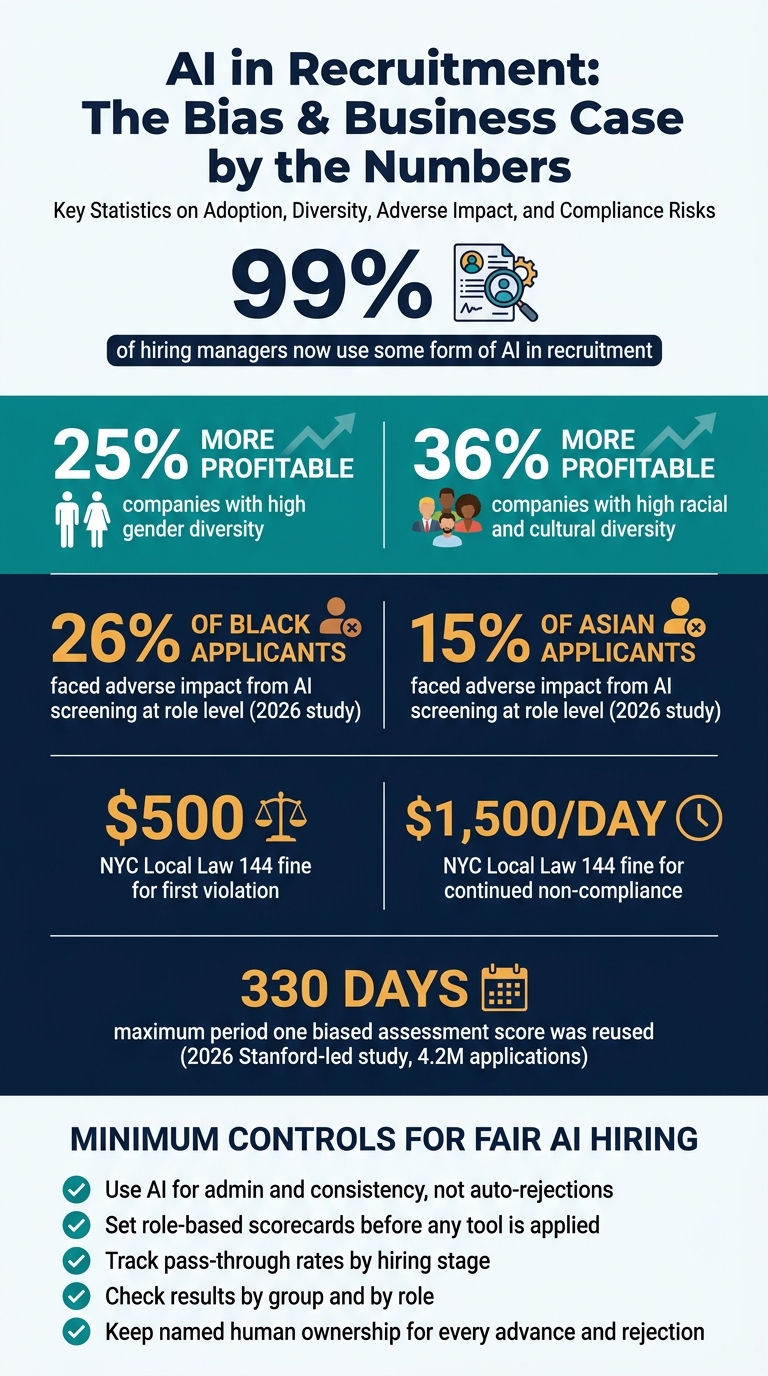
- Use AI for admin and consistency, not auto-rejections
- Set role-based scorecards first, before any tool is applied
- Track pass-through rates by hiring stage, not just top-line hiring numbers
- Check results by group and by role, so problems do not stay hidden
- Keep named human ownership for every advance and rejection
A few numbers make the business case clear:
- 99% of hiring managers now use some form of AI in recruitment
- Companies with high gender diversity are 25% more profitable
- Companies with high racial and cultural diversity are 36% more profitable
- One 2026 study found 26% of Black applicants and 15% of Asian applicants faced adverse impact from AI screening at role level
- NYC Local Law 144 fines start at $500, then move to $1,500 per day for continued non-compliance
What matters for you is simple. Bias in hiring is not just a process issue, it is a cost, speed, and control issue. If you want AI to support growth instead of creating more clean-up work, you need a structured hiring system first.
That is the lens for the rest of the article.
AI Hiring Bias: Key Stats & Business Impact
Where Bias Enters the Recruitment Process
Bias builds up across hiring stages, often out of sight, until it starts shaping who moves forward and who gets screened out. For scaling SMEs, that risk grows fast. A small issue at one stage can turn into a much bigger hiring problem once volume goes up.
Human bias, data bias, and model bias
These are not the same thing, but they often work together.
| Bias Type | Where It Comes From | What It Looks Like in Practice |
|---|---|---|
| Human Bias | Recruiter or manager subjectivity | "Culture fit" rejections with no defined criteria; inconsistent interview questions across candidates |
| Data Bias | Historical hiring patterns | AI recommending only candidates from the same universities the founding team attended |
| Model Bias | Opaque model logic that overweights weak correlations | High rejection rates tied to specific ZIP codes or candidates with employment gaps |
In most hiring teams, these issues show up early, usually in the job ad, screening, and interview stages.
Proxy signals are a major problem. ZIP codes, school names, employment gaps, and extracurriculars can all skew outcomes [1][2].
Amazon scrapped an AI recruiting tool after it penalized resumes containing "women’s", because the model had been trained on mostly male resumes [1].
High-risk stages for growing companies
Every part of the funnel carries some risk, but a few stages tend to cause the most trouble for SMEs that are scaling fast.
Job descriptions are often the first entry point. Gendered or exclusionary language in job ads can narrow your applicant pool before screening even starts [3].
Resume screening is the next pressure point. Algorithms trained on past hiring data often repeat old patterns and old prejudices [1][3].
Interviews bring another layer of risk, especially when AI video tools are used. These systems can misread non-native speakers and strong regional accents [1].
At scale, that matters a lot. One biased stage can cut down the candidate pool before anyone later in the process has a chance to correct it.
Growing companies also face another issue: shared-model bias. That happens when the same tool filters candidates across multiple employers [4].
What to measure before problems grow
If you are not measuring bias, you are leaving hiring outcomes to chance. The good news is that the key metrics are simple.
Pass-through rates by stage show what percentage of candidates from different demographic groups move forward at each step. If one group keeps dropping out at resume screening but not at interview, that is a clear signal to review the process.
Subgroup analysis breaks outcomes down by gender, race, disability, and other protected characteristics. That helps you spot patterns that top-line numbers can miss.
The four-fifths rule flags possible adverse impact when a group’s selection rate falls below 80% of the highest-scoring group’s rate [4]. A 2026 Stanford-led study found some assessment scores were reused for up to 330 days, letting one biased read affect nearly a year of applications [4].
For hiring leaders, this is not just a compliance issue. It affects who enters your pipeline, how much time your team wastes reviewing weak outputs, and whether your hiring system holds up as you scale.
Once you know where bias enters, the next step is controlling it with structured criteria, fairness checks, and human oversight.
sbb-itb-a23bd6a
Bias Reduction Strategies That Work With AI
The fix is not more AI. It is tighter control over how AI is used.
That means skills-first criteria, stage-specific guardrails, and human sign-off. Then you track pass-through rates and subgroup analysis to see if each control is doing its job. If the numbers drift, you know where to look.
Use skills-first criteria and structured scorecards
The most direct way to cut bias is simple: screen for job-related skills, not pedigree signals.
Start by defining the role-specific competencies first. Then score every candidate against the same rubric. Use a standard scorecard with clear rating anchors, plus behaviors and outcomes you can score in a consistent way.
Strip out identifiers such as names, schools, ZIP codes, and gendered language before screening. Pair that with explainable scoring, where the system cites resume evidence for each rating, and the output is much easier for your team to review and defend [2].
| Bias Risk | Mitigation Strategy |
|---|---|
| Proxy bias from ZIP codes or school names | Anonymized screening strips identifying details before evaluation |
| Opaque scoring | Explainable scoring cites resume evidence for each rating |
| Historical data bias | Skills-first criteria replace pedigree-based signals |
| Manager instinct | Standardized scorecards with defined rating anchors |
Once the criteria are set, apply AI where it helps with consistency and workload, not where it replaces judgment.
Apply AI at the right stages with fairness controls
Use AI for volume and consistency, not final decisions.
| Funnel Stage | AI Capability | Key Bias Control |
|---|---|---|
| Sourcing | Inclusive job description review and candidate sourcing | Diversity checks on candidate lists before human review |
| Screening | Resume parsing and skills matching | Anonymization of names, schools, and locations [2] |
| Interviewing | Structured interview questions | Standardized scorecards with rating anchors [4] |
| Decision | Recommendation summaries | Mandatory human rationale log for every decision [4] |
A second AI check can also help flag scores driven by non-skill signals, such as employment gaps [2].
That matters because the risk often shows up in small ways. A scoring model may look neutral on paper, but still lean on signals that have little to do with performance. This extra check gives you one more layer of control before a human reviewer makes the call.
Every AI output still needs a human decision.
Keep humans accountable for hiring decisions
AI can flag patterns, but people should make the decision. Log every advance or rejection with a short human rationale. That review trail also helps with U.S. audit and documentation requirements [4].
More than that, the log creates a feedback loop. It pushes reviewers to explain why someone moved forward or got rejected. Over time, that makes bias easier to spot, easier to challenge, and less likely to spread through your hiring process.
How SMEs Can Implement AI Hiring Without Losing Control
Strategy only matters if it shows up in the day-to-day. For high-growth SMEs, that means choosing the right tools, setting firm rules for how AI is used, and putting simple routines in place that still work when hiring volume climbs. The next step is turning those controls into tool choices and repeatable hiring habits.
Choose tools that show how decisions are made
Start with a simple test: can the tool show why a candidate got a score? If the answer is vague, that’s a warning sign.
Prioritise transparent, auditable tools, systems where the logic is visible, your company owns the data and audit trail, and every score links back to CV evidence. Avoid platforms that issue auto-rejections or make company-wide bias claims without role-level data.
Per-role adverse-impact reporting tells you far more than broad company-wide bias summaries.
| Feature | Good Practice Benchmark | Red Flag |
|---|---|---|
| Audit trail | Attributed decisions with written rationales | Status changes with no recorded reasoning |
| Bias testing | Per-position adverse-impact reporting (four-fifths rule) | Company-wide bias claims without role-level data |
| Explainability | Clear input variables and resume citations for every score | Black-box scoring with no candidate feedback |
| Data control | Proprietary data ownership; clear deletion policy | Data pooled with other employers or reused across cycles |
Compliance adds another layer. NYC Local Law 144 carries fines of $500 for a first violation, rising to $1,500 per day for continued non-compliance [4]. Colorado’s SB 26-189, effective January 1, 2027, requires three-year record retention for AI-assisted hiring decisions [4]. A tool that logs decisions by named user from day one will save you a lot of pain later.
Once the tool is auditable, rollout is what decides whether fairness holds up in practice.
Build a simple rollout plan for a scaling company
Most SMEs do not need a heavy implementation process. A five-step sequence is usually enough for growing teams, and each step helps protect the skills-first, structured-scorecard process already in place:
- Inventory current tools: document every platform involved in your hiring process and flag which ones use AI, even in the background.
- Define approved use cases: state clearly where AI is allowed, such as CV parsing and scheduling, and ban auto-rejections outright.
- Pilot structured workflows: start with one department or one role type first.
- Train hiring managers: show them how to read AI-generated summaries with care, write a short rejection rationale, and spot scoring anomalies.
- Review pass-through rates and override rates monthly: flag any role that fails the four-fifths rule.
This does two things at once. It keeps the rollout simple, and it gives you a paper trail if anyone later asks how AI decisions were handled.
Use embedded recruitment support to maintain consistency
As hiring volume grows, consistency often slips. Different managers make calls in different ways, shortcuts creep in, and the process starts to drift.
That is where Rent a Recruiter can help. They embed experienced recruiters directly into your team, typically within five days, to keep AI-assisted workflows consistent across every open role as managers change, so the structured, skills-first process holds regardless of who is running a given search [1].
Conclusion: A Practical Framework for Fairer, Faster Hiring
AI does not cut bias by itself. It only helps when it sits inside a hiring process with clear structure, skills-first criteria, human accountability, and regular review. So the next move is simple: get control of the process before you add more tools.
There is also a clear business risk here. SMEs that get this right tend to hire faster and make steadier decisions. Those that do not can face legal risk under laws such as NYC Local Law 144, damage to brand trust, and the kind of adverse impact shown in a 2026 Stanford-led study of 4.2 million applications, where 26% of Black applicants and 15% of Asian applicants faced adverse impact at the per-position level [4]. The practical response is to put controls in place first, starting with the stages where risk is highest.
Key actions to take next
Start with the highest-risk stages, CV screening and initial shortlisting. Then put role-specific scorecards in place before applying any AI tool to those steps.
Use AI only where controls already exist. It can help summarise information and surface context, but it should never make autonomous rejection decisions. Review outcomes per position using the four-fifths rule, not just company-wide averages that can hide problems at role level. Log every advance and reject decision with a named human rationale. Give one person clear ownership of bias audits and hiring governance, and treat that as a repeated review, not a one-off task.
Use this as your minimum rollout checklist.
| Priority Action | Why It Matters |
|---|---|
| Map bias by stage | Aggregate data hides role-level problems |
| Set scorecards first | Criteria must exist before AI can apply them fairly |
| Keep AI advisory | Prevents autonomous rejection decisions and systemic bias |
| Audit by role | Catches adverse impact early, before legal or reputational damage |
| Name an owner | Accountability without a named owner doesn’t hold |
For scaling SMEs, consistency is what turns fair hiring into something you can repeat. It is also what helps you move faster without losing control.
FAQs
How can we audit AI hiring tools for bias?
Audit AI hiring tools before deployment and once a year after launch at the individual job level.
Use the four-fifths rule to test for adverse impact across gender, race, and disability. That gives you a clear check on whether the tool is screening out protected groups at a higher rate, role by role, not just across hiring as a whole.
You should also build in a few non-negotiables:
- Human oversight in final decisions
- Detailed, traceable decision logs
- Masking demographic identifiers
- Review with diverse stakeholders
This matters for more than compliance. If an AI hiring tool filters out strong talent or creates bias risk, the cost shows up fast in missed hires, slower hiring, and legal exposure. A proper audit process helps you catch those issues early, before they turn into a hiring and finance problem.
What hiring metrics should we track each month?
Track data at each hiring stage, resume review, interviews, assessments, and final offers, so you can monitor both bias and hiring performance. Stage-by-stage measurement helps you see where outcomes shift before the problem turns into wasted time, extra cost, or missed hires.
Use the four-fifths rule to check for adverse impact. If a protected group’s selection rate falls below 80% of the selection rate for the highest-selected group, your process needs a closer look. If hiring volume is low, pool data across similar role families so you have enough data to spot patterns worth acting on.
How do we start using AI without losing human control?
Use AI as a support tool that filters noise, not as an automated decision-maker. Put a human-in-the-loop process in place so your team reviews AI recommendations, questions the output, and keeps final hiring decisions with people, where accountability belongs.
That matters for more than compliance. It protects hiring quality, cuts the risk of poor-fit decisions, and gives leaders more control over how screening works across the business.
Before any tool goes live, audit it. Then review it every year for bias. During screening, mask identifying details and make sure human reviewers check AI-generated shortlists before anyone moves forward.