
AI matching can cut hiring time, but a faster shortlist only pays off if the hire fits the assignment. We recommend testing it on one recurring temporary role before committing more budget. Compare recruiter hours, skills fit, assignment results, and total costs against your current process.
For your pilot, we would focus on:
- Speed and capacity: Reduce review time while keeping worker availability up to date.
- Hiring quality: Check rankings against project work, with recruiters making final decisions.
- Cost and control: Count setup, data upkeep, and contract checks before claiming savings.
- Bias and transparency: Check how rankings are produced and whether they hold up against assignment results.
The article provides no measured percentage gains, so we would set targets from your own baseline. Our rule: <u>scale only when time saved does not come at the expense of hiring quality or accurate checks</u>.
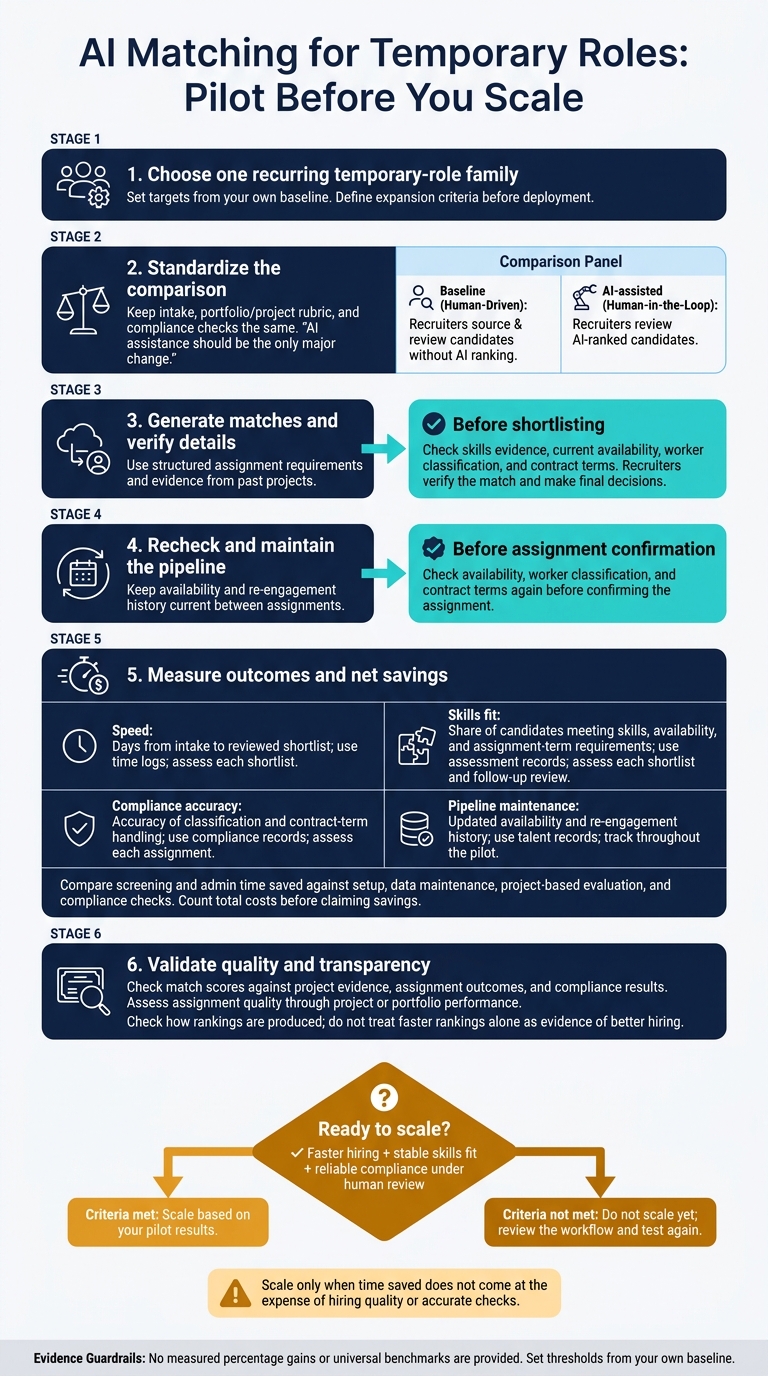
AI Matching for Temporary Roles: Pilot Before You Scale
Screening Speed and Skills Matching
In temporary hiring, the screening workflow tests whether AI can cut review time without sacrificing assignment fit.
From Job Requirements to a Reviewed Shortlist
Start with structured assignment requirements and evidence from past projects. Review portfolios and relevant work examples, then ask a recruiter to verify the match.
Structure your shortlist review around these factors.[1]
| Workflow element | Contingent/temporary focus |
|---|---|
| Timeline | Results in days, not weeks |
| Assessment | Portfolio and project-based evaluation |
| Compliance | Worker classification, benefits eligibility, and contract terms |
| Relationship | Continuous pipeline management |
Check Skills, Availability, and Assignment Terms
Use AI to identify likely matches. Then verify skills evidence, availability, and contract terms before moving candidates to review. These checks establish whether someone can start the assignment and whether the arrangement meets compliance requirements.
Measure Shortlist and Assignment Quality
The source provides no benchmark gains for screening speed or shortlist quality. Compare screening effort, shortlist quality, and compliance accuracy against your current process to assess whether AI saves time while maintaining hiring standards.
sbb-itb-a23bd6a
Screening Capacity and Consistency
Speed is only part of the picture. For recurring roles, AI also needs current candidate data and consistent screening rules to support repeat hiring.[1]
Set Up Data and Screening Workflows
Screening capacity improves when candidate records stay current and teams apply the same project- and portfolio-based criteria across recurring assignments. Connect contingent hiring data with your embedded recruitment records so you can find candidates you have already assessed.[1]
The focus shifts from matching one role well to supporting recurring hiring demand.[1]
| Outcome | Process requirement | Measurement method | Operational limit |
|---|---|---|---|
| Speed | AI workflows for temporary roles | Time-to-fill in days | Standard AI tools may be designed for permanent hiring |
| Capacity | Regular pipeline maintenance | Recurring assignments per candidate | Candidates move between assignments quickly, so records need constant updates |
| Consistency | Standardized project and portfolio reviews | Quality of project deliverables | Assess work output rather than structured interview performance |
| Workload | Automated compliance checks and worker classification | Recruiter hours spent on contract terms and state and local compliance | Requirements vary by engagement type and location |
Review Matches and Verify Candidate Details
Check current availability, worker classification, and contract terms after generating matches and before shortlisting. Check them again before confirming the assignment. This second checkpoint catches changes since the first review.[1]
Calculate Net Cost and Time Savings
Measure screening and admin time saved against the time and cost of setup, data maintenance, project-based evaluation, and compliance checks. Track time-to-fill and recruiter hours spent on compliance to assess net savings.[1]
Use those figures before testing bias, transparency, and research limits.
Bias, Transparency, and Research Limits
Treat claimed gains as hypotheses to test. After measuring speed and fit, check that the model remains accurate, transparent, and compliant. Gains from AI in temporary hiring remain provisional until tested against contingent-role timelines, assessments, and compliance requirements.[1]
Weigh Benefits, Risks, and Safeguards
The source suggests three practical safeguards for contingent matching.[1]
| Possible benefit | Failure risk | Safeguard | Monitoring measure |
|---|---|---|---|
| Faster sourcing | Poor fit for short-term needs | Use tools built for temporary hiring | Track time-to-fill against assignment completion rates |
| Skills-based matching | Interview bias outweighs technical output | Use portfolio and project-based evaluation | Compare match scores against assignment quality |
| Process efficiency | Classification or contract errors | Automate contract and benefits eligibility checks | Audit classification and local compliance |
These safeguards only work if match scores reflect actual assignment performance, not just a faster hiring process.
Explain and Validate Match Results
Check match scores against project evidence, assignment outcomes, and compliance results.[1] Validate them using contingent-role data and project delivery, rather than relying on permanent-hire studies.[1]
Use these checks to set the pilot metrics in the next section.
Test AI Matching With a Small Pilot
Once you’ve defined speed, fit, and compliance, test them with one recurring temporary-role family. Compare the results with your baseline and rate your recruitment process, using the portfolio rubric already defined.[1]
Compare the Pilot With a Baseline
Keep the intake, rubric, and compliance checks the same in both workflows. AI assistance should be the only major change, so you can judge its effect on hiring outcomes.
| Metric | Baseline workflow | AI-assisted workflow | Definition and data source | Evaluation period |
|---|---|---|---|---|
| Speed of hire | Recruiters source and review candidates without AI ranking | Recruiters review AI-ranked candidates | Days from intake to reviewed shortlist; time logs | Each shortlist |
| Skills fit | Portfolio and project-based review using the agreed rubric | The same rubric, with AI support | Share of candidates meeting skills, availability, and assignment-term requirements; assessment records | Each shortlist and follow-up review |
| Compliance accuracy | Manual checks for worker classification, contract terms, and local benefits eligibility | The same checks, with AI support | Accuracy of classification and contract-term handling; compliance records | Each assignment |
| Pipeline maintenance | Rebuild candidate pools for each new need | Track workers between assignments | Updated availability and re-engagement history between assignments; talent records | Throughout the pilot |
Set your criteria for expansion before deployment: faster hiring, reliable compliance, and stable skills fit. Base the thresholds on your own results, not a universal benchmark.
Recruitment Support From Rent a Recruiter
If your internal team has limited capacity, recruiter support can help you run the pilot consistently.
Rent a Recruiter can embed experienced recruiters to structure review steps, maintain candidate records, and organize pilot reporting during temporary hiring spikes.
Conclusion: Validate Benefits Before Scaling
AI matching can speed up temporary hiring when your workflow includes project-based evaluation and regular pipeline updates.[1] Research supports AI-powered recruitment tools, but it does not prove they deliver better assignments or lower costs.
Measure results before you scale. Compare sourcing time against your baseline, and assess assignment quality through project or portfolio performance, with human review and compliance checks.[1]
Keep recruiters accountable for final decisions. Update availability between assignments, and review match quality as roles and jurisdiction-specific compliance requirements change.[1] Scale only when your pilot shows faster sourcing, stable fit, and clean compliance under human review.
FAQs
How much candidate data do I need for a pilot?
For smaller businesses, 20 to 50 candidates often cover a mix of roles without adding too much admin. Data quality and structure matter more than volume. Keep your ATS records clean, remove duplicates, and use consistent categories for skills, seniority, and location [1][2].
Start with a 30-day trial for one or two hard-to-fill roles to establish a performance baseline [1][3].
How can I spot bias in AI rankings?
Watch for candidate groups consistently being screened out, frequent manual overrides of AI rankings, and unexpectedly low candidate-to-interview conversion rates. These patterns may point to historical bias, rankings that don’t match your hiring requirements, or incomplete or outdated data.
Run quarterly bias tests using controlled test profiles, audit outcomes regularly, and apply consistent scoring criteria. Keep a human review at the final decision stage: AI should inform your hiring choices, not dictate them.
How long should I test AI before scaling?
Run a 30- to 60-day pilot on live requisitions [1][2]. Start with at least 2 to 4 weeks of human oversight, with recruiters approving every shortlist. This sets quality thresholds before the system works independently [3].
Measure speed, accuracy, and team adoption against your pre-AI baseline [3][1]. A 15% to 20% improvement is a strong signal to expand [3].