
I recommend setting your pay ceiling before interviews, using market rates, internal pay equity, and the full employer cost, not base salary alone. That gives you a clear limit without letting an underfunded offer delay the hire.
Set minimum, target, and maximum offers. Confirm salary expectations early, then separate guaranteed pay from bonuses, equity, and other terms. A promised pay review is not a guaranteed increase.
To check whether your budget works, I would track:
- Offer acceptance: accepted offers ÷ offers made × 100.
- Hiring delays and pay exceptions: signs that your range or role scope needs review.
- Recruitment costs and 90-day retention: checks that lower spending still leads to hires who stay.
<u>Keep recruitment spending separate from compensation.</u> Rent a Recruiter states that clients can save more than 80 internal hiring and administrative hours per month. Verify that against your own records, while keeping salary decisions under your control.
Start with the pay gap, then decide whether to change the package, the role, or your hiring approach.
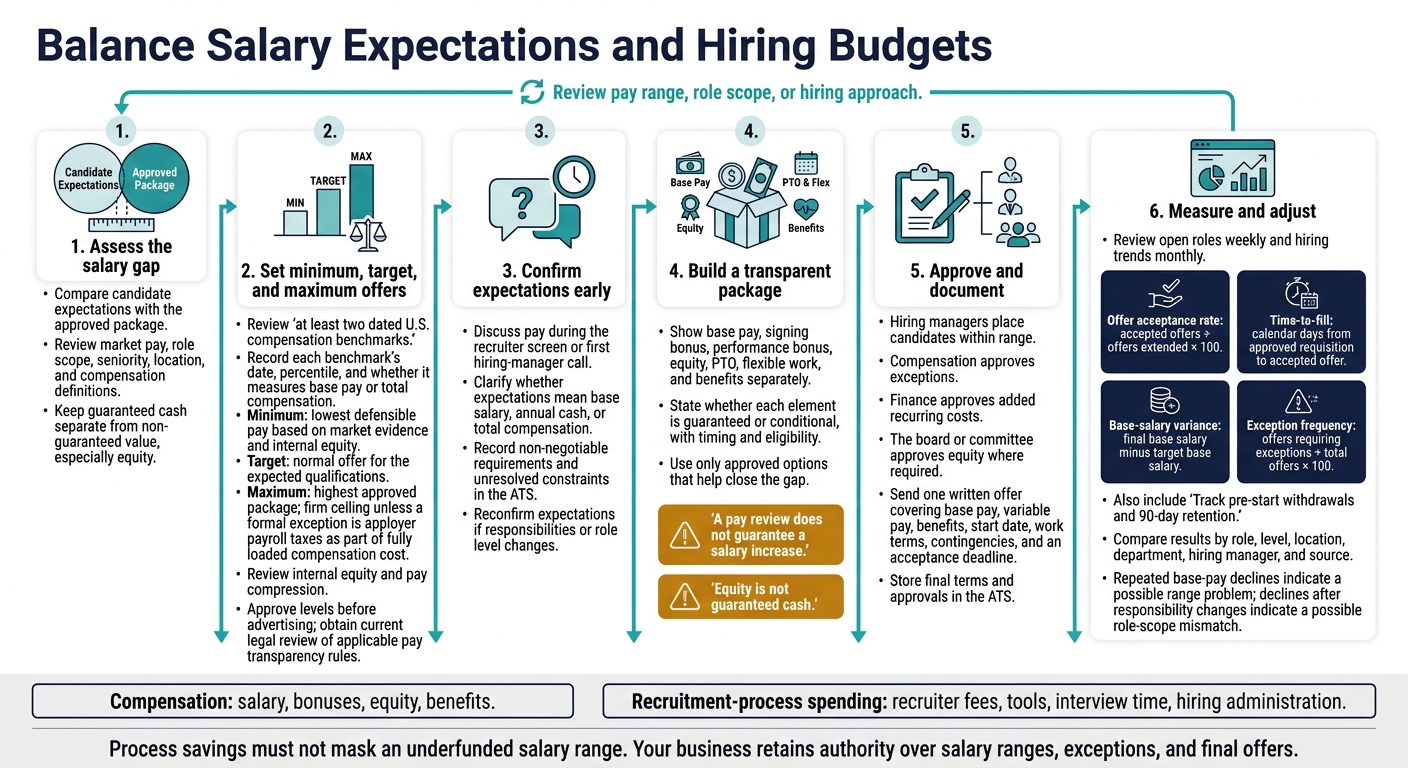
Balance Salary Expectations and Hiring Budgets
Assess the Salary Gap and Set a Pay Range
Find the mismatch before changing the budget. Review market pay, role scope, seniority, location, and how each side defines compensation. If the role includes broader responsibilities, management duties, or scarce skills, reassess its level before increasing pay.
This helps you decide whether you need a better package, a different role level, or a different candidate.
Compare Candidate Expectations With the Budget
Compare your approved package with the candidate’s stated expectations. Keep guaranteed cash separate from non-guaranteed value, especially equity. Use the worksheet below to identify what you can negotiate and which costs are fixed.
| Compensation element | Employer budget | Candidate ask | Decision |
|---|---|---|---|
| Base salary | Approved annual range | Annual guaranteed cash requested | Negotiable within approved range |
| Bonus or commission | Target and maximum payout | Target payout or on-target earnings | Conditional on results |
| Sign-on payment | Approved one-time limit | Requested payment | Negotiable; approval required |
| Equity | Grant size, vesting, and valuation assumptions | Expected grant and perceived value | Conditional and uncertain; not salary |
| PTO and remote flexibility | Policy and permitted exceptions | Requested days and work arrangement | Negotiable within policy |
Check the offer’s fully loaded cost, including benefits and employer payroll taxes. Factor in recruiting, onboarding, and vacancy costs too. Review internal pay equity before increasing the ceiling.
Define Minimum, Target, and Maximum Offers
Review at least two dated U.S. compensation benchmarks, such as BLS occupational data and a reputable compensation survey. Match the role’s level, location, industry, company size, and skills.
Record each benchmark’s date and percentile, and whether it measures base pay or total compensation. Use that evidence to set an approved ceiling so recruiters don’t promise pay your business cannot approve.
| Offer level | Purpose | Approval requirements | Negotiation use |
|---|---|---|---|
| Minimum | Lowest defensible pay based on market evidence and internal equity | Hiring manager and HR or compensation approval | Use only when the candidate meets requirements and the full package remains competitive |
| Target | Normal offer for the expected qualifications | Standard budget and compensation approval | Intended offer for a qualified candidate |
| Maximum | Highest approved package | Written finance and executive approval with rationale | Firm ceiling unless a formal exception is approved |
Approve these levels before advertising. Recruiters can then focus on candidates within budget, while finance can forecast hiring costs consistently.
Publish an approved range that reflects what you genuinely expect to pay. Label it clearly as annual or hourly. Get current legal review of applicable state and local pay transparency rules before posting, as requirements vary.[1][2][3][4]
Before approving the range:
- [ ] Fully loaded costs fit the budget.
- [ ] Internal equity and pay compression have been reviewed.
- [ ] Offer levels and exception approvers are documented.
- [ ] The published range meets applicable rules, and recruiters know the ceiling.
sbb-itb-a23bd6a
Align Expectations and Build an Offer Within Budget
Discuss Base Salary Expectations Early
Once you approve the range, confirm pay fit during the recruiter screen or first hiring-manager call. Resolve salary expectations before investing time in more interviews. Ask for the minimum base-salary range that would make the role viable, then check whether the candidate means base salary, annual cash, or total compensation.
Keep the discussion within the approved U.S. dollar range. Explain how level, location, scope, experience, and skills determine placement within it.
Ask about non-negotiable requirements for remote work, location, travel, benefits, equity, or relocation. Log the answers in the ATS, including any unresolved constraints, before proceeding. Reconfirm expectations if the role’s responsibilities or level changes, and never promise flexibility without approval.
Focus on expected pay, not past earnings. Do not ask for prior salary where state or local law prohibits it.[5][6]
Compare Bonuses, Equity, Benefits, and Flexibility
If base salary cannot move, consider other parts of the package. Use only the options that help close the gap. List each element separately, explain whether it is guaranteed or conditional, and state its timing and eligibility.
Clear terms can help prevent late-stage withdrawals. They cannot turn an uncompetitive base salary into a competitive one.
| Offer element | Employer cost | Candidate value | Approval needed | Timing and eligibility |
|---|---|---|---|---|
| Signing bonus | One-time cash cost | Immediate cash | Finance or executive approval | Payment date; repayment triggers |
| Performance bonus | Recurring budget exposure if earned | Conditional cash | Approved bonus plan | Metrics, target, maximum, proration, payment date |
| Equity | Potential long-term cost and dilution | Potential future value, not guaranteed cash | Board or designated committee, where required | Vesting, exercise terms where applicable, expiration, termination rules |
| Paid time off | Leave cost and any payout obligation | Paid leave and recovery time | Applicable policy or exception approval | Accrual, carryover, waiting periods, payout rules |
| Flexible work | Added technology, travel, or management costs | Autonomy and reduced commuting burden | Role and manager approval | Work location, core hours, travel expectations, review conditions |
| Health, retirement, and other benefits | Recurring employer premiums or contributions | Insurance, retirement savings, and protection | Plan eligibility | Coverage start, employee costs, contribution formulas |
Explain vesting and tax timing in plain language. RSUs are generally taxable when they vest. Stock options can create tax consequences at exercise, so candidates should review the plan documents with a qualified tax adviser.[7][8]
Make bonus conditions and repayment terms clear. A pay review does not guarantee a salary increase.
Approve and Document the Complete Offer
Set approval authority before negotiations begin. Hiring managers place candidates within range, compensation approves exceptions, and finance approves added recurring costs. The board or committee approves equity where required.
Record the reason for each exception and any measurable conditions for future adjustments. This gives you a clear record of what was approved and why.
Send one written offer covering base pay, variable pay, benefits, start date, work terms, contingencies, and an acceptance deadline. Allow reasonable review time based on the package’s complexity, give the candidate one contact for questions, and issue revised terms after material changes.
Store the final package and approvals in the ATS, alongside acceptance, decline, and exception data, so you can review offer outcomes and costs later. For more tools to optimize your hiring process, explore our recruitment resources.
Measure Offer Results and Recruitment Costs
Once offers go out, check whether your approved pay range is working. Review open roles weekly and hiring trends monthly to see whether offers lead to acceptances or require exceptions. Track:
- Offer acceptance rate: accepted offers ÷ offers extended × 100.
- Time-to-fill: calendar days from approved requisition to accepted offer.
- Base-salary variance: final base salary minus target base salary.
- Exception frequency: offers requiring exceptions ÷ total offers × 100.
Compare results by role, level, location, department, hiring manager, and source, rather than relying on company-wide averages. Low acceptance, frequent exceptions, and long fill times may point to a mismatch between salary expectations and your budget.[9][10]
Log internal hiring and administrative hours weekly, including scheduling, interviews, approvals, and offer preparation. Multiply those hours by each employee’s fully loaded labor cost per hour.
Keep recruitment-process costs separate from compensation. Track recruiter fees, tools, and interview time separately from salary, bonuses, equity, and benefits. Report cost per hire alongside compensation variance so process savings don’t mask an underfunded salary range.[10][11]
Record structured reasons for declined offers, then compare them with candidates’ stated expectations and your approved budget. Repeated declines over base pay may point to a range problem. Declines after changes to responsibilities may suggest a mismatch in role scope. This helps you identify whether pay, scope, or both need attention.
Count accepted offers that are withdrawn before the start date. Monitor 90-day retention or other quality-of-hire indicators, too. Faster, cheaper hiring isn’t automatically better hiring.
Use Embedded Recruiters to Support Hiring Demand
If hiring volume is stretching your team, embedded recruiters can add capacity without changing who controls salary decisions. Rent a Recruiter provides embedded recruiters to support hiring execution. Whether the service fits your business depends on hiring volume, role complexity, duration, and support needs.
Keep the service fee within recruitment-process spending. Your business retains authority over salary ranges, exceptions, and final offers. Measure performance against your baseline using offer acceptance, time-to-fill, internal hours, and retention.
Process data should help you improve hiring, not replace pay analysis. Rent a Recruiter’s free recruitment health check can assess workflows and bottlenecks. Use it to improve the process, not to set pay. Link findings to measurable changes, such as shorter approval delays or fewer administrative hours per hire.
Rent a Recruiter states that clients can save more than 80 internal hiring and administrative hours per month. Check that claim against your own time logs.[9][10]
Conclusion: Keep Offers Fair and Within Budget
Aim for a fair offer that balances candidate expectations, market pay, and internal equity without stretching your budget.
If acceptance rates stay low or pay exceptions keep increasing, review your pay range and approval limits before making more offers.
For surge hiring, Rent a Recruiter adds embedded recruiting capacity while keeping pay decisions under your control.
FAQs
When should we raise our hiring budget instead of redefining the role?
Increase your hiring budget when leaving a role vacant costs more than the extra salary. For high-impact, revenue-generating, or hard-to-fill roles, lost productivity could cost $500 per day.
If your offers consistently fall below market benchmarks and acceptance rates are low, a higher budget is needed to stay competitive.
Rent a Recruiter embeds experienced recruiters who bring structure and visibility to your hiring process, helping you direct your budget where it supports growth.
How can we negotiate pay without losing a strong candidate?
Build offers around total compensation, not just base salary. If your salary budget is capped, consider extra PTO, a higher 401(k) match, better health coverage, professional development funding, or remote or hybrid work.
Ask what matters most to each candidate and share salary ranges early to align expectations. Back your offer with clear growth opportunities. Agree on negotiation limits with Finance before making the offer to avoid approval delays, and set an expiration date of 5 to 7 business days.
How do we prevent a higher offer from creating pay inequity?
Agree clear, pre-approved salary ranges with Finance before posting roles. Use market data to keep pay consistent, and check alignment with a compa-ratio: the proposed salary divided by the market median.
If a candidate’s salary expectations exceed your range, avoid inflating base pay and creating internal pay gaps. Instead, strengthen the total offer with flexible scheduling, professional development budgets, or better benefits.