
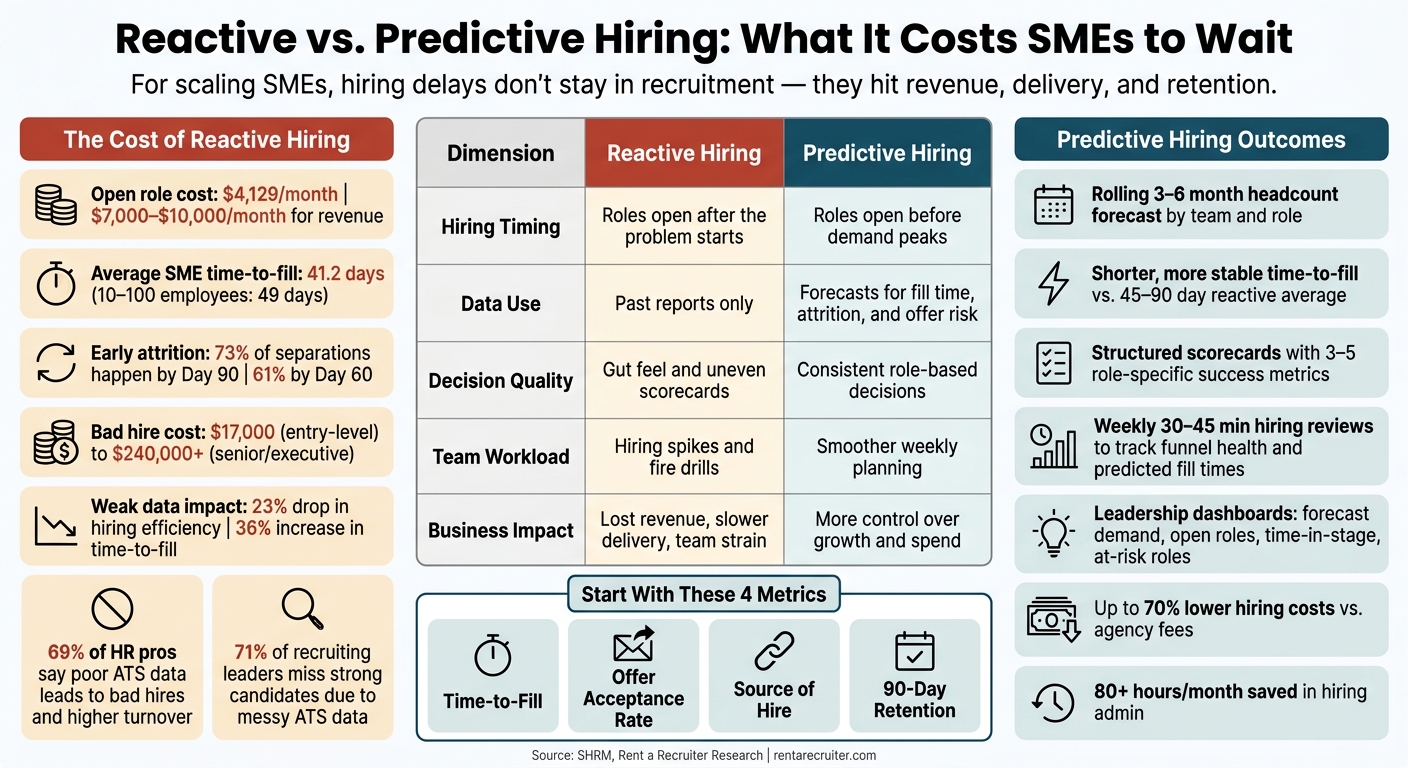
If one open role can cost you $4,129 a month, or $7,000 to $10,000 in a revenue role, waiting to hire is expensive.
I see the core point like this: predictive hiring analytics helps you plan hiring before demand turns into a gap. That gives you more control over headcount, lowers the cost of delay, and cuts the risk of rushed hiring that leads to poor retention.
For scaling SMEs in SaaS, tech, fintech, engineering, security, insurance, and professional services, the upside is clear:
- forecast hiring demand earlier
- spot roles likely to miss hiring targets
- improve time-to-fill and offer planning
- cut rework from poor-fit hires
- give leadership a clearer view of hiring risk and spend
The article also makes a plain point about execution: data alone does not fix hiring; you may need to rate your recruitment process to find the gaps. You need clean ATS data, role-based success measures, weekly review rhythms, and someone close to the process to act on the numbers. That is where embedded recruitment and support from Rent a Recruiter can help, especially if you want up to 70% lower hiring costs versus agency fees and 80+ hours a month saved in hiring admin.
A simple way to read the article is this:
| What changes | Reactive hiring | Predictive hiring |
|---|---|---|
| Hiring timing | Roles open after the problem starts | Roles open before demand peaks |
| Business impact | Lost revenue, slower delivery, team strain | More control over growth and spend |
| Data use | Past reports only | Forecasts for fill time, attrition, and offer risk |
| Decision quality | Gut feel and uneven scorecards | More consistent role-based decisions |
| Team workload | Hiring spikes and fire drills | Smoother weekly planning |
If you are scaling and still hiring role by role, this article shows why that model starts to break, and what to put in place instead.
Reactive vs Predictive Hiring: The SME Cost of Waiting
HR Analytics & Workforce Intelligence | How Data, AI and Predictive Analytics Are Transforming HR
sbb-itb-a23bd6a
The Problem: Why Reactive Hiring Breaks Down as SMEs Scale
Most SMEs do not struggle because they lack effort. They struggle because they hire too late.
As your business grows, the gap between demand and hiring capacity gets more expensive. A funding round, product launch, market entry, or sudden jump in demand can turn a hiring delay into lost revenue fast. At that point, the issue is not how hard your team is working. It is visibility.
Unplanned Hiring Demand Leads to Delays and Missed Growth
When hiring starts with ad hoc manager requests instead of a headcount plan, visibility drops across the business. Teams push for roles at different times. Priorities shift. Some roles open too late, while others open in the wrong sequence, with support hires approved before the revenue-generating roles needed to pay for growth.
That creates drag across the business, and the data backs it up. SMEs with 10 to 499 employees take an average of 41.2 days to hire, almost 10 days longer than larger companies.[4] Small businesses with fewer than 100 employees take an average of 49 days to fill a role.[3]
That delay does not stay in recruitment. It hits revenue, delivery, and customer experience at the same time.
Then the second-order problems kick in. Existing teams carry the extra workload. Burnout risk goes up. The people meant to drive growth end up filling gaps instead.
Missing Data Drives Up Costs and Weakens Hiring Decisions
If your recruitment reports and hiring data are weak, you cannot see where the process is slowing down.
Without clean, consistent funnel data on source quality, conversion rates, offer acceptance, and 90-day attrition, SMEs are left guessing. They add more activity without fixing the actual bottleneck. More sourcing. More interviews. More admin. But not better hiring.
That pushes up cost per hire and pulls hiring managers into time-heavy reviews of poor-fit candidates.
The scale of the issue is hard to ignore. A SHRM survey found 69% of HR professionals believe poor data quality in recruiting software leads to poor hiring decisions and increased turnover.[6] Organizations with weak recruitment data see a 23% drop in hiring efficiency and a 36% increase in time-to-fill.[6] At the same time, 71% of recruiting leaders say they miss strong candidates because of messy ATS data.[6]
When you cannot see where candidates are dropping out, you cannot fix it.
And when you cannot fix it, cost keeps climbing.
Unstructured Hiring Increases Early Attrition and Rework
When interviews are inconsistent and scorecards vary from one interviewer to the next, it becomes much harder to judge candidates against what the role needs. In practice, hiring slips toward gut feel instead of job fit.
That is a costly habit, especially for scaling companies.
In high-volume environments, 73% of all separations happen by day 90, and 61% happen within the first 60 days.[5] One bad hire can cost anywhere from $17,000 for entry-level roles to $240,000+ for senior or executive roles.[7] Then there is the refill cost in time. With an average of 42 days to refill those roles,[7] the business lands back at the start, slower, more expensive, and no better prepared to stop the same mistake from happening again.
Without role-specific success criteria, hiring defaults to gut feel. That is the gap predictive hiring analytics is built to close.
The Solution: How Predictive Hiring Analytics Improves Hiring Speed, Quality, and Control
Predictive hiring analytics shifts hiring from reactive to planned. For SMEs, that means more visibility, earlier action, and tighter control over headcount.
Forecast Headcount Needs Before Hiring Becomes Urgent
Start by linking business data to your hiring plan. Instead of waiting for a manager to report a gap, you model when demand is likely to land and open roles early enough to meet it.
That usually means combining past hiring data with business inputs such as your sales pipeline, signed contracts, product roadmap milestones, and known seasonal demand. A SaaS company, for example, can model how many customer success hires it needs for each extra slice of ARR closed. From there, it can back-schedule openings based on typical onboarding lag and past fill time for that role.
The output is a rolling 3 to 6 month headcount forecast by team and role, updated monthly as pipeline and business conditions change. That leads to earlier req timing, fewer last-minute hiring scrambles, and start dates you can actually plan around.
The business impact is simple: fewer hiring delays that slow revenue, delivery, and customer response.
Once demand is forecast, the next job is to rank candidates with the same discipline.
Prioritize Candidates More Consistently and Cut Time-to-Fill
Most SMEs lose too much recruiter time on low-fit applicants. Predictive analytics helps you spot stronger candidates earlier, so the best people move to the top faster.
It starts with 3 to 5 role-specific success metrics. For account executives, that might be quota attainment history. For customer success roles, it could be CSAT impact. Structured application questions and scored phone screens then give you comparable data across every applicant.
Clean intake data and scored screens turn day-to-day recruiting activity into hiring signals you can use. When those signals are tagged in your ATS and reviewed against past outcomes, patterns start to show up. Candidates with high scores and the right background can be pushed up the queue automatically, which cuts shortlist time. Your recruiters spend time where it counts first, and hire quality improves.
There’s another upside here. Consistent scoring gives leaders a clearer read on hiring risk across roles and hiring managers.
Use Data to Improve Decision Consistency and Leadership Visibility
Standardized scorecards help hiring teams assess candidates against the same criteria, rather than relying on different gut calls. Scorecards with behavioural anchors, role-specific indicators, and a required hire or no-hire recommendation bring more discipline to the process.
That matters because rushed, uneven hiring often leads to early attrition and repeat vacancies. And that gets expensive fast.
Predictive indicators, such as composite interview scores and prior performance data from similar hires, can show which patterns link to 12-month retention and strong performance ratings. Over time, analytics can also flag where individual managers keep drifting away from those patterns. That gives you a clear opening for coaching and drives more even decision quality across the business.
The difference between reactive and predictive hiring shows up across the whole hiring function:
| Dimension | Reactive Hiring | Predictive Hiring |
|---|---|---|
| Planning approach | Ad hoc and reactive | Planned around business demand |
| Time-to-fill | Less stable, often 45 to 90 days | More stable and typically shorter |
| Attrition risk | Higher, due to rushed, inconsistent evaluation | Lower, driven by standardized scorecards and data-backed fit signals |
| Recruiter workload | Spiky and crisis-driven | Smoother and more predictable |
| Leadership visibility | Fragmented data and little forward visibility | Clear dashboards showing forecast demand, hiring progress, and risk by quarter |
At a minimum, your dashboards should show:
- Forecast demand
- Open roles
- Time in stage
- Projected fill time
- At-risk roles
That visibility gets far more useful when SMEs turn it into a simple, repeatable hiring framework.
How SMEs Can Build a Predictive Hiring Framework Without Overcomplicating It
SMEs do not need heavy systems to use predictive hiring analytics. What you need is a simple way to use data you already have, your ATS, past hiring data, and basic reporting.
The job is not to build a perfect model on day one. It is to turn those signals into a simple hiring rhythm your team can use every week.
Start With the Right Metrics and Clean Recruitment Data
Start with a small set of metrics that covers speed, cost, quality, and pipeline health. For U.S.-based SMEs, that usually means tracking time-to-fill, funnel conversion rates at each stage, source quality by 12-month retention, offer acceptance rate, cost per hire in USD, 90-day attrition, and 12-month retention.
This gives you a clear view of what is slowing hiring down, what is costing too much, and which channels are bringing in people who stay.
Clean data matters here. If your ATS is full of messy job titles, mixed salary formats, and free-text fields, your reporting will drift fast. Standardize job titles, seniority levels, and salary fields in the ATS. Use dropdowns instead of free text.
Once your data is clean, you can rate your recruitment to define what success looks like and start using that benchmark to spot which candidates are more likely to do well.
Define What a Successful Hire Looks Like by Role
Success should be defined by role, not by gut feel.
Work with hiring managers to set 3 to 5 measurable first-year outcomes for each role. For a sales development representative, that might include being retained at 12 months, hitting qualified pipeline targets by month 6, and meeting agreed activity standards during the first 90 days.
That gives your team a shared scorecard. It also makes interviews more consistent and helps you see which sources, interview scores, or profile traits are linked to good hires in your business.[8][9]
Put simply, if you do not know what a good hire looks like, you cannot predict one.
With those success markers in place, keep the first test small and focused on the roles that matter most.
Pilot on High-Impact Roles and Build Into Weekly Hiring Operations
Start narrow. Pick one or two high-impact role families where hiring volume is high enough to give you usable data, and where performance can be measured clearly.
A simple way to rank roles is to look at:
- Annual hiring volume
- Direct link to revenue or customer results
- Current pain points, such as attrition, mis-hires, or slow fill times
Pilot the top one or two roles first.
Run the pilot over 30 to 90 days. Audit the data you already have, set baseline metrics, apply simple scoring rules based on your success definitions, and review results every week.
A short weekly hiring review, around 30 to 45 minutes, is usually enough. Keep it focused on active roles, funnel health, and predicted fill times. That keeps predictive hiring close to day-to-day decisions without piling on admin.[2][1][10]
The table below shows how core metrics and predictive indicators work together, and where each one fits in practice:
| Metric Type | Metric | Data Source | Primary Use | Business Impact |
|---|---|---|---|---|
| Foundational Metric | Time-to-fill | ATS / HRIS | Measure hiring speed | Plan capacity; reduce delays |
| Foundational Metric | 90-day attrition | HRIS / payroll | Track early turnover | Identify mis-hire and onboarding issues |
| Foundational Metric | Cost per hire | Finance / HR | Monitor hiring spend | Control cost of growth |
| Predictive Indicator | Source → 12-month retention | ATS + HRIS combined | Forecast candidate longevity | Prioritize high-retention channels |
| Predictive Indicator | Interview score | ATS / interview logs | Estimate ramp and performance | Improve selection accuracy |
| Predictive Indicator | Offer competitiveness against salary band | Compensation data | Predict offer acceptance probability | Reduce offer declines and time-to-fill |
This works best when recruiters are part of the hiring process day to day and demand is reviewed weekly. That is one reason many scaling firms look at an embedded recruiter model. It keeps hiring data, hiring decisions, and hiring delivery close together, which saves time and helps you act on the numbers faster.
Operationalizing Predictive Hiring With Embedded Recruitment Support
Predictive hiring only works when someone owns the weekly follow-through.
It starts to fall apart when ATS data is patchy, interview feedback lives in Slack or inboxes, and reports show up too late to shape hiring decisions. If no one owns the process, forecasts don’t change what your team does next.
Where Rent a Recruiter Fits Into a Predictive Hiring Strategy
Rent a Recruiter places recruiters inside your ATS and day-to-day hiring workflows, so stage updates, scorecards, and reporting stay current. That matters more than most teams think. If the data is out of date, the forecast is off. And if the forecast is off, hiring plans drift.
Embedded recruiters run structured intake sessions with hiring managers to define role success profiles, roll out consistent scorecards across interviews, and keep a regular reporting rhythm so leadership can see pipeline health clearly.
They also turn forecast changes into action straight away. If demand shifts, sourcing, screening, and interview capacity shift with it. So if you’re expecting a post-launch spike in engineering hiring, an embedded recruiter can start building pipeline earlier and open up more interview capacity before the pressure lands.
This model works well for high-growth SMEs with hiring demand that changes fast, especially in technology, SaaS, fintech, engineering, and professional services. The gap is rarely just a data problem or just a capacity problem. It’s both.
Business Outcomes: Lower Cost of Growth, More Capacity, Better Forecasting
A fixed monthly model makes hiring spend easier to plan and can cut hiring costs by up to 70%, while saving 80+ hours per month in internal hiring and admin time. That time goes back into onboarding, product delivery, or customer operations.
The impact is even clearer during post-funding scale-ups or multi-role expansion phases, when slow or uneven hiring gets expensive fast. With sourcing, pipeline management, candidate coordination, and offer management handled by dedicated embedded recruiters, founders, HR generalists, and line managers can stay focused on the work that drives growth.
Conclusion: Build a More Predictable Hiring Engine
Predictive hiring analytics gives SMEs a better grip on growth. You can forecast headcount, cut time-to-fill, improve hire quality, and give leadership a clearer view of pipeline risk. That shifts hiring from a reactive scramble to planned capacity building ahead of demand. The business impact is simple: steadier revenue planning and tighter control over growth.
You do not need a data science team to get started. Start with a simple hiring forecast and a small set of metrics:
- time-to-fill
- offer acceptance rate
- source of hire
- 90-day retention
Each hiring cycle gives you more data. Over time, your forecasts get sharper. Predictive hiring works much like financial forecasting. The more consistently you track it, the better your planning gets.
If you need more hiring capacity as well as better forecasting, Rent a Recruiter can help. An embedded recruiter working inside your team can deliver up to 70% lower hiring costs and 80+ hours saved per month. That is time and budget you can put straight back into growth. You can Book a Call to talk through your hiring challenges, or use the ROI calculator to see what this model could mean for your recruitment budget.
The best scaling companies build a hiring process that gets better every quarter.
FAQs
What data do we need to start predictive hiring?
Start with clean, standardised data from your ATS and HRIS, ideally covering at least 2 years or 8 quarters.
That gives you enough history to spot patterns, compare periods, and make hiring decisions based on evidence instead of guesswork. If your data is patchy or inconsistent, your reporting will be too, and that leads to poor planning, wasted time, and higher hiring costs.
Track requisition data such as job title, department, location, work model, seniority, salary range, and opening date. Then layer in candidate data, including source, application date, stage progression, interviews, stage duration, offer outcome, and start date.
Don’t stop at the offer stage. Add post-hire data like 90-day retention and performance ratings so you can see which hiring channels, teams, and role types lead to hires that stick and perform well.
In plain terms, this is how you move from activity tracking to hiring outcome tracking. And that’s where better forecasting, lower cost-per-hire, and stronger hiring decisions start to show up.
How soon can an SME see results from predictive hiring analytics?
SMEs can start seeing measurable results from predictive hiring analytics within 90 days.
In most cases, the first 30 days are spent cleaning data and auditing the Applicant Tracking System. Days 31 to 60 usually focus on building the model. The final 30 days are used to compare predictions against actual hiring outcomes.
The key is keeping the scope tight. When you focus on one high-impact hiring problem, your team can start acting on early insights by the end of the first three months.
Which roles should we pilot predictive hiring analytics on first?
Start with one high-volume, business-critical role family that has a direct link to revenue or customer results, such as sales, software engineering, or customer success. Put your attention on the role where hiring risk is highest.
This matters because trying to fix every role at once usually slows things down. A tighter focus gives you a clear line of sight to impact, whether that’s more sales capacity, faster product delivery, or better customer retention.
Then narrow it further. Pick one measurable hiring problem you can improve within 30 to 90 days. Use the last 6 to 12 months of hiring data to spot where the payoff is biggest.
That could be:
- Time-to-fill staying too high for revenue-driving roles
- Offer acceptance dropping in a key team
- Hiring manager delays creating bottlenecks
- Too many late-stage dropouts in interview process
When you anchor the work to one role family and one clear problem, it becomes much easier to show cost saved, time saved, and hiring output improved.