
If you only compare the fee line, you can miss the part of hiring cost that hits your team later.
If you are choosing between staffing platforms and agency support, the short answer is this: agencies often cost more per hire, but they take more work off your team. Platforms can look cheaper, but your managers, HR team, or talent team usually pick up more of the work. For scaling companies, that choice affects cash spend, team time, and budget control.
Here’s the commercial view:
- Agency markups for contract hiring often sit around 25% to 75%
- Placement fees for permanent hires often land around 15% to 30% of first-year salary
- A small gap in fees can turn into a large cost issue when you are hiring across multiple roles
- Lower platform pricing can still cost you more if your team spends hours on screening, scheduling, and follow-up
- Embedded recruitment can make more sense when you need repeat hiring capacity on a fixed monthly cost
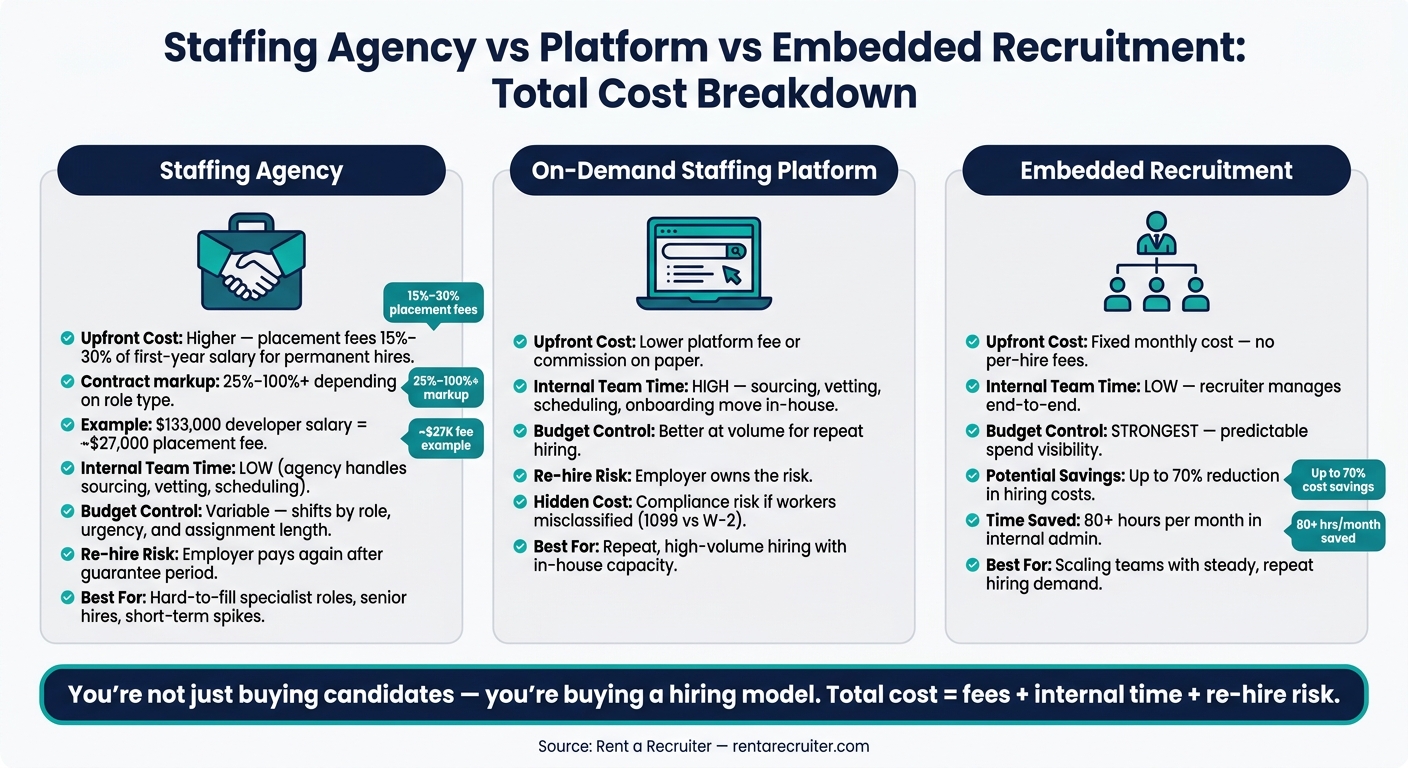
Staffing Agency vs Platform vs Embedded Recruitment: Total Cost Comparison
How much does a Recruitment Agency cost in 2025?!
sbb-itb-a23bd6a
Quick Comparison
| Model | Upfront Cost | Internal Team Time | Budget Control | Best Fit |
|---|---|---|---|---|
| Staffing Platform | Lower fee on paper | Higher | Often better at volume | Repeat hiring with in-house capacity |
| Agency | Higher hourly markup or placement fee | Lower | Can shift by role, urgency, and length | Hard-to-fill roles or short-term hiring spikes |
| embedded recruitment | Fixed monthly cost | Lower than self-service models | Stronger spend visibility | Scaling teams with steady hiring demand |
The key point is simple: you are not just buying candidates. You are buying a hiring model, and each model changes your total cost, internal workload, and hiring output.
I’d read the rest of this article through one lens only: what will this cost your business after fees, team time, and refill risk are added together?
How Staffing Agencies Price Temporary and Contract Hiring
Hourly Bill Rates, Markups, and Common Fee Models
The basic math is simple. Bill rate = worker pay rate + agency markup.
That markup covers payroll taxes, insurance, recruiting, screening, compliance, and admin before profit. Even then, the agency’s net margin on temp staffing is often just 3% to 8% [3].
For a worker earning $25.00/hour, a 50% markup brings the bill rate to $37.50/hour [2]. That extra $12.50 per hour does not go straight to profit. It is usually split across employment costs and agency delivery work.
| Component | Cost per Hour | What It Covers |
|---|---|---|
| Worker Pay Rate | $25.00 | Gross hourly wage paid to the worker |
| Statutory Burden | $4.50 | Employer FICA, FUTA, SUTA, and workers’ compensation |
| Program & Admin | $5.50 | Recruiting, background checks, and payroll processing |
| Total Bill Rate | $37.50 | What you’re invoiced per hour |
This is where many hiring teams get caught out. The hourly charge may look clear at first glance, but it rarely tells the whole cost story.
Temp-to-hire conversion fees often run 10% to 25% of the worker’s first-year salary [2]. For direct permanent hires, agencies usually charge 15% to 30% of first-year salary, with 20% being a common benchmark [2]. So if you’re using temp staffing as a path to permanent hiring, the total spend can climb well beyond the hourly bill rate.
Those charges are only part of the picture. Pricing gets less predictable once role type, urgency, and assignment length start to shift.
What Drives Agency Cost Variance
The bill rate is the easy number to spot. The hard part is that markups can move a lot by job type [3].
| Role Category | Typical Markup Range |
|---|---|
| Administrative / Clerical | 25% to 50% |
| Light Industrial (Warehouse, Manufacturing) | 35% to 60% |
| Skilled Trades (Electricians, Technicians) | 40% to 75% |
| Professional Services (IT, Accounting, Engineering) | 50% to 100%+ |
| Healthcare | 100%+ |
A big part of that spread comes down to role specialisation. Hard-to-fill jobs cost more. But timing matters too, and so does assignment length.
Short assignments, especially those under two weeks, often come with higher rates. The reason is straightforward: the agency has less time to recover recruiting and onboarding costs across billable hours. If you need someone fast, the price can climb again. Rush requests may add a 10% to 25% premium on top of the standard markup. Many agencies also set a 4- to 8-hour minimum per shift [3].
Then there are conversion fees, which can make cost planning messy. If you want to hire a temporary worker directly before they reach the agency’s waiver threshold, often 520 to 1,000+ hours, you may owe a buyout fee [2]. In practice, the waiver schedule often decides whether that fee applies [2].
That is the trade-off with agency pricing. It is usually easier to quote at the start than to keep under control as hiring needs change. Platform pricing shifts that balance by changing how you pay for access, control, and internal effort.
How On-Demand Staffing Platforms Compare on Cost and Control
Platform Fees, Transaction Pricing, and Self-Service Trade-Offs
On-demand staffing platforms usually charge the worker’s hourly rate plus a platform fee or commission. In many cases, that fee is lower and easier to predict than a standard agency markup.
On paper, that can look like a clear win. But cost on paper and cost in practice are not always the same.
The lower fee can be misleading if your team ends up doing the work a traditional recruitment agency would normally cover. With a self-service platform, sourcing, vetting, scheduling, and onboarding often move in-house. For a lean SME that is already stretched, that internal time cost can quietly eat into the savings.
If your hiring team is small, conducting a recruitment health check matters. A lower platform fee may save cash at the point of purchase, but it can also pull managers, HR, or ops leads into admin-heavy work that slows down the rest of the business.
Fee structure is only one part of the comparison. Worker classification changes the actual cost base.
W-2 vs. 1099 Arrangements and Their Impact on Total Cost
How a platform classifies workers has a direct impact on both what you pay and what sits on your side of the desk. Some platforms act as the Employer of Record (EOR), handling tax withholding, workers’ comp, and benefits under a W-2 setup. Others connect you with 1099 independent contractors, which shifts tax and compliance responsibility back to your team.
That changes more than admin. It changes cost, control, and risk.
A misclassified 1099 arrangement can wipe out any saving very fast, so you need to check worker status before you engage. What looks cheaper at first glance can become far more expensive once payroll handling, legal review, and internal oversight are factored in.
| Cost Component | W-2 Platform (EOR Model) | 1099 Platform (Contractor Model) |
|---|---|---|
| Tax withholding and payroll handling | Handled by the platform | Shifted to your team |
| Workers’ comp and benefits | Handled by the platform or EOR | Not covered by the platform |
| Internal admin work | Lower | Higher |
| Compliance risk | Lower when properly structured | Higher if worker is misclassified |
The 1099 model can look cheaper on paper. But once you account for internal compliance work and classification risk, the gap can narrow fast.
That trade-off comes into sharper focus when you compare direct fees against the internal time and compliance effort needed to support them.
Total Cost of Ownership: Agencies vs. Platforms
Direct Hourly Cost vs. Hidden Internal Effort
Once you look past markup, the next issue is simple: what does the hire cost your team to run?
For a $133,000 developer salary, a 20% agency placement fee adds about $27,000 upfront [1]. And salary is only the first line item. Payroll taxes, benefits, equipment, and overhead push the full cost up fast. If that person leaves after the guarantee period, you may need to pay again to refill the role [1][5].
That’s where the gap between agencies and platforms becomes clear. One cost sits on the invoice. The other shows up in your team’s time.
| Cost Factor | Staffing Agency | On-Demand Platform |
|---|---|---|
| Visible fee | Placement fee or hourly markup | Lower platform fee or subscription |
| Internal effort | Low | Higher; your team handles more of the top of the funnel |
| Re-hire risk | Employer pays again after the guarantee period | Employer owns the risk |
| Cost predictability at volume | Cost rises with each hire | Better for repeated hiring cycles |
Internal labor is part of total cost of ownership. A lower fee is not automatically the cheaper option if your team spends more time screening, coordinating, and backfilling roles.
When Agencies Make Sense and When Platforms Work Better
The right model depends less on headline price and more on role type and hiring volume.
Agencies tend to make sense for one-off, specialist hires, especially when speed matters and your internal team has limited bandwidth. Platforms tend to work better for repeatable, higher-volume hiring, where your team can take on more coordination at the top of the funnel.
In other words, you’re not just buying access to candidates. You’re buying a hiring model. The best choice comes down to how much work your team can absorb, and how often you need to hire. You can also rate your recruitment process to identify specific efficiency gaps.
How Embedded Recruitment Can Lower Total Hiring Cost
For SMEs with repeat hiring needs, a fixed-capacity model can lower the swings in per-hire cost.
Rent a Recruiter places experienced recruiters inside your team within days, managing hiring end-to-end for a fixed monthly cost. That gives you more control over spend, without the per-hire fees that stack up as hiring grows.
Companies using this model can reduce hiring costs by up to 70% and save more than 80 hours per month in internal hiring and admin time [4].
Conclusion: Choosing the Right Staffing Model for Your Budget and Growth Plan
Model Your Costs Before Committing to a Staffing Route
The core takeaway is straightforward: no single staffing model works best in every case. The right choice comes down to the roles you’re hiring for, your expected hiring volume, and how much work your internal team can realistically take on.
The headline fee gets attention, but total cost of ownership is what shapes the true budget impact. That means looking at fees, internal time, and replacement risk before you commit to a route.
Use traditional recruitment agencies for roles you genuinely can’t fill another way, such as rare specialists or senior leaders where the search process warrants the fee [1]. Use embedded recruitment for repeat hiring when you need steady capacity and more control over delivery. That shifts the decision away from price alone and back to what matters: how much hiring work your team can absorb, and what it will cost if they can’t.
Next Step: Get a Savings Estimate
If growth is speeding up, delays get expensive fast. Rent a Recruiter places experienced recruiters directly into your team within days, managing hiring from start to finish for a fixed monthly cost. If you want a tailored estimate, book a call or request a savings model for your headcount plan.
FAQs
How do I calculate total hiring cost?
To calculate total hiring cost, look back over the last 6 to 12 months and add up both direct and hidden spend.
That includes internal recruiter salaries and benefits, admin time, ATS and sourcing tools, job ads, background checks, and any agency fees.
Then add vacancy drag, the lost productivity that builds while roles sit open.
Once you have the total, divide it by the number of hires. That gives you your cost per hire and lets you compare recruitment models on a like-for-like basis.
When is an agency worth the higher fee?
A traditional agency can justify the higher fee in a small number of cases:
- Confidential executive searches
- Highly specific niche roles your in-house team can’t source
- Sudden, short-term hiring spikes your team isn’t staffed to handle
That’s where the model tends to make commercial sense.
Used this way, an agency is a specialist tool. Not a default hiring model.
For broad, repeatable, or high-volume hiring, percentage-based fees can get expensive fast. And when hiring plans ramp up, those commissions often become hard to defend against the time saved, cost saved, and control you could get from a different setup.
How many hires justify embedded recruitment?
Embedded recruitment tends to work best for companies making 10 to 24 hires a year. At that level, shifting from unpredictable commission-based agency fees to a fixed monthly retainer often gives you a better return on investment.
If you’re hiring fewer than 10 people per year, contingent agencies may still do the job. If you’re hiring 25 or more, building an internal recruitment team may be the most cost-effective route.