
If your hiring team is paying high agency fees and still struggling to fill roles, your social presence is part of the problem, or part of the fix.
I’d boil this down to one point: social media employer branding helps you cut hiring costs, save recruiter time, and improve applicant quality when it is tied to a clear EVP, the right channels, employee and leader posts, and funnel tracking. The article shows that 82% of people check employer brand before applying and 3 in 4 review social media, which means your feeds shape hiring results before your team speaks to anyone.
Here’s the short version:
- Define what you want to be known for before you post
- Pick one or two channels that fit your target roles
- Use employees, recruiters, and leaders to expand reach
- Link social activity to hiring metrics like time-to-hire, cost-per-hire, and application completion
- Treat employer branding like a hiring system, not a side marketing task
For scaling teams in SaaS, Technology, IT, Fintech, Engineering, Security, Insurance, and Professional Services, the message is simple: better brand signals can mean lower spend on agencies, less wasted sourcing time, and stronger hiring control. If you need that work tied more closely to live hiring demand, Rent a Recruiter or an embedded recruiter model can help connect brand activity to delivery.
What follows is a clear view of how to turn social media into a hiring asset, not just a content stream.
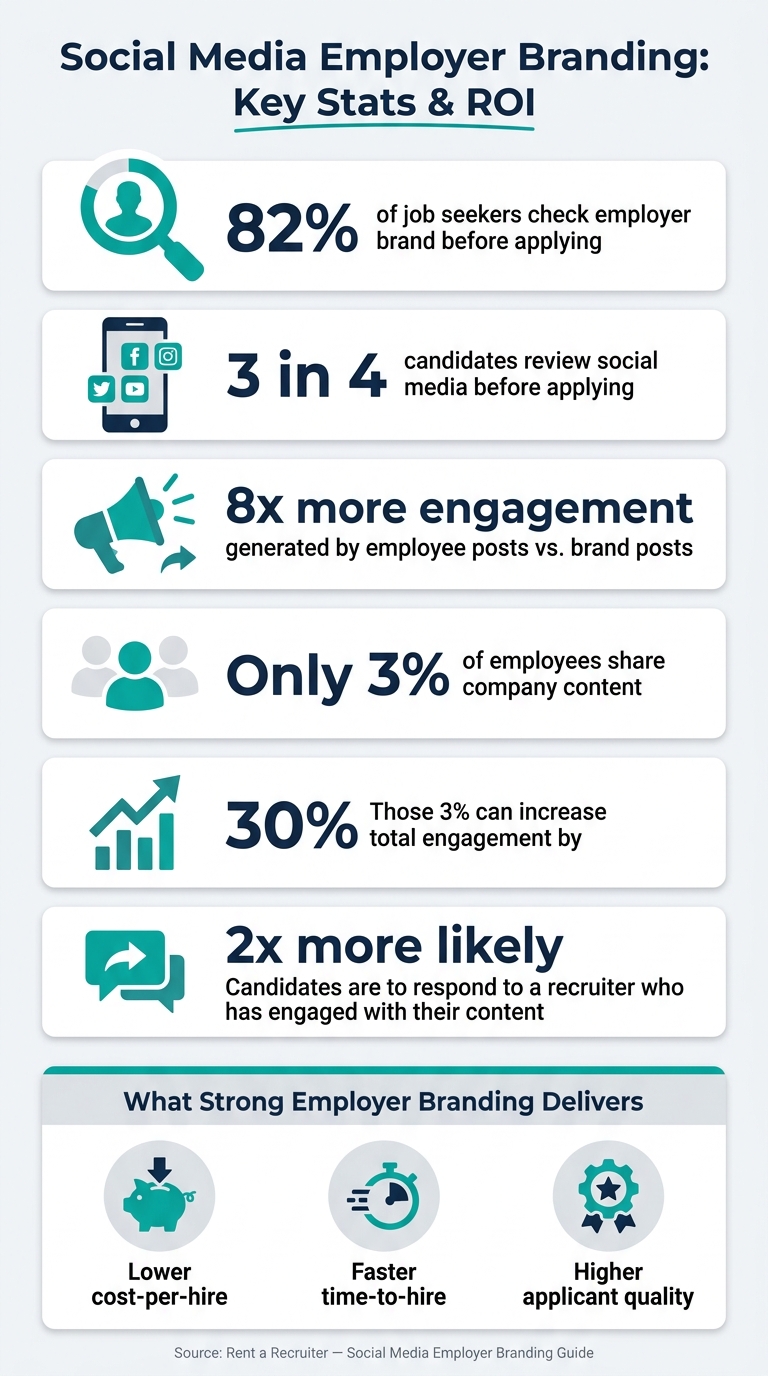
Social Media Employer Branding: Key Stats & ROI at a Glance
How Can Social Media Transform Your Employer Branding – Tribal Impact Live
sbb-itb-a23bd6a
Build the Foundation Before You Start Posting
More posts will not fix a weak employer brand. Before you write a caption or film a team video, you need to know what people already see when they look up your company. Start with an audit. Then set the message. Then make it clear who owns what.
Audit Your Employer Brand Across Social and Review Channels
Search for your company the way a candidate would. Check your LinkedIn company page, employee profiles, your Glassdoor and Indeed ratings, and your careers page. Look for gaps. Does your feed only come to life when you’re hiring? Does it show what work is actually like, how the team grows, and what day-to-day life looks like?
A lot of people will search your company as soon as they see a job post. If they land on a feed filled with job ads and little else, that sends a weak signal. Your audit shows where your external presence backs up the job description and where it creates doubt.
Use an anonymous survey to get honest employee feedback. Ask what people like about working there. Ask what frustrates them. That gives you a clearer view of internal reality versus external perception.
Then use what you find to shape the themes you want candidates to remember.
Turn Your EVP into 3–4 Content Pillars
Use the gap between perception and reality to shape your EVP. Skip vague lines. Get specific. Maybe it’s an unusual career path. Maybe it’s a flexibility policy people can point to. Maybe it’s a mission your team can explain in plain English.
From there, turn your EVP into 3 to 4 repeatable content pillars. These are the themes your team can come back to each week. Common pillars include career growth, team culture, technical challenge, and flexibility or benefits.
Each pillar gives your team a clear angle for content. That keeps your brand signal consistent across platforms and helps candidates see the same message more than once, instead of finding a single statement buried on your careers page.
Once the message is clear, assign who creates it, who approves it, and who posts it.
Align Target Roles, Candidate Personas, and Internal Owners
Content only works when it speaks to the right roles and has clear ownership inside the business. Map your priority hiring groups by function and seniority so your content speaks to the people you want to attract.
Then split ownership across HR, recruitment, marketing, and leadership:
- HR owns the EVP and the internal feedback loop.
- Marketing sets visual and tone guardrails.
- Recruiters act as visible brand voices.
- Leadership shapes perception through values-led posts.
Without clear ownership, this work gets ignored.
With the foundation in place, the next step is picking the channels that can carry these signals best.
Choose the Right Channels and Build a Simple Content System
Once you’ve set your pillars and owners, don’t stretch a lean team across every platform. Pick one or two channels that line up with your priority roles and the amount you can post each week. Then give each channel a clear job, a content format, and an owner.
That keeps the work simple. It also makes it far easier to see what’s driving better hiring outcomes, saved time, and lower spend.
Use LinkedIn for Credibility, Leadership Voice, and Candidate Discovery
LinkedIn is the main channel for professional, technical, and managerial hiring. For SaaS, Technology, IT, Fintech, Engineering, Security, Insurance, and Professional Services, it’s usually where your brand is judged first.
Use your company page for EVP, team updates, project stories, employee milestones, and hiring manager posts, not just open roles. If every post says “we’re hiring”, people tune out fast.
Your leaders, recruiters, and hiring managers should be visible too. That’s what gives the brand weight. It shows there are real people behind the hiring process, not just a logo and a vacancy.
Recruiters should also engage with candidate content before outreach. A like, comment, or share can warm up the conversation. Prior interaction often leads to better response rates, which means less wasted outreach and more productive recruiter time.
This works best when people post on a steady rhythm, not only when hiring spikes hit.
Use Instagram, TikTok, and Facebook for Culture and Community Signals
These platforms help people see what working at your company feels like, not just what the job description says.
Instagram Reels and Stories are a good fit for day-in-the-life content, team events, and behind-the-scenes moments. TikTok can help you reach Gen Z and entry-level talent with short, unscripted video. Facebook still has a place, especially for local hiring and high-volume service roles through community groups and targeted ads.
In plain terms, polished brand content often looks nice but says very little. Slightly imperfect content tends to do better because it feels more human and more believable.
People don’t join a polished graphic. They join a team they can picture themselves working with.
That matters if you want stronger top-of-funnel interest before someone ever lands on an application form.
Channel Comparison Table and Connecting Social to Your Careers Page
Use the table below to match each platform to its role in your employer-branding system:
| Platform | Target Audience | Best Content Format | Core Use Case |
|---|---|---|---|
| Professionals, tech, managers | Thought leadership, employee stories, job posts | Credibility and candidate discovery | |
| Millennials, Gen Z | Reels, Stories, day-in-the-life | Culture and community signals | |
| TikTok | Gen Z, entry-level, creative roles | Short-form video, behind-the-scenes | Authenticity and brand personality |
| Local candidates, service sector | Community groups, events, targeted ads | High-volume and local hiring |
When social content does its job, it should lead people somewhere better than a generic job board. Send that traffic to a branded careers page or talent community so you can hold attention before people are ready to apply.
That step is easy to miss, but it matters. If your social posts create interest and your next click sends people into a bland job listing, you lose momentum. A branded destination gives you more control over message, conversion, and follow-up.
From there, extend reach through employee and leader advocacy.
Get Employees, Recruiters, and Leaders to Extend Your Reach
Employee posts generate 8x more engagement than brand posts. That makes internal voices one of the fastest ways to expand reach and build trust.
Once your channels are in place, the next step is simple. Put the people candidates trust most in front of the market.
Build an Employee Advocacy Program with Clear Guardrails
Start with employees who already post on social media, especially in priority teams or key roles. Give them a short guide based on approved content pillars, so they know what to share and where the line is.
Good topics are easy to spot:
- Project wins
- Onboarding moments
- Team learning
- Day-in-the-life posts
To make this work, keep it light. Repurpose marketing-approved assets like job ads, careers page copy, and existing culture content into simple post drafts. The aim is to make posting easier, not bury people in approvals.
Only 3% of employees share company content, but those shares can increase total engagement by 30%. Employees who post and engage on social media are also more likely to attract and retain top talent [2].
Use Recruiters and Hiring Managers as Visible Brand Voices
Hiring managers should talk about what the team is working on and why it matters. Recruiters should answer candidate questions, join industry conversations, and guide interested people into a talent community before a role even opens.
That early visibility pays off. Candidates are 2x more likely to respond to a recruiter who has already engaged with their content [1].
This works best when those voices stay close to live hiring activity. If posts are disconnected from open roles or hiring plans, attention goes up but hiring impact does not.
Rent a Recruiter embeds experienced recruiters directly into your team, keeping employer brand content tied to live hiring needs.
Comparison Table: Employee, Leader, and Recruiter Advocacy
Use this table to decide where your team should spend time and what each voice should share:
| Advocate Type | What to Share | Trust | Risk | Guardrails |
|---|---|---|---|---|
| Employee | Day-in-the-life, team wins, onboarding stories, culture rituals | Highest , seen as authentic and unbiased | High , potential for off-brand or sensitive messaging | Lightweight posting guide and approved content themes |
| Leader | Vision, industry trends, company milestones, company values | High , builds authority and shows leadership accessibility | Medium , can feel too polished or corporate | Align posts with your 3-4 core EVP content pillars |
| Recruiter | Role expectations, hiring tips, team priorities, candidate FAQs | Medium , high utility for active candidates | Low , usually well-versed in brand standards | Use drafts based on approved job ads and careers page copy; align them with live roles |
Measure success by what happens in the funnel. Are social-sourced candidates moving faster? Are more of them reaching interview or offer stage? That is the metric that matters to hiring leaders.
Run Campaigns, Measure ROI, and Plan Next Steps
Once your channels and advocates are active, turn that work into a repeatable monthly system.
Build a Repeatable Monthly Employer-Branding Workflow
Employer branding works best when it runs on a steady monthly rhythm. A simple cadence beats random bursts of activity every time.
Each month should follow four steps:
- Collect: employee spotlights, behind-the-scenes footage, and reused job ads or careers page copy
- Schedule: batch and automate posts to cut manual work
- Post: publish on a consistent basis and reply to comments
- Review: look at what worked and rate your recruitment process to decide what to repeat, cut, and scale
Rotate a small set of recurring themes, like employee spotlights, culture moments, benefits, and hiring manager introductions. The employees, recruiters, and leaders introduced in the previous section should now become recurring campaign assets. The goal is a steady signal about what it feels like to work at your company.
Use the monthly review to decide what to repeat, cut, and scale.
Track Brand Metrics, Recruiting Metrics, and Business Outcomes
Don’t stop at engagement. You need three layers of measurement: what the brand is doing, what is happening in the hiring funnel, and what all of that means for cost. Track whether social-sourced candidates move through the funnel faster than other sources.
Here’s a clean breakdown of what to measure and where to find it:
| Metric Category | Key KPIs | Data Sources |
|---|---|---|
| Brand Metrics | Reach, engagement rate, click-through rate, follower growth, Glassdoor/Indeed ratings | Platform analytics, social listening tools, review sites |
| Recruiting Metrics | Application volume, application completion rate, source quality (interview-to-offer ratio), talent community sign-ups | ATS reporting, talent community dashboards |
| Business Metrics | Time-to-hire, cost-per-hire (social vs. agency), offer acceptance rate, 90-day new hire retention, internal time saved | Internal hiring dashboards, financial reports, HRIS |
Pay close attention to the gap between application starts and completed applications. If people click through but don’t finish the application, check mobile speed and form length first. That’s often where the leak is.
When you measure both brand and hiring results, employer branding becomes a business tool, not just a content task.
Conclusion: Turn Employer Branding into a Hiring Asset
Social media employer branding works when EVP, channels, voices, and metrics line up.
Start with clear audience and message direction. Give each channel a specific job. Get employees, recruiters, and leaders posting on a consistent basis. Then track what happens downstream. Are social-sourced candidates moving faster through the funnel? Is cost-per-hire coming down? Is your team spending less time on manual sourcing?
If hiring demand outpaces your team’s capacity, Rent a Recruiter can embed recruiters into your team to run hiring end to end and reduce agency dependence.
FAQs
How long does employer branding take to impact hiring?
Employer branding can start to affect metrics like organic application volume and social engagement within a few months.
The bigger shifts tend to take longer. Changes in Glassdoor reputation or major drops in time-to-fill usually show up over 6 to 12 months or more. That depends on your starting point and how consistently you invest in it.
For hiring leaders, that matters. Early signs can tell you if your message is landing. The more commercial gains, like lower hiring friction and better pipeline flow, often need steady effort before they show up in the numbers.
What should a small team post first?
Start with the day-to-day work and the people doing it. Skip polished campaigns. Use the moments you already have, like team wins, peer shout-outs, and onboarding stories.
Begin by defining your employee value proposition. Talk to your top performers and ask why they stay. What keeps them here? What makes the work worth doing? Their answers give you the raw material.
From there, share steady, relatable stories that show what it’s actually like to work on your team. Focus on real team dynamics, real projects, and the kind of work people would walk into if they joined.
How can we prove social media is improving hiring?
Track hiring outcomes, not just reach.
It’s easy to get distracted by views, likes, and impressions. Those numbers might look good in a report, but they don’t tell you if social activity is helping you hire. What matters is whether it drives the right people into your funnel, and whether those people turn into hires.
Focus on metrics tied to business impact:
- Career site traffic and engagement
- Application volume and quality from social
- Offer acceptance rate
- Retention or quality of hire over time
Use source tracking such as UTM links, along with your ATS or CRM, to connect posts and videos to clicks, completed applications, and qualified hires. That gives you a clearer line from content to hiring results.
From there, compare funnel metrics like time-to-fill, cost-per-hire, and how many social-sourced candidates make it to interview or offer stage. That’s where you start to see whether social is just generating attention, or actually helping you hire better and faster.