If a niche role sits open for 60 to 90 days and costs $1,500 to $4,000 per day in lost output, waiting until the job opens is an expensive hiring model.
I’d sum it up like this: if you hire specialist talent in SaaS, Technology, IT, Fintech, Engineering, Security, Insurance, or Professional Services, you need a pipeline before demand hits. Teams that do this often cut time-to-fill by 40% to 60%, lower recruitment spend by about 30%, and give hiring leaders more control over quality, timing, and workload.
Here’s the short version:
- Prioritise the roles where vacancy cost is highest
- Define success clearly, not just the job spec
- Source through niche channels, not generic job boards
- Segment and nurture talent before a role goes live
- Track pipeline health with response rate, pipeline depth, time-to-engage, and offer acceptance
- Add hiring capacity if your team cannot build and run the pipeline properly
For many scaling firms, the issue is not just finding talent. It is having enough hiring capacity to build the process properly. That is where Rent a Recruiter or an embedded recruiter can help, especially when you need more control than traditional recruitment agencies usually give.
Below, I’ll break down what matters, what to track, and how to turn a niche talent pipeline into faster hires, lower spend, and less pressure on your team.
Talent Pipeline Priority Tiers: Depth, Cadence & Key Metrics
How to Build Your Talent Pipeline and Hire Better Faster (Small Team Friendly!)
1. Why niche roles need a dedicated talent pipeline
Reactive hiring only works when the market is broad and active. For niche roles, it usually is not. The talent pool is smaller, and most of the people you want are passive [4].
That changes the job completely.
Instead of starting the search when a role opens, you need to build relationships before there’s a vacancy. A dedicated pipeline does exactly that. It turns hiring from a last-minute scramble into a steady process [7].
When companies skip this step, the pattern is familiar. Hiring gets rushed. Candidate quality drops. Agency spend climbs [7][1]. And when the role affects product, revenue, compliance, or delivery, that cost hits the business fast.
Traditional recruiting assumes there are plenty of active candidates ready to move. For specialist roles, that assumption falls apart [7].
1.1 Which roles should be prioritized for pipeline building
Not every role needs this level of attention. The smart move is to focus on the jobs that have the biggest business impact and the hardest hiring conditions.
A simple way to frame it is this three-tier model [3]:
| Priority Tier | Pipeline Depth | Refresh Cadence |
|---|---|---|
| Mission Critical | 10+ candidates | Always active |
| High Impact | 5 to 10 candidates | Quarterly |
| Standard | 3 to 5 candidates | Bi-annual |
Mission Critical roles are the ones where an empty seat has a direct effect on revenue, product delivery, compliance, or growth plans. High Impact roles still matter a lot, but the business can absorb a short delay. Standard roles need less attention and can be managed with a lighter-touch pipeline.
Roles that often sit in the top two tiers include:
- AI/ML engineers
- Cybersecurity analysts
- DevOps/SRE talent
- Quantitative analysts
- Compliance officers
- Risk managers
- VLSI and robotics engineers
- Senior HR leaders [3][4][1]
A lot of companies get this backwards. They spend too much time building entry-level pipelines and not enough time building pipelines for hard-to-fill specialist roles [3].
If a role is tough to hire for, or it has a direct link to growth, it belongs in the pipeline.
Pipeline depth should match business impact. That’s the key idea. The more costly the vacancy, the more active your pipeline should be. Once you’ve set priorities, you can look at the return in hiring speed, quality, and cost.
1.2 What a strong pipeline delivers for the business
Once you know which roles matter most, the next step is to make the business case.
A mature talent pipeline can fill roles 50% faster and improve candidate quality [3]. Structured pipelines can also cut recruitment costs by about 30% [2].
That matters for more than speed.
When your team is not hiring under pressure, managers can assess candidates against the role you actually need filled, not just the person who happens to be available. That usually means fewer poor hires and less expensive rework later.
It also gives leadership better visibility into hiring demand and supply. And that makes planning easier, whether you’re scaling a SaaS team, building out a security function, or adding specialist talent in Fintech, Engineering, or Professional Services [7][1].
2. Define the role and map the target talent profile
Before outreach starts, map the role against your current team structure, expected demand over the next 12 months, and the skill gaps you need to close. A success profile gives you more than a job description ever will. For the roles you’ve already prioritised, the next move is to define who is most likely to perform well in the job.
2.1 Build a success profile beyond the job description
A job description lists tasks. A success profile defines the outcomes, skills, behaviours, and motivators needed to deliver them.
That gap matters in practice. Organisations that regularly analyse workforce needs are 3 times more likely to make successful hires [2]. Companies that use well-defined success profiles fill roles 40% faster than those that do not [2].
A simple place to start is with your top performers in similar roles. Look at what they achieved in their first six months, the problems they solved, and why they performed well. That gives you a clearer view of the role’s mission and business impact.
A strong success profile should cover:
- The outcomes the hire must deliver in the first 6 to 12 months
- The technical skills required on day one
- The soft skills that matter
- The motivators most likely to attract them
Use intake conversations to separate true must-haves from skills that can be taught. This is also where you test the business risk of easing key requirements [4]. If you skip that step, you often end up with a brief that looks precise on paper but slows hiring in the market.
2.2 Identify alternate titles, adjacent backgrounds, and search keywords and filters
Niche roles rarely sit under one standard title. That’s why title-only sourcing tends to miss strong people. Search by skills, keywords, tools, and domain signals instead. Map target companies, industry clusters, and nearby sectors that produce similar talent. Focus on certifications, systems, domain knowledge, and transferable expertise, not just exact job titles.
This matters most when the talent pool is tight. Adjacent industries can open up options you would otherwise miss. For example, an international research centre hiring for beam instrumentation roles found electronics professionals in related sectors who had transferable FPGA programming and precision measurement experience. That approach cut recruitment costs by 45% and time-to-hire by 40% [6].
For specialised engineering roles in the U.S., include licensing requirements and work authorisation status in the profile from the start. It saves time and helps you avoid late-stage blockers [1][3].
2.3 Segment the pipeline before outreach starts
Segment candidates before outreach begins so the message fits their background and level of readiness. If you send the same note to everyone, response rates tend to drop.
A practical way to segment the pipeline is across four dimensions:
| Segment Factor | Examples |
|---|---|
| Skill set | Technical depth, certifications, domain expertise |
| Seniority | Mid-career, senior, executive |
| Location | U.S. regional, remote-ready, specific R&D hubs |
| Engagement level | Hot (active dialogue), Warm (recent contact), Cool (long-term nurture), Cold (re-engagement needed) |
Add compensation band in U.S. dollars and, where needed, licensing or work authorisation status as extra tags. That makes re-engagement much faster when a role opens.
"A niche pool changes time-to-slate for specialty reqs because conversations started months earlier." – Michal Juhas [5]
Readiness tags help you keep the pipeline clean and usable. Once the pipeline is segmented, you can match each group to the right sourcing channel and outreach message.
sbb-itb-a23bd6a
3. Build sourcing channels for scarce talent
Once your pipeline is segmented, the next step is deciding where to find the people you’ve defined. For scarce roles, the channel matters as much as the message.
3.1 Use role-specific channels instead of one-size-fits-all sourcing
For niche positions, role-specific channels matter more. Around 70% of open roles in niche specialisms are never publicly advertised [8]. That changes how you should source.
In plain terms, the people you need are less likely to come from a standard job board and more likely to sit inside specialist communities, technical forums, and industry events.
| Role Category | Recommended Sourcing Channels |
|---|---|
| Technology | GitHub, Stack Overflow, Slack/Discord communities, Hacker News |
| Engineering | Engineering.com, IEEE Job Site, trade associations |
| Biotech/Pharma | BioSpace, therapeutic-area communities, investigator networks |
| Specialist roles | LinkedIn, niche job boards, alumni networks, industry conferences |
Match each segment to the places where those people already spend time. That’s how you cut wasted outreach and improve response rates.
Structured employee referral programs also deserve attention early. Referred candidates are 5 times more likely to be hired and stay with companies 70% longer than other hires [2]. For hiring teams under pressure, that’s a direct gain in time-to-hire, retention, and cost control.
A simple tiered referral model works well:
- A smaller reward for qualified introductions
- A larger reward when someone is hired
Once you know where niche talent gathers, shape your outreach around the segment and its readiness level.
3.2 Build a repeatable outreach approach for passive talent
Outreach has to earn attention fast. Use an empathy-based outreach approach: learn what your best people value, then craft personalized, value-driven messages instead of generic "checking in" emails [2][9].
Start with the success profile you built in Section 2. Use it as your base. Then reference something specific in the person’s background, a project, publication, or specialist skill, and tie it to the problem the role is there to solve.
Keep it short. Keep it direct. If your message reads like it could go to 50 people, it’ll probably be ignored.
A good outreach note should feel like it came from someone who understands the work, not someone filling a sequence.
Here’s what that looks like in practice. A fintech company facing a shortage of blockchain developers ran a 48-hour virtual hackathon focused on DeFi innovations, with a $10,000 prize. The result was 15 high-quality candidates entering the pipeline, and 3 accepted offers within two months [2]. That’s not just a nice story. It’s a model you can repeat when direct outreach alone isn’t enough.
If response rates stay low, the issue is often sourcing capacity, not message quality.
3.3 When extra hiring capacity helps
When sourcing demand goes past internal bandwidth, add recruiting capacity before the pipeline slows down. If sourcing stalls or timelines start slipping, extra hands can protect hiring momentum and stop delays from spreading across the business.
This is where Rent a Recruiter can help. They place experienced recruiters directly into your team to manage niche hiring end-to-end.
If you’re weighing whether an embedded recruiter makes financial sense, the key question is simple: what is slow hiring already costing you? In scaling SaaS, Technology, Fintech, Engineering, Security, Insurance, and Professional Services teams, delays usually show up as lost output, heavier workloads, and missed growth targets.
4. Nurture, track, and refresh the pipeline
Once the pipeline is built, the job changes. Now you need to keep it warm, current, and ready to use.
A talent pipeline only pays off when it stays active, organised, and up to date. If it sits untouched, it stops being a pipeline and turns into an old database.
4.1 Keep passive candidates warm with light-touch engagement
Pipelines for niche roles tend to break down when passive candidates go cold. The aim is to stay relevant without becoming noise.
A simple cadence works well: monthly for 3 months, quarterly for the next 9 months, then reassess fit every 3 years [3].
Send updates that are worth opening. That could include market insights, compensation data, or invites to targeted events. Use clear triggers like a promotion, a new certification, or company funding news [3].
Silver medalists need their own track. They already know your business, and they’re often far closer to a yes than a net-new prospect. About 60% stay open to future opportunities when engagement continues [2].
4.2 Use an ATS or CRM as the single source of truth
That outreach only works if your data is clean and stored in one place.
Keep all candidate data in a single ATS or CRM. Track every interaction, note, and data point there. Use the same hot, warm, and cool tags from your segmentation so your team isn’t working from mixed signals.
Track:
- last outreach
- compensation expectations in U.S. dollars
- skill tags
- career signals
- consent status [5]
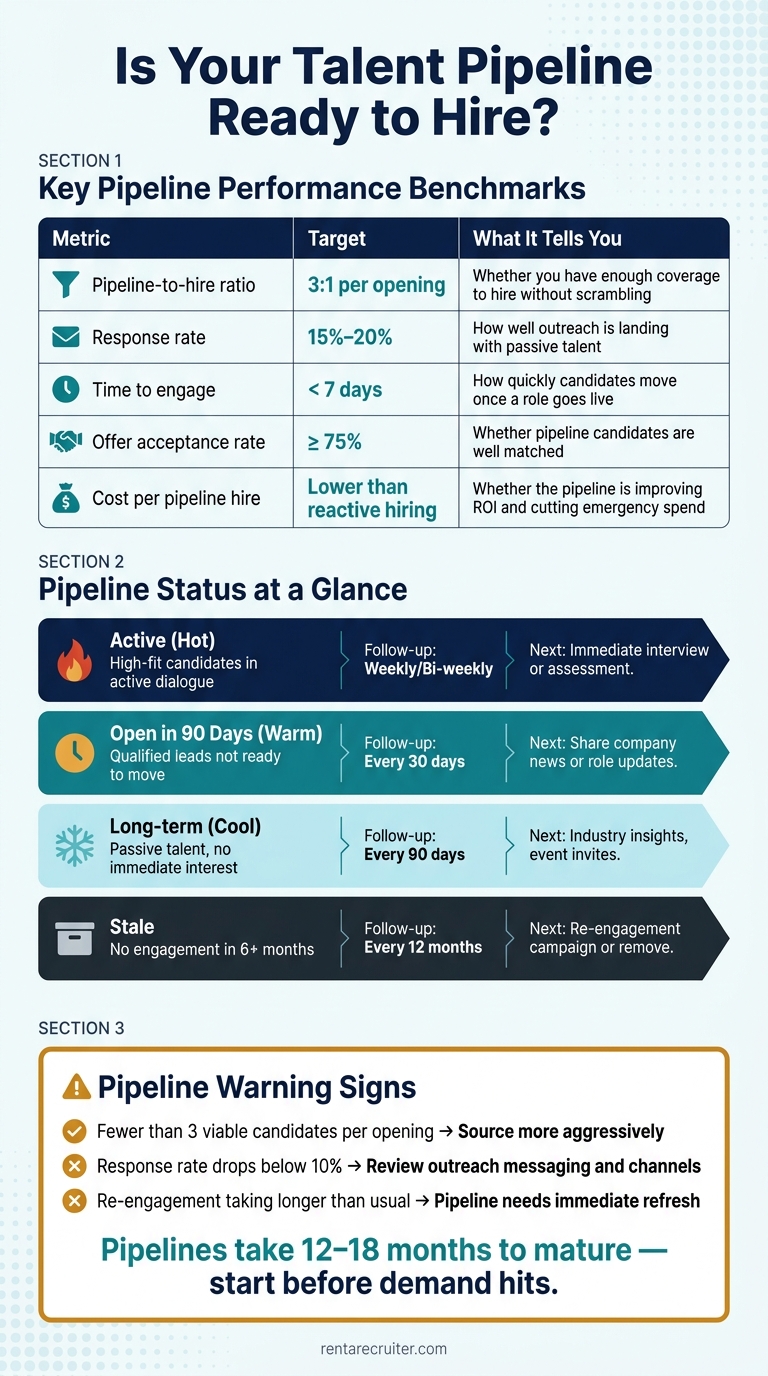
Pipeline status is what turns a contact list into something your team can act on. Here’s a simple framework to use:
| Pipeline Status | Definition | Follow-up Timing | Next Action |
|---|---|---|---|
| Active (Hot) | High-fit candidates in active dialogue or recently interviewed | Weekly / Bi-weekly | Immediate interview or technical assessment |
| Open in 90 Days (Warm) | Qualified leads who have engaged but aren’t ready to move immediately | Every 30 days | Share relevant company news or specific role updates |
| Long-term (Cool) | Passive talent with high potential but no immediate interest in moving | Every 90 days | Send industry insights, event invites, or technical workshops |
| Stale | No engagement in 6+ months or data is unverified | Every 12 months | Re-engagement campaign or remove from pipeline |
Assign a named owner to each pipeline segment. If nobody owns it, it drifts. And when a role opens, drift turns into delay.
4.3 Set a review cadence to remove stale leads and spot gaps
Once the data is in place, you need a review rhythm that keeps the pipeline accurate.
Regular reviews help you cut time-to-fill when a role goes live. Run monthly reviews for cold leads and outreach activity. Then run quarterly audits to update talent maps, skill tags, and contact data [5][3].
If a critical role has fewer than three viable candidates per opening, source more aggressively [10][3]. That’s a warning sign. The same goes for response rates dropping below 10%, or re-engagement taking longer than usual. In most cases, those signals show the pipeline needs work before it becomes a hiring bottleneck [3].
Bring hiring managers into quarterly reviews as well. That keeps the pipeline lined up with current role needs, not last quarter’s assumptions.
5. Measure pipeline performance and turn it into hiring outcomes
Once your pipeline is clean and up to date, the next job is simple: find out if it’s ready to produce hires, not just names in a system.
A pipeline only matters if it helps you hire with less delay, lower spend, and less last-minute pressure.
5.1 Track the metrics that show pipeline health
The most useful metrics tie straight back to business results: speed, cost, and quality.
A 3:1 pipeline-to-hire ratio is a solid benchmark. That means three viable candidates for every projected opening. If you’re under that level for a hard-to-fill niche role, you likely don’t have enough cover yet [2][3]. Add a time-to-engage of under 7 days and an offer acceptance rate of at least 75%, and you’ve got a strong sign that the pipeline is ready when a role opens [2].
| Metric | Target | What It Tells You |
|---|---|---|
| Pipeline-to-hire ratio | 3:1 per opening [2][3] | Whether you have enough coverage to hire without scrambling |
| Response rate | 15% to 20% [3] | How well your outreach is landing with passive talent |
| Time to engage | < 7 days [2] | How quickly candidates move once a role goes live |
| Offer acceptance rate | ≥ 75% [2] | Whether pipeline candidates are well matched |
| Cost per pipeline hire | Lower than reactive hiring [1][11] | Whether the pipeline is improving ROI and cutting emergency spend |
It’s also worth tracking qualified-candidate rate by source and overall candidate quality. That’s how you catch fit issues early, before they turn into wasted interviews and stalled hiring.
Break the numbers down by role family and pipeline stage too. If sourcing is working but nurture is weak, you’ll see it. If one channel brings volume but poor-fit candidates, you’ll see that as well.
5.2 Turn the process into a repeatable hiring playbook
Once the metrics are in place, use them to build a hiring rhythm your team can run again and again.
Keep it simple: forecast needs, define success profiles, source, engage, assess, measure, and refine. Assign clear ownership at each step and review it every quarter. That way, the pipeline becomes part of how you operate, not a one-off push when pressure builds.
Document what works for each niche role, including:
- The best channel
- The message that gets replies
- The follow-up pattern that moves people forward
That playbook should come from the pipeline work itself, not sit off to the side as a separate project. Run the steps in sequence and give each stage one owner [7][11].
5.3 Next step: assess your current hiring capacity
If the numbers show your pipeline is underpowered, the next issue is capacity.
Pipelines take 12 to 18 months to mature, so short-term hiring targets often need extra support [3]. That’s the gap many scaling firms run into. The plan is right, but the team doesn’t have the time to build and run it properly.
If your internal team is stretched, Rent a Recruiter can embed experienced recruiters into your team within days to build and run the pipeline end to end. Companies typically cut hiring costs by up to 70% and save 80+ hours per month.
FAQs
How long does it take to build a niche talent pipeline?
Building a talent pipeline takes time. In most cases, you should expect 3 to 6 months of steady work before you start seeing strong relationships and a consistent flow of candidates.
That matters because hiring gaps rarely hurt all at once. They show up in missed targets, slower team growth, and extra pressure on your leaders. If you want better hiring outcomes later, you need to start building the pipeline now.
For senior niche roles, the timeline is often much longer. It can take 6 months to 2+ years before the right person is ready to move. That’s especially common in SaaS, Technology, Fintech, Engineering, Security, Insurance, and Professional Services, where top talent is rarely on the market at the exact moment you need them.
This is where Rent a Recruiter can help. By placing experienced recruiters inside your team early, you can start building those relationships sooner, reduce delays, and put yourself in a better position when hard-to-fill roles open up.
What tools should I use to manage a talent pipeline?
Use an ATS or CRM as your central system. It gives you one place to tag candidates, track every touchpoint, group talent by skill or seniority, and automate follow-ups.
That matters when hiring starts to scale. If your data sits across spreadsheets, inboxes, and Slack threads, you lose time and miss people. A central system keeps your pipeline organised and makes it easier to see who’s warm, who’s qualified, and who needs a nudge.
For niche roles, AI-driven tools can help with sourcing through technical contribution analysis or behavior-based engagement. Smaller teams can also run this well with customised tracking boards. The main thing is simple: clean data and steady follow-up. Without that, even the best tools won’t do much.
When should I add recruiting capacity to support the pipeline?
Add recruiting capacity before a vacancy turns urgent.
Talent pipelining is a long-term, always-on approach. It usually takes 3 to 6 months of steady work to build relationships and keep talent flowing into your hiring process.
For senior roles, the timeline is often much longer. Many candidates need 6 months to 2 years of contact before they’re ready to make a move.
That’s where Rent a Recruiter helps. You can add recruiter capacity fast by embedding experienced recruiters into your team, so you’re building pipeline early instead of scrambling when a role lands on your desk.