
Building a talent community can cut your hiring time by up to 50% and reduce sourcing costs by 60%. Yet, only 22% of companies with talent communities see measurable hires. Why? Most treat them as email lists instead of active networks.
A well-managed talent community keeps your company top of mind for skilled professionals, whether or not they’re actively job hunting. This proactive approach ensures a steady pipeline of qualified candidates, saving time and money.
Here’s how to make your talent community work for you:
- Set clear goals: Define your target audience and future hiring needs.
- Simplify sign-ups: Make joining quick and easy with minimal steps.
- Segment members: Group candidates by skills, experience, or interests.
- Deliver value consistently: Share relevant content, not just job alerts.
- Host events: Engage members with webinars, challenges, or in-person meetups.
- Leverage employees: Use staff networks to expand your reach.
- Track performance: Use talent insights and HR reporting to refine your approach and improve results.
If managing this feels overwhelming, consider using an embedded recruiter to handle it for you. This approach ensures your talent community delivers measurable results without adding to your workload.
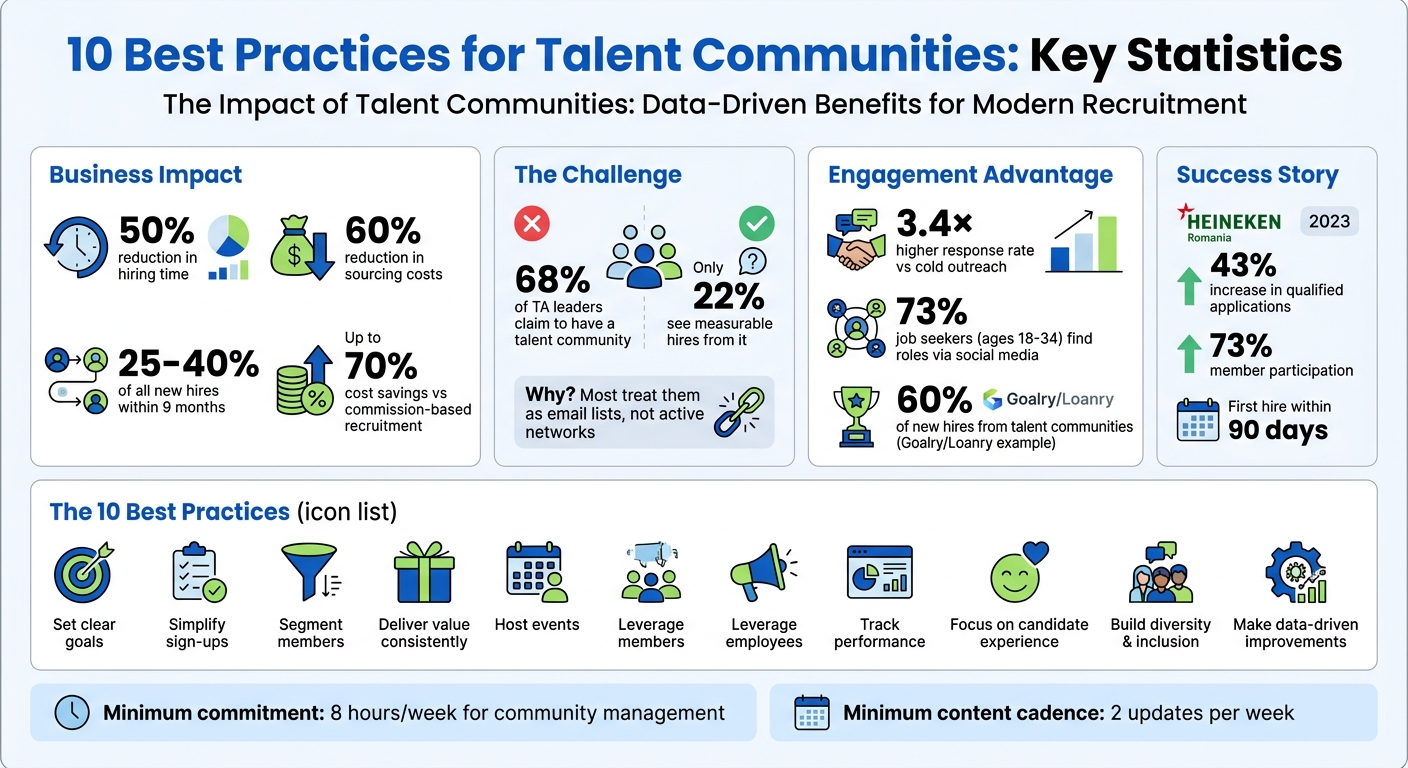
Talent Community Impact: Key Statistics and Benefits
Recruitment Marketing: How to Build an Engaged Talent Community
sbb-itb-a23bd6a
1. Set Clear Goals and Identify Your Target Audience
Before starting, it’s crucial to define your target audience and objectives. Communities that focus on a specific group, offer clear value, and have well-defined goals consistently perform better. For instance, a community aimed at "cloud-native engineers in Central and Eastern Europe" will yield better results than one targeting "all tech talent" [5].
Start by pinpointing the skill gaps within your organization – those hard-to-fill roles or positions you frequently hire for, such as software engineers. Collaborate with hiring managers to create candidate profiles that align with your company’s future needs [6][7]. This ensures your community supports your business’s growth trajectory. From there, craft a value proposition that resonates deeply with your chosen audience.
Delivering Value to Your Community
Your community needs a clear value exchange to attract members. People won’t join unless they see a concrete benefit. This could include insider knowledge, such as recruitment webinars, career growth resources, insights into industry trends, or even skill-building challenges (available in our recruitment resources) [5]. For example, gamified challenges or industry-specific simulations can drive engagement while attracting qualified candidates. Communities built around these strategies see a 3.4× higher response rate compared to traditional cold outreach [5].
Personalizing Communication
Make your value offering even stronger by personalizing your outreach. Use CRM tools to segment your community by skill sets, experience levels, and job interests. This ensures your messages feel relevant and targeted [7][2]. Adding a sign-up preference center allows members to select the type of content they want, further boosting engagement [1]. As highlighted in the Jobful Playbook:
The narrower the audience, the easier the content brief, the higher the engagement rate [5].
This tailored communication approach not only keeps your audience engaged but also ensures your company remains top-of-mind for future hiring needs.
2. Make Joining Easy and Straightforward
Once you’ve defined clear objectives and crafted targeted communication, the next step is eliminating obstacles in the sign-up process. This is where many talent communities lose potential members. A cumbersome process – like lengthy, multi-step forms – can deter even the most interested candidates. The key? Simplify every step and meet candidates where they already are.
Engagement Strategies
Place sign-up forms in high-visibility spots, such as your careers page, job postings, and even social media profiles. Integrate one-click options with platforms like LinkedIn or Facebook, and use resume parsing tools to minimize manual input. Recruitment chatbots are another great tool – they can answer questions instantly while capturing essential contact details at the same time.
Another effective method is adding an opt-in checkbox to your job application process. Applicants are already engaged, so this simple step can convert them into active community members with minimal effort. These strategies not only simplify the process but also set the stage for personalized communication – key to keeping your talent community active and engaged.
Personalization of Communication
The journey toward personalization starts as soon as someone considers joining. A sign-up preference center, for instance, allows candidates to choose the type of content they want and how often they receive it. This small but thoughtful feature can significantly improve engagement. As Jason Messinger from Recruitics points out:
"The more choices you offer your talent network about your communications, the more responsive they’ll be to messages they receive" [1].
Additionally, pre-filling known information when transitioning someone from community member to applicant saves time and shows you value their experience. These details matter – engaged community members are 3.4 times more likely to respond compared to cold outreach efforts [5].
Community Value Delivery
Getting candidates to sign up is just the first step. Keeping them engaged requires a clear and compelling value proposition. For instance, explain the benefits of joining, such as receiving updates on future roles or gaining access to exclusive career resources like salary reports, industry insights, and interview tips. These offerings position your talent community as more than just a job search tool – it becomes a resource for career growth.
You can also include interactive elements like gamified challenges or skill simulations. For example, Wyndham Hotels saw a 290% increase in applications and reduced their time-to-shortlist by about two weeks using a dedicated talent community platform [5]. Balancing promotional content with genuinely helpful resources ensures members find value, even when they’re not actively looking for a job.
3. Group Members by Skills and Interests
Once you’ve set clear goals and simplified sign-ups, the next step is segmentation. Broad, one-size-fits-all messaging simply doesn’t work. What grabs the attention of a cloud engineer won’t resonate with a marketing professional. Segmentation transforms a generic audience into a network where every member gets content they actually care about. Let’s explore how to tailor communication and deliver meaningful, segment-specific content.
Engagement Strategies
The secret to successful segmentation is being specific. Instead of lumping everyone into a broad "tech talent" group, focus on something more precise, like "engineers working on cloud-native solutions." This not only simplifies your content strategy but also boosts engagement significantly.
Interactive tools, like gamified challenges, are a great way to engage members while also assessing their skills. These activities give you valuable insights into their abilities and provide members with a fun, rewarding reason to stay involved.
Personalization of Communication
When segmenting your community, don’t stop at job titles. Think about grouping members by profession (e.g., marketing, engineering, sales), experience level (entry-level versus senior roles), location (to share local events or office news), or affinity groups (such as veterans, alumni, or niche interest areas) [3][5].
A preference center is a great tool for this. By letting members choose their interests during sign-up, you ensure they only receive content they find useful. This also helps cut down on unsubscribe rates. Jason Messinger from Recruitics sums it up well:
When subscribers receive only the content they’re interested in, they’ll likely be more responsive to messaging [4].
Pair this with a CRM to track member activity – like clicks on job posts or downloads of specific resources – and send follow-ups tailored to their behavior. This kind of targeted communication makes your messaging more relevant and impactful [7][3].
Community Value Delivery
Segmentation is all about delivering content that feels personal. Engineers might engage with technical deep-dives or architecture discussions, while marketers might prefer updates on brand strategies or campaign results. Balance job alerts with content that adds real value – like salary reports, industry trends, or leadership Q&As tailored to each group’s interests [5].
Our embedded recruitment case studies show that the results speak for themselves. Engaged community members respond 3.4× more often than cold outreach [5]. Companies that actively segment their talent communities can also cut their time-to-hire by up to 50% and reduce sourcing costs by around 60% [5][3]. When members consistently receive content aligned with their interests, they stay engaged – even if they’re not actively looking for a job. This keeps your talent pipeline warm and ready when the right role opens up.
4. Share Useful Content on a Regular Basis
Once you’ve segmented your talent community, the next step is keeping them engaged with consistent, meaningful content. A successful talent community thrives on regular interaction and relevant updates. Think of it as an ongoing relationship that requires attention to stay strong.
Engagement Strategies
Striking the right balance is key here. Avoid overwhelming members with constant job alerts – they’ll tune out fast. Instead, focus on delivering content that’s genuinely useful, even when they’re not actively job searching. Share things like engineering case studies, leadership Q&A sessions, "day-in-the-life" employee videos, or reports on industry trends. This kind of insider content not only adds value but also builds trust and keeps your company top-of-mind.
Interactive content can be a game-changer too. Gamified challenges or skill-based simulations can spark engagement while also attracting highly qualified candidates. Just like setting clear goals, the content you create should align with the interests and needs of each segment within your community.
Delivering Value to Your Community
Practical resources are just as important as company updates. Go beyond simply sharing news about funding milestones or product launches. Offer things like market salary reports, tips for building a standout resume, guides for interview prep, or advice on salary negotiations. These resources provide immediate value while positioning your company as a trusted expert in your field.
Aim to share at least two pieces of content per week – one focused on insider insights and another offering practical, actionable advice. Consistency is crucial. While 68% of talent acquisition leaders claim to have a talent community, only 22% say it results in measurable hires. Why? Often, it’s due to inconsistent engagement [5]. By providing value regularly, you’ll keep your pipeline warm with candidates who are ready to step into future roles. For companies needing to scale quickly, a recruitment on demand model can provide the necessary flexibility.
5. Keep a Steady Communication Schedule
Engagement Strategies
Consistency is the backbone of effective communication. Research highlights that engaged community members are 3.4 times more likely to respond compared to cold outreach, yet only 22% of talent acquisition leaders report measurable hires from their efforts [5]. The key difference? A predictable and steady communication rhythm.
Stick to a minimum of two updates per week. As Jobful aptly states:
Silence is the death cadence [5].
One update should deliver insider insights – such as leadership Q&As or technical deep-dives. The other should focus on practical value, offering resources like skills challenges or career development tools. You can also join our community for helpful tips and resources to see these strategies in action. This approach keeps your company visible and relevant without overwhelming your audience.
To execute this effectively, assign a dedicated team member – such as a Talent Marketing Lead or Community Manager – to spend at least 8 hours per week on crafting and scheduling these updates [5]. This focused effort ensures your communication remains purposeful and aligned with your talent community goals. With a steady cadence in place, the next step is tailoring your approach to different audience segments.
Personalization of Communication
Consistency alone isn’t enough – your messages need to feel tailored and relevant. Avoid sending generic updates by empowering community members to set their content preferences [4]. This small adjustment reduces unsubscribe rates and ensures your messages resonate with the right audience.
Regularly experiment with subject lines, calls-to-action (CTAs), and message frequency to refine your outreach [4]. What grabs the attention of a senior engineer may not work for an entry-level designer. Keep in mind:
A talent community is a relationship, not a database [5].
And relationships thrive on mutual understanding. By listening to your audience and adapting your messaging, you’ll not only improve engagement but also strengthen your community for future hiring success.
6. Organize Online and Offline Events
Hosting events – both virtual and in-person – can transform your talent community from a passive audience into an engaged network, creating meaningful connections and driving hiring success.
Engagement Strategies
Events provide an opportunity to actively involve your community. For instance, gamified challenges like coding competitions, marketing simulations, or business case studies encourage participation while showcasing skills. A great example of this is HEINEKEN Romania’s 2023 initiative, which saw a 43% increase in qualified applications and 73% participation through such interactive activities [5].
In-person events, like networking mixers, also play a key role in fostering authentic connections. Take Built In Chicago’s "Built In Brews" series as an example. These monthly social gatherings allow candidates to meet employees in a casual setting, helping partner companies make thousands of hires each year [2].
Adding Value to the Community
For events to resonate, they need to offer more than just brand exposure – they should provide real, practical value. Webinars featuring insider insights, such as engineering deep-dives, leadership Q&A sessions, or "day in the life" showcases, can give candidates a genuine glimpse into your workplace culture [5]. Similarly, career-focused sessions like interview workshops or salary report reviews deliver immediate benefits, whether participants are ready to apply now or later [2].
Tailoring events to specific teams or departments adds another layer of connection. As Metaview suggests:
Events should ideally be tailored to specific functions, departments, and offices. You want to give candidates a sense of belonging and connection, even before they apply [7].
This approach not only strengthens the learning experience but also builds a sense of community and inclusion.
Business Impact of Events
A well-executed event strategy can significantly improve hiring metrics. Companies with active talent communities often reduce time-to-hire by up to 50% and cut sourcing costs by around 60% compared to paid sourcing methods [5]. To maintain momentum, establish a regular event schedule, such as quarterly webinars or monthly mixers, to keep your community engaged and set clear expectations for interaction.
7. Use Your Employees to Expand Your Reach
Your employees are your most trusted advocates. Their personal networks often include skilled candidates, making them a powerful resource for finding top talent. Consider this: 73% of job seekers aged 18 to 34 landed their most recent role through social media [4]. Companies like Goalry and Loanry have seen around 60% of their new hires come directly from their talent communities [6].
Engagement Strategies
Encourage your team to share genuine stories about their work experiences. Content like testimonials, photos, videos, or "day in the life" posts offers an authentic glimpse into your company that resonates far more than standard corporate messaging. To make it easier, provide employees with shareable content, including company updates, industry insights, and job openings. A branded hashtag for your talent community can also help potential candidates find these posts quickly.
Ethan Taub, CEO of Goalry and Loanry, highlights the value of starting small:
We started small and with friends. Staying connected to who your friends know can build up your talent communities pretty quickly. Then, working on social media to spread the news further can expand that even more.
Additionally, maintaining alumni networks can be a goldmine for referrals and even rehiring former employees. This approach fosters authentic connections and opens the door to more personalized interactions.
Personalization of Communication
One-on-one connections are a game-changer for engagement. Samantha O’Connor, Global Community Experience Manager at Lionbridge, explains:
We started with one-to-one recruitment and engagement. Each community member had a direct contact within our organization whom they could interact with.
This individual approach strengthens relationships within your talent community, turning it into a network built on trust. It also aligns well with DEI recruitment best practices by fostering meaningful, tailored interactions.
Diversity and Inclusivity Efforts
Employee networks can help you reach diverse candidates beyond the usual job boards. Start by identifying gaps in diversity and then encourage employees to tap into their unique networks. Denise Graziano, CEO of Graziano Associates, underscores the importance of collaboration:
Companies need to take a collaborative approach to talent. This is not HR’s solution to come up with on their own. When you have marketing working with HR and with the other departments, you can put together an approach that is going to serve the company best.
8. Focus on Positive Candidate Experiences
Transforming a talent community from a static list into an engaged, trusted network hinges on delivering a positive candidate experience. Yet, while 68% of talent acquisition leaders claim to have a talent community, only 22% see measurable hires from it – often due to low engagement [5]. To bridge this gap, here are strategies to ensure every candidate interaction leaves a lasting, positive impression.
Engagement Strategies
Consistent, two-way communication is the backbone of a thriving talent community. Instead of simply sending job alerts, create moments for candidates to interact with your team, ask questions, and share feedback. HEINEKEN Romania set an excellent example in 2023. By launching a branded talent community with interactive challenges, they achieved 73% member participation and made their first hire within 90 days [5].
It’s also important to balance promotional messaging with genuinely useful content. Share practical resources like interview tips, updates on industry trends, and career growth advice – not just job openings. This approach builds trust and goodwill, ensuring candidates see value in your community even when they aren’t actively job searching. When the right opportunity arises, they’ll already feel connected.
Personalization of Communication
Generic, one-size-fits-all emails often fail to engage. Personalization, however, can make a big difference. Drift showcases this by using AI-powered recruitment tools like a recruiting chatbot on its careers page to deliver tailored content. For candidates exploring their options, the bot suggests relevant YouTube videos about company culture. It also collects industry-specific data through newsletter signups, enabling Drift to share highly targeted content and job openings [2].
Consider implementing a preference center where candidates can choose the type and frequency of updates they receive. Some may want weekly updates on technical roles, while others prefer occasional news about company developments. As Jason Messinger from Recruitics explains:
"The more choices you offer your talent network about your communications, the more responsive they’ll be to messages they receive" [1].
This flexibility reduces unsubscribes and keeps your community engaged, ensuring your communication remains relevant and welcomed.
Community Value Delivery
To turn a passive list into an active network, offer clear benefits from the start. IHS Markit achieves this with a straightforward opt-in form where candidates select areas of interest and expertise. A welcome email then outlines exactly what members can expect [2]. Regular check-ins every 6–12 months allow you to gather feedback, adjust your content, and ensure you’re meeting the evolving needs of your community.
These efforts create a talent community that not only engages but also delivers real value, strengthening your hiring pipeline over time.
9. Build a Diverse and Inclusive Community
A diverse and inclusive talent community doesn’t just happen – it’s built with intention and effort. By ensuring all voices are represented, you create a stronger, more resilient network.
Diversity and Inclusivity Efforts
Start by examining your current organization. Where are the gaps in representation? Identifying these areas allows you to focus on underrepresented groups and create meaningful connections with them [2]. The goal isn’t just to recruit but to build genuine pathways for diverse talent to engage with your company.
Go beyond the usual job boards. Samantha O’Connor, Lionbridge’s Global Community Experience Manager, reshaped recruitment by tapping into social media and broader communication channels. She explains:
We started with one-to-one recruitment and engagement… As technology expanded, we expanded the ways in which we connect with new members… spreading the word wide helps them bring in a diverse population [6].
This approach not only broadens your reach but also addresses specific local needs while offering opportunities for skill development.
Community Value Delivery
A thriving, diverse community is built on mutual benefit. As O’Connor points out, the best talent communities focus on creating value for their members [6]. Offer opportunities for skill-building and professional growth – not just job alerts.
Share your company’s diversity initiatives, CSR efforts, and other programs that align with inclusivity. These efforts help position your company as a top choice for talent who prioritize these values [7][1]. To deepen engagement, let community members personalize updates about diversity programs and CSR news, ensuring they receive the information that matters most to them [1][4].
10. Track Performance and Make Improvements
When it comes to building a talent community, relying on data rather than intuition is key. As Jason Messinger from Recruitics puts it:
Make changes according to analytics data from the audience instead of gut feelings [4].
Engagement Strategies
Start by focusing on metrics that reveal how your content is landing with your audience. Metrics like open rates, click-through rates (CTR), and weekly active members can tell you if your messaging is catching attention [1]. But don’t stop there – dig deeper. Track more detailed engagement data, such as completed challenges or specific content that members interact with, to provide recruiters with richer insights beyond just application data [5].
Keep an eye on unsubscribe rates as well. A spike in opt-outs could signal that your communication frequency needs adjusting. If members haven’t engaged in 3–6 months, consider scaling back or pausing your outreach. As Messinger warns:
If you keep regularly emailing that person [who isn’t engaging], you’ll cause issues with your metrics. To know if your content is effective, you need a healthy read on engagement [1].
These metrics do more than measure activity – they guide how you tailor your content for better results.
Personalization of Communication
Leverage tools like A/B testing and preference centers to identify what resonates most with your audience. Whether it’s technical topics, company updates, or career advice, understanding these preferences helps you craft messages that drive stronger engagement [4] [1].
Community Value Delivery
The ultimate goal is to turn these performance insights into measurable hiring improvements. Track metrics like Pipeline Contribution Rate (what percentage of hires come from your community), Time-to-Shortlist Delta (how much faster roles are filled), and Cost-per-Hire Delta [5]. These numbers reveal the real value of your talent community.
Interestingly, while 68% of Talent Acquisition leaders say they have a talent community, only 22% report actual hires from it [5]. To bridge that gap, regularly survey your community every 6–12 months to gauge satisfaction with your content. As Messinger advises:
Let your audience help guide the content you create [1].
Conclusion
Building a talent community is about creating a permission-based connection with potential candidates before the need to hire arises [5]. This forward-thinking strategy not only cuts costs but also speeds up the hiring process. Yet, while 68% of Talent Acquisition leaders claim to have a talent community, only 22% report measurable hires from it [5].
As discussed earlier, the key to a thriving talent community is sustained and intentional engagement. This means setting clear objectives, sharing valuable content regularly, and having a dedicated owner who can commit at least 8 hours a week [5]. Without someone accountable, even the best plans can lose momentum.
For high-growth SMEs working with tight budgets and ambitious hiring goals, talent communities can help make the most of past efforts. By nurturing "silver medalist" candidates and previously vetted applicants who weren’t hired, businesses can save time and resources [2][6]. A well-maintained community can eventually account for 25–40% of all new hires within just nine months [5], turning recruitment into a predictable, scalable process rather than a costly, last-minute rush. This proactive approach prevents the common pitfalls of speed hiring without alignment.
If maintaining the discipline to engage your talent community feels overwhelming, expert help can make all the difference. Rent a Recruiter can embed skilled recruiters into your team in days, ensuring your talent community delivers measurable results. With our support, you’ll gain the structure, visibility, and commitment needed to turn engagement into actual hires – while cutting hiring costs by up to 70% compared to commission-based recruitment models.
The ideal time to start building your talent community was yesterday. The next best time? Today, before you’re forced into reactive hiring.
FAQs
What’s the fastest way to get people to join a talent community?
To get people to join quickly, make it easy and straightforward. Provide multiple ways to sign up – whether through forms, email subscriptions, or opt-ins during applications. Use targeted channels to promote your community and emphasize clear benefits, like access to job updates or the latest company news. Consistently share relevant content and maintain timely communication to build trust and keep interest high.
How should I segment my talent community from day one?
From the very beginning, focus on organizing your talent community by pinpointing candidates who’ve already expressed interest in your company – whether through job applications, newsletter sign-ups, or other interactions. Keep them engaged consistently by sharing relevant updates, meaningful content, and personalized messages. Leverage automation tools to stay connected and maintain their interest, building trust and loyalty over time. This approach ensures you have a well-prepared and engaged talent pool when it’s time to hire.
What metrics show a talent community is driving hires?
Key metrics to keep an eye on are cost-per-hire reduction, time-to-fill improvement, and pipeline quality metrics. On top of that, engagement indicators like open rates, click-through rates, and conversion rates offer insight into how effectively your efforts are connecting with potential candidates. Together, these numbers paint a clear picture of how well your talent community is driving your hiring objectives.