
Recruitment costs can make or break your growth strategy. Every open role costs businesses an average of $500 per day in lost productivity, and hiring mistakes can cost up to 150% of an employee’s annual salary. Yet, with only 17% of HR leaders expecting budget increases by 2026, scaling companies must forecast and control recruitment expenses with precision.
Here’s how to stay ahead:
- Align hiring with growth goals. Plan roles based on revenue targets, product launches, or market expansions.
- Break down costs. Include fixed recruiter salaries, variable expenses like job ads, and hidden costs like lost productivity during ramp-up.
- Prioritize critical roles. Focus resources on high-impact positions where vacancies hurt revenue most.
- Track key metrics. Monitor cost-per-hire, time-to-fill, and offer acceptance rates to adjust budgets quarterly.
- Consider embedded recruitment. This model can reduce hiring costs by up to 70%, saving time and streamlining processes.
The takeaway? Recruitment isn’t just filling roles – it’s a core driver of growth. By forecasting costs accurately and optimizing your approach, you can scale efficiently without overspending.
How to forecast recruiting capacity to meet headcount planning goals
sbb-itb-a23bd6a
Step 1: Define Your Hiring Needs and Growth Goals
To accurately forecast recruitment costs, start by aligning your hiring plan with your business objectives – whether that’s hitting revenue milestones, launching a new product, or expanding into fresh markets. Without tying your hiring strategy to these goals, any cost estimates will be little more than guesswork.
Work backward from your objectives. For instance, if you’re targeting a new SaaS feature launch in Q3 2026, map out the critical roles needed to hit that milestone. With the average time-to-hire sitting at 42 days [5], begin recruiting 3–4 months in advance to allow for onboarding and ramp-up time [9].
Calculate How Many People You Need to Hire
Start by establishing a baseline. Factor in your current headcount, pending hires, and expected departures [9]. Then, layer in growth projections and any replacement needs.
Use this formula to estimate your hiring volume:
Current Headcount × Annual Attrition Rate + Planned Growth Hires = Total Hires Needed [6][9].
For example:
- With 50 employees and an annual turnover rate of 15%, you’d need about 8 replacement hires.
- If you’re planning to add 10 new roles, your total hiring volume jumps to 18.
Keep in mind that turnover rates have climbed by over 30% in some industries since the pandemic [7]. Ignoring attrition could leave your forecast way off the mark.
Next, factor in recruitment yield ratios. If your offer acceptance rate is around 50%, you’ll need to attract at least twice the number of qualified candidates to hit your hiring targets [8].
These headcount projections are the cornerstone of building an accurate recruitment budget, but you should also rate your recruitment process to identify further efficiencies.
Identify Critical Roles and Skills Gaps
Not all roles carry the same weight. Certain vacancies – like a senior engineering position – can have a much larger impact on your business than others, such as a customer support role. This is where prioritizing roles becomes essential. Break your hiring needs into three tiers:
- High Impact roles (e.g., revenue-driving positions like sales executives or specialized engineers)
- Core roles (e.g., mid-level operational positions)
- Volume roles (e.g., entry-level or easily repeatable positions) [1].
To decide which roles to prioritize, calculate the Cost of Vacancy (CoV) – the daily financial impact of leaving a role unfilled. You can determine this by dividing the role’s annual revenue contribution by 220 workdays [1].
For example:
- If a vacancy costs $500 per day in lost productivity, it makes sense to allocate more resources to fill it quickly.
- A sales executive generating $220,000 annually could cost you $1,000 for every day the role stays open.
Next, conduct a skills gap analysis. Compare your current team’s capabilities with the skills required to deliver your product roadmap [7]. Focusing on skills rather than just job titles can yield better results. Recruiters using skills-based searches have reported 24% higher candidate engagement [1]. This approach also helps you decide whether to hire externally or promote internally – keeping in mind that internal promotions create backfill needs [9].
Once you’ve nailed down your hiring plan and prioritized roles, you’re ready to dive into detailed cost forecasting.
Step 2: Break Down Your Recruitment Costs
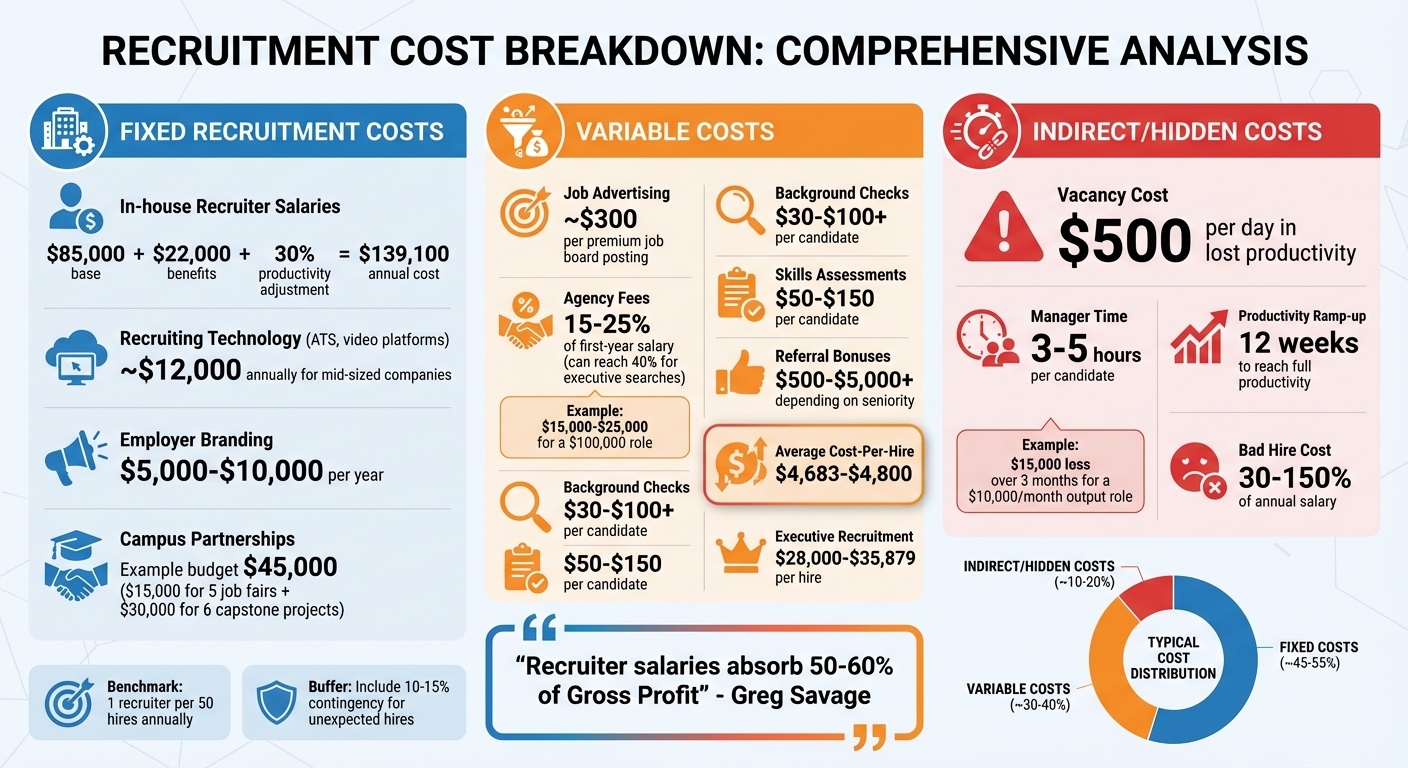
Recruitment Cost Breakdown: Fixed, Variable, and Hidden Expenses
Once you’ve outlined your hiring needs, it’s time to dissect where your recruitment dollars are going. Recruitment costs generally fall into three main categories: fixed expenses, variable costs, and indirect costs. Let’s take a closer look at each to help you map out a precise recruitment budget.
Fixed Recruitment Costs
Fixed costs are the foundation of your hiring infrastructure – expenses that remain steady regardless of how many people you hire. The largest portion typically goes to in-house recruiter salaries. To calculate this accurately, include not just base pay but also benefits, payroll taxes, and productivity adjustments. For instance, a recruiter earning $85,000 annually, with $22,000 in benefits and a 30% productivity adjustment, totals $139,100 in annual costs [8].
Benefits alone often add 30% to 40% to base salaries, while payroll taxes range from 7% to 15% [3]. The productivity adjustment accounts for time spent on non-recruiting activities, sick days, and onboarding [2][8]. A common benchmark is one in-house recruiter for every 50 hires annually [6].
Beyond salaries, consider recruiting technology. Tools like Applicant Tracking Systems (ATS), video interview platforms, and background check software typically cost mid-sized companies around $12,000 annually [4]. Then there’s employer branding – maintaining career pages, creating social media content, and producing marketing materials can cost between $5,000 and $10,000 per year [2][4]. If your strategy includes university hiring, allocate funds for campus partnerships. For example, Ravi, a Talent Acquisition lead, budgeted $45,000 in 2024 for university recruitment: $15,000 for five job fairs and $30,000 for six sponsored capstone projects [8].
To avoid waste, audit your tech subscriptions annually to eliminate unused features or overlapping tools [4][1]. Also, include a 10% to 15% contingency buffer for unexpected turnover or urgent hires [4]. Prioritize funding for high-impact roles where vacancies hit revenue hardest and opt for leaner budgets for roles that are easier to fill [1].
Variable Costs and External Fees
Variable costs shift with hiring activity, giving you flexibility to adjust mid-year. The most visible expense here is job advertising. Premium job board postings on platforms like LinkedIn or Indeed cost around $300 per post [2]. Sponsored listings and social media campaigns can quickly add up when filling multiple positions.
External recruitment agency fees are often the largest variable expense. Contingency fees typically range from 15% to 25% of the new hire’s first-year salary [4][3]. For a $100,000 role, that’s $15,000 to $25,000 per hire. Executive searches can climb to 40% of base salary [6]. While these fees may seem high, leaving key roles unfilled can cost your company an average of $500 per day in lost productivity [1][4].
Other variable costs include candidate evaluation expenses like background checks, which range from $30 to over $100 per candidate, and skills assessments, which cost $50 to $150 per candidate [3][8].
Don’t forget incentives and travel. Employee referral bonuses often range from $500 to $5,000 or more, depending on the role’s seniority [10][4].
"Cost-per-hire depends on company size and number of hires. Larger companies making a lot of hires can keep the cost lower than smaller companies. But, generally, aiming for an average cost-per-hire between $3,000 and $5,000 is good practice." – Lacey Brandt, CFO, Workable [6]
The average cost-per-hire currently hovers between $4,683 and $4,800 [10][4], though executive recruitment can skyrocket to $28,000–$35,879 per hire [10][1].
Indirect Costs of Hiring
Indirect costs are often overlooked but can quietly drain your budget. A major factor is manager and team time spent on recruitment. Reviewing resumes, conducting interviews, and onboarding new hires all pull employees away from their core responsibilities. To quantify this, track the hours spent on hiring tasks and multiply by their hourly pay rates [11][4]. A good rule of thumb is to budget 3 to 5 hours of manager time per candidate [4].
Another hidden cost is the productivity ramp-up. On average, it takes 12 weeks for a new hire to reach full productivity [10]. For a role generating $10,000 in monthly output, operating at 50% capacity during the ramp-up period results in a $15,000 loss over three months [11].
Finally, account for the risk of a bad hire. Replacing an underperforming employee can cost between 30% and 150% of their annual salary [3][11]. This includes severance, re-recruiting costs, and the productivity hit from starting over.
"Recruiters account for the most significant expense for any recruitment agency. Indeed, most recruitment companies will find that staff salaries, mostly recruiters, absorb 50% to 60% of their Gross Profit." – Greg Savage, Recruitment Expert [1]
Step 3: Calculate and Forecast Your Recruitment Budget
Now that we’ve broken down recruitment costs, it’s time to translate those numbers into a clear and actionable budget. Use the fixed, variable, and indirect costs we’ve outlined earlier to ensure every expense category is accounted for in your planning.
How to Calculate Cost-Per-Hire
To determine your cost-per-hire, add up all internal and external recruiting expenses, then divide that total by the number of hires during a specific period [12][13][14]. Internal costs include recruiter salaries and benefits, prorated time spent by hiring managers on interviews, referral bonuses, internal training programs, and ATS or software subscription fees [2][12][16]. External costs typically cover recruitment agency fees (which range from 20% to 30% of the hire’s salary), job board ads, background checks, candidate travel reimbursements, and relocation expenses [12][13][16].
Internal expenses often make up the bulk of the total – frequently accounting for 60% or more of the overall cost-per-hire [16]. On average, the cost-per-hire in the U.S. stands at about $4,800 as of 2026 [14][15]. However, this figure can vary significantly depending on the role. For instance, hiring a customer service representative might cost around $1,950, while bringing in a senior data scientist could hit $50,000 due to specialized sourcing and agency fees [12]. Executive hires typically range from $28,000 to $35,879 [1][13], while specialized tech roles average around $6,200 [13][14].
"The goal isn’t simply to spend less; it’s to invest smarter. A rock-bottom CPH might mean you’re cutting corners on sourcing or rushing the interview process." – Vicky Liu, Juicebox [14]
Instead of relying on a single company-wide average, break down cost-per-hire by department, seniority, or role type to identify trends and make better decisions [12][14][16]. For example, to calculate the cost of interview time, multiply each participant’s hourly rate by the hours they spend on hiring tasks [12]. You can also calculate your Cost of Vacancy using this formula: (Annual revenue generated by the role) ÷ 220 workdays. This metric highlights the daily cost of leaving a role unfilled – often around $500 per day in lost productivity – and can help justify additional hiring investments [1].
These calculations will provide the foundation for building a recruitment budget that aligns with your hiring goals.
Build a Scalable Recruitment Budget
Once you’ve calculated cost-per-hire, you can project your budget based on hiring volume and recruiter productivity. Use this formula to forecast future costs:
(Planned Hires × Average Cost-per-Hire) + (Recruiter Compensation + Tech Stack + Employer Branding + Candidate Experience) [1].
Recruiter capacity plays a key role in this equation. Typically, one recruiter can manage 8–15 high-volume roles, 4–8 mid-level roles, or 1–3 specialized positions per month [2]. For example, if you’re targeting 30 mid-level hires in Q3, you’ll need at least four to eight recruiters to handle the workload effectively.
To allocate funds efficiently, categorize roles into three tiers:
- High-impact roles: These are revenue-generating or hard-to-fill positions (e.g., senior engineers). They warrant larger budgets.
- Core roles: Positions like analysts or account managers fall here and need moderate spending.
- Volume roles: Entry-level or support roles can use leaner budgets with standardized processes [1].
Consider setting up automatic triggers to reallocate funds if cost-per-hire exceeds your target for two consecutive weeks. For instance, you could shift 15% of your budget to the most effective sourcing channels [1]. Additionally, monitor recruiter productivity by aiming for a Gross Profit to Total Pay ratio of 2.0 to 2.5x. Ratios above 2.5x indicate optimal scaling efficiency [1].
These steps will ensure your recruitment budget adapts to your needs while keeping costs under control. For more expert insights on optimizing your hiring strategy, explore our recruitment blog.
Step 4: Reduce Costs with Embedded Recruitment
After setting your recruitment budget, it’s time to explore ways to cut costs – and embedded recruitment can be a game-changer. Traditional hiring methods, whether through in-house teams or recruitment agencies, often come with hefty fixed costs or steep commission fees. Embedded recruitment offers a more flexible, cost-effective approach that not only reduces direct expenses but also simplifies internal processes.
How Embedded Recruitment Saves Money
Embedded recruitment eliminates the ongoing overhead tied to full-time recruiters – like salaries, benefits, training, and software subscriptions – which remain constant even when hiring slows [4]. For instance, a mid-sized company hiring 10 developers spent around $73,000 using an in-house team (factoring in salaries and tools). By switching to an embedded recruitment provider, the cost dropped to approximately $32,500 – a 55% reduction [2].
Traditional agency fees can quickly inflate hiring expenses. With embedded recruitment, companies can cut these costs by as much as 70%, while also freeing up over 80 hours per month previously spent on hiring and administrative tasks.
This model also absorbs additional costs, such as job board postings, applicant tracking systems, and recruiting software, eliminating the need for separate investments [2]. Plus, by avoiding disruptions like sick leave, training, and onboarding inefficiencies, embedded recruitment aligns expenses more closely with actual hiring demands [2].
Boost Hiring Efficiency and Scale
Beyond cost savings, embedded recruitment improves hiring efficiency by accelerating the recruitment process. With access to established networks and specialized expertise, embedded recruiters can fill positions faster than in-house teams working solo. Every day a role remains unfilled translates to lost productivity.
Services like Rent a Recruiter can integrate experienced recruiters into your team within days. They handle the entire hiring process while providing valuable data insights on sourcing efficiency and recruiter performance. Whether you’re scaling after securing funding, launching a new product, or navigating a hiring surge, this approach gives you the agility to keep up with demand. For fast-growing SMEs, the ability to adapt quickly is critical – some may need short-term support to hit hiring targets, while others aim to build a scalable, predictable recruitment function over time. The money saved can then be reinvested to drive further growth, aligning with your broader hiring strategy.
"A recruitment process outsourcing arrangement can actually reduce overall recruiting costs by eliminating fixed overhead while maintaining consistent hiring capacity." – 4 Corner Resources [4]
For smaller businesses hiring fewer than 30 people annually, embedded recruitment or external support often proves more cost-effective than keeping a full-time recruiter on staff [2]. Once your embedded partnership is in place, review your internal tech stack to avoid paying for tools your partner already includes [1].
Step 5: Track Metrics and Adjust Your Forecasts
Once you’ve laid out a detailed cost breakdown and budget forecast, the next step is to keep a close eye on recruitment metrics. Why? Because hiring isn’t static. Markets shift, turnover rates fluctuate, and business needs evolve. A set-it-and-forget-it annual budget just doesn’t cut it anymore. To stay ahead, you need to monitor and adjust your forecasts quarterly, ensuring they reflect actual performance and market dynamics [18].
Key Recruitment Metrics to Monitor
To keep your forecasts relevant, focus on six core metrics that directly impact costs. Among these, cost-per-hire (CPH) stands out as the most critical. Regularly update your CPH figures by role tier to account for shifting trends [4].
- Time-to-fill (TTF): This measures the days between opening a requisition and securing an accepted offer. The median TTF falls between 41 and 50+ days [1][4]. Every extra day adds costs – whether through extended job board fees or recruiter hours. Worse, vacant roles carry a hidden cost of lost productivity [1][4].
- Source efficiency: Track which channels deliver the best ROI. For example, if referrals consistently outperform premium job boards in both quality and cost, shift your budget immediately – don’t wait for next year’s planning cycle [4][18].
- Offer acceptance rate: A declining acceptance rate could point to issues with compensation or candidate experience, both of which can waste recruitment dollars [4].
- Quality of hire: Measure this through 90-day performance reviews and first-year retention rates. It’s a metric that only 20% of organizations formally track, yet it has the largest long-term impact on costs [4].
"The cheapest hire you’ll ever make is the one you never have to replace." – 4 Corner Resources [4]
Update Forecasts Based on Results
Armed with these metrics, adjust your forecasts every quarter to address inefficiencies and optimize spending. Compare actual spending to budgeted amounts to identify "waste points" – such as underperforming job boards or high-cost tactics that fail to deliver quality hires [18][4]. For example, use historical turnover rates by department to project backfill needs, especially as turnover rates in some sectors have surged by over 30% since pre-pandemic levels [7].
Always include a 10–15% contingency buffer in your forecasts to cover unexpected resignations or sudden growth demands [4][18]. Introduce budget tripwires as well: if a source’s CPH exceeds the target for two consecutive weeks, reallocate 15% of that budget to higher-performing channels [1].
"Executives want to see that you’ve planned for agility, not perfection." – Andie Parker, Senior Client Director, Recruitics [17]
The goal is a flexible forecast that evolves alongside real-world conditions. Quarterly reviews allow you to spot inefficiencies early and shift resources where they’re needed most [1][18][4].
Conclusion
Breaking Down the Key Steps
Start by forecasting recruitment costs carefully. Identify your hiring needs – whether it’s new positions or replacements due to turnover [4]. Categorize expenses into fixed, variable, and indirect costs to get a complete picture. This comprehensive approach ensures accuracy when calculating your cost-per-hire.
Understand that cost-per-hire varies by role and seniority. For instance, executive hires can exceed $28,000, while entry-level roles may cost closer to $2,000 [4]. Build scenario-based budgets, including a 10–15% buffer for unexpected resignations or growth spikes [4][17]. And don’t overlook the hidden cost of vacancies – each unfilled role can drain up to $500 daily in lost productivity [4].
Embedded recruitment offers a flexible way to scale hiring while cutting overhead. Businesses using this approach have reported savings of up to 40% compared to traditional in-house recruitment models [19].
"Momentum is a competitive asset and losing it hands your talent pipeline to competitors" – Olivia Yongue, SVP at Recruitics [17]
By combining these steps with a well-structured hiring process, you can sustain growth without compromising efficiency.
Why Choose Rent a Recruiter?
When it’s time to scale, Rent a Recruiter places skilled recruiters directly into your team, offering a cost-effective alternative to traditional hiring models. This approach can reduce recruitment costs by up to 70% while saving over 80 hours of administrative work each month. We handle the entire hiring process, giving your team the structure and visibility needed to stay ahead – without the burden of fixed overhead.
Discover how embedded recruitment can turn your hiring process into a reliable, scalable advantage. Visit rentarecruiter.com to learn more.
FAQs
What costs are most often missed in a recruitment budget?
When budgeting for recruitment, it’s easy to focus solely on direct expenses like wages. But there’s a lot more beneath the surface that can impact your bottom line.
Think about indirect costs: onboarding, training, and employee benefits. These are essential investments, but they add up quickly. Then there are the hidden costs: turnover risks, hiring delays, and the time it takes for new hires to reach full productivity.
Don’t forget the smaller but still impactful expenses like recruitment advertising, agency fees, background checks, and the hours your managers spend interviewing and evaluating candidates. These all chip away at your budget.
To avoid surprises, make sure your hiring plan accounts for both upfront and less obvious costs. A clear picture of these expenses will help you manage your resources effectively and prevent financial strain.
How do I estimate cost-per-hire for different roles as we scale?
To figure out the cost-per-hire for specific roles, start by adding up all recruitment-related expenses for that role. This includes costs like job ads, agency fees, time spent on interviews, and onboarding expenses. Once you have the total, divide it by the number of hires made for that role.
Keep an eye on trends over time. This helps pinpoint roles that are more expensive to fill, allowing you to adjust your hiring approach and allocate resources more effectively as your company scales.
When should I use embedded recruitment instead of hiring a full-time recruiter?
Embedded recruitment is a smart choice when you need flexible hiring solutions for specific projects or during periods of high demand. It helps you scale your recruitment efforts quickly, handle the entire hiring process, and stay in control – without the long-term commitment of a full-time hire. This approach works particularly well for rapid growth phases, product launches, or hiring surges, delivering both cost efficiency and specialized expertise designed to match your exact needs.