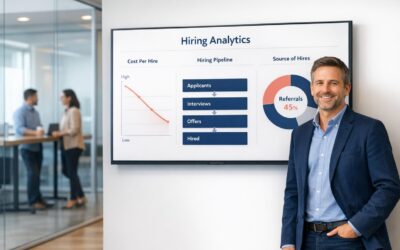
AI in hiring is transforming how organisations recruit talent in 2026, but human judgement still remains essential.
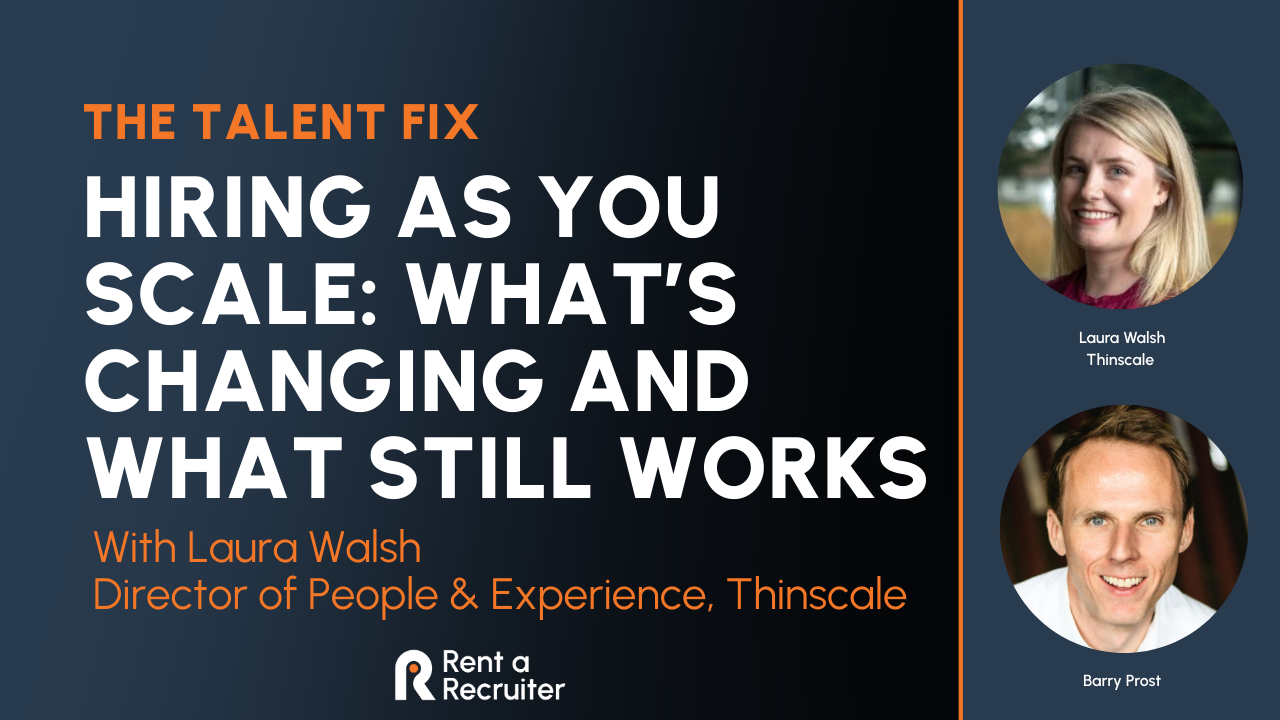
These insights come from a recent episode of the Rent a Recruiter podcast, where Barry Prost spoke with Laura Walsh, HR leader at Thinscale, about AI, recruitment and the future of remote work.
Key Takeaways: AI in Hiring in 2026
- AI is already reshaping recruitment workflows, from job descriptions to CV creation.
- Automation improves efficiency but should not replace human judgement in hiring decisions.
- Keyword-based screening risks filtering out strong candidates.
- Candidate experience remains a key differentiator for employer brands.
- Remote-first companies are shifting from time-based work to output-based performance.
Many companies are exploring new recruitment models to support this shift, including embedded recruitment, where experienced recruiters integrate directly into internal hiring teams.
AI in Hiring: Why Human Judgement Still Matters in 2026
AI is transforming hiring in 2026, but it will not replace human judgement. The most effective organisations use AI to automate administrative recruitment tasks while keeping people responsible for screening, interviews, candidate experience, and culture fit.
In a recent episode of the Rent a Recruiter podcast, Barry Prost spoke with Laura Walsh, HR leader at Thinscale, about how AI is changing recruitment, the risks of automated hiring processes, and how remote-first companies think about culture and performance.
Their discussion highlights a key reality facing HR leaders today: technology is accelerating recruitment workflows, but hiring decisions still depend on people.
According to McKinsey, 88% of organisations now use AI in at least one business function, showing how quickly automation is being embedded into everyday business processes. Yet when it comes to hiring, human judgement remains critical.
How Is AI in Hiring Changing Recruitment in 2026?
Artificial intelligence is already influencing multiple stages of the hiring process.
Many organisations now use AI tools for:
-
writing job descriptions
-
sourcing candidates
-
parsing CVs
-
interview scheduling
-
candidate communication
-
screening large volumes of applications
These technologies significantly reduce administrative work for recruiters, allowing them to focus on more strategic activities.
However, as Laura Walsh explained during the podcast discussion, AI is already influencing both sides of the hiring process.
“Everybody’s using AI to write CVs. We’re using it to write job descriptions. Why wouldn’t you? It saves time, but you still need to assess the person behind the application.”
In other words, automation can improve efficiency, but it cannot replace human evaluation of skills, behaviour, and cultural alignment.
Will AI Replace the CV and Interview?
Despite the rapid growth of AI-driven recruitment tools, it is unlikely that traditional interviews will disappear anytime soon.
While technology can help shortlist candidates or identify patterns in applications, it still struggles to evaluate qualities such as:
-
communication skills
-
curiosity and willingness to learn
-
cultural alignment
-
problem-solving ability
-
interpersonal dynamics
During the podcast conversation, Laura emphasised that hiring ultimately involves evaluating human interaction.
“You are dealing with people. You need to assess their communication skills, how they react to questions, and how they engage in a conversation.”
For HR leaders, this means AI should support the hiring process rather than replace it.
Automated keyword screening alone can also create risks. Strong candidates may be filtered out simply because their CV does not match a predefined set of search terms.
Human review remains essential to ensure the best candidates are not overlooked.
Why Candidate Experience Still Matters in an Automated Hiring Market
As recruitment becomes more automated, candidate experience is becoming a key differentiator for employers.
Many job seekers report submitting applications and never receiving a response. While automation can help companies manage high application volumes, poor communication can damage employer brand and future hiring success.
During the discussion, Laura highlighted the importance of treating applicants with respect.
“If somebody has gone to the trouble of applying, you should at least give them the time to review their CV.”
This reflects a broader shift in hiring expectations. Candidates increasingly expect transparency, responsiveness, and clear communication during recruitment processes.
Research from McKinsey shows that overall hiring success rates remain relatively low across many organisations, meaning companies that improve candidate experience may gain a competitive advantage in attracting talent.
What AI Still Cannot Assess in Recruitment
One of the most interesting themes from the podcast discussion was the importance of human traits that technology cannot easily evaluate.
For example, Laura Walsh highlighted curiosity as a key indicator of strong candidates.
“If somebody shows curiosity in an interview whether it’s about technology, industry trends, or even broader topics, that’s a really positive sign.”
Curiosity often signals:
-
willingness to learn
-
adaptability to change
-
engagement with new technologies
-
openness to innovation
These traits are increasingly valuable as AI reshapes how work is performed across industries.
Algorithms may help identify qualifications or experience, but assessing mindset and potential still requires human interaction.
How Remote-First Companies Build Culture
The conversation also explored how hiring and culture intersect in remote-first organisations.
Thinscale operates as a remote-first business with employees located across Ireland, the UK, Europe, and North America. For companies like this, traditional workplace culture models no longer apply.
Instead of focusing on time spent at a desk, remote-first organisations increasingly prioritise output and flexibility.
As Laura explained:
“We’re not obsessed with whether someone is sitting at their desk at two minutes past nine. We’re concerned with whether the work is getting done.”
This reflects a broader shift away from rigid working structures that originated during the industrial era.
For many modern organisations, culture is now built around:
-
trust and autonomy
-
strong leadership
-
meaningful work
-
flexibility in working patterns
Leadership quality also plays a critical role.
Employees are far more likely to stay engaged when they believe in their leaders and the products or services their company delivers.
What Hiring Leaders Should Focus On Next
For HR leaders navigating the rise of AI in hiring, the challenge is not whether to adopt technology – but how to integrate it effectively.
Based on insights from the podcast conversation, several practical priorities stand out.
Use AI to remove administrative work
Automation is most valuable when it reduces repetitive tasks such as scheduling, sourcing, or documentation.
Keep humans responsible for hiring decisions
Recruiters and hiring managers should remain involved in candidate evaluation, interviews, and final decisions.
Prioritise candidate experience
Communication and transparency still matter, even in automated processes.
Focus on human skills
Curiosity, communication ability, and adaptability are increasingly important indicators of long-term success.
Align hiring with culture
Hiring decisions should reflect leadership values, organisational culture, and team dynamics.
Need to improve your hiring process without adding permanent headcount?
Our embedded recruiters can integrate within 5 days, giving you on-demand hiring capability without the overhead of traditional agency models.
Case Studies: Embedded Success In Action
Unique
Unique streamline its global hiring across Berlin, Zurich, New York, London, and Singapore. Within months, our embedded recruiter coordinated 291 interviews, delivered 17 offers, and achieved 10 successful hires.
MasterTech
Rent a Recruiter partnered with Mastertech for 27 months, embedding a dedicated Talent Partner directly into their business. €123,000 savings vs traditional agencies costing, 29 Placements
+3000 Passive candidates reached & 4:1 CV to interview ratio
These successes show how embedded recruitment transforms hiring from a reactive task into a strategic function that drives growth and resilience.
Why the Future of Hiring Is AI-Enabled but Human-Led
Artificial intelligence will continue to reshape recruitment technology over the coming years.
But as the conversation between Barry Prost and Laura Walsh illustrates, the fundamentals of hiring remain the same.
Successful organisations will combine:
-
the efficiency of AI
-
the judgement of experienced recruiters
-
and a strong focus on candidate experience and culture
Companies that strike this balance will be far better positioned to attract, hire, and retain the talent they need to grow.
If speed and flexibility matter
Our embedded recruiters can integrate with your hiring team within five days, helping you build a smarter, more effective recruitment process.
FAQs:
What is AI in hiring?
AI in hiring refers to the use of artificial intelligence tools to automate recruitment activities such as sourcing candidates, screening applications, scheduling interviews, and analysing hiring data.
Can AI replace recruiters?
No. AI can automate repetitive tasks, but recruiters are still needed to evaluate communication skills, culture fit, and long-term potential.
How are companies using AI in recruitment?
Most organisations use AI for job description creation, CV screening, candidate sourcing, and interview scheduling.
Does AI improve recruitment outcomes?
AI can improve efficiency and reduce administrative work, but hiring quality still depends on human judgement and well-designed recruitment processes.
Will AI remove the need for interviews?
Unlikely. Interviews remain one of the best ways to assess communication skills, curiosity, and cultural alignment.

About the Author:
Barry Prost has 20 years’ experience in international recruitment and has co founded award winning brands in the sector including Propel Consult, Yala, and now Rent A Recruiter, whose mission is to be a leading international, technology-led, embedded recruitment services provider with operations in Ireland, US, Middle East and Australia. Barry has a degree in Business from Trinity College Dublin and MBA from the Smurfit School of Business. Barry is a Committee Member of the Employment & Recruitment Federation, serves on the board for the SFA overseeing the MentorsWork initiative. Also nominated to Vice Chair of the Dublin Regional Skills Forum.