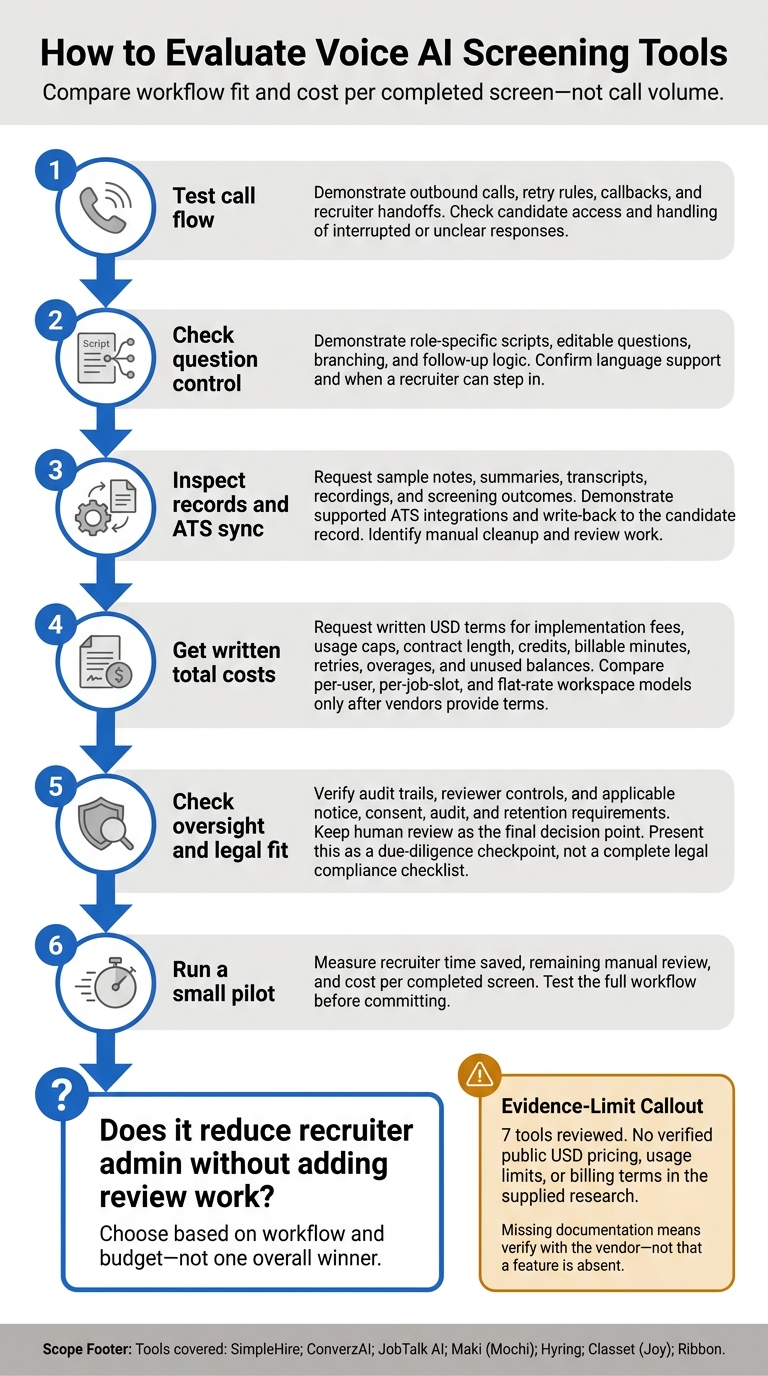
I would choose a voice AI screening tool by its cost per completed screen, not its call volume. Across these 7 tools, the supplied research provides no verified public USD pricing, so your first step is to request written costs and test the workflow. This is especially important if you are moving from a commission-based model to Recruitment as a Service.
I compare call handling, question controls, screening records, ATS connections, and budget fit. For your team, the test is simple: does it reduce recruiter admin without adding review work?
Before you buy, I recommend checking:
- Call flow: outbound calls, retries, and recruiter handoffs.
- Question control: role-specific scripts and follow-up questions.
- Records and ATS sync: usable notes and results that reach your hiring system.
- Total cost: setup, usage limits, and charges beyond the quoted allowance.
<u>Start with a small pilot.</u> Measure recruiter time saved and cost per completed screen before committing, or perform a recruitment health check to identify further efficiencies.
How to Evaluate Voice AI Screening Tools
AI voice screening in action: How Phenom helps HR hire faster at scale
sbb-itb-a23bd6a
1. SimpleHire
SimpleHire’s public documentation is limited. Before committing, use a live demo or explore free AI-powered recruitment tools to check the screening workflow, record capture, and ATS sync. The key test for each tool: can it manage calls, capture responses, and sync results without leaving your team with manual cleanup?
Call Handling
Ask to see outbound screening, retry rules, and recruiter handoff in action.
Question Flows
Check how your recruiters can edit questions, handle unclear answers, and route candidates to a person.
Screening Records and ATS Connectivity
Verify which ATS integrations are available and whether notes, transcripts, and screening outcomes write back to the candidate record.
SME Pricing Fit
To assess affordability for your SME, request a quote covering call usage, implementation, and ATS sync. Check setup fees and usage limits so you can assess the total cost.
2. ConverzAI
Public details are limited. Use a live demo to test workflow control, ATS write-back, and total cost before making a buying decision.
Call Handling
Public documentation does not specify ConverzAI’s call limits or outreach controls. In a demo, check call volumes, retry logic, and how calls pass to a recruiter.
Once you’ve checked routing, test how much control recruiters have over the script.
Question Flows
Public documentation does not show whether recruiters can edit prompts, change follow-up questions, or tailor questions by role and hiring stage. Test each control in the demo, then check how screening results reach your ATS.
Screening Records and ATS Connectivity
Ask which native ATS integrations are available. Confirm whether summaries, recordings, transcripts, and outcomes write back to the candidate record, so you know what recruiters may need to transfer manually.
SME Pricing Fit
Pricing, minimum commitments, and implementation fees are not public. SMEs should confirm the total cost and ask whether the product has a ethical standards and bias audits before use.
3. JobTalk AI
As with the tools above, validate JobTalk AI in a demo before rollout.
Call Handling
Ask for a live demo showing how the tool handles screening calls and routes completed screenings to the correct role. Check that this works without manual cleanup for your team.
Question Flows
Check whether recruiters can tailor questions by role and update them without disrupting other workflows.
Screening Records and ATS Connectivity
Request a sample candidate record. Check the recorded responses, recruiter summaries, correction controls, and ATS write-back through supported integrations.
SME Pricing Fit
Pricing remains unverified, so its fit for talent acquisition for SMEs is still unclear. Ask for an itemized quote covering seats, usage, and setup.
Apply the same checklist to the next tool: call flow, question control, record capture, and ATS sync.
4. Maki (Mochi)
Call Handling
The sources do not document Maki (Mochi)’s call types, language coverage, or callback handling. Verify all three in a live demo to check whether they match your hiring needs.
Question Flows
The sources do not confirm support for editable scripts, role-based branching, language switching, or adaptive follow-ups. Use a demo to test how much control your recruiters have over each feature.
Screening Records and ATS Connectivity
The sources do not document transcripts, scores, or named ATS integrations. Request sample screening records and a demonstration of ATS write-back to assess record quality and potential manual admin.
SME Pricing Fit
No verified pricing, minimum seat count, minimum commitment, or setup fee is published for Maki (Mochi). Request an itemized quote to assess affordability for your SME.
Apply the same checks to the next tool: call flow, script control, note capture, and ATS sync.
5. Hyring
Call Handling
Public material does not verify Hyring’s call flow, call routing, or callback handling. Test all three in a live demo to see whether they fit your screening workflow.
Question Flows
Once you’ve checked call flow, test prompts, follow-up questions, and recruiter handoff. Ask Hyring to demonstrate how it handles unclear answers so you can judge when your recruiters need to step in.
Screening Records and ATS Connectivity
Public material does not verify which screening records Hyring saves or how they connect to your ATS. Request a sample record showing summaries, scoring logic, and ATS write-back. Use it to assess how much manual review your team would still need.
SME Pricing Fit
No verified entry-level USD price or usage allowance is published. If you run a smaller team, compare the total commitment, not just the advertised starting price.
6. Classet (Joy)
Call Handling
Public documentation does not confirm Joy’s call handling. Check missed-call handling and recruiter handoff first before using it for frontline screening. This is the first test for high-volume frontline hiring.
Question Flows
Confirm that Joy can screen for availability, licenses or certifications, and role requirements. Check that it can route unclear answers to a recruiter.
Screening Records and ATS Connectivity
No Joy-specific record format or native ATS integration is documented here. Confirm what it stores, which ATS integrations it supports, and any syncing limits. You’ll also need to check how it handles notice, recording, and retention requirements. Setup and sync details affect total cost.
SME Pricing Fit
No confirmed pricing, setup fees, or usage limits are published. Request an itemized quote covering implementation, call usage, and ATS connection costs before judging whether it fits your budget.
7. Ribbon
Call Handling
Candidates join through a dedicated interview link, with no app download or account required. Ribbon’s AI agent runs structured voice interviews, moves between questions, and records responses in real time. Your next check is how much control you have over those questions.
Question Flows
Ribbon supports dynamic question flows. However, the available sources do not confirm customization options, follow-up logic, or whether interrupted interviews can resume.
Screening Records and ATS Connectivity
The available sources do not document Ribbon’s screening records, ATS connections, or export options. That leaves your team unable to assess what it can review or sync after screening, or how much manual follow-up it will need. You can also rate your recruitment process to identify other efficiency gaps. For SMEs, fractional recruitment services and workflow costs also need checking.
SME Pricing Fit
No verified pricing or plan limits are available, so the sources do not establish whether Ribbon fits an SME budget. Its link-based access may help candidates start screening quickly without creating an account.
Compare Screening Features and Costs
The supplied research confirms SimpleHire and JobTalk AI support high-volume outbound screening and fast candidate contact. For the other five tools, you’ll need vendor confirmation on call flow, question control, ATS sync, and pricing.
Use the comparison below to separate confirmed details from questions your team needs answered in a demo.
Call Handling and Candidate Access
“Not documented” means the supplied research did not confirm the feature.
| Tool | Verified call mode | Best-fit use case to verify |
|---|---|---|
| SimpleHire | High-volume outbound screening | High-volume candidate screening |
| ConverzAI | Not documented | Needs vendor confirmation |
| JobTalk AI | High-volume outbound screening | Fast contact with new applicants |
| Maki (Mochi) | Not documented | Needs vendor confirmation |
| Hyring | Not documented | Needs vendor confirmation |
| Classet (Joy) | Not documented | Needs vendor confirmation |
| Ribbon | Not documented | Needs vendor confirmation |
Question Control and Follow-Up Logic
The supplied research does not verify question templates, branching, language support, or recruiter review controls for any of the seven tools. Ask vendors to demonstrate these controls so you can assess whether screening will meet your hiring requirements.
Records and ATS Write-Back
The supplied research does not confirm recordings, transcripts, scorecards, or ATS write-back for any of the seven tools.
Check these features alongside pricing. Your team needs to understand both the workflow fit and any manual work left after screening.
SME Pricing and Usage Limits
The supplied research contains no verified, publicly documented USD pricing, usage limits, or billing terms for any of the seven tools.
When vendors share pricing, compare per-user, per-job-slot, and flat-rate workspace models[1]. Request written USD terms covering implementation fees, usage caps, contract length, credits, billable minutes, retries, overages, and unused balances.
Pros, Cons, and Hiring Team Fit
Public detail is limited, so assess fit with your hiring team. Treat missing information as questions to resolve during due diligence, not reasons to endorse or dismiss a product.
- Internal teams: Look for audit trails for screening notes and reviewer controls, with human review as the final decision point [2].
- Agencies: Check ATS write-back and client visibility.
- Independent recruiters: Assess setup effort and whether total costs are predictable.
- Frontline hiring: Check screening-call speed and ease of deployment.
- Global teams: Confirm time-zone coverage and local compliance, as seen in our global scaling case study.
Legal fit matters alongside workflow fit. Select screening tools that support applicable requirements: annual independent bias audits, public summaries, and 10 days’ notice for covered NYC tools; notice and consent for AI video interview analysis in Illinois; and four-year retention of covered automated-decision data in California [2].
Conclusion: Match Screening Tools to Hiring Needs
Choose screening tools based on your workflow and budget, rather than looking for one overall winner. Run a small pilot to test the full process, then calculate the true cost per completed screen [2].
More screens won’t increase hiring capacity if review, calibration, or coordination still slows your team down.
FAQs
How do I calculate cost per completed screen?
Calculate cost per completed screen by dividing your total internal and external recruiting costs for the screening stage by the number of completed screens [1].
Include software subscriptions, integration, setup, training, and the human labor needed to review, audit, and correct AI output [2][3]. Convert screening labor hours into dollars using your organization’s approved loaded hourly rates.
Use one consistent definition of a completed screen so you can reliably compare costs over time [2][1].
How can I test voice AI for screening bias?
Don’t rely on vendor claims alone. Pilot one role with 30 to 50 candidates and track selection-rate ratios across demographic groups. Investigate any ratio below 80% for potential adverse impact.
Audit rules for unexplained exclusions linked to speech patterns, accents, or geography. Use consistent test profiles to check for uneven scoring.
Require trained human reviewers to score responses independently of AI recommendations. Document disagreements and keep hiring decisions grounded in job-related evidence.
How do I accommodate candidates who can’t use voice screening?
Offer accessible, equivalent alternatives, such as written assessments or other ways to communicate. Give candidates equal consideration, without penalizing them for a disability or communication style.
Before you introduce AI tools, set out a clear process for requesting and granting accommodations without requiring medical documentation. Tell every candidate how to request an alternative.
Assign an accessibility lead and have your recruitment team track requests. This helps prevent bias and ensures that requesting an accommodation does not limit a candidate’s screening opportunities.