
Poor recruitment vendor control can drain tens of thousands of dollars from your hiring budget, often through duplicate fees, weak service levels, and auto-renewals no one catches.
If you want better hiring control, I’d keep the process simple: set ownership before signing, lock in clear fees and service rules, track vendor performance monthly, and review each contract 60 to 90 days before renewal. That gives you tighter cost control, less wasted interview time, and better visibility into which vendors are worth keeping.
Here’s the short version:
- Define scope early so vendors know what a qualified hire looks like
- Choose the right model for the role, contingency, retained, or contract support
- Write fee terms clearly so you do not overpay on base salary, timing, or ownership disputes
- Set service levels for submissions, reporting, and replacement timing
- Track results monthly using time-to-fill, cost per hire, retention, and invoice accuracy
- Review before renewal so you can renew, renegotiate, or exit with data, not guesswork
For scaling companies in SaaS, IT, fintech, engineering, security, insurance, and professional services, this is not just admin. It is spend control for hiring. If agency markups can range from 25% to 100% of wages, weak contract control gets expensive fast.
The rest of the article breaks down how I’d put that control in place, from contract setup through renewal.
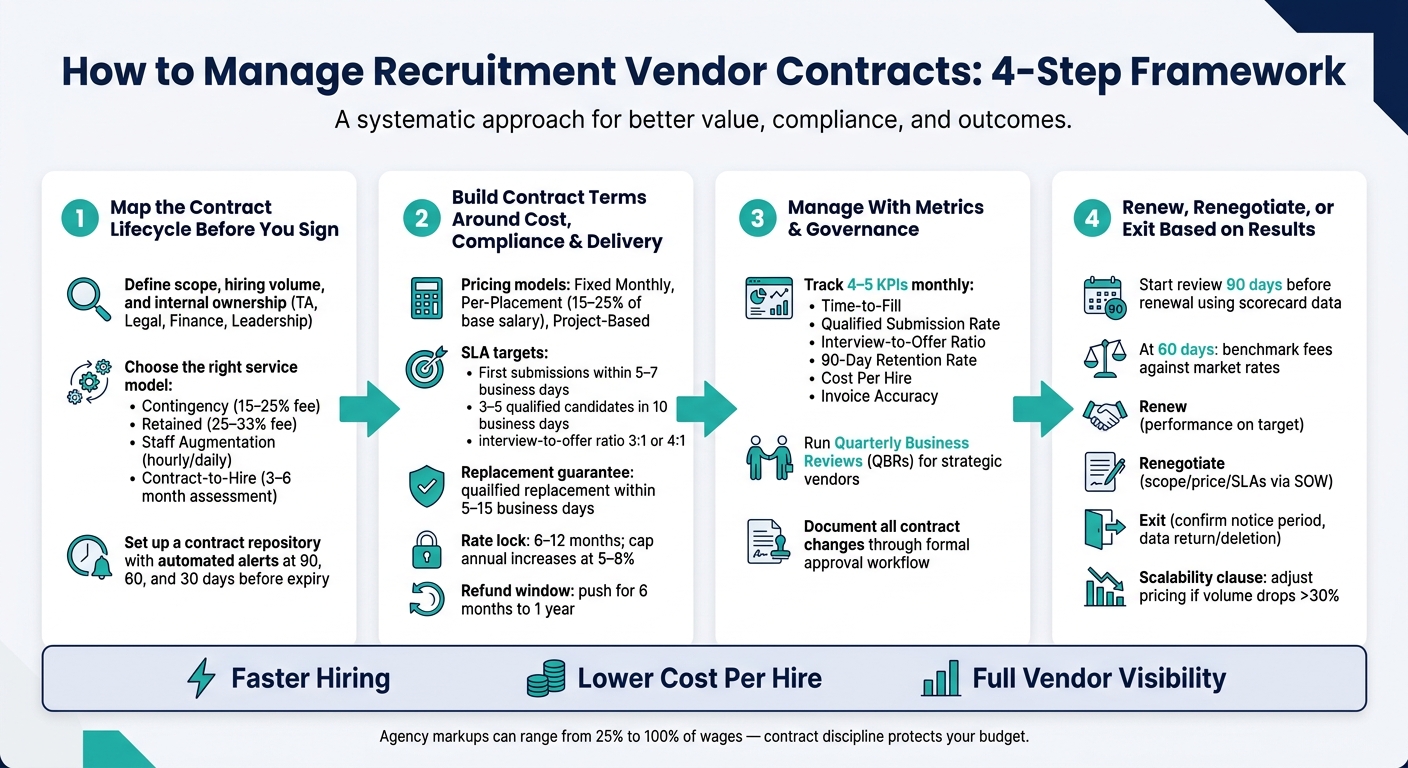
Recruitment Vendor Contract Management: 4-Step Process
How to Navigate the Biggest Risks In Vendor and Contract Management
sbb-itb-a23bd6a
Step 1: Map the Contract Lifecycle Before You Sign
Contract control starts before signature, not when problems show up later.
Most issues begin early, when scope, ownership, and renewal steps are still vague. If the lifecycle is mapped from the start, you cut down risk before terms are even drafted. That makes lifecycle planning your first control point.
| Lifecycle Stage | Key Activities |
|---|---|
| 1. Planning | Define role families, volume, budget, and technical, compliance, and delivery requirements |
| 2. Contracting | Negotiate pricing, SLAs, and guarantees; sign and store the agreement |
| 3. Monitoring | Track KPIs such as time-to-hire and candidate quality |
| 4. Renewal/Exit | Assess value 90 days before expiration |
Define Scope, Hiring Volume, and Internal Ownership
Before you discuss pricing with any vendor, document exactly what you need.
Be specific. Set out role families, expected monthly hiring volume, seniority levels, technical requirements, compliance standards, budget limits, and delivery needs. Spell out non-negotiable experience levels and culture fit expectations so agencies do not fall back on keyword screening and weak submissions [4].
Define a qualified candidate profile in writing before you sign. That gives you a clear yardstick later and makes vendor accountability much easier [4].
Internal ownership should also be clear from day one:
- TA owns the vendor relationship
- Legal reviews terms
- Finance tracks spend and renewals
- Leadership approves major commitments
Once scope and ownership are clear, you can assess your current hiring health to pick the service model that fits the need and avoid paying for the wrong setup.
Choose the Right Service Model for Your Hiring Need
The service model shapes cost, control, and accountability.
Contingency often suits mid-level roles where the talent pool is solid. Fees usually sit between 15% and 25% of first-year base salary, and you only pay when the hire is made [4].
Retained search fits executive hiring or highly specialised roles such as AI engineers, where you need deeper agency focus. Fees usually range from 25% to 33% and are often paid in stages [4].
Staff augmentation works for short-term project gaps, usually on hourly or daily rates. Contract-to-hire can lower hiring risk by giving you 3 to 6 months to assess someone before making a full commitment [4].
Get this choice wrong and the commercial impact adds up fast. You may pay executive-search fees for roles that do not need them, or end up with weak accountability on hard-to-fill positions.
Set Up a Contract Repository and Review Calendar
Once a contract is signed, it needs one permanent home.
Store every active agreement, SOW version, notice period, and renewal date in a single searchable repository. If you do not, teams end up digging through inboxes, working from old terms, and missing the window to review vendor performance.
That is where costs start to drift.
Central tracking gives you time to review results before a vendor gains leverage through auto-renewal.
"Without centralized tracking and renewal alerts, the contract can auto-renew at higher rates, even if usage has declined." – Chris Sumida, Group Manager of Product Marketing, Ramp [1]
Set automated alerts for 90, 60, and 30 days before each contract expires [1].
The timing matters:
- 90 days: review performance and compare pricing
- 60 days: start negotiation
- 30 days: finalise terms or begin transition if you are exiting
This kind of review rhythm saves time, protects spend, and gives you more control over hiring outcomes.
Once the lifecycle is mapped, the contract itself should lock in cost, compliance, and delivery standards.
Step 2: Build Contract Terms Around Cost, Compliance, and Delivery
Step 1 set contract ownership. Step 2 is where you lock down the terms that shape day-to-day performance.
At this point, the lifecycle is mapped. Now the contract needs to protect cost, compliance, and delivery in plain, enforceable language. Keep it short. Keep it clear. If a term affects budget, hiring speed, or risk, it should be written so there is no room for debate later.
Define Pricing, Payment Terms, and Spend Controls
Once ownership and scope are clear, the next job is to turn them into contract terms that control spend and output. The pricing model matters because each one shifts risk in a different way, based on hiring volume and how predictable demand is.
| Pricing Model | Typical Structure | Spend Control |
|---|---|---|
| Fixed Monthly | Set fee regardless of volume | Budget certainty; no per-hire spikes (often found in Recruitment as a Service models) |
| Per-Placement | 15%–25% of base salary [6][7] | Pay-for-performance; no upfront cost |
| Project-Based | Lump sum for a defined project | Capped total spend for defined output |
Spell out fee triggers, exclusions, and payment timing with care. Percentage fees should apply to base salary only. Payment should be due on the candidate’s start date, not at offer acceptance. If fees are large, split them into instalments [6].
If the engagement will last several months, add a rate lock for the first 6 to 12 months and cap yearly increases at 5% to 8% [8]. That gives you more control over future spend and helps avoid budget drift. Pre-existing candidate exclusions also need to be tight. If your team already knew the person, you should not be paying a fee for that introduction. Set the protection period at one year [6].
Once the commercial side is set, move to the service levels that support it.
Set Service Levels and Reporting Expectations
SLAs turn sales language into something you can measure. Without them, you are left judging effort instead of output.
Define a qualified submission in plain terms. If that is vague, reporting can look busy while hiring results stay poor. You want fit, not just CV volume.
Set clear expectations:
- First batch of qualified submissions within 5 to 7 business days of a role going live
- At least 3 to 5 qualified submissions within the first 10 business days
- Weekly hiring reports
- An interview-to-offer ratio of 3:1 or 4:1 as a baseline benchmark [4]
Replacement guarantees need the same level of detail. If a hire fails, require the agency to provide a qualified replacement within 5 to 15 business days [8]. Do not accept loose wording like "find someone." That sounds fine until a role sits open for weeks.
After performance terms are set, close the legal gaps that tend to cause friction later.
Cover the Few Clauses That Prevent Disputes
You do not need pages of legal padding. You do need the clauses that cut legal and operating risk.
Focus on labor-law compliance, confidentiality, indemnification, non-solicitation, dispute venue, and termination notice.
The contract should require compliance with all applicable local, state, and federal labor laws, including anti-discrimination rules, immigration rules, and limits on salary history, credit checks, or criminal history inquiries [6][11]. For employers hiring across the US, Ireland, Australia, or the Middle East, this matters even more. One weak clause can create a messy problem across regions.
Confidentiality and candidate data should be defined with care. State what counts as confidential information, how it must be protected, and make clear that those duties continue after the contract ends [10]. Mutual indemnification also matters. If a claim comes from the agency’s screening or recruiting activity, the agreement should say who carries that risk [6][10].
Add a no-poaching clause so the agency cannot approach your current employees [11]. On refund windows, push for six months to one year. The default position from many agencies, 30 to 60 days, is often too short to judge whether a hire is working out [6]. Also confirm that the contract names your local jurisdiction and venue for disputes [6]. A 30-day termination notice period is standard [10].
"A critical element to look for in your recruiting agency contract is a full money-back guarantee. This term ensures that if a candidate leaves the job within the first 60–90 days of placement, you are entitled to a complete refund." – Cassie Adams, BountyJobs [11]
After signature, these terms should shape daily vendor management and monthly reviews. If the contract is written well, it does more than sit in a folder. It gives hiring managers, finance, and procurement a shared set of rules to work from.
Step 3: Manage the Contract After Signing With Metrics and Governance
Once the contract is signed, the job changes. You’re no longer negotiating terms. You’re managing outcomes.
That means measuring performance, enforcing process, and reviewing vendors on a set schedule. Most vendor issues don’t start with the provider. They start when internal teams drift from the agreed process. Strong governance keeps cost, hiring quality, and compliance under control.
Turn Contract Terms Into a Hiring Playbook for Managers
The contract should not sit in a folder and gather dust. Turn it into a short operating playbook your hiring managers can use day to day.
Set up one intake channel for all candidate submissions, whether that’s your ATS, a VMS, or a structured email alias. This cuts down duplicate submissions and helps avoid fee disputes [2]. TA owns the vendor relationship, and hiring managers should not contact vendors directly without TA oversight [2].
Finance should approve invoices only when a signed agreement and a confirmed placement record are on file. Your internal team also needs a clear feedback SLA for candidate submissions, so vendors aren’t left waiting and roles don’t stall [2]. During onboarding, spell out escalation paths so everyone knows who handles service issues or disputes [3].
Keep the contract, scorecard, and communication history in one central working record. If your team is working from different versions of the truth, problems show up fast [3][1].
Once managers are using one process, you can judge whether vendors are following it too.
Track Performance With Hiring and Financial KPIs
Keep the scorecard tight. You don’t need ten metrics. Four or five is enough if they shape vendor decisions [12].
| KPI Category | Key Metrics | Review Frequency |
|---|---|---|
| Hiring | Time-to-fill, qualified-submission rate, interview-to-offer ratio | Monthly |
| Candidate Quality | 90-day retention rate | Monthly |
| Financial | Cost per hire, invoice accuracy | Monthly |
Cost per hire, time-to-fill, and 90-day retention tie straight back to business results. They show how fast you can hire, how well you control budget, and whether people stay once they join [2][5]. If a vendor keeps missing on any of these, that stops being a performance issue and becomes a contract issue.
Run Formal Reviews and Document Changes Properly
Reviews should be planned, structured, and based on data.
Strategic vendors, those filling core or high-volume roles, should have a Quarterly Business Review, or QBR. Operational vendors handling routine hiring can be reviewed monthly or quarterly. Lower-priority vendors may only need an annual review [12].
Send the scorecard to the vendor at least one week before each review. That gives both sides time to prepare and keeps the discussion tied to facts, not opinion [12].
Any contract change should be put in writing and moved through the approval workflow so legal, finance, and leadership can sign off [1]. If hiring needs change halfway through the term, use a formal amendment. Don’t leave it buried in an email thread.
For teams that want tighter control and direct visibility, Rent a Recruiter places recruiters inside your team and manages hiring end-to-end.
Documented review outcomes should guide the next move: renew, renegotiate, or exit.
Step 4: Renew, Renegotiate, or Exit Based on Business Results
Use the Step 3 scorecard to make the call, or rate your recruitment process to identify broader gaps. Every vendor relationship ends in one of three places: renew, renegotiate, or exit.
The difference between a clean decision and a messy one usually comes down to two things: timing and data.
Review Value 60 to 90 Days Before Renewal
Start the review 90 days before renewal. Go back to the Step 3 scorecard and pull the metrics that matter at renewal: time-to-fill, cost per hire, quality of hire, and replacement-claim frequency. A high replacement-claim rate is a warning sign on quality of hire [4].
You should also confirm the vendor still meets privacy and data-handling duties before extending the contract, mainly if they source candidates across borders [4][3]. This matters more than most teams expect. A vendor can hit hiring targets and still create risk if data controls have slipped.
At 60 days, move into a more structured negotiation. Check current fees against market rates before you renegotiate [4]. If pricing has drifted above market and results have not improved, you have a clear opening to push on commercial terms.
If results are below target, move to renegotiation. If performance holds, you can renew, or exit on your terms rather than under pressure.
Renegotiate Scope and Terms When Hiring Needs Change
Use the renewal review to work out what needs to change: price, scope, or vendor.
Business conditions shift. You may be entering a new market, launching a product, slowing hiring in one function, or ramping up in another. When that happens, the contract should move with the business.
A practical way to do this is through Statements of Work, or SOWs. These let you adjust hiring volume, role mix, or SLA targets without reopening the full agreement [1][9]. That saves time and gives you more control when priorities change mid-year.
If roles are moving into specialist areas, such as AI/ML engineering, update the SLAs to reflect that. Set clear technical screening criteria and tighter delivery timelines, such as 3 to 5 qualified candidates within 10 business days [4]. Otherwise, you can end up paying for a service model built for generalist hiring while your team needs niche talent.
If hiring volume drops sharply, negotiate a scalability clause. That clause should adjust pricing when volume falls past a defined threshold, for example 30%, without forcing a full renegotiation [5]. For CFOs and HR leaders, that kind of protection helps control spend when plans change.
If you’re planning to exit a vendor, review the termination for convenience clause, confirm the notice period, and make sure data return or deletion steps are documented before ending the engagement [1][9].
"Termination clauses should also address data return or destruction requirements so you retain control of your information security after the relationship ends." – Chris Sumida, Group Manager of Product Marketing, Ramp [1]
Conclusion: Use Contract Discipline to Cut Costs and Improve Hiring Control
Strong recruitment vendor contract management is a commercial discipline.
When you map the lifecycle early, set terms around actual cost and delivery expectations, track performance in a consistent way, and use renewal data to decide whether to renew, renegotiate, or exit, you put yourself in a better position on cost, speed, and hiring control.
That means faster hiring, clearer visibility, and lower spend per hire.
FAQs
Who should own vendor contracts internally?
Vendor contracts should sit with a designated internal team. That gives you clear accountability and a single point of control.
In most companies, ownership falls to procurement, legal, or operations, depending on size and structure. What matters is less the department name and more who is accountable day to day.
One team, or one named person, should own the full contract lifecycle. That includes performance tracking, renewal planning, and spotting issues early so you don’t end up with gaps, delays, or extra cost.
What KPIs matter most for vendor performance?
For recruitment vendor performance, the KPIs that matter most are time to fill, quality of hire, offer acceptance rate, candidate Net Promoter Score, and the submit-to-interview ratio.
These metrics show you two things fast: how efficiently a vendor works and whether their hiring output is worth the spend. If time to fill is slipping or the submit-to-interview ratio is off, that usually points to weak targeting, poor role calibration, or wasted hiring team time.
It also helps to track candidate retention, compliance with data privacy policies, and issue-resolution time. Those measures give you a clearer view of risk, service level, and long-term hiring value, not just short-term delivery.
Reviewing these KPIs on a regular basis helps you check that vendors are meeting contract terms and delivering strong hiring results.
When should I review a contract before renewal?
Review the contract before renewal if performance has slipped, your hiring plan has changed, or the vendor no longer fits what your business needs.
A simple check-in every three to six months helps you stay on top of the numbers that matter, including fill rates, time-to-hire, and candidate quality. That gives you a clearer view of whether the service is saving you time, controlling cost, and helping you hit hiring targets.
Before you renew, look at your own internal process too. Delays in feedback, shifting role briefs, or changes in hiring priorities can affect results just as much as vendor delivery. If targets were missed or contract terms were breached, go back through the agreement in detail before you decide whether to renew or end the arrangement.