Unfilled roles cost you more than you think. Every week a position stays vacant, you lose 1–2% of its annual salary in productivity. For scaling companies, this adds up fast.
Predictive forecasting software solves this by turning hiring from a reactive scramble into a planned, data-driven process. Companies that use these tools:
- Fill roles 40% faster.
- Reduce cost-per-hire by 25–40%.
- Avoid last-minute recruitment fees of 15–20% of a salary.
By linking hiring needs to real business metrics, like revenue per employee or customer demand, forecasting software ensures you hire the right people at the right time. It helps you plan 2–4 quarters ahead, build talent pipelines, and prevent costly delays.
The takeaway? Stop guessing. Start planning. Explore our recruitment resources for more insights. Forecasting software doesn’t just cut costs – it directly impacts your bottom line by ensuring your workforce grows in sync with your business.
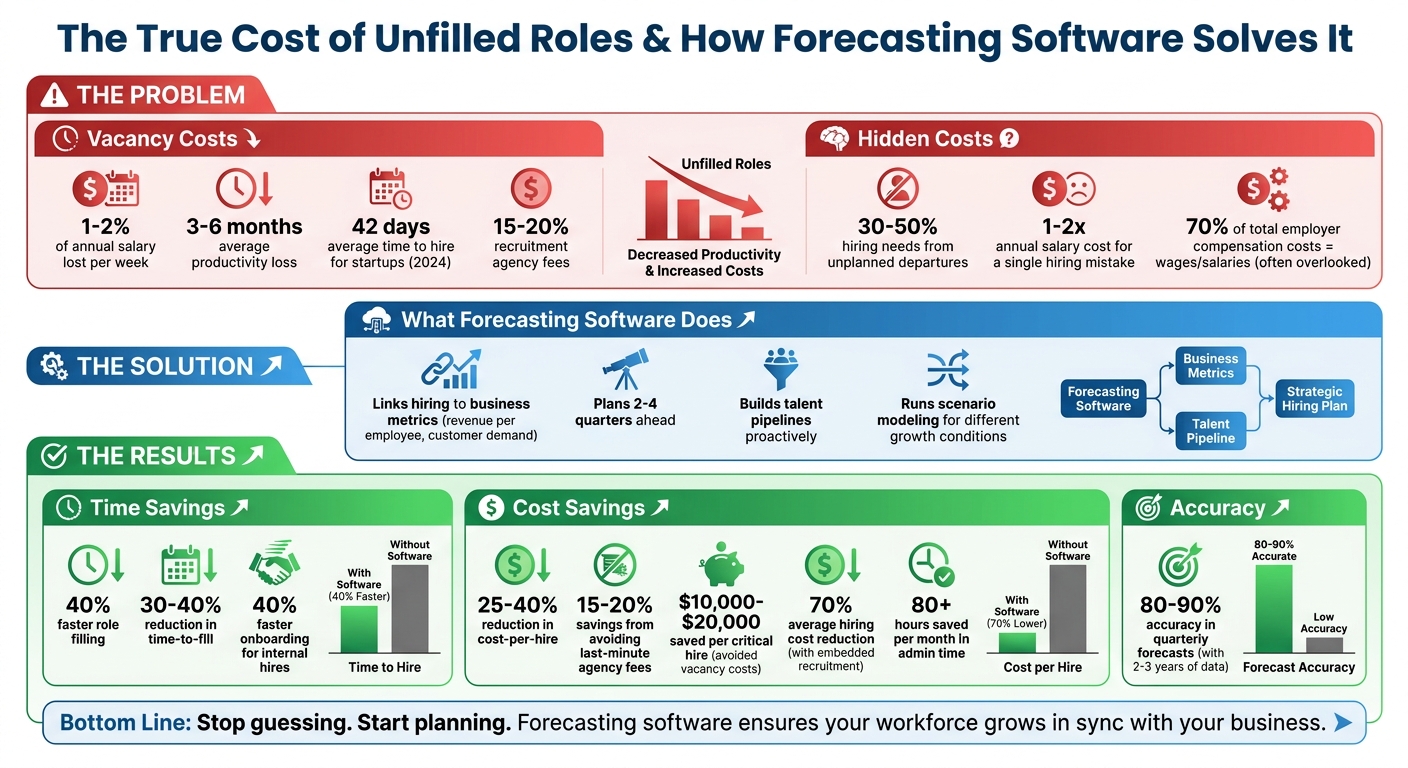
Cost and Time Savings of Forecasting Software for Hiring
Common Hiring Demand Challenges for SMEs
Unpredictable Workforce Requirements
For SMEs in 2026, workforce unpredictability is the norm. Economic shifts, regulatory changes, and political instability have rendered traditional annual headcount plans ineffective[3].
But the challenges go beyond external factors. Many SMEs overlook attrition trends, even though unplanned departures make up 30% to 50% of hiring needs[2]. Employees in their first year are especially risky, with a departure rate often twice that of the company average[2]. Add to this the impact of rapid business pivots – like shifting product strategies or entering new markets – and it becomes clear why historical data often falls short of predicting staffing needs[4][2].
When hiring is siloed as an HR task instead of being tied to business metrics like revenue per employee or customer service demand, the gap between talent acquisition and business objectives only grows wider[7][2].
"Traditional workforce planning is not planning. It is budgeting with job titles." – Superdots Team[7]
This volatility creates a ripple effect, amplifying the resource and cost challenges SMEs face.
Resource Constraints
For many SMEs, HR teams are stretched thin, acting more as reactive support functions than strategic partners. Instead of planning proactively, they spend their time tackling urgent hiring demands[3][6]. This often pulls leadership away from critical tasks like driving revenue or managing operations[3].
Budget limitations compound the issue. A single hiring mistake can cost 1 to 2 times the employee’s annual salary when accounting for recruitment, onboarding, and lost productivity[3][7]. Without the right tools or dedicated data resources, SMEs struggle to forecast workforce needs. This lack of insight leaves them unable to track attrition trends, align hiring with business goals, or plan for different growth scenarios. Investing in forecasting tools could help SMEs allocate resources more effectively and focus on long-term hiring strategies.
Costs of Inefficient Hiring
Outdated hiring practices are a major drain on SME resources. When a role goes unfilled, the productivity loss can last 3 to 6 months[2], and each week of vacancy costs 1% to 2% of the role’s annual salary[8]. In 2024, the average time to hire for startups rose to 42 days, up from 38 days the previous year[4], further compounding these losses.
Under pressure, SMEs often turn to costly recruitment agencies, paying placement fees of 15% to 20%[7]. This urgency can also lead to hiring less qualified candidates, creating long-term performance issues. Many SMEs make the mistake of focusing solely on base salaries in their forecasts, overlooking the fact that wages and salaries represent about 70% of total employer compensation costs[5]. The result? Budget overruns and financial strain by year-end.
Predictive forecasting offers a way out. Companies using these tools fill roles 40% faster and reduce cost-per-hire by 25% to 40%[2][8]. Yet, many SMEs still operate reactively, treating open roles as minor inconveniences rather than recognising them as bottlenecks to revenue and growth[3][8].
sbb-itb-a23bd6a
How Forecasting Software Addresses Hiring Problems
Data-Driven Workforce Planning
Forecasting software transforms hiring from a reactive scramble into a strategic process by leveraging the data already at your fingertips. Instead of relying on outdated plans or gut instinct, these tools analyze live HRIS and ATS data to determine exactly when to hire [2][7].
The magic lies in connecting headcount needs directly to business metrics. For example, revenue per employee can guide sales hiring, ticket volume informs support staffing, and project milestones dictate engineering needs. If your sales pipeline expands, the software calculates how many account executives you’ll need. If support tickets surge, it flags staffing gaps before they become critical.
A standout feature is scenario modeling. This allows businesses to run "what-if" scenarios, testing different market conditions and generating flexible hiring plans – no manual spreadsheet updates required [2][4].
But it’s not just about numbers. These tools also help refine the mix of skills within your team.
Identifying Skills Gaps
Beyond headcount forecasts, forecasting software identifies skill shortages early. By analyzing resumes, project histories, and performance data, AI tools build a detailed inventory of your team’s skills [7]. This reveals not only what your team excels at but also where critical gaps exist – or where skills are concentrated in too few hands.
For instance, if your only cloud infrastructure expert is likely to leave in six months, the software flags the risk with enough lead time to either cross-train others or start recruiting. Attrition modeling takes this further by examining historical turnover patterns to predict when replacements will be needed, often two to four quarters in advance [2][7]. Some platforms even use a "churn hazard index" to highlight employees at risk of leaving, based on tenure patterns and digital activity [1].
These insights also boost internal mobility. When a role opens, the software matches candidates from within your team based on their full skill sets – not just their job titles. This approach enables internal hires to onboard 40% faster and deliver better results in their first year [7].
Optimizing Hiring Schedules and Budgets
The software doesn’t stop at headcount and skills. It also fine-tunes hiring schedules and budgets to align perfectly with business needs. By syncing recruitment timelines with operational demands, it helps eliminate expensive delays [6]. Roles automatically move from long-term planning (90+ days out) to active recruitment (0–90 days), triggering outreach efforts so candidates are ready as soon as positions are approved [6].
Budget management gets a similar upgrade. These platforms turn hiring pipelines into detailed cash flow projections, accounting for not just salaries but also benefits, taxes, and onboarding costs. This ensures hiring budgets are tied directly to revenue targets, avoiding surprises [7][9].
For SMEs scaling their operations, this level of precision is invaluable. Seventy percent of startups struggle to forecast hiring needs accurately, often leading to understaffing or costly overhiring [4]. Forecasting software addresses this by letting you adjust hiring speed based on actual performance data, cutting out guesswork. The result? A 20% faster time-to-fill and budgets that reflect your business reality [4].
How to Implement Forecasting Software
Evaluate Your Hiring Needs
Before diving into software selection, start with a thorough audit of your data. Check the accuracy and completeness of your HRIS, ATS, and payroll records. For AI models to work effectively, they typically require data from 50–100 completed hires per role category to identify patterns and avoid random noise [10][2]. Without this foundation, even the most advanced tools will struggle to produce reliable predictions.
Establish a clear workforce baseline. This should include your current headcount, active vacancies, pending hires, and confirmed departures. This baseline acts as the foundation for all future projections [5][2]. Next, identify the key business metrics that influence staffing needs in each department. For example, revenue might dictate sales hiring, ticket volume could shape support team growth, and engineering hires might align with project milestones [7][4].
Dive into your historical attrition data, breaking it down by department and tenure. Employees within their first 12 months often pose a higher risk of leaving [2]. This data helps forecasting tools predict when replacements might be necessary, often two to four quarters in advance. Finally, evaluate each role by considering the business outcomes it drives and the cost of delaying the hire by three months [3].
| Data Category | Minimum History Needed | Primary Source |
|---|---|---|
| Departure Data | 8 quarters (2 years) | HRIS, exit interview records [2] |
| Headcount Snapshot | Current + quarterly snapshots | HRIS, payroll [2] |
| Business Metrics | 8 quarters (2 years) | Finance, CRM, product analytics [2] |
| Strategic Plan | Current year + next year | Executive team, board materials [2] |
This baseline ensures you select a forecasting tool that aligns with your specific needs.
Select the Right Software
Opt for software that offers scenario modeling. This feature allows you to test different growth scenarios – such as 20% versus 40% growth – so you’re not locked into a single forecast [7][2][5]. This flexibility is crucial for making informed decisions in fluctuating markets.
Prioritize tools with direct integration into your HRIS and ATS. Live data feeds reduce manual entry errors and prevent version control issues [2][5]. If your company has over 100 employees or more than five departments, it’s time to move beyond spreadsheets. At this scale, managing formulas manually becomes inefficient and prone to mistakes [2][11].
Ensure the software calculates the total cost of headcount, not just base salaries. It should include benefits, taxes, equity, recruitment fees, and onboarding costs to avoid budget surprises [5]. For pricing context, Treegarden offers a Startup plan starting at $299/month, while Visier costs between $5,000–$15,000 annually for mid-sized businesses [2][7].
Connect Software to Your Recruitment Process
Begin with a pilot program in a department with clear links between business performance and headcount, such as Sales or Customer Support [7]. Run the pilot for six weeks, comparing the software’s predictions to actual hiring outcomes. Use the results to fine-tune the model before rolling it out across the company [1].
Standardize your data capture processes before full integration. You can also rate your recruitment process to identify further optimization gaps. Clearly define each stage in your ATS – for example, differentiating between a "phone screen" and a "technical interview" – to ensure consistent data input [10]. Incorporate realistic hiring timelines (30–120+ days) and ramp-up periods to ensure new hires become productive as quickly as possible [5].
Shift to a quarterly review cycle instead of annual planning. This allows you to adjust forecasts regularly, keeping them aligned with business performance [3][5]. For example, MasterTech adopted this approach and, over 27 months, achieved 29 successful placements with a 4:1 CV-to-interview ratio, saving approximately $123,000 compared to traditional recruitment agency costs [3].
Benefits of Forecasting Software for Hiring
Better Hiring Decisions
Forecasting software transforms hiring from guesswork to a data-driven process. Instead of department heads inflating headcount requests to anticipate budget cuts, the software uses historical attrition trends and business performance to pinpoint actual needs [7]. This eliminates unnecessary headcount requests, reducing the risk of overstaffing or leaving critical roles unfilled.
With models based on 2–3 years of data, companies achieve 80%–90% accuracy in quarterly forecasts [2]. This accuracy helps you prioritize essential roles and delay non-critical ones when business conditions shift, turning recruitment into a proactive strategy [2].
The financial impact of hiring mistakes is significant, often costing one to two times an employee’s annual salary due to recruiting expenses, onboarding, and lost productivity [7]. Forecasting software connects headcount planning directly to business metrics – like hiring one customer success manager for every $1 million in annual recurring revenue – ensuring every hire contributes to measurable business outcomes [7][4]. These smarter hiring decisions deliver measurable cost savings. For more insights on optimizing your talent strategy, explore The Talent Fix recruitment blog.
Lower Costs and Faster Hiring
By addressing inefficiencies, forecasting software cuts costs and speeds up hiring. It reduces cost-per-hire by 25%–40% and shortens time-to-fill by 30%–40% [2]. Building talent pipelines ahead of requisition approval eliminates the need for costly last-minute agency searches, which typically charge 15%–20% of a placement’s salary [7].
The cost benefits go beyond recruitment fees. Predicting departures months ahead allows you to avoid the productivity losses that occur when roles stay vacant for three to six months [2]. With weekly vacancy costs often reaching 1%–2% of a role’s annual salary, proactive forecasting can save $10,000–$20,000 per critical hire [1].
Scalable Hiring for Business Growth
Forecasting software doesn’t just save money – it enables scalable hiring that aligns with business growth. It allows you to create best-case, expected-case, and worst-case scenarios, so you can quickly activate pre-approved requisitions when growth exceeds targets or pause non-essential hiring during slower periods [2][7].
This flexibility is crucial for fast-growing SMEs. Around 70% of startups struggle to forecast hiring needs accurately, leading to either persistent understaffing or expensive overstaffing [4]. By integrating data and demand planning, the software ensures your workforce grows in sync with revenue. For example, it links headcount requirements to real-time metrics like revenue per employee or customer support ticket volume [2][7].
Additionally, forecasting software identifies internal candidates through skills gap analysis, helping them ramp up 40% faster than external hires. This approach provides a cost-effective and efficient way to scale your team [7].
How to Build a Headcount Plan to Hit Revenue Targets
See how this approach works in practice by reviewing our embedded recruitment case studies.
Conclusion
Forecasting software shifts hiring from a reactive scramble to a structured, forward-thinking process. It gives small and medium-sized businesses (SMEs) a 2–4 quarter advantage to build talent pipelines, prioritize roles based on revenue goals, and test "what-if" hiring scenarios [2][7].
The impact is clear: data-driven forecasting reduces cost-per-hire by 25%–40% and time-to-fill by 30%–40%, while avoiding last-minute placement fees of 15%–20% [2][7]. Even more crucial, it helps prevent the 1–2x annual salary cost of hiring the wrong person [7][2].
However, software alone doesn’t solve the execution gap. As Mark Loughnane, Service Lead at Rent a Recruiter, puts it:
"Workforce planning for SMEs often fails not because leaders lack clarity but because they lack capacity to execute consistently" [3].
That’s where pairing forecasting tools with embedded recruitment makes all the difference. This combination bridges the gap between strategy and action.
Rent a Recruiter integrates into your team in just 5 days, providing the talent acquisition services to act on forecasting insights without the overhead of building an internal team or paying hefty agency fees [3]. On average, companies cut hiring costs by up to 70% and save over 80 hours per month in admin time – turning workforce plans into tangible hiring results that drive business growth.
Whether you’re scaling post-investment, launching a new product, or navigating unpredictable hiring demands, combining forecasting software with the right execution partner ensures your workforce grows in sync with your revenue goals.
FAQs
What data do I need before using hiring forecasting software?
To make the most of hiring forecasting software, start by collecting the right data. This includes your current headcount, attrition rates, and recruitment metrics to create a clear baseline. Don’t stop there – factor in insights from your internal talent pool, external market trends, and historical data on turnover and hiring activity.
Make sure your forecasts align with broader business objectives, like hitting revenue targets or supporting expansion plans. As you go, keep a close eye on metrics such as forecast accuracy and cost-per-hire. Regular reviews and adjustments will help you fine-tune predictions and stay on track.
How far ahead can hiring forecasts realistically predict demand?
Hiring forecasts usually provide insights 2 to 4 quarters ahead, giving businesses the chance to plan and source talent in advance. This lead time helps align recruitment strategies with growth objectives, ensuring workforce needs are met without unnecessary delays.
How do I connect forecasts to actual recruiting execution without adding headcount?
To keep your forecasts in sync with recruiting execution without adding to your team size, turn to predictive hiring analytics and workforce planning tools. These tools allow you to proactively build talent pipelines, anticipate hiring needs two to four quarters in advance, and allocate resources more effectively. By using data-driven insights and AI-powered forecasting, you can cut down on reactive hiring, simplify recruitment processes, and meet business goals efficiently – all while keeping your team lean.