Your SaaS employer brand should help you attract better-fit applicants, reduce wasted interviews, and improve offer acceptance. I recommend starting with three to five workplace strengths your employees can confirm, then using those facts consistently from job ads to offers.
Here’s the approach I use to keep the focus on hiring results:
- Check promises against practice: Verify role scope, pay, flexibility, and management expectations before promoting them.
- Make each role clear: Explain decision rights, resources, and success measures so your team spends less time on mismatched applications.
- Measure outcomes, not attention: Track qualified applicant rate, hiring time, cost per hire, and acceptance, then check new-hire feedback at 30, 60, and 90 days.
Better messaging cannot fix a weak role or slow decisions. Start with a <u>30-day plan</u> that assigns owners, sets a baseline, and links each change to hiring cost, speed, or fit.
Employer Branding on a Shoestring: What Works in 2026
sbb-itb-a23bd6a
How Employer Branding Affects the Hiring Funnel
Employer branding helps candidates understand complex SaaS roles and decide whether to apply, stay in the interview process, and accept an offer. Their first impressions come from your careers pages, reviews, referrals, and outreach.
Your employer brand should move qualified candidates forward. It cannot rescue a weak role. A strong first impression fades when job descriptions lack detail, interviews feel inconsistent, or offers take too long. Keep the facts consistent from first click to offer so candidates know what they’re signing up for.
Improve Applicant Fit and Conversion
Use employee stories, manager profiles, and representative projects to answer candidates’ questions about the role and business. These examples help people assess fit before your team spends time interviewing them. Recruiters and interviewers should give the same answers across every channel.
| Touchpoint | Content or action | Intended outcome | Priority metrics |
|---|---|---|---|
| Careers page | Share employee accounts, role families, benefits, compensation philosophy, and realistic working conditions | Build awareness and qualified interest | Career-page visits; source attribution; qualified visitor rate |
| Job description | State outcomes for the first 6-12 months, responsibilities, and hiring steps | Help candidates assess their fit | Qualified applicant rate; application-start rate; application-completion rate |
| Recruiter communication | Personalize outreach and answer role-specific questions | Increase relevant responses | Positive response rate; recruiter-screen attendance; candidate clarity score |
| Interviews | Use consistent questions and let candidates meet future teammates or managers | Check mutual fit and maintain trust | Interview participation; stage-to-stage conversion; candidate-experience score |
| Offer | Connect the role’s value to evidence about growth, the team, the manager, and working conditions | Support informed acceptance | Offer acceptance rate; time from approval to offer; decline reasons |
Prioritize qualified applicant rate, application completion, interview participation, and offer acceptance over application count. More applications don’t tell you whether your hiring funnel is working.
Calculate qualified applicant rate as qualified applicants ÷ total applicants, using one screening standard. Track application completion and interview attendance separately. This helps you distinguish problems with the application form from scheduling issues or missing information.
Compare results by role, channel, seniority, geography, and market before drawing conclusions.
Set Clear Expectations to Reduce Hiring Mismatches
Once candidates understand the role, make sure expectations match. Be specific about workload, autonomy, and management. Explain how often managers review decisions, how much working-hour overlap you expect, and how you make advancement decisions. That detail helps prevent late-stage disappointment and wasted hiring time.
Better messaging cannot fix unclear responsibilities, poor working conditions, weak management, or slow hiring decisions. Address those problems through recruitment process improvements to role ownership, management, workload, or approval processes, not stronger promotional claims.
Compare recruitment promises with new-hire feedback at 30, 60, and 90 days. Track early retention at 30, 90, and 180 days, alongside hiring-manager satisfaction, offer-decline reasons, interview-withdrawal reasons, and replacement searches for the same role.
Assess these results alongside onboarding, pay, manager quality, and market conditions. Employer branding is only one factor in retention and hiring results.
Build an Employer Value Proposition Based on Employee Experience
Your employer value proposition (EVP) is the work experience you deliver, not the slogan you promote. Use expectations set during hiring to choose three to five strengths that employees experience today, top candidates value, and you can prove. This helps improve fit, conversion, and offer acceptance.
Keep future ambitions separate from current strengths. Before publishing any claim, check it against employee feedback.
Check Workplace Claims Against Employee Feedback
Use the worksheet below to review anonymous surveys, employee interviews, stay and exit feedback, candidate feedback, and themes in employee reviews. Assess impact, growth, leadership access, autonomy, flexibility, pay, benefits, belonging, ethics, and stability.
Compare results by team and tenure. Public reviews are signals to investigate, not proof.
| Workplace claim to test | Employee feedback to review | Why it matters | Proof to verify | Message gap |
|---|---|---|---|---|
| Technical ownership | Decision authority and required approvals | Engineering autonomy | Decision records, shipped work, and employee examples | Does ownership match actual authority? |
| Flexible work | Actual schedules and differences between managers | Location and schedule fit | Written policy and team practices | Are location and hour rules explicit? |
| Career development | Learning access, promotions, and internal moves | Advancement opportunities | Promotion framework, learning budgets, and internal-mobility records | Are current and planned programs clearly separated? |
Classify each finding as keep and prove, clarify, or fix before promoting. Assign each workplace fix an owner, deadline, and follow-up measurement. Label claims current, in progress, or planned so hiring messages do not promise what you cannot yet deliver.
Protect confidentiality: aggregate responses, suppress small groups, remove identifying details, and restrict access to raw comments. Get explicit permission before publishing an employee’s name, photo, quote, or story, and let them review its final use.
Address What Matters to Each SaaS Role
Keep your core EVP consistent, but gather role-specific proof so hiring teams can answer the questions that affect acceptance:
- Engineering: Decision records, technical constraints, on-call logs, and incident-support practices.
- Product: Roadmap governance, access to customer research, and executive involvement in decisions.
- Sales: Quota methodology, territory design, ramp time, attainment distribution, and commission rules.
- Customer success: Portfolio data, ownership of renewals and expansion, and escalation procedures.
- Leaders: Hiring and budget authority, executive access, and board or investor accountability.
Start with hard-to-fill engineering roles and questions candidates ask repeatedly. A promise of ownership needs proof of actual decision rights.
Apply the EVP Across the Candidate Journey
Once you have verified the EVP, use the same proof points at every candidate touchpoint. Using an embedded recruitment service helps you Maintain one approved source for role scope, reporting lines, technical environment, success measures, development, working arrangements, hiring stages, and estimated timelines. This keeps hiring conversations consistent and reduces mismatched expectations.
Before publishing job ads, have HR and legal verify pay-transparency rules for each U.S. hiring location and remote-work arrangement.[1][2][3] Make content accessible, separate required qualifications from preferred ones, and provide an accommodation contact.
| Touchpoint | Change | Owner | Target metric |
|---|---|---|---|
| Careers page | Publish location, schedule, and office rules | People operations | Qualified-career-page conversion |
| Job description | Add ownership boundaries and success measures | Hiring manager | Qualified applicant rate |
| Outreach | Use verified job details only | Recruiting | Recruiter-screen pass rate |
| Interviews | Use one interview guide and a realistic job preview | Talent acquisition | Candidate satisfaction |
| Offer | State pay, benefits, equity, reporting line, and work setup in plain language | HR and compensation | Offer acceptance rate |
Measure Hiring Results and Recruitment Costs
Once your EVP is live, track whether it improves applicant quality, offer acceptance, and retention. Test employer branding against hiring fit, speed, and cost, not visibility alone.
Set a baseline before changing employer messaging. Choose a comparable historical period and record results by role, source, location, and seniority. Treat visibility metrics as early signals, then link them to applications, offers, hires, or retention.
Define Employer Brand and Recruitment Metrics
Use consistent definitions to compare hiring results across roles, channels, and markets.
| Category | Metric and definition | Data source | Owner | Review |
|---|---|---|---|---|
| Brand perception | Employer familiarity: percentage of surveyed target candidates who recognize the company | Target-candidate surveys | Employer brand lead | Quarterly |
| Candidate experience | Career-page conversion: completed applications ÷ unique career-page visitors | Career-site analytics and applicant tracking system (ATS) | Recruiting operations | Monthly |
| Candidate experience | Application completion: completed applications ÷ application starts | Application analytics | Recruiting operations | Monthly |
| Candidate experience | Interview participation: interviews attended ÷ interviews scheduled | ATS | Talent acquisition | Monthly |
| Candidate experience | Candidate satisfaction: percentage rating the experience positive or strongly positive | Consistent post-stage surveys | Talent acquisition | Monthly |
| Hiring performance | Qualified applicant rate: applicants meeting agreed requirements ÷ total applicants | ATS and screening records | Recruiter and hiring manager | Monthly |
| Hiring performance | Application sources: applicant counts and shares by where candidates first found the role | Source tracking and candidate responses | Recruiting operations | Monthly |
| Hiring performance | Offer acceptance: accepted offers ÷ offers extended | ATS | Talent acquisition | Monthly |
Define time to fill as the period from approved requisition to accepted offer. Define time to hire as first recorded candidate contact to accepted offer. Report both the median and average in calendar days, since long searches can skew averages. Recruiting operations should own the timing rules and data quality.
Cost per hire = (internal recruiting costs + external recruiting costs) ÷ number of hires. Include recruiter and agency fees, job-board costs, employer-brand campaigns, candidate travel, assessment tools, recruiting software, referral bonuses, and allocated recruiting labor costs. Decide whether to include hiring-manager time and onboarding costs, then keep that boundary fixed.[4][5][6] Review cost per hire alongside hiring speed and outcomes, rather than on its own.
Measure quality of hire after acceptance. Before hiring, agree on two to four measurable new-hire outcomes. Review them at 90 days, six months, and one year, alongside manager satisfaction and retention.
Examples include delivering a production-ready feature within 90 days, reaching a sales pipeline or quota milestone by month six, meeting customer-response or incident-resolution targets, or earning a satisfactory 90-day performance review.
Where sample sizes allow, track retention at 90 days, six months, and 12 months. Pair results with candidate and employee feedback to identify gaps between the hiring promises people saw and their experience. Account for the manager, role level, onboarding quality, and performance-review timing.
Compare Results by Role, Channel, and Market
Compare like-for-like groups by role family, source, location, work model, and seniority to assess employer-brand impact. Record withdrawal and offer-decline reasons consistently: compensation, location or work model, process length, competing offer, role scope, or culture concerns.
At quarterly reviews, show baseline, current result, target, and sample size. Before crediting employer branding for a change, check for shifts in compensation, role difficulty, sourcing volume, recruiter capacity, and market conditions.
Review group outcomes only where lawful. Protect candidate outcome data through employment-counsel review, restricted access, aggregated reporting, and small-group suppression. Use candidate comments to identify patterns, not to prove them from small samples.
Conclusion: Your Employer Branding Action Plan
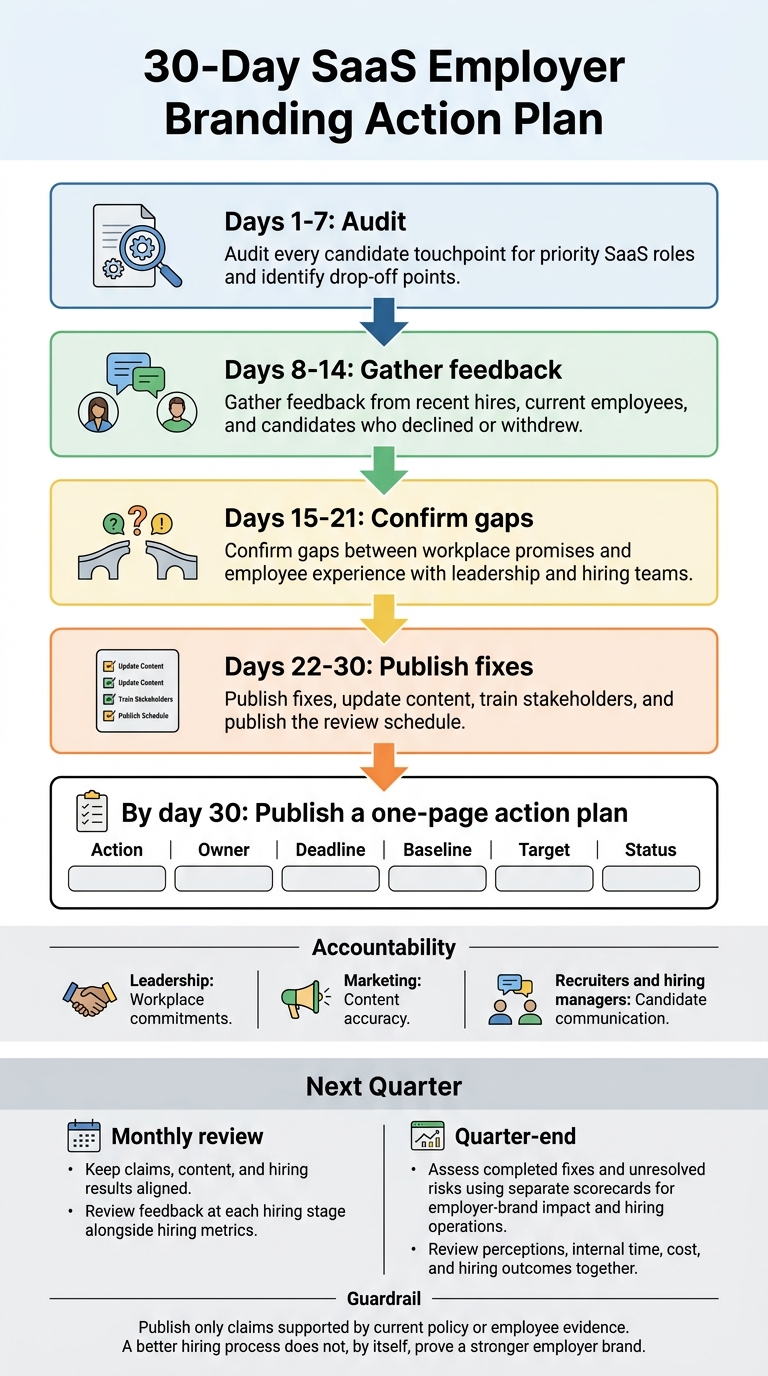
30-Day SaaS Employer Branding Action Plan
Turn the audit, EVP, and metrics above into a 30-day action plan with clear owners and measurable targets.
First 30 Days: Audit and Assign Owners
- Days 1-7: Audit every candidate touchpoint for priority SaaS roles and identify drop-off points.
- Days 8-14: Gather feedback from recent hires, current employees, and candidates who declined or withdrew.
- Days 15-21: Confirm gaps between workplace promises and employee experience with leadership and hiring teams.
- Days 22-30: Publish fixes, update content, train stakeholders, and publish the review schedule.
By day 30, publish a one-page action plan showing each action’s owner, deadline, baseline, target, and status. Leadership owns workplace commitments. Marketing owns content accuracy. Recruiters and hiring managers own candidate communication.
Next Quarter: Make Changes and Review Results
Once fixes are live, run a monthly review to keep claims, content, and hiring results aligned. Use the EVP and measurement framework above to guide research, EVP updates, content approval, recruiter training, candidate feedback, and reporting.
Publish only claims supported by current policy or employee evidence. Review feedback at each hiring stage alongside hiring metrics.
At quarter-end, assess completed fixes and unresolved risks using separate scorecards for employer branding impact and hiring operations. A better hiring process does not, by itself, prove a stronger employer brand. Review perceptions, internal time, cost, and hiring outcomes together to see what changed.
If your team lacks capacity, use embedded recruiting support from Rent a Recruiter to execute the plan from start to finish, keeping workplace promises, supporting evidence, and the hiring process consistent.
FAQs
How soon can employer branding improve SaaS hiring?
Employer branding takes time, but you may see early progress. Track application volume and candidate experience monthly. Review brand sentiment, quality of hire, and retention quarterly.
Keep your messaging consistent and measure results against your hiring goals. Use that data to adjust your approach, shorten hiring timelines, and reduce costs over time.
How can a small SaaS team build its employer brand on a budget?
Build your employer brand on consistency and evidence, not a large marketing budget. Review employee feedback and your digital reputation to define three to five employee value proposition (EVP) pillars.
Back each claim with proof, such as promotion rates or learning budgets. Keep that message consistent across every hiring touchpoint so applicants know what your business offers.
Encourage employees to share their experiences, and use videos featuring your employees rather than stock images. Track offer acceptance rates and application volume monthly to see whether your messaging is helping attract applicants and convert offers into hires.
How should we address negative employee reviews?
Start with a digital reputation audit. Check Glassdoor and other review platforms for recurring themes, then compare your Employee Value Proposition with employees’ day-to-day experiences. Where does your promise fall short?
Fix internal issues before changing external messaging. Address concerns about management or company culture first. When your employer brand reflects what employees experience, you help protect your reputation, improve offer acceptance rates, and reduce turnover.