
Every unfilled role costs your business $500–$1,000 per day. For senior hires, the cost per hire can hit $28,000. Yet many SMEs still rely on a "post and pray" approach to hiring, wasting money and missing top talent with inefficient talent acquisition services.
Here’s the problem: 75% of candidates research your employer brand before applying, and 69% will reject an offer if your reputation doesn’t meet their expectations – even if they’re unemployed. The solution? Track the right metrics to improve your employer brand, attract better talent, and reduce hiring costs.
Two metrics every SME should track:
- Candidate NPS (cNPS): Measures how candidates view your hiring process. A high cNPS improves reputation, attracts more qualified applicants, and cuts recruitment costs by up to 50%.
- Employee NPS (eNPS): Tracks employee satisfaction and advocacy. A strong eNPS reduces turnover by 28% and drives referrals, saving on expensive job boards and recruiters through fractional recruitment services.
The impact: SMEs with strong employer brands get 50% more qualified applicants, reduce time-to-hire by half, and avoid paying a 10% "reputation tax" on salaries.
Want to cut costs and hire smarter? Start by measuring cNPS and eNPS. They’re simple to implement, affordable, and deliver clear business results.
How to Measure your Employer Brand ROI
sbb-itb-a23bd6a
1. Candidate Net Promoter Score (NPS)
Candidate Net Promoter Score (cNPS) measures how likely candidates are to recommend your company based on their recruitment experience. The process revolves around a single question: "How likely are you to recommend applying to [Company Name] to a friend or colleague?" Responses are scored on a scale from 0 to 10, dividing candidates into three groups: Promoters (9–10), Passives (7–8), and Detractors (0–6) [6]. The overall score ranges from –100 to +100, with 30–70 considered strong and anything above 70 reflecting outstanding performance [6]. What sets cNPS apart is its focus on advocacy rather than just satisfaction – candidates who rate you highly can become champions for your brand, even if they don’t get the job. On the flip side, detractors can discourage others from applying [6].
Relevance to SMEs
For small and medium-sized enterprises, cNPS can be a game-changer. Competing with larger companies on high salaries or lavish perks isn’t always feasible, but SMEs can shine by offering a more personal and engaging hiring experience. Features like direct interaction with leadership, office tours, and clear, open communication are highly valued by candidates. cNPS helps you measure how well you’re delivering this experience. A strong candidate experience not only helps you attract top talent but also reduces the need to overcompensate with inflated salary offers. By tracking cNPS, you can identify weak spots – whether it’s delayed responses, unclear communication, or poorly managed interviews – and address them before losing standout candidates.
Ease of Implementation
Setting up cNPS is simple. After interviews, send out a short, anonymous survey featuring the core question along with one or two follow-ups, such as "What did we do well?" and "What could we improve?" Tools like Google Forms or SurveyMonkey make it easy to gather and analyze this feedback.
Impact on Branding
A high cNPS score can transform your employer brand. Positive candidate experiences often translate into glowing reviews on platforms like Glassdoor and LinkedIn – resources that 85% of job seekers check before applying [4]. Candidates also tend to trust employee reviews three times more than official company messaging [6].
"A strong employer brand shifts you from active sourcing to an attractive position where talent comes to you." – Hiring Notes [2]
Every positive interaction captured through cNPS boosts your reputation, turning candidate experiences into a powerful marketing tool. This can help you attract qualified applicants without additional spending on advertising.
Cost Efficiency
A strong cNPS doesn’t just enhance your brand; it also saves money. Companies with a high cNPS score can reduce recruitment costs by up to 50% [6]. A strong employer brand means more unsolicited applications and less reliance on expensive job boards or embedded recruitment services. Additionally, by ensuring a smooth candidate experience, you lower the risk of losing top talent to competitors, avoiding the costs of restarting the hiring process. Instead of relying on higher salaries to compensate for a poor experience, SMEs can focus on showcasing their culture, growth opportunities, and efficient hiring processes – all at a lower cost [1].
Next, we’ll look at how employee feedback, measured through eNPS, complements these candidate insights.
2. Employee Net Promoter Score (eNPS)
Employee Net Promoter Score (eNPS) is a way to measure whether your internal culture lives up to the image you project externally. It asks your employees a simple question: "On a scale of 0 to 10, how likely are you to recommend our company as a great workplace?" [7]. Based on their responses, employees are categorized as Promoters (9–10), Passives (7–8), or Detractors (0–6) [7]. The eNPS is then calculated by subtracting the percentage of Detractors from the percentage of Promoters, resulting in a score between –100 and +100. Scores over 30 are considered strong, while anything above 50 is exceptional [7]. This metric ensures your internal culture aligns with the promises you make to candidates.
Relevance to SMEs
For small and medium-sized businesses, your employees are your best advocates. 37% of U.S. employees say a company’s reputation significantly influences their decision to join or leave an organization [3]. In smaller teams, every employee’s opinion matters, and their feedback can either enhance or hurt your brand. eNPS gives you a clear picture of whether your team members are promoting your company or quietly undermining it. Considering replacing an employee can cost between 90% and 200% of their annual salary [5], catching signs of disengagement early can save money and prevent turnover. SMEs have an edge here – direct access to leadership means you can act on feedback faster than large corporations burdened by complex hierarchies [2].
Ease of Implementation
Rolling out eNPS is straightforward and affordable. All it takes is a short, anonymous survey conducted quarterly or bi-annually. Start with the core question and add one or two follow-ups like, "What do you enjoy most about working here?" or "What’s one thing we could improve?" [7]. Tools like Google Forms or SurveyMonkey are perfect for small teams. Be transparent about the survey’s purpose and assure confidentiality to encourage honest responses [7]. Once results are in, share the findings with your team and outline the steps you’ll take based on their feedback [7]. This approach not only strengthens internal culture but also ensures your external branding reflects reality.
Impact on Branding
A strong eNPS score signals a healthy workplace culture, which boosts your company’s reputation. Satisfied employees often act as recruiters, referring friends and colleagues to open roles. Positive reviews from employees can be a deciding factor for top talent considering your company. Conversely, a low eNPS is a red flag – unhappy employees may harm your reputation with negative reviews or word-of-mouth [3]. Use eNPS results to close the gap between what you promise during recruitment and what employees experience daily. For example, if you promote an "agile culture" or a "family-like environment", ensure those values are reflected in day-to-day operations [4].
Cost Efficiency
A strong eNPS doesn’t just improve morale – it also cuts hiring costs. Companies with a strong employer brand can lower cost-per-hire by up to 50% [6]. High eNPS scores lead to more employee referrals, which are far cheaper than relying on job boards or on-demand recruitment services [4]. On the flip side, companies with poor reputations often have to offer at least 10% higher salaries to attract candidates [6]. Improving eNPS is an investment that reduces turnover by 28% [5] and makes your company more appealing without inflating compensation. For SMEs working within tight budgets, this kind of efficiency is invaluable.
Advantages and Disadvantages
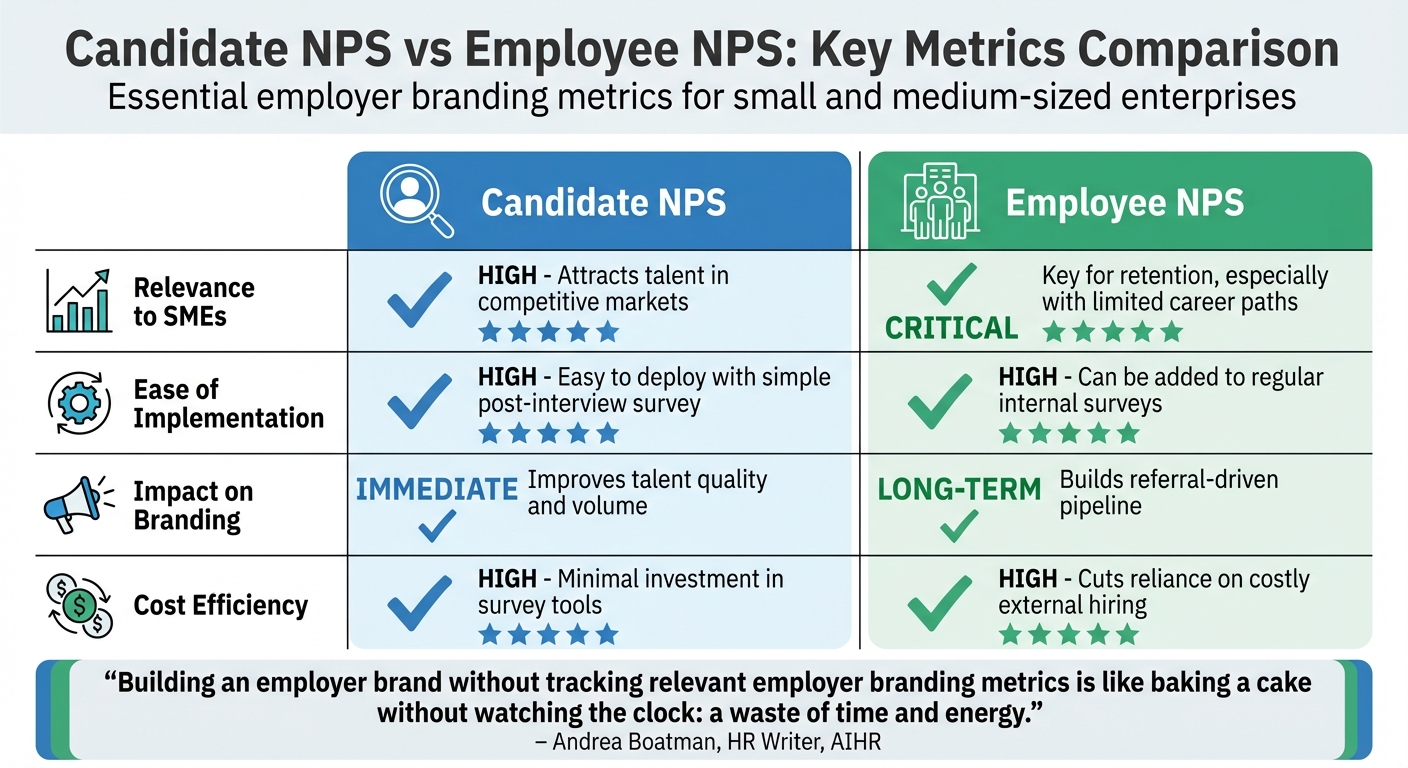
Candidate NPS vs Employee NPS: Key Metrics for SME Employer Branding
When evaluating metrics like Candidate NPS (cNPS) and Employee NPS (eNPS), it’s essential to consider how they work together, especially for SMEs. Each has its strengths, but relying on one without the other can lead to challenges.
Candidate NPS helps protect your external reputation by pinpointing issues in your recruitment process that might discourage top talent – crucial in competitive markets [2]. However, focusing too much on cNPS can backfire. If the recruitment process sets unrealistic expectations, new hires may quickly feel disillusioned, leading to high turnover and wasted hiring costs. This disconnect is often referred to as the "brand-reality gap" [6].
Employee NPS, on the other hand, measures your actual workplace culture. For smaller teams, it’s a critical tool for retention, as losing even one employee can be costly [5]. A strong eNPS score creates a network of employees who act as ambassadors, driving referrals – one of the most cost-effective ways for SMEs to source talent [4]. But eNPS alone has limitations. It won’t attract candidates if your company lacks visibility. Think of it as an internal health check rather than a marketing strategy.
"Building an employer brand without tracking relevant employer branding metrics is like baking a cake without watching the clock: a waste of time and energy." – Andrea Boatman, HR Writer, AIHR [6]
Here’s a quick comparison of how these metrics stack up across areas that matter most to SMEs:
| Metric | Relevance to SMEs | Ease of Implementation | Impact on Branding | Cost Efficiency |
|---|---|---|---|---|
| Candidate NPS | High: Attracts talent in competitive markets [2]. | High: Easy to deploy with a simple post-interview survey [6]. | Immediate: Improves talent quality and volume [5]. | High: Requires minimal investment in survey tools [6]. |
| Employee NPS | Critical: Key for retention, especially with limited career paths [2]. | High: Can be added to regular internal surveys [3]. | Long-term: Builds a referral-driven pipeline [4]. | High: cuts reliance on costly external hiring [6]. |
Conclusion
For small and medium-sized businesses (SMEs), Candidate NPS and Employee NPS aren’t just metrics – they’re game-changers. They provide clear, actionable insights to fine-tune your hiring process and strengthen employee retention. With the high cost of replacing employees [5], even a single poor hire or avoidable resignation can disrupt a small team’s progress.
These scores do more than just safeguard your reputation – they optimize the way you hire. Candidate NPS protects your external image, helping you attract top talent without resorting to inflated salary offers of 10% or more [1]. Meanwhile, Employee NPS ensures your workplace lives up to the promises made during recruitment, reducing the risk of early turnover. Together, they create alignment between what your brand promises and what employees actually experience. When that alignment happens, you unlock the power of employee referrals – a cost-effective way to build your talent pipeline [5].
Make these metrics work for you by implementing post-interview surveys for candidates and adding NPS questions to regular employee check-ins. Break down the data by departments and roles to identify specific challenges instead of relying on company-wide averages. Monitor trends monthly or quarterly to catch issues early, and use exit interviews to verify whether your brand promises match employees’ day-to-day realities [4].
To take it a step further, consider structured tools to assess your recruitment strategy. For example, Rent a Recruiter’s Recruitment Health Checks offer a free, detailed analysis of your hiring efficiency and employer brand. With personalized recommendations, this diagnostic can help you enhance both candidate experience and internal culture, giving you a competitive edge.
FAQs
What’s a good cNPS score for an SME?
For small and medium-sized enterprises (SMEs), a cNPS score above 20 is seen as favorable, signaling solid customer loyalty. If your score exceeds 50, you’re in excellent territory. These benchmarks offer a clear way to measure how satisfied and loyal your customers truly are.
How often should we measure eNPS and cNPS?
eNPS (Employee Net Promoter Score) and cNPS (Candidate Net Promoter Score) are best measured quarterly or biannually. This regular cadence allows you to track sentiment shifts over time, giving you a clear view of trends.
By monitoring these scores consistently, you can spot emerging concerns early and take action before they escalate. Whether it’s improving the employee experience or refining your candidate journey, frequent tracking ensures you stay ahead of potential challenges.
How can we address low NPS while maintaining anonymity?
Improving low NPS while maintaining anonymity requires a thoughtful approach. Start by using aggregated data and tools like anonymized surveys or feedback forms. These allow you to gather insights without linking responses to specific individuals.
The key is to focus on trends and patterns, not individual feedback. By analyzing recurring themes, you can pinpoint areas that need attention and develop strategies to address them.
Transparency is crucial. Make it clear to participants that their feedback is completely anonymous and will only be used to improve their experience. This builds trust and encourages honest input.
Finally, make it a habit to review the data regularly. This helps you stay ahead of systemic issues and ensures you’re addressing concerns effectively – without compromising anyone’s privacy.