
A weak employer brand costs you money. It can mean fewer qualified applicants, more spend on job boards and agencies, slower hiring, and early exits that hit small teams hard.
If you lead hiring in a scaling SME, this is the short version: clear employer positioning helps you cut cost-per-hire, reduce time-to-hire, improve offer acceptance, and lower early attrition. The article makes one point well, employer branding is not a marketing side project. It is a hiring system issue tied to output and cost.
Here’s what matters most:
- Weak visibility means strong people do not find or trust your business fast enough
- Unclear messaging leads to drop-off, longer hiring cycles, and more paid sourcing
- Overpromising in the process leads to early turnover, re-hiring cost, and lost team capacity
- A clear EVP helps filter better-fit applicants in earlier
- Consistent messaging across job ads, interviews, and onboarding improves hiring results
- Embedded recruitment can add structure when your team lacks hiring bandwidth
For CEOs, CFOs, HR leaders, and Talent Leaders, the commercial point is simple: if hiring is slow, expensive, or inconsistent, employer branding affects the numbers whether you track it or not. This article breaks down where the cost shows up, and what you can do about it.
Employer Branding Explained: Attracting Top Talent Strategy
sbb-itb-a23bd6a
The Hiring Problems a Weak Employer Brand Creates for SMEs
The Real Cost of a Weak Employer Brand for SMEs
Low Visibility Means Fewer Qualified Applicants
Most SMEs are simply invisible to the people they most want to hire.
If your employer brand is weak or inconsistent, your business rarely makes the shortlist when strong candidates weigh up where to apply. That problem gets worse in crowded markets like software engineering, fintech, and specialised professional services.
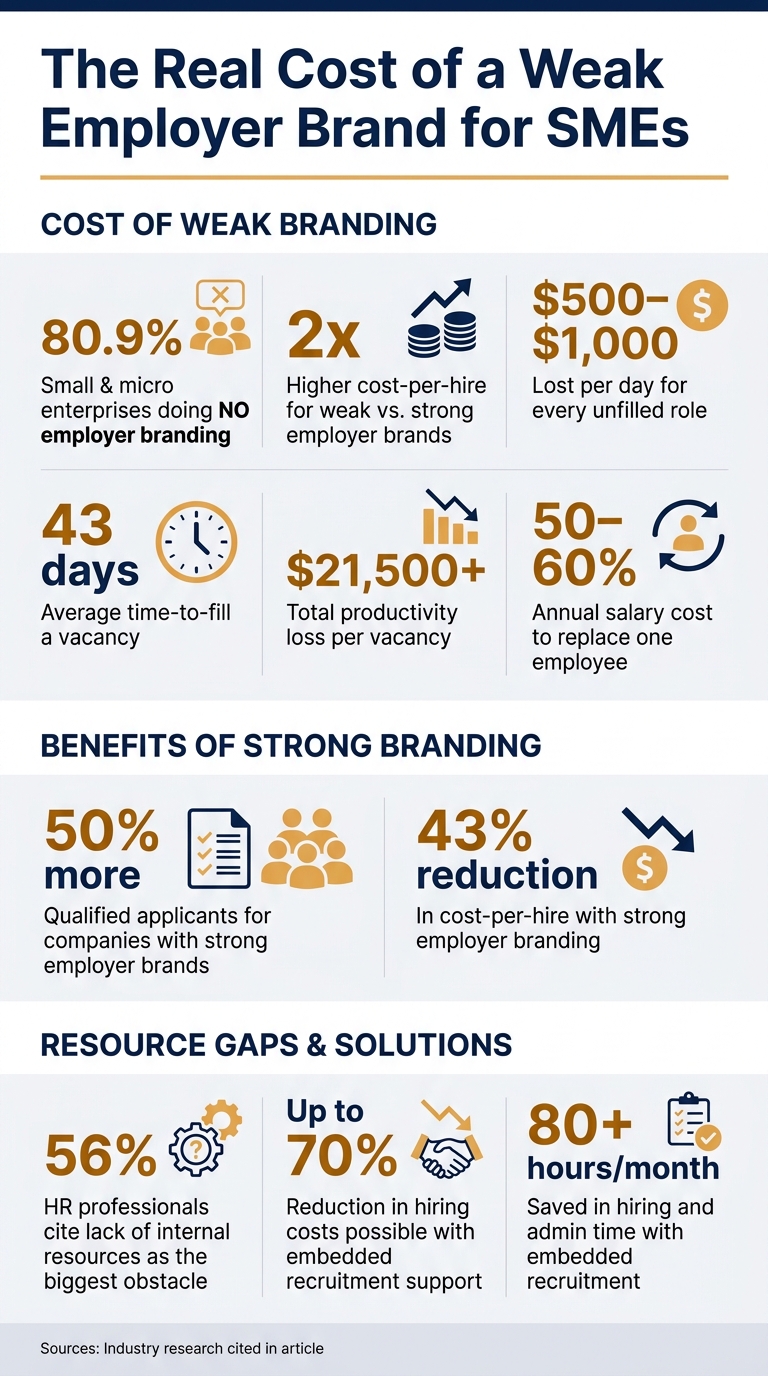
The data is hard to ignore. 80.9% of employees at small and micro enterprises report that their company does not engage in any employer branding activity [7].
When candidates cannot find a clear picture of who you are, what it is like to work with you, and why your business is worth their time, they fall back on names they already know.
That creates a very direct hiring issue. You get fewer applications, and a larger share of them are poor fits. Your team then has to spend more time sourcing manually on LinkedIn and in industry forums just to build a pipeline that better-known employers attract on their own, often requiring more structured talent acquisition services to regain control.
At that point, hiring stops being an attraction problem and becomes a search problem. And search takes time, money, and internal effort.
Unclear Positioning Raises Hiring Costs and Slows Time-to-Hire
If candidates cannot quickly see why they should join your company instead of another one, they pause. That hesitation has a cost.
Employers with weak brands report a cost-per-hire almost double that of strong-branded companies [4][8]. In practice, that usually means more spend on paid job boards, paid ads, and external agency fees.
The knock-on effect is slower hiring too. When your positioning is unclear, candidates tend to ask more questions, need more reassurance during the process, or drop out late. Then your team has to reopen the search and start again.
That delay adds up fast. Every unfilled role costs an average of $500 to $1,000 per day in lost productivity, and with a typical time-to-fill of around 43 days, that can reach $21,500+ per vacancy [5][6][3].
For an SME, that is not a small dent. One open role can slow delivery, put pressure on revenue, and stretch the rest of the team. In a scaling business, you often feel the gap straight away.
The same clarity problem does not stop once the offer is signed.
Vague Employer Promises Drive Early Turnover in Small Teams
When what you promise during hiring does not match the day-to-day reality, new hires can feel like they bought one thing and got another.
In a small team, that kind of mismatch hurts more than most leaders expect. One early exit does not just leave an empty seat. It can disrupt delivery, shift work onto already busy teammates, and force managers back into hiring mode.
The mismatch is often simple:
- A candidate expects stable responsibilities but walks into constant pivots
- They expect a single-function role but end up covering several jobs
- They expect fast promotion without a clear view of the limits inside the business
When that happens, turnover gets expensive fast. Replacing a single employee typically costs 50% to 60% of their annual salary once recruiting, onboarding, and lost productivity are factored in [8].
For micro and small enterprises, the risk is even sharper. Losing as little as 20% of staff and their competencies can disrupt operations [9].
That is why clearer employer messaging matters. A sharper employer value proposition, backed by a steady hiring process, helps set the right expectations before someone joins.
How Employer Branding Fixes These Recruitment Problems
The fix is not more hiring spend. It is clearer positioning.
A Clear Employer Value Proposition Improves Applicant Quality
For SMEs, a clear EVP gives candidates a specific reason to apply. It spells out what they’ll get in return for joining: career growth, autonomy, access to leadership, and real ownership.
That matters because clarity filters people in and out earlier. When candidates understand the role, the pace, and what success looks like, they can decide faster if the fit is right. Your team then spends less time screening poor-fit applicants and more time moving strong ones through the process.
Companies with strong employer brands see 50% more qualified applicants and can reduce cost-per-hire by up to 43% [1]. For a lean hiring team, that means less admin, better shortlists, and stronger offer acceptance rates.
For many SMEs, the EVP points that land best are simple and specific:
- Faster progression
- Broader responsibility
- Real ownership
- Direct access to leadership
Consistent Brand Messaging Lowers Cost-per-Hire and Speeds Up Hiring
Once your EVP is clear, consistency does the heavy lifting.
Your careers page, job ads, outreach, interviews, and onboarding should all tell the same story. If they do, you reduce drop-off, help candidates decide faster, and cut spend on paid sourcing.
When messaging lines up across the hiring process, trust starts earlier. Candidates come into interviews with a clearer picture of the business, the role, and the expectations. That usually leads to shorter time-to-fill and less dependence on paid job boards or traditional recruitment agencies.
Put plainly, mixed messages slow hiring down. Clear ones move it forward.
Honest Positioning Helps SMEs Compete With Larger Employers
A lot of SMEs try to sound bigger than they are. On paper, that may seem like a smart move. In practice, it often falls flat.
If the pitch says one thing and the day-to-day job says another, new hires notice fast. That gap can hurt acceptance, early retention, and trust.
A better approach is honest positioning. Be clear about what your company is, and what it is not. Maybe you have fewer layers of management. That can mean more access and faster decisions, but it may also mean less structure and support. Maybe the business moves quickly. That can be exciting, but it also asks more of the person in the role.
When you show both sides clearly, you attract people who want that kind of setup. You avoid hiring people who expect a large-company experience and then feel blindsided once they join.
In U.S. hiring markets, the SME strengths that often matter most are faster career progression, direct access to senior leadership, broader scope, and visible impact on business outcomes. In sectors like Technology, SaaS, Engineering, Security, Insurance, and Professional Services, many candidates value those points as much as, or more than, small differences in salary.
SMEs do not need to outspend larger employers. They need a clear, credible promise for the right candidates, and they need to deliver on it.
How to Build Employer Branding into a Repeatable Hiring Process
Once your EVP is clear, the next move is to build it into every hiring touchpoint. This is not about running a one-off campaign. It is about building a hiring system your team can use again and again.
Define Your Employer Value Proposition and Apply It Across Hiring
Start with one working EVP document.
Pull input from employees through surveys and interviews. Ask why they joined, why they stay, and what keeps them engaged. Then group the themes that come up again and again into 4 to 6 core statements that answer: "Why should a strong candidate choose us over another employer?"
From there, use that EVP across the full hiring process, including job posts, outreach, interviews, and onboarding. In job descriptions, add a clearly labeled "What working here is like" section. Keep it concrete. Show internal promotions, typical team size, or the day-to-day impact of the role.
That matters because vague claims do not help candidates make a decision. Specifics do.
A simple test helps here. If candidates can summarise your EVP after the interview, your message is getting through.
Track Employer Branding with Recruitment Metrics
Employer branding should change hiring outcomes, not just how your careers page sounds.
Track the hiring metrics that show whether your message is improving candidate quality and hiring speed. Review them monthly if you’re hiring at pace, or at least quarterly:
- Cost-per-hire
- Time-to-hire
- Offer acceptance rate
- Source quality
- Candidate drop-off
- First-3-to-6-month attrition
Use these metrics as feedback loops.
If offer acceptance goes up but early attrition stays high, your message may be bringing in the right people, but onboarding is not matching what was sold. If drop-off jumps after first interviews, your job descriptions may be setting one expectation while the interview process shows another.
This is where employer branding becomes a business issue, not just a marketing one. Better alignment can save time, cut wasted interview hours, and reduce the cost of replacing early leavers.
Use Embedded Recruitment Support to Add Structure and Consistency
When internal capacity is stretched, structure matters just as much as messaging. 56% of HR professionals cite a lack of internal resources as the biggest obstacle to executing employer branding effectively. [1]
That is where embedded recruitment support can help.
Rent a Recruiter places experienced recruiters directly inside your team, often within days, to manage hiring end-to-end. They begin with an employer branding assessment and a recruitment process audit. That includes reviewing your current job descriptions, career site, and candidate feedback to spot where messaging is unclear or inconsistent.
From there, they put structure around the process with standard templates, outreach scripts, and interview scorecards that build your EVP into each stage.
Because an embedded recruiter works inside your team, not at arm’s length, your employer message stays more consistent across candidate touchpoints. For scaling companies, that can mean lower hiring costs, less admin strain, and a smoother process from first contact to offer.
That structure can cut hiring costs by up to 70% and save 80+ hours a month in hiring and admin time. [1][2]
Conclusion: Employer branding is a practical lever for lower-cost, faster, more scalable hiring
Taken together, these steps make employer branding a measurable hiring advantage. It is a hiring lever, not a communications exercise. A clear EVP helps you attract stronger applicants, cut drop-off, and improve retention.
For SMEs, that matters fast. Every open role, bad hire, and agency fee hits delivery and growth directly.
Key takeaways for hiring leaders at scaling SMEs
The next step is simple. Define your EVP. Use it the same way across your hiring process. Track the numbers. Add embedded recruitment support when internal capacity is tight.
If hiring is slowing growth, start by tightening the message candidates see. If you want to see where hiring is costing you most, book a call with Rent a Recruiter or take a Recruitment Health Check.
FAQs
What is an employer value proposition?
An Employer Value Proposition (EVP) sits at the heart of your employer brand. It’s the clear promise you make about what people get in return for their time, skills, and commitment.
A strong EVP usually covers pay, benefits, career growth, work-life balance, and company culture. Put simply, it answers one commercial hiring question: why should someone join your company instead of another one?
How can an SME improve employer branding quickly?
Start with the basics. Audit your reputation on Glassdoor and Indeed, respond to reviews within 48 to 72 hours, and create a clear one-page Employer Value Proposition.
That message should stay consistent across your job descriptions and career pages. Mixed signals slow hiring, weaken trust, and make it harder to convert strong applicants.
This is where Rent a Recruiter can help. By placing experienced recruiters inside your team, they bring consistent communication, structured hiring, and a professional candidate experience across every touchpoint.
Which hiring metrics should we track first?
Start with cNPS and eNPS. cNPS shows how people view your hiring process. eNPS reflects employee culture and whether your team would speak well about working with you.
Then track candidate quality, offer acceptance rates, and brand awareness. On their own, these numbers tell part of the story. Together, they show whether your employer brand is improving hiring outcomes and supporting long-term retention.
For hiring leaders, that matters. A stronger employer brand should lead to better-fit hires, more accepted offers, and less friction in the process. If those numbers are flat, or slipping, your brand work may look good on paper but fail to move the business.