If your company hires in the EU or UK, weak vendor controls can slow hiring, add legal spend, and put growth plans at risk.
I’d boil this guide down to one point: you need a clear process for checking recruitment vendors before candidate data moves through your stack. In early 2026, regulators had issued 193 employment-related GDPR fines worth about €360.9 million. For scaling companies, the bigger issue is often not the fine itself. It is the time drain, the contract fixes, and the hiring delays that show up when agencies, ATS platforms, and screening tools were never reviewed properly.
If you want hiring pace and control, this is what matters most:
- Know each vendor’s role: controller, processor, or in some cases joint controller
- Check the paperwork: DPAs, SCCs, UK transfer terms, retention rules, and privacy notice wording
- Score vendor risk: AI tools, background checks, offshore access, and large data volumes need deeper review
- Track ownership inside your business: HR, Legal, IT, and Procurement each need a clear part in the process
- Build one system, not ad hoc fixes: onboarding, review cycles, incident response, and offboarding should all be logged
For CEOs, CFOs, HR leaders, and Talent leaders, the business point is simple. Messy vendor governance costs money. Clean vendor governance protects hiring output. It cuts wasted admin, reduces contract back-and-forth, and gives you more control as hiring volume grows across SaaS, Technology, IT, Fintech, Engineering, Security, Insurance, and Professional Services.
One model that helps is embedded recruitment, where recruiters work inside your systems instead of around them. That can reduce tool sprawl, tighten data control, and make retention, access, and approval rules easier to enforce. If you want help reviewing your setup, Rent a Recruiter supports teams that need hiring structure without adding more agency noise.
The rest of the article breaks down the vendor roles, audit checks, contract points, and control model you need to keep hiring moving without losing grip on GDPR.
Life With GDPR: Episode 113 – AI in Recruitment: Navigating GDPR Compliance and Challenges
sbb-itb-a23bd6a
GDPR roles, data flows, and risk in recruitment vendor relationships
GDPR separates data controllers from data processors. That split shapes the rules for every vendor relationship. Once your vendor scope is clear, the next job is to assign the right legal role to each part of the hiring process.
Controller vs. processor in day-to-day hiring
Your company will usually be the data controller in recruitment. That’s because you decide which roles to hire for, what candidate data to collect, how long to keep it, and how that data will be used in hiring decisions.[9][7]
Recruitment vendors such as ATS providers, sourcing platforms, background-check services, and external recruiting agencies will often act as data processors when they handle candidate data on your instructions.[2][13][4]
But it’s not always that simple. The legal role can shift depending on the workflow.
A recruitment agency that keeps its own candidate database and decides which clients should see those candidates is often acting as an independent controller for that database, not your processor.[18][19][10] In some cases, agencies may be joint controllers where both sides influence how the data is used.[20][21]
This matters because controller status drives who is on the hook for privacy notices, retention rules, rights requests, and breach response. If a vendor suffers a breach, you still need to show that you picked a processor with adequate technical and organizational safeguards.[2][12][4]
For hiring leaders, that has a clear business angle. If roles are misclassified, accountability gets blurry fast. That creates delay, legal cost, and extra work when something goes wrong.
The GDPR principles that apply most directly to recruitment
A few GDPR principles create direct day-to-day obligations for hiring teams. In practice, they should show up in your audit process.
Lawfulness, fairness, and transparency mean candidates must know, before you collect their data, what you’re collecting, why you need it, and who will see it. Your privacy notice should match how hiring actually works, including which vendors receive CVs, run assessments, or carry out background checks.[8][9][2]
Data minimization means reviewing vendors for unnecessary data capture. If your ATS pushes your team to collect more fields than the role requires, that’s a compliance gap.[8][9]
Storage limitation is one of the most common weak spots. Set fixed retention periods for unsuccessful candidates and clear renewal rules for talent pools. Don’t keep CVs forever.[24][26][25][24][28][27][29]
Accountability means keeping records that show how you reviewed vendors, mapped data flows, and dealt with incidents.[12][4][17]
These points matter even more when vendors handle sensitive data, AI screening or scoring, or cross-border transfers. That’s where risk, legal review, and internal time cost tend to climb.
How to identify high-risk recruitment vendors
As hiring volume grows, some vendors create far more GDPR pressure than others. A scheduling tool does not carry the same exposure as a platform that scores candidates with AI or handles sensitive data.
When you assess vendor risk, focus on the areas that push exposure higher:
- Data volume, scope, and international transfers: Vendors with access to your full candidate database, those working across regions, or those routing data through cloud providers, analytics tools, or embedded third-party services, especially outside the EU/EEA, create more exposure if something breaks. You need to know where candidate data sits and which legal mechanism supports the transfer.[2][13][4][12][14][17]
- Special-category data: Background-check services, diversity analytics platforms, and tools that collect health or disability data need tighter safeguards and a clear lawful basis.[8][9][11]
- AI screening or scoring: Tools that rank, score, or filter candidates using automated logic can trigger Article 22 concerns and should usually go through a formal Data Protection Impact Assessment (DPIA) before deployment.[11][15][16][22][23]
- Prior incidents or weak security documentation: Warning signs include regulatory investigations, vague incident response timelines, or security documents that read like generic sales copy.[12][14]
Under GDPR Article 28, you must use only processors that provide adequate technical and organizational safeguards.[12][14] In 2026, supervisory authorities expect controllers to show how each vendor was assessed, not just that a DPA was signed. That means keeping records of security reviews, questionnaires, and risk evaluations, especially for AI-driven tools.[12][14][17]
A sensible approach is to score vendors against these factors, place them into low, medium, and high-risk groups, and apply oversight to match. High-risk vendors need more than paperwork. They need tighter DPAs, DPIAs, and steady monitoring.
Those risk levels shape how deep your audit needs to go. They also set the standard for what your DPA and audit checklist must cover next.
Legal and audit requirements SMEs should apply to recruitment vendors
Risk scoring shows where to look. Legal paperwork and audit evidence show whether the controls are there in practice.
Once you’ve mapped vendor risk, the next job is simple: use talent acquisition services to: prove the right controls exist before candidate data moves anywhere.
What a recruitment-ready DPA must include
Under GDPR Article 28, processors need a valid DPA before handling candidate data. A DPA is mandatory, not optional. If a vendor cannot produce these terms in writing, it fails the audit.
A recruitment-ready DPA should set out scope, instructions, security controls, subprocessors, support for data rights, end-of-contract deletion, breach notice timing, and audit rights.[30][31][39] It should also bind all authorised vendor staff to confidentiality.
If the agreement hides behind generic boilerplate on security measures, don’t let that slide. Ask for a specific security annex instead.
Once the contract is in place, check the legal basis behind each hiring workflow.
Lawful basis, transparency, retention, and international transfers
Use legitimate interests for most pre-hire processing. Reserve contract-based processing for steps tied to an actual offer or employment contract.[6][27] Don’t rely on consent for core hiring workflows. In the employer-applicant context, it’s usually too weak.
Where you rely on legitimate interests, document a Legitimate Interests Assessment (LIA). It should:
- identify the specific interest
- confirm the processing is necessary
- record the safeguards in place, such as clear candidate information, limited retention, and opt-out options
For long-term talent pools, consent may be a better fit, but it must be specific, informed, and easy to withdraw.[1][26]
Your privacy notice must match what vendors actually do with data. If your ATS routes records to a US-based server, or a background-check provider accesses records from an offshore team, that needs to be disclosed.
When data is hosted or accessed outside the EEA or UK, you need valid international transfer safeguards, usually EU Standard Contractual Clauses (SCCs) or a UK International Data Transfer Agreement (IDTA). You may also need extra safeguards and a Transfer Impact Assessment (TIA).[21][37][38]
Keep unsuccessful candidate data only as long as needed, usually 6 to 24 months. Deletion or anonymisation should be tracked in your ATS or CRM.[1][3][26]
A GDPR audit checklist for recruitment vendors
Use the table below to test both the contract and the vendor’s day-to-day practice.
| GDPR Article | What It Covers | Audit Questions & Evidence to Request |
|---|---|---|
| Art. 5 – Principles | Data minimization, fairness, storage limitation, accountability | Data maps of recruitment workflows; list of fields collected per role with justification; sample candidate communication templates |
| Art. 6 – Lawful basis | Legal ground for processing | Completed LIAs; consent records for talent pools; internal recruiter guidance on which basis applies at each hiring stage |
| Art. 13 – Transparency | Candidate privacy information | Company and vendor privacy notices; onboarding emails sent to candidates; candidate information sheets |
| Art. 28 – Processors | DPA requirements | Signed DPA; sub-processor register with locations and certifications such as ISO 27001 or SOC 2; records of controller instructions; documentation on how the vendor handles data subject requests |
| Art. 32 – Security | Technical and organizational measures | Security annex or TOMs summary; penetration test reports or third-party attestations; access control matrices; encryption and MFA configuration; staff training logs; incident response procedures |
| Art. 35 – DPIAs | AI screening, profiling, or large-scale processing | Completed DPIAs for AI-driven tools; risk findings and mitigation steps; records of pre-deployment assessments |
For vendors that use AI screening or automated scoring, a DPIA should be completed before the tool goes live.[35][36] Ask for the completed DPIA, including the risks found and how they were dealt with.
A recent UK reprimand after a misconfigured storage container exposed 12,000 records is a sharp reminder that configuration checks are not just paperwork. They matter in the real hiring process.[32][33][34]
A vendor management model for ongoing GDPR compliance
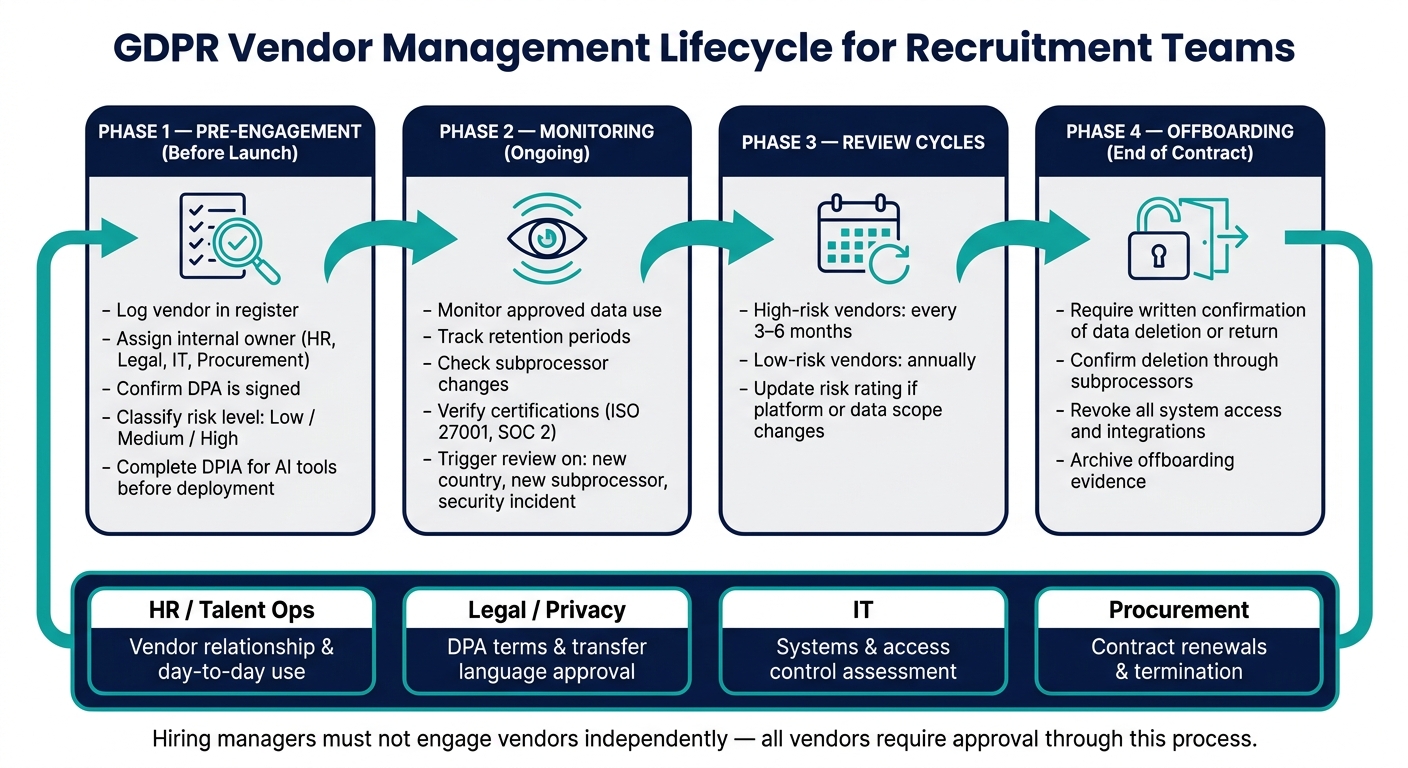
GDPR Vendor Management Lifecycle for Recruitment Teams
Once the audit is done, turn it into a vendor control system that keeps running. That’s how you keep candidate data under control as hiring volume goes up and down.
A repeatable model matters most when your team is scaling. One hiring spike, one rushed agency engagement, or one new tool added without review can create legal risk, data risk, and extra admin. The aim is simple: make vendor control part of how you hire, not a one-off clean-up exercise.
Onboarding, monitoring, and offboarding controls
Run vendor management as a four-step cycle: pre-engagement, monitoring, review, offboarding.
Before launch, log the vendor, assign ownership, and confirm the contract is complete. Then monitor approved data use, retention, subprocessors, and certifications. Review high-risk vendors every 3 to 6 months, and low-risk vendors once a year. If a vendor changes its platform, adds a new country, brings in a new subprocessor, or has a security incident, trigger a review straight away.
That kind of structure saves time later. Instead of scrambling when something changes, you already know who owns the vendor, what data is involved, and what needs to be checked.
Monitoring is only part of the job. Offboarding has to be enforced too.
When a vendor relationship ends, require written confirmation that data has been deleted or returned. Confirm deletion through subprocessors as well. Archive the offboarding evidence, then revoke all system access and integrations. If you skip this step, old access and stale candidate data can sit in the background for months, which is exactly where risk builds.
Internal ownership, documentation, and incident handling
The process only works when one team owns it.
HR or Talent Operations should own the vendor relationship and day-to-day use. Legal or Privacy should approve DPA terms and transfer language. IT should assess systems and access controls. Procurement should manage contract renewals and termination workflows. Hiring managers should not be able to engage vendors on their own without going through this approval path.
This is less about bureaucracy and more about control. If ownership is blurred, accountability disappears. And when something goes wrong, that costs time, money, and trust.
Your vendor register should capture:
- vendor name
- service type
- business owner
- GDPR role
- DPA status
- data categories processed
- systems used
- countries involved
- retention period
- subprocessors
- risk rating
- review date
- incident history
- offboarding status
- who approved the vendor
The register should make every vendor decision traceable in one place. For a growing company, that traceability matters. It gives Legal, HR, IT, and leadership one view of risk instead of scattered notes, inbox threads, and contract folders.
For incidents, define the response before one happens. Escalate at once, preserve evidence, and assess the 72-hour reporting clock. Key incident types to plan for:
- Unauthorized data access , Internal owner: Legal/Privacy + IT
- Misdirected candidate communication , Internal owner: HR/Talent + Legal
- Retention overrun , Internal owner: HR/Talent + Procurement
- Improper subprocessor data sharing , Internal owner: Legal/Privacy
- Candidate-data breach or ransomware affecting hiring systems , Internal owner: Legal/Privacy + IT
If that response path is already mapped, your team can act fast under pressure. That cuts confusion, limits delay, and reduces the chance of a bad situation getting worse because nobody knew who was in charge.
Balancing hiring speed with compliance during growth spikes
With ownership and controls in place, hiring speed comes from preparation, not shortcuts.
Post-funding hiring surges are where compliance frameworks often start to crack. A lean talent team under pressure to fill roles fast will cut corners if the process feels like friction. That’s why the compliance work needs to happen before the spike, not in the middle of it.
Pre-approved clauses, a cleared vendor list, and a fast intake checklist make a big difference. They help your team move at pace without pausing every hire for legal review or rechecking the same vendor risks again and again. That protects hiring speed and keeps control in place at the same time.
The goal is fast hiring with controls already approved, documented, and owned.
Building a scalable recruitment model with stronger GDPR control
Once your vendor controls are set, the next step is structure. As hiring grows, your recruitment model has a direct effect on how easy GDPR is to manage.
Why embedded recruitment can simplify GDPR governance
Fragmented hiring setups create avoidable GDPR risk. Multiple agencies, separate tools, and shadow spreadsheets make data flows hard to track. They also make retention rules harder to enforce. An embedded recruitment model keeps hiring inside one controller-owned process.
That is where operating model matters as much as contract terms.
Recruitment structure shapes candidate-data control. When recruiters work inside your ATS and HR workflows, candidate data moves through one controller-owned process. Privacy notices stay standardised. Lawful-basis decisions are recorded in one place. Access is governed by your own identity and security controls, not separate agency tools.[4][5][41]
Retention rules can then be applied centrally to every candidate record. That cuts down the number of systems and data paths an auditor needs to review.[3][42][43]
Where Rent a Recruiter supports compliant, scalable hiring
Rent a Recruiter places recruiters inside your team and systems. That means GDPR controls can sit inside the hiring workflow, not around the edges.
The table below shows how this model supports specific GDPR controls.
| Service Area | GDPR Control Outcome |
|---|---|
| Embedded recruitment | Centralises candidate data into a single ATS; keeps privacy notices and lawful-basis decisions consistent across all hiring activity |
| Recruitment health checks | Maps tools and data flows; flags unmanaged spreadsheets and ROPA gaps |
| Process design and standardisation | Documents hiring stages, feedback, and approvals in one system |
| ATS optimisation and configuration | Automates retention and cuts manual exports |
| Vendor management support | Maintains a vendor register; reviews vendor DPAs for GDPR clauses; flags vendors with weak security or poor retention practices |
That structure cuts manual handoffs, improves visibility, and makes compliance easier to keep in place.
Conclusion and next steps for 2026
This guide has covered the core obligations that apply when SMEs use recruitment vendors. You are the data controller, and that accountability does not transfer to your agencies or tools.[4][2][44]
Robust DPAs, clear controller-processor role definitions, and a structured vendor lifecycle, onboarding, monitoring, and offboarding, are the base layer.[3][40][43] Your operating model then determines whether those controls hold up as hiring scales. This is where the move from fragmented agency-led hiring to embedded recruitment matters.
For US-based SMEs, GDPR still applies whenever EU candidate data is processed, no matter where the company is headquartered.
Review your vendor stack. Check which DPAs are current. Map where candidate data sits outside your controlled systems.
FAQs
When does a recruitment vendor become a controller?
A recruitment vendor usually becomes a controller when it stops acting only on your instructions and starts deciding how and why candidate data is used.
In plain terms, that line is crossed when the vendor uses candidate data for its own business goals, not just to fill your roles.
That often includes things like:
- building its own talent pools
- using candidate details for its own marketing
- running recruitment activity beyond your specific hiring brief
Why does that matter? Because once a vendor is acting as a controller, data responsibility gets more complicated. You have less direct control over how candidate information is handled, and that can affect compliance, risk, and supplier oversight.
Do U.S. companies need GDPR checks for EU hiring vendors?
Yes. If a U.S. company works with an EU-based hiring vendor, it still needs to make sure GDPR rules are followed when EU residents’ personal data is involved, no matter where the company itself is based.
That means you should have a Data Processing Agreement in place and look closely at how candidate data is:
- collected and handled
- stored and retained
- deleted
- transferred across borders
SOC 2 on its own isn’t enough. It may show that a vendor takes security seriously, but it does not deal with the legal side of GDPR in full.
For hiring teams, this matters for one simple reason: compliance risk turns into business risk fast. If your vendor touches EU candidate data, you need clear terms, clear processes, and clear accountability.
What should we review first in a high-risk hiring tool?
Start with a pass/fail review of the tool’s legal and security foundations before you look at performance.
Begin with a basic screening checklist. Then move to a security review if the tool connects to internal systems like your ATS or candidate databases.
Check three things first:
- How candidate PII is handled
- Who can access project information
- Whether the vendor can maintain system availability
Only score delivery metrics after those checks pass.