A remote employee working abroad can create tax costs for your business, even if the stay is under 183 days. I recommend checking tax residency, payroll duties, and employer tax exposure before you approve the move. That gives you a clearer hiring budget and helps avoid payroll corrections, penalties, and delays.
Before you agree, check:
- Residency and wage taxes: Where the employee lives and physically works can lead to different tax duties.
- Treaty relief: Day limits alone do not guarantee an exemption. Dual residency and U.S. worldwide-income rules may need separate review.
- Employer costs: Check withholding, social security contributions, registration, and whether the work creates a taxable business presence.
- Records and responsibility: Keep work-location logs, assign filing owners, and review changes to dates, locations, or duties.
My starting point is simple: <u>confirm the full cost before approving overseas work</u>. A country-specific review helps you plan hiring across borders with insights from our recruitment blog with fewer unexpected costs.
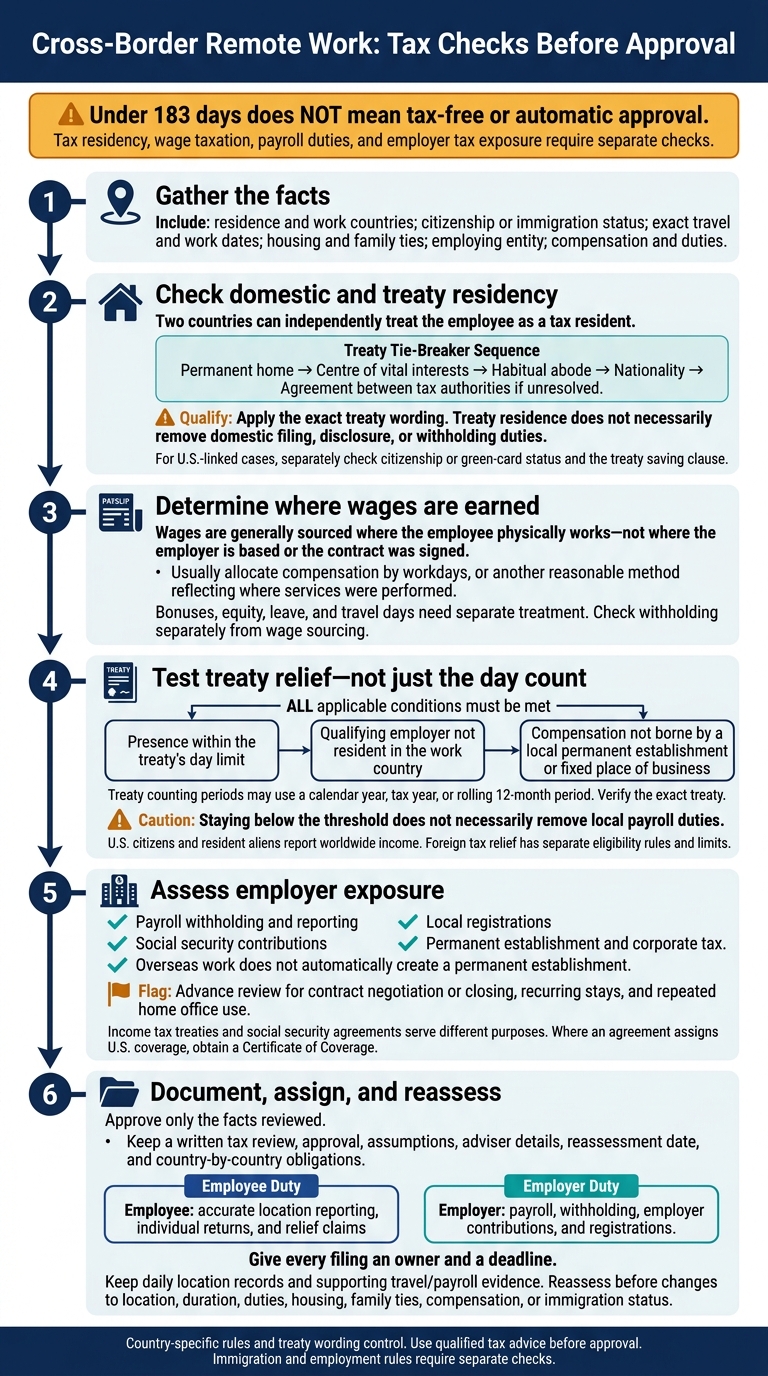
Cross-Border Remote Work: Tax Checks Before Approval
Residenza Fiscale vs. Remote Work: The Real Conflicts
sbb-itb-a23bd6a
When Remote Work Creates Dual Tax Residency
Use the facts you’ve gathered to check the employee’s residency in each country. Dual residency means two countries independently treat the employee as a resident under their own tax laws. A treaty may assign residence to one country for treaty purposes, but filing, disclosure and withholding duties usually remain in the other country.[6][9]
Domestic Residency Rules and Treaty Tie-Breakers
Start with each country’s domestic residency rules, then check treaty eligibility. Treaty tie-breakers typically consider permanent home, closest personal and economic ties (centre of vital interests), habitual abode and nationality. If these tests don’t resolve residency, the tax authorities may need to reach an agreement.
Apply the exact treaty wording to the facts already collected. For U.S.-Canada arrangements, review the treaty’s residence article alongside IRS Publication 597.[7][8][9]
U.S. cases also need a separate saving-clause check. This clause generally preserves U.S. taxation of citizens and residents, subject to specific exceptions. A noncitizen claiming treaty residence may need Form 1040-NR and Form 8833, depending on the facts. Citizenship or green-card status can change the outcome, so check current IRS requirements before claiming treaty treatment.[7][8][10]
Tax Residency vs. Wage Taxation
Residency and wage taxation are separate questions. Your review needs to cover both the employee’s tax position and your payroll duties.
| Question | Relevant test | Potential consequence |
|---|---|---|
| Domestic residency: Does each country treat the employee as a resident? | Each country’s own residence rules | Returns, worldwide-income reporting and tax payments may be required in both countries.[6][10] |
| Treaty residence: Where is the employee resident under the treaty? | Treaty eligibility, the residence article and tie-breakers | Treaty relief may apply, but disclosures and other domestic obligations can remain.[6][9] |
| Work-country wage taxation: Can the country where work takes place tax the employee’s pay? | Where services are physically performed, plus the treaty’s employment-income conditions | Locally earned wages may be taxable, with employer withholding or payroll duties.[11][12] |
The short-term employment exemption usually requires more than staying within a 183-day limit. It also requires a qualifying nonresident employer and no salary cost borne by a local permanent establishment. Check every condition before assuming wages are exempt from local withholding.[11][13]
Before travel: Get a written review covering residence rules, treaty articles, saving-clause limits, disclosures, payroll duties and double-tax relief. Coordinate the employee’s returns with your payroll procedures and filing deadlines to help prevent duplicate administration, payroll corrections and unexpected costs.[6][8][11]
Where Cross-Border Remote Wages Are Taxed
Tax residency and wage sourcing are separate tests. Wages are generally taxed where your employee physically works, not where your business is based or where the contract was signed.[11][16]
Compensation is usually allocated by workdays, or another reasonable method that reflects where services were performed. Bonuses, equity, leave and travel days need separate treatment.
Wage sourcing and withholding also require separate checks. Keep daily location records and reconcile them with travel and payroll data so your payroll team works from the same information.
Why 183 Days Is Not a Universal Tax Exemption
A day-count rule may apply to residency or treaty relief, but the counting rules can differ. Treaties may measure days by calendar year, tax year or a rolling 12-month period.
Treaty short-stay exemptions commonly require all three conditions: presence within the treaty limit, an employer that is not resident in the work country, and compensation that is not borne by a permanent establishment or fixed place of business there.[17]
Record the applicable period, counted travel days, employing entity and entity bearing the compensation cost. Staying below the threshold does not necessarily remove local payroll duties.
U.S. Tax Residency Tests for Foreign Workers
For U.S.-linked workers, test residency separately from where wages are earned. A noncitizen becomes a U.S. tax resident under the green card test or the substantial presence test. Immigration status alone does not determine the result.[15]
The substantial presence test generally requires at least 31 days in the United States in the current year and 183 weighted days across three years.[14][18] That calculation includes:
- All current-year days.
- One-third of prior-year days.
- One-sixth of second-prior-year days.
Some days do not count under statutory exceptions. A worker may qualify for a closer-connection exception by showing a foreign tax home, closer foreign ties and timely filing. Generally, actual U.S. presence must be fewer than 183 days in the current year.
Treaty tie-breaker rules can also change the result. First- and last-year situations may require dual-status reporting, so check residency start and end dates separately.
U.S. Worldwide Income and Foreign Tax Relief
Foreign tax relief may reduce double taxation. U.S. citizens and resident aliens report worldwide income on Form 1040.[3] A foreign tax credit may reduce double taxation for qualifying foreign income taxes, subject to the credit’s limits.
The foreign earned income exclusion requires a foreign tax home, plus either bona fide residence for an uninterrupted period that includes an entire tax year or physical presence for at least 330 full days during a 12-month period.[3][5]
The exclusion is limited and is not automatic. Foreign tax credits cannot be claimed for foreign taxes on excluded income. Nonresident aliens follow a different framework.
Employer Tax Risks of Overseas Remote Work
Once you know where an employee’s wages are taxed, check what their overseas work means for your business. Working abroad does not automatically create a permanent establishment (PE), but it can trigger payroll withholding, social security, registration, and corporate tax duties. PE concerns the employer’s corporate tax, not the employee’s income tax. Immigration and employment rules need separate checks.[4][22][23]
Employee vs. Employer Tax Risks
| Risk | Employer impact |
|---|---|
| Income tax | May require payroll support, reporting, or tax equalization. |
| Withholding | May require local registration, withholding, reporting, and remittance. |
| Social taxes | May require employer contributions and local registration. |
| Permanent establishment | May trigger corporate tax, profit attribution, and filing duties. |
| Registration | May require payroll, tax, labor, or business registration. |
| Penalties | May lead to assessments, penalties, interest, and audits. |
Income tax treaties and social security agreements serve different purposes. A social security agreement may prevent contributions in both countries. If it assigns U.S. coverage, obtain a Certificate of Coverage to document the exemption from the other country’s system.[19][20][21]
Put responsibilities in writing. Employees must report accurate work locations and travel. Your business must manage required payroll registrations, withholding, employer contributions, and corporate tax review. Specify who handles payroll corrections, registrations, and penalty disputes.[19][20][21]
Roles and Work Locations That Need Advance Review
Review overseas work before it starts for anyone who negotiates, signs, or regularly closes contracts. Recurring stays and repeated home office use also need review. A private work location can matter even if your business does not own it, and a lack of final signing authority does not end the assessment.[22][23]
A home office can create PE only when local law or the applicable treaty treats it as a fixed place of business. OECD guidance is not a global safe harbor.[22][23][24]
Use the tax review to set your approval and recordkeeping requirements. Require written pre-approval, exact work locations and dates, travel records, and advance tax review. Require a new approval when the employee’s duties or length of stay change.[22][23][24]
Managing Cross-Border Tax Compliance
After the residency analysis and pre-approval review, put the findings in a written tax compliance file. Record the reviewer, adviser, approval date, assumptions, and reassessment date. Approval applies only to the facts reviewed.
Your file should answer three questions: where the worker is taxed, who files, and which records support the position.
Pre-Approval Tax Review Checklist
- Facts: Record residence and work countries, citizenship or immigration status, dates, housing, family ties, employing entity, compensation, and duties.
- Tests: Document residency and wage-sourcing conclusions, the treaty position, and the basis for any exemption. Support the filing position with the approved location log, and cite the treaty article and official guidance used.
- Obligations: Keep a country-by-country record of withholding, social taxes, payroll registration, employer reporting, individual returns, payment deadlines, required disclosures, and permanent-establishment review. Assign individual filings and relief claims to the employee. Assign payroll, employer contributions, and registrations to the employer. Give every filing an owner and a deadline.
Assess foreign-account reporting separately. Working abroad alone does not create a filing obligation. Check thresholds and deadlines against current government guidance.
Records Workers and Employers Should Keep
Keep the evidence supporting your approved residency, withholding, and treaty positions for filings and audits. This includes travel dates, overnight locations, workdays in each country, leave, and supporting tickets or border records.
Retain housing records, employment agreements, compensation and payroll records, returns, payment confirmations, treaty analysis, approvals, and professional advice. Record partial days under each country’s rules. Set retention periods by jurisdiction and document type, rather than using one global period.[25]
Store records securely with role-based access, and collect only the personal information needed. Maintain one current approval file and a dated change log so your team can track what changed and when.
Your policy can require monthly location confirmations and quarterly reviews for recurring arrangements. Require reassessment before changes to location, duration, duties, housing, family ties, compensation, or immigration status. These review intervals are company controls, not universal legal deadlines.
Conclusion: Check Tax Duties Before Working Abroad
Tax residency depends on the facts, not just days spent abroad. Where an employee works can also create tax duties.[28][26][27] Approve cross-border remote work only after a country-specific tax review covering residency, withholding, and supporting records.
Before work begins, document approval, assign responsibility for filings, and check your payroll exposure. Use qualified tax advisers for multi-country arrangements, executive roles, or employees with authority to negotiate contracts. A stay under 183 days does not mean automatic approval.
FAQs
How do taxes work if I work in several countries?
Working across countries can create a permanent establishment, a taxable presence that may trigger corporate taxes, payroll obligations, and local registration, even without an office.
Your risk depends on local laws, tax treaties, and how people actually work, not just what their contracts say. Check residence ties, work hours, and whether anyone has authority to bind your company to contracts.
Many companies use an Employer of Record to manage international payroll, taxes, and compliance. This support does not, by itself, remove permanent establishment risk.
What if I already worked abroad without tax approval?
Working abroad without prior tax approval can create a permanent establishment for your company, triggering corporate tax liabilities, payroll obligations, penalties, and interest [1].
Confirm the employee’s location immediately, then review local tax residency and treaty rules. Consider adjusting their duties or limiting their time in the country to reduce further exposure [1].
Put a written cross-border remote work policy in place. Require HR or finance approval before any relocation [2][1].
Can my employer restrict remote work for tax reasons?
Yes. When an employee works from another country or state, they may create a permanent establishment or tax nexus for your business. That can trigger corporate taxes, payroll obligations, and legal penalties.
To manage these risks, you may require HR or finance approval before relocation, define approved work locations, or limit the length of stays. You may also prohibit activities such as contract negotiations in places where your company has no legal entity to avoid creating a taxable business presence.