Before you advertise abroad, confirm where the hire will work, who will employ them, and what must be ready before they start. We recommend two clear checkpoints: approval to advertise and approval to start work. This helps you avoid wasted recruitment spend, revised offers, and delayed starts.
For hiring across Ireland, Australia, the US, and the Middle East, we focus on four checks:
- Hiring setup: confirm the work location, employer, and employment model.
- Total cost: budget for pay, employer contributions, provider fees, and setup costs.
- Data and selection: approve recruitment tools, data access, and screening processes before sourcing.
- Delivery: give each approval an owner and deadline, then track delays and rework.
Recruiters coordinate the process; qualified specialists approve the legal, tax, immigration, and privacy details. We use that split to keep hiring moving with on-demand recruitment support without treating a target start date as permission to skip checks.
How Should Employers Structure And Manage Cross-Border Workforces In Europe? | Employment Roundtable
sbb-itb-a23bd6a
Approve Hiring Countries and Employment Arrangements
Approve each country based on the work location and employment model already defined. Keep a country-approval record with named owners, evidence, deadlines, and escalation paths.
Do not advertise until legal feasibility is cleared. Do not start work until permits and registrations are complete. Refer uncertain classification, licensing, immigration, or tax questions to qualified local advisers. The approved country record determines whether you can advertise the role.
Create a Hiring Profile for Each Country
Keep one profile for each country and specific locality to support the advertising go/no-go decision. Record contract language, pay, hours, leave, termination, registrations, privacy, screening, and retention rules. Use the matrix below to assign verification work.
Log source links, status, deadlines, and review dates. Update each profile annually and after material changes.
| Country | Rules to verify and evidence to retain | Payroll dependencies | Approval owners and review timing |
|---|---|---|---|
| Ireland | Contract, leave, termination, privacy, screening, retention, and permit requirements; retain local advice and applicable permit evidence | Employer registration, withholding, and social insurance | HR/legal, finance, privacy; before advertising and after material changes |
| Australia | Employee-versus-contractor classification, pay, hours, benefits, termination, and candidate-data rules; retain the classification assessment and supporting evidence[5][6] | Payroll, tax, and required benefit setup | HR/legal, finance, privacy; before advertising and after work-pattern changes |
| United States | Federal, state, and local wage, leave, pay-transparency, background-check, privacy, and classification requirements | Applicable payroll-tax registrations and withholding | HR/legal, finance, privacy; before advertising and after location changes |
| United Arab Emirates | Relevant emirate’s contract, permit, sponsorship, privacy, screening, retention, and outsourcing rules | Local registrations and applicable wage-protection requirements | Local legal/HR, finance, privacy; before advertising and after material changes |
| Saudi Arabia | Contract, sponsorship, work-permit, privacy, screening, retention, and agency restrictions; record work city | Local registrations and applicable wage-protection requirements | Local legal/HR, finance, privacy; before advertising and after material changes |
Choose the Legal Employer and Hiring Model
U.S. at-will assumptions do not transfer abroad. Compare termination obligations alongside setup costs, and confirm that local law allows your chosen model.
An embedded recruitment provider is not necessarily the employer. Your agreement must name who employs, pays, sponsors, supervises, handles complaints, protects data, and owns work product. Check licensing, assignment limits, and local restrictions. No model removes your company’s duties.
| Model | Employer responsibility | Setup and payroll | Costs and control | Main risks |
|---|---|---|---|---|
| Existing local entity | Entity employs, pays, withholds, provides benefits, and handles employment obligations | Ready only when registrations are active and payroll is compliant | Usually more control and potentially lower recurring provider fees; requires internal capability | Permanent-establishment exposure, registration gaps, and local HR obligations |
| New local entity | New entity becomes the employer and operating platform | Work cannot start until incorporation, banking, registrations, and payroll are ready; requires continued administration | Highest setup burden; useful for sustained hiring volume | Delays, maintenance costs, tax exposure, and local governance requirements |
| Employer of record | Provider is typically the contractual employer and runs payroll and local employment administration | Available subject to provider capability and local law; often faster to set up | Higher per-worker cost; your company still directs day-to-day work and remains responsible for lawful hiring decisions | Unclear responsibilities, provider licensing, assignment limits, data transfers, and co-employment or permanent-establishment concerns |
| Agency staffing | Agency employs or supplies workers under local staffing rules | Agency usually manages payroll; assignment terms and timesheets need approval | Flexible for temporary work; often higher markup | Licensing, staffing restrictions, equal-treatment duties, and assignment-duration limits |
| Genuine independent contractor | Worker runs an independent business and invoices for services | Can work without employee payroll only if classification is valid; tax and reporting duties may remain | Potential flexibility and less administration | Misclassification, unpaid benefits, tax liabilities, penalties, and loss of control over the relationship |
Check Worker Status and Work Authorization
Assess how the relationship works in practice, not just its label. Separately check agency licensing, equal-treatment duties, and assignment limits, plus posted-worker notifications and records where applicable.
Record the authorized activity, employer or client, location, sponsor, start date, expiry, and renewal owner. Retain assignment letters, timesheets, travel records, and posted-worker notifications where relevant.
Check the actual immigration category before any start date. In Ireland, certain permit applications must be submitted at least 12 weeks before the proposed start; some require a 28-day advertising period.[4] Get local advice if eligibility is uncertain.
| Assessment area | Evidence to check | Risk requiring review |
|---|---|---|
| Control | Hours, methods, location, priorities, supervision | Worker is directed like an employee |
| Integration | Team structure, systems, and management hierarchy | Worker is part of the ordinary business |
| Economic independence | Other clients, pricing, ability to advertise services, profit or loss | Little genuine business independence |
| Tools and expenses | Equipment, software, insurance, materials | Company supplies employee-like resources |
| Relationship duration | Project-based or indefinite and continuous | Long-term arrangement looks employment-like |
| Benefits and payroll | Paid leave, benefits, withholding, salary-like payments | Treatment conflicts with claimed status |
| Registration and business status | Registered business and local tax compliance | Missing or unsuitable registrations |
| Immigration status | Authorization for the proposed activity and client relationship | Work falls outside the worker’s permission |
Confirm Contract, Payroll, and Tax Requirements
Before advertising, get qualified local review of contract language, mandatory terms, intellectual property, benefits, payroll currency, withholding, employer and social-security registrations, permanent-establishment exposure, and relevant sanctions or hiring restrictions.
Finance should budget one-time and recurring costs in U.S. dollars, while retaining local-currency amounts and dated exchange-rate assumptions. Include employer contributions, immigration, equipment, provider fees, and termination exposure so the budget reflects the full hiring cost.
Before work starts, require signed documents, completed registrations, payroll readiness, cleared work authorization, benefits setup, required notifications, and approved data arrangements. A feasible plan is not enough to approve a start date.
Once approval is complete, move directly to candidate data handling and fair-selection rules.
Protect Candidate Data and Follow Fair Selection Rules
Once you approve the hiring arrangement, set data and selection rules before sourcing starts. Map the candidate’s residence, work location, employer location, recruiter location, data-hosting locations, and any countries where vendors or subprocessors can access the data. No single location determines which laws apply. Have privacy and legal owners confirm the applicable laws and their effective dates before collecting applications.
Set Candidate Privacy and Retention Rules
Document the lawful basis for each use of candidate data. Do not rely on consent when applicants cannot freely refuse. Your privacy notice must cover the data collected, its purpose, recipients, retention, and candidate rights.[1][7]
Collect only necessary data, limit access, and assign an owner to handle candidate requests. Set retention periods by record type and jurisdiction. Delete or anonymize information when permitted, unless mandatory recordkeeping rules or litigation holds require you to keep it.[1][10]
Review Recruitment Tools and Data Transfers
Map where each tool hosts data, who can access it for support, which subprocessors it uses, and how deletion works. Identify controller and processor roles where relevant.
Require privacy and security approval before granting access. Cover processing terms, confidentiality, security, breach reporting, deletion or return, and limits on secondary use or model training.
Approve any required international-transfer mechanism and transfer-risk assessment before access begins. A vendor certification alone does not clear transfer risk.
Check Job Ads, Interviews, and Background Checks
Review pay disclosures, salary-history restrictions, recruiter licensing, prohibited candidate fees, accessibility, and criminal-record rules. Use consistent, job-related interview criteria, offer reasonable accommodations, and avoid unnecessary sensitive questions.
For U.S. third-party background checks, provide the required stand-alone disclosure, obtain written authorization, and follow federal and state rules. Complete pre-adverse-action steps before taking adverse action based on a report. After the decision, provide the adverse-action notice. Check state and local requirements separately.[8][9]
Review AI and Automated Screening Tools
Put AI tools through the same fair-selection checks as interviews and background checks. Inventory tools used for resume ranking, assessments, interview analysis, and rejection recommendations.
Check location-specific requirements for notices, audits, impact assessments, accessibility, discrimination, and human review. Document when those requirements take effect. Keep records of vendor checks, validation evidence, version history, and review owners. Test for bias and access barriers before launch and after material changes.
Do not let automated tools make final hiring decisions without human review. Give candidates a way to request an explanation, correction, accommodation, reconsideration, or manual review. Require a trained reviewer to examine disputed results.
California’s 2025 regulations require covered employment records, including automated-decision data, to be retained for at least four years.[11]
Build these approvals into your hiring workflow so recruiters cannot advance a candidate until privacy and selection checks are cleared.
Build a Recruitment Compliance Workflow
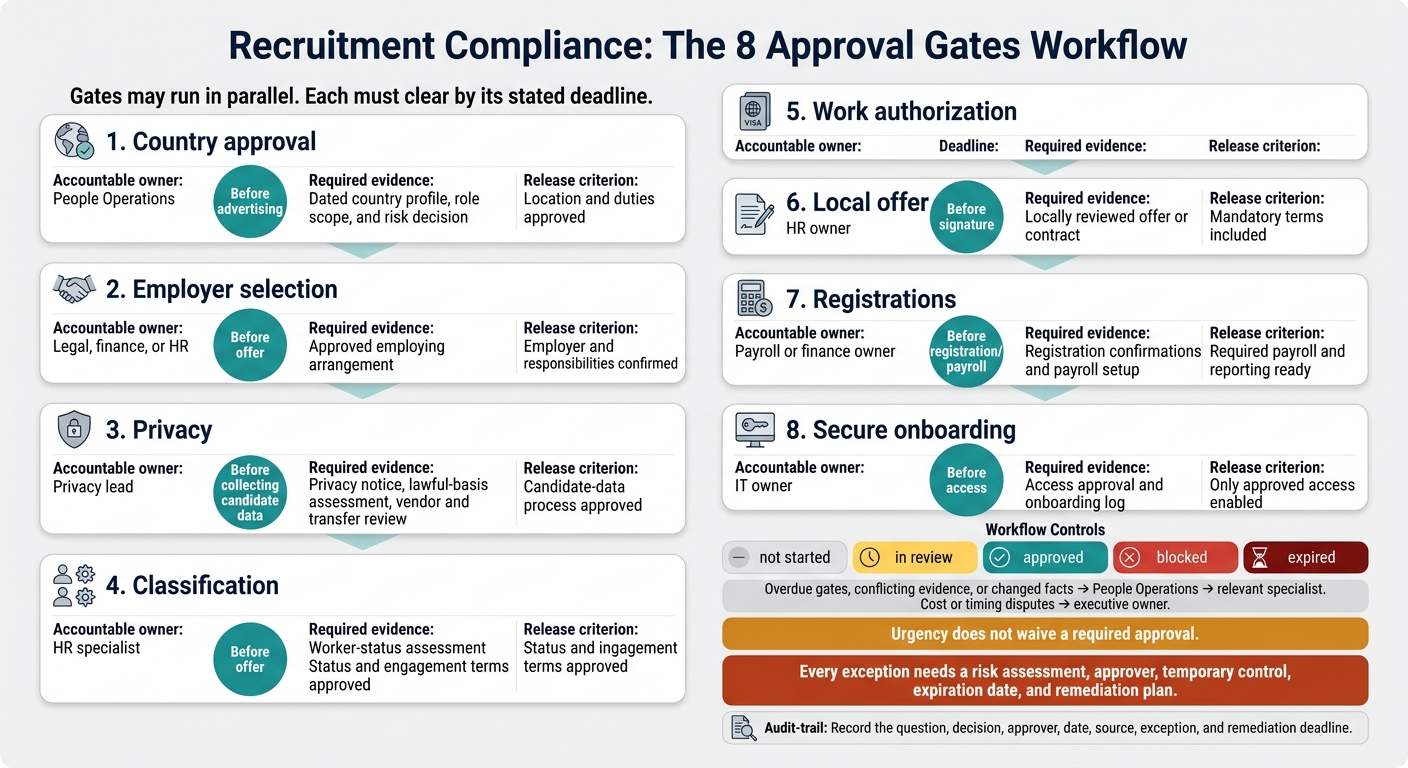
Cross-Border Recruitment Compliance: 8 Approval Gates
Once country and data rules are set, turn them into approval gates that prevent requisitions from advancing too soon. Add a country-specific checklist to your ATS or HR system and block progress until every required approval is complete.
Assign Owners and Records to Each Hiring Gate
Give each gate one accountable owner and a named approver. Set actual due dates for each requisition and track its status as not started, in review, approved, blocked, or expired.
Keep the gate sequence consistent across requisitions. Recruiters, managers, and specialists should know exactly when a file can move forward.
| Hiring gate | Accountable owner | Deadline | Required evidence | Release criterion |
|---|---|---|---|---|
| Country approval | People Operations | Before advertising | Dated country profile, role scope, and risk decision | Location and duties approved |
| Employer selection | Legal, finance, or HR | Before offer | Approved employing arrangement | Employer and responsibilities confirmed |
| Privacy | Privacy lead | Before collecting candidate data | Privacy notice, lawful-basis assessment, vendor and transfer review | Candidate-data process approved |
| Classification | HR specialist | Before offer | Worker-status assessment | Status and engagement terms approved |
| Work authorization | Immigration or HR owner | Before work begins | Required authorization evidence | Role and location authorized |
| Local offer | HR owner | Before signature | Locally reviewed offer or contract | Mandatory terms included |
| Registrations | Payroll or finance owner | Before applicable registration and payroll deadlines | Registration confirmations and payroll setup | Required payroll and reporting ready |
| Secure onboarding | IT owner | Before access | Access approval and onboarding log | Only approved access enabled |
Escalate overdue gates, conflicting evidence, or changed facts to People Operations, then to the relevant specialist. Send cost or timing disputes to the executive owner.
Urgency does not waive a required approval. Every exception needs a risk assessment, approver, temporary control, expiration date, and remediation plan. Your audit trail must record the question, decision, approver, date, source, exception, and remediation deadline.
Track Hiring Delays and Rule Changes
Review a monthly dashboard covering median and 90th-percentile approval times, offer revisions, blocked start dates, checklist completion rates, and admin hours. Break results down by country and hiring model to see where compliance bottlenecks delay hiring.
Audit your recruitment workflow quarterly, covering permit expirations, payroll dependencies, access, vendors, and legal updates. Give every country profile an effective date, source owner, and next review date. Clearly separate current rules from confirmed future requirements, proposals, and unverified items.
Reassess immediately if the work location, duties, worker status, employer, or hiring volume changes. As hiring volume grows, embed recruitment support to keep approvals moving without losing control.
Coordinate Hiring With Embedded Recruiters
Rent a Recruiter embeds recruiters into growing teams to manage gate status, specialist handoffs, missing evidence, and candidate updates. Company owners and qualified specialists retain responsibility for legal, tax, immigration, privacy, classification, and employment approvals.
Conclusion: Final Checks and Next Steps
Check Readiness Before Advertising and Starting Work
Use the approval gates from the workflow above for your final go/no-go check.
- Before advertising: confirm the country profile, legal employer, worker classification, immigration feasibility, pay requirements, privacy notice, lawful processing grounds, vendor agreements, international transfers, access controls, and retention periods. Check that selection criteria, background-check procedures, and ethical automated screening are approved.
- Before work begins: once the role is cleared for advertising, confirm the local contract, work authorization, payroll readiness, tax treatment, social security registration, required pay, and benefits before anyone starts work.
Give each open item an owner and a review date. Repeatable checks help reduce rework and delays. Unresolved legal, tax, immigration, and employment issues must go to local specialists.
Discuss Hiring Capacity and Workflow Gaps
If hiring demand is outpacing your team, compare upcoming hiring needs with your sourcing, interview, and compliance capacity. Include the time your team spends on compliance administration to see where embedded recruitment support could help.
Book a call with Rent a Recruiter to discuss hiring capacity and workflow gaps. Any savings estimate must be specific to your business, not guaranteed.
FAQs
Can a candidate work remotely while awaiting a permit?
No. Filing a permit application does not give a candidate permission to start work, even remotely. Before their start date, confirm that they have the legal right to work in the location where they will perform the role.
If the required authorization is still pending, delay their start date. Letting someone work informally before all required approvals are in place exposes your business to serious compliance risks.
What if a new hire moves to another country?
A new hire who moves abroad may create a permanent establishment (PE) for your business. That can trigger corporate taxes, payroll obligations, penalties, and interest [1][2].
Set a written cross-border remote work policy that requires HR or finance approval before any relocation. Track employee locations and review local risk thresholds quarterly [1][2].
If exposure is high, you may need to adjust the employee’s duties, limit their time in-country, or use an Employer of Record (EOR) service [1][2][3].
How can we verify a hiring provider’s compliance?
Put evidence before provider claims. Verify tax forms, business licenses, insurance certificates, Data Processing Agreements (DPAs), and SOC 2 Type II reports. Keep a central register of each provider’s role, risk rating, and services so your team can see who handles what.
Apply pass/fail legal and security checks before reviewing performance. Regularly sample background-check consent records or automated hiring logs to check that providers follow the agreed requirements.
Assign an internal owner to each compliance task and track findings in a clear audit trail. This keeps accountability clear and reduces time spent chasing records during audits.