
I recommend setting your full hiring budget and salary ranges before you make an offer, so you can compete for talent without losing control of costs. Start with the roles your business needs most, check pay against at least two reliable sources, and use the 50th percentile, the market median, as a reference rather than an automatic target.
My approach brings four decisions together:
- Budget: Count salary, employer taxes, benefits, and both target and maximum incentive payouts.
- Pay ranges: Match pay to responsibilities, skills, and level, then set clear offer approval rules.
- Packages: Separate guaranteed pay from performance-based payouts and equity with uncertain value.
- Reviews: Track offer acceptance, retention, and spending. Review salary ranges at least annually.
<u>Your goal is a package you can afford, explain, and apply consistently.</u> Here’s how I would turn those decisions into a compensation plan that supports hiring and protects your cash runway.
Variable Compensation Plans for Small Business
sbb-itb-a23bd6a
Benchmark Roles and Build Salary Bands
Salary Bands Explained: Range Spread and Compa-Ratio
Use your budget and pay philosophy to benchmark the roles that matter most for growth and retention. Clear salary bands help you control offer costs and make consistent pay decisions.
Match Jobs by Responsibilities and Scope
Price the role, not the title. Create a one-page job profile covering core responsibilities, required and preferred skills, reporting relationships, decision-making authority, working conditions, expected outcomes, and measurable performance indicators. Record geography, industry, company size, work arrangement, and level.
Level the role using autonomy, problem complexity, leadership scope, decision authority, and business impact, not tenure. Job content, not title, drives equal-pay comparisons.[7][10]
Once you’ve set the level, use market data to price it.
Choose and Check Salary Data
Use at least two reliable sources for important roles. Record publication dates, survey periods, sample coverage, geography, level, and compensation definitions.
Do not average base salary, total cash, and total compensation together. Check differences first. They may come from mismatched jobs rather than conflicting market evidence.
| Source | Strengths | Limits | Best use |
|---|---|---|---|
| U.S. Bureau of Labor Statistics OEWS | Public employer-reported data with geographic and occupational detail | Broad categories; straight-time wages are not total compensation | Regional and occupational baseline checks[8][9] |
| Employer compensation surveys | Can separate levels, industries, company sizes, and pay elements | Cost and participant coverage vary | Primary benchmarks for recurring roles |
| Professional-association data | Industry-specific or functional detail | Membership may limit sample coverage | Checking specialized roles , such as engineering recruitment, |
| Aggregated compensation databases | Searchable market signals | Self-reported figures and small samples may distort results | Supplementary comparisons |
| Documented recruiting evidence | Shows candidate expectations, offers, and compensation-related declines | Narrow searches can produce misleading signals | Testing a band during an active search |
| Job-board salary figures | Accessible advertised ranges | Posted pay may differ from actual offers; scope may be unclear | Directional checks validated against stronger sources |
BLS categories can blend different specialties. Refine those benchmarks with industry, level, and recruiting evidence. BLS annual wages often assume 2,080 hours, so do not treat them as total compensation.[8]
Set Salary Ranges and Pay Placement Rules
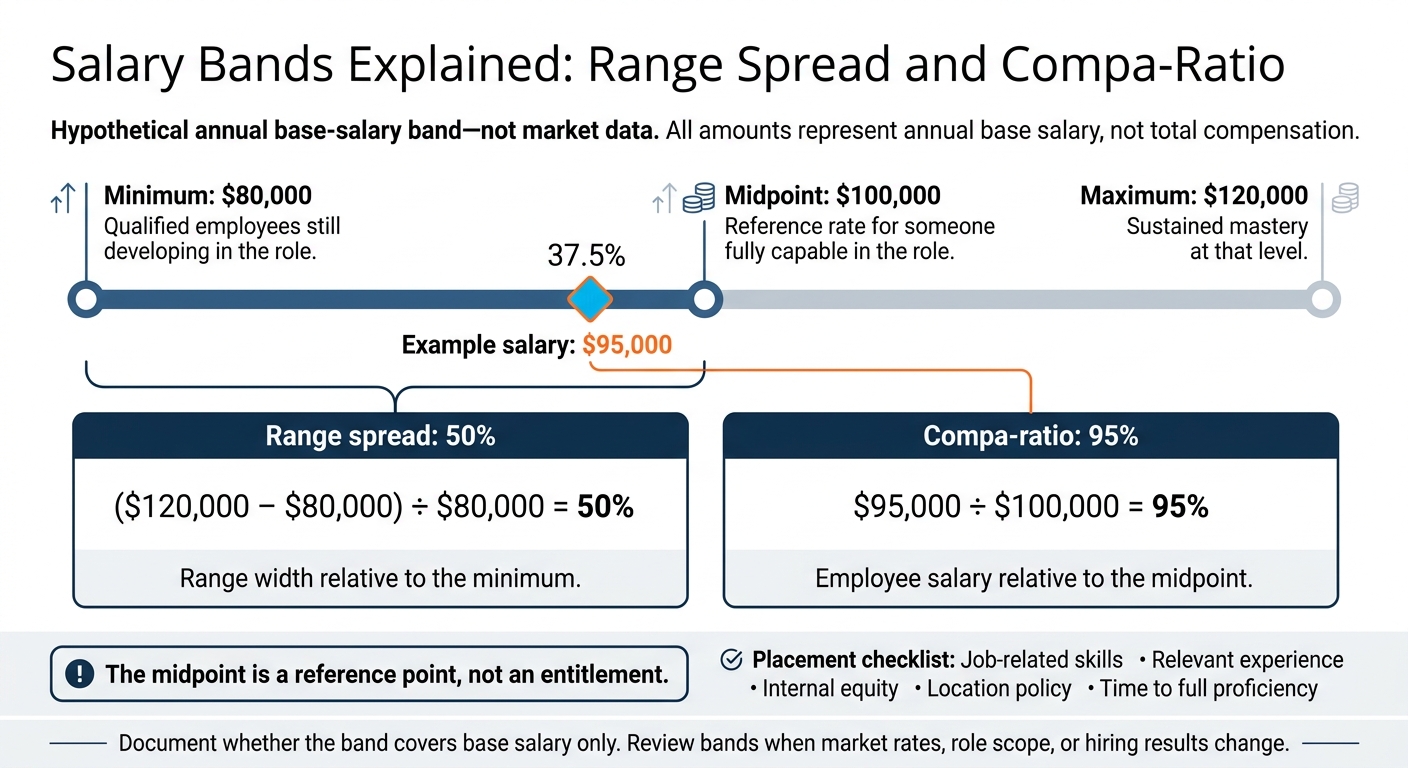
Set the minimum for qualified employees still developing in the role, the midpoint as the reference rate for someone fully capable in the role, and the maximum for sustained mastery at that level.
Document the supporting data and state whether the band covers base salary only. Review bands when market rates, role scope, or hiring results change. The midpoint is a reference point, not an entitlement.
Hypothetical annual base-salary band – not market data: Minimum $80,000, midpoint $100,000, maximum $120,000. The range spread is 50%: ($120,000 − $80,000) ÷ $80,000. A salary of $95,000 has a 95% compa-ratio: $95,000 ÷ $100,000.
Write placement rules before offers begin. Give managers clear criteria for each pay decision:
- New hires: Use job-related skills, relevant experience, internal equity, location policy, and time to full proficiency.
- Progression: Use sustained performance, expanded responsibilities, skill development, or demonstrated independence.
- Promotions: Require a documented change in job scope and level.
- Market adjustments: Set review triggers based on external data, recruiting difficulty, retention risk, or major changes in role requirements.
Create a correction plan for employees below range. For employees above range, decide whether to freeze pay, use lump-sum increases, or recalibrate the band.
Exceptions need written business justification, approval from designated leaders, an expiry or review date, and an equity check. Managers should know both the range and the escalation path before making an offer.
Track offer-approval time, compensation-related declines, exception rate, new-hire versus incumbent pay, and pay compression. Use the bands to build base pay, incentives, equity, and benefits into each offer package.
Build the Compensation Package
Use your role band and placement rules to build an offer with clear base pay, performance upside, and benefits.
Set Base Salary and Incentives
Separate each offer into guaranteed pay, variable pay, and long-term compensation. Keep base pay within the role band. Incentives should reward measurable performance, not make up for weak base pay.
Use bonuses for measurable goals, commissions for sales, and profit sharing for team results. Choose metrics employees can influence, and balance volume with quality or margin.
Put the payout rules in writing: eligibility, performance period, metrics, targets, maximum payout, timing, proration, termination, and dispute handling. Budget for both target and maximum payouts so you understand the full cost exposure.
For nonexempt employees, commissions and nondiscretionary bonuses usually affect overtime calculations. Have payroll and counsel verify rates and deadlines.[13][15]
Add long-term upside once the cash components are clear.
Explain Equity Terms and Risks
Equity is upside, not guaranteed pay. Stock options, RSUs, and profits interests have different tax and legal treatment.
Explain the grant size, vesting schedule, approval conditions, forfeiture rules, expiration, and post-termination rules. Disclose dilution, uncertain valuation, exercise costs, potential taxes, and restrictions on selling shares. A preferred-stock financing price does not establish the value of employee common shares.
Have qualified legal and tax advisers review plans and changes. Recommend independent tax advice to recipients. Once long-term pay is defined, set out the benefits and flexibility that complete the offer.
Choose Benefits, Leave, and Flexibility
Choose benefits that support retention without exceeding your employer-cost budget. National premium data provides a benchmark, not your actual cost. Your costs depend on plan design, location, and eligibility.[16][17][18]
Compare medical, dental, vision, retirement, leave, mental-health support, learning budgets, and flexibility. Confirm eligibility, waiting periods, dependent costs, payroll deductions, enrollment, and administration.
Separate required benefits and leave from optional perks. Federal FMLA provides eligible employees of covered employers with unpaid, job-protected leave. State and local requirements may add obligations.[11][12][14]
For remote work, specify the location, schedule, equipment, and terms for changing the arrangement.
Compare Packages and Write Offers
Compare cost, employee value, and complexity before sending the offer. Use the table to weigh tradeoffs, not to set market prices.
Calculate each cost separately: payroll taxes, expected and maximum incentives, benefit premiums, retirement contributions, paid-time-off costs or liabilities where applicable, equity administration, and onboarding.
| Component | Employer cost | Cash-flow impact | Potential retention value | Administrative complexity |
|---|---|---|---|---|
| Base pay | Wages plus payroll taxes | Predictable payroll | Provides certainty | Low to moderate |
| Incentives | Target and maximum payouts; overtime adjustments | Performance-dependent outflows | Rewards results when targets are realistic | Moderate; verify calculations |
| Equity | Dilution, legal, valuation, and administration costs | Less immediate wage cash; other costs remain | Vesting may encourage tenure | High |
| Benefits | Premiums, contributions, and administration | Recurring payments | Health and financial security | Moderate to high |
| Leave | Paid time, coverage costs, and possible liabilities | Payroll continues during absence | Recovery and family support | Moderate; accrual and jurisdiction rules |
| Flexibility | Equipment and coordination | Arrangement-dependent | Supports retention when it fits employee needs | Low to moderate |
Write the offer to clearly distinguish guaranteed pay from contingent upside. State base pay, pay frequency, location, start date, and classification. Label incentive targets and maximums as contingent opportunities, and reference the written payout rules.
Describe equity separately, including approval and vesting conditions. Do not assign it guaranteed cash value. Specify benefit eligibility, employee contributions, leave rules, and flexibility terms.
Align the offer with plan documents and payroll rules. Before issuance, have counsel verify wage notices, commissions, deductions, and leave requirements.
Manage, Explain, and Review Pay
Once offers are out, keep pay controlled, easy to explain, and subject to regular review.
Set Approval Rules and Check Pay Equity
Put a written approval matrix in place for starting salaries, range exceptions, merit increases, promotions, bonuses, commissions, equity grants, retention awards, and location-based pay.
Managers recommend pay decisions. HR checks job level and internal equity, often supported by an embedded recruitment service to ensure consistency. Finance confirms the budget, and executives approve exceptions. Require written reasons for exceptions and follow the same workflow for employees and candidates.
Compare roles by actual duties, not job titles. Investigate unexplained pay gaps, compression, and inversion. Record corrective actions and who owns them.[6][7]
Approval rules control pay decisions; compliance determines whether those decisions are legal. Keep a compliance calendar that lists employee work jurisdictions, responsible owners, review frequency, and government sources or legal advisers.
Check minimum wage, overtime, worker classification, equal pay, salary-history restrictions, pay transparency, required benefits and leave, and payroll-record requirements. Track compliance in a calendar, not as a one-time signoff.
Explain Pay Ranges and Career Progression
Train managers and recruiters to explain salary placement criteria, progression requirements, incentive measures, and review timing. Employees should understand how you build ranges and where their pay sits within them.
Give employees an annual total-rewards statement showing guaranteed cash, incentives, employer-paid benefits, employee-paid costs, and equity risk.
Provide a manager and HR contact for questions. Acknowledge concerns within five business days, assign someone to own the review, and prohibit retaliation.
Track Hiring Results, Retention, and Pay Costs
Use the bands you set earlier to spot poor placement, compression, and pay drift.
Review a monthly or quarterly dashboard covering offer acceptance, time to fill, pay-related declines, voluntary turnover, promotions, compensation costs against revenue and budget, and internal pay placement.
Calculate range penetration as:
(salary − range minimum) ÷ (range maximum − range minimum) × 100%
Use this measure to flag unusual placement, not to trigger automatic pay increases. Break results down by role, level, and location. Check candidate feedback and exit interviews before attributing hiring or retention problems to pay alone.
Rebenchmark at least annually, or sooner after major market, funding, legal, or hiring changes. Update ranges, geographic rules, approval limits, and manager training.
Record the sources, changes, affected employees, effective date, and next review date. Make clear whether updates apply only from the effective date forward or also apply retroactively.
Conclusion: Put Your Compensation Plan into Practice
Turn this guide into a one-page compensation plan. Connect your priority hires to your pay philosophy, approved salary bands, total employer costs, and offer scripts. Give each action a named owner and a review date.
Leadership approves policy and budget. HR maintains the compensation framework. Finance checks affordability and hiring ROI, and managers define role expectations. Clear ownership keeps hiring decisions moving without losing control of costs.
Review hiring results and exceptions quarterly. Review salary bands, benefits, budgets, and pay equity annually, or sooner after major business or market changes. Once the operating plan and ownership are in place, launch your first hire under the approved package.
If limited internal hiring capacity is holding up implementation, Rent a Recruiter can embed recruiters into your team to manage hiring from start to finish. Your company retains control of compensation policy, equity terms, exceptions, and final approvals.
Start by appointing your compensation owner and approving the package for your most urgent role.
FAQs
How can I compete for talent on a tight budget?
Focus on the total offer value, not just base salary. Use benchmarking tools to check that your pay is competitive. Then strengthen your offer with benefits that matter without stretching your budget: flexible or hybrid work, clear career growth paths, and professional development budgets.
Rent a Recruiter embeds experienced recruiters into your team to bring structure to hiring, reduce recruitment costs, and save over 80 hours of administrative time each month.
How should I handle salary requests above my pay range?
Use internal pay bands and external market data to keep salary discussions objective. This helps you make a competitive offer and maintain pay equity.
If base salary is fixed, focus on the total rewards package. Additional paid time off, quarterly bonuses tied to clear milestones, or professional development opportunities can help close the gap. Tailor the discussion to the candidate’s priorities without exceeding your budget.
How can I fix pay compression without overspending?
Benchmark your current salaries against market data to pinpoint pay gaps [1][2]. If base pay is fixed, be clear about the full rewards package, including flexibility, growth opportunities, and support [3].
Extra paid time off, structured quarterly bonuses, or professional development budgets can make that package more attractive without increasing fixed payroll costs [3][4].
Document why you make each pay decision. This helps you keep your pay structure consistent and equitable as your company grows [5].