We recommend collaborative hiring with one decision owner, clear assessment roles, and scores submitted before group discussion. For your business, the aim is simple: less duplicated work, fewer approval delays, and hiring decisions tied to business goals.
Start with three to five measurable outcomes for the role, agree on the budget, and involve only the people needed to assess the work. Keep assessments focused and set deadlines so collaboration does not become a drain on your team’s time.
We focus on three checks:
- Cost: Track interviewer hours and cost per hire.
- Speed: Monitor stage deadlines and time to an accepted offer.
- Results: Review the hire’s progress at 30, 60, and 90 days.
<u>Test the process on one priority role first.</u> You can also audit your current hiring strategy to identify other areas for improvement. Then use the results to decide what to keep, what to change, and whether you need embedded recruitment support.
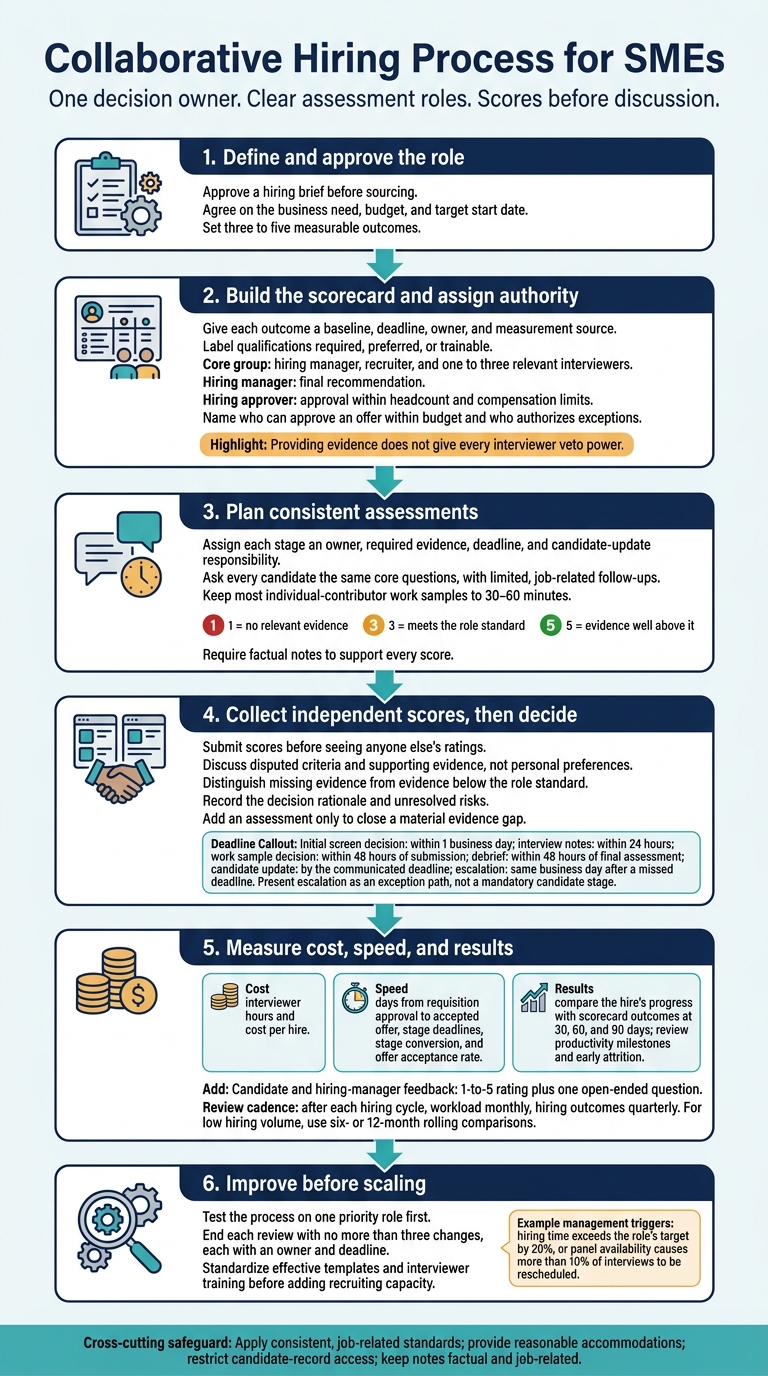
Collaborative Hiring Process for SMEs
Define Hiring Goals, Criteria, and Authority
Start with the business need: growth, retention, delivery, compliance, capacity, or replacement hiring. Approve a hiring brief before sourcing with talent acquisition services so everyone works to the same scope and budget.
Cover the business problem, compensation range, benefits, bonus and variable pay assumptions, target start date, reporting line, work location and remote-work expectations, employment type, and expected first-year results. Name the budget owner and the first-year target.
Once the role is approved, turn the brief into a scorecard and decision map before scheduling interviews.
Build a Role Scorecard
Your scorecard should define the role’s purpose, three to five measurable outcomes, required capabilities, observable job-related behaviors, and capabilities someone can learn during onboarding.
Give each outcome a baseline, deadline, owner, and measurement source. Match every criterion to an assessment method so interviewers know what evidence to collect.
Label qualifications required, preferred, or trainable. A qualification belongs in the required category only if someone cannot perform a core duty without it. Replace vague judgments with observable work behaviors, and record why each requirement matters.
The U.S. Office of Personnel Management recommends identifying job competencies and developing questions and rating scales before interviews begin.[5][6]
Assign Assessment and Decision Roles
Keep the core group to the hiring manager, recruiter, and one to three relevant interviewers. Assign responsibilities before sending invitations. Providing evidence does not give every interviewer veto power.
| Participant | Role | Decision responsibility | Assessment area |
|---|---|---|---|
| Hiring manager | Owns the vacancy and scorecard | Makes the final recommendation | Role outcomes and overall evidence |
| Recruiter | Coordinates hiring and candidate communication | Maintains process consistency and checks approvals | Screening against agreed criteria and process adherence |
| Subject-matter interviewer | Assesses an assigned competency | Provides evidence-based input | Technical or functional capability |
| Cross-functional interviewer, if needed | Assesses stakeholder-facing work | Recommends within the assigned area | Collaboration and customer or operational impact |
| Hiring approver | Confirms alignment with approved headcount, compensation, and business plan | Approves within headcount and compensation limits | Business case and budget |
Use this table as your internal baseline and publish it before interviews begin. Name one approver for budget exceptions and one owner for stalled decisions so approvals do not hold up hiring.
Document each responsibility separately, including who can approve an offer within budget and who must authorize exceptions. If the scope, criteria, or salary changes, log the change, secure approval, notify affected candidates, and repeat any assessments the change has invalidated.
sbb-itb-a23bd6a
Structure Assessments and Keep Hiring on Schedule
Turn your role scorecard into a one-page assessment plan before scheduling interviews. Translate every must-have criterion into evidence you can observe. Give each stage an owner, required evidence, a deadline, and someone responsible for candidate updates.
Keep only stages that add useful evidence, and involve only the people needed to assess it. This keeps interview time focused on making the hiring decision.
Use Consistent Questions, Work Samples, and Scores
Give each criterion a primary assessment method and an evaluator. Ask every candidate the same core questions, with limited, job-related follow-ups. Use predefined rating anchors: 1 = no relevant evidence, 3 = meets the role standard, 5 = evidence well above it. Require factual notes to support every score.[9][10]
Keep most individual-contributor work samples to 30-60 minutes. Explain the evaluation criteria, permitted tools, and submission format upfront. Use hypothetical or sanitized material, never confidential information or free production work.
Train Interviewers and Set Deadlines
Give interviewers a written guide covering the scorecard, assigned competencies, approved questions and follow-ups, rating definitions, and note-taking standards. Include the accommodation process, prohibited topics, and feedback deadline. Don’t leave these details to memory.
Schedule interviews and the debrief in advance. Reserve backup interviewers and name one process owner to resolve scheduling conflicts. Tell candidates the stages, preparation required, time commitment, contact person, and expected decision timing.
| Stage | Owner | Purpose | Evidence collected | Decision deadline |
|---|---|---|---|---|
| Initial screen | Recruiter or hiring manager | Confirm baseline requirements and motivation | Eligibility answers and candidate questions | Within 1 business day |
| Structured competency interview | Assigned interviewers | Assess priority competencies | Scored answers and factual notes | Notes within 24 hours |
| Work sample, if needed | Designated evaluator | Assess a critical task | Output, reasoning, and rubric scores | Within 48 hours of submission |
| Debrief | Hiring manager | Resolve material gaps and decide | Independent scores and decision rationale | Within 48 hours of final assessment |
| Candidate update | Recruiting owner | Communicate status or outcome | Written next steps or decision | By the communicated deadline |
| Escalation | Hiring manager or process owner | Resolve delays or conflicting information | Missing feedback or unresolved issue | Same business day after a missed deadline |
Score Candidates Before the Debrief
Require assessors to submit scores before seeing anyone else’s ratings. Use the debrief to discuss disputed criteria and supporting evidence, not personal preferences.
Distinguish missing evidence from evidence that falls below the role standard. Record why you made the decision and any unresolved risks. Add another assessment only to close a material evidence gap, not to get everyone to agree.[9][11]
Protect Candidate Data and Prevent Discrimination
As more people join the process, keep candidate records accessible only to approved participants in an approved system. Avoid personal email and public chat channels. Keep notes factual and job-related, and review retention, deletion, and legal-hold rules against applicable requirements.
Train interviewers to avoid questions about protected characteristics, family plans, or medical conditions. Provide a confidential accommodation contact and store accommodation details separately from evaluation notes. EEOC guidance addresses reasonable accommodations for qualified applicants.[12][13]
Consult qualified counsel on federal, state, and local employment, privacy, and hiring-technology rules.
Measure Results and Plan Hiring Capacity
Track Hiring Time, Costs, and Outcomes
Once collaborative hiring is live, check whether it delivers faster decisions and stronger hires.
Create a one-page dashboard for each role. Track days from requisition approval to accepted offer, interviewer hours, cost per hire, stage conversion, and offer acceptance rate.[15][16]
Collect candidate and hiring-manager feedback using a 1-to-5 rating plus one open-ended question. Compare results at 30, 60, and 90 days with the outcomes in the role scorecard. Review productivity milestones and early attrition alongside speed and cost. If hiring volume is low, use six- or 12-month rolling comparisons. Account for onboarding and manager support, too, as both affect results.
Review results after each hiring cycle, check workload monthly, and assess hiring outcomes quarterly. Investigate recurring rating gaps. For every override, record the evidence, requester, and approver.
Review selection patterns using only lawfully collected data with restricted access. The EEOC’s 80% rule of thumb can flag possible adverse impact, but it is not a legal conclusion. Small samples can also distort results. Refer concerning patterns to qualified counsel.[7][14]
End each review with no more than three changes, each with an owner and deadline.
Weigh Benefits and Risks
| Benefit or risk | Business impact | Control or metric |
|---|---|---|
| Stronger evidence | A broader assessment of job requirements | Compare interview scores with post-hire scorecard results |
| Shared ownership | Better alignment, but accountability may become unclear | Track approval delays and hiring-manager feedback |
| Coordination costs | Less time for core work | Limit panels to necessary assessors; track total hours per hire |
| Delays | Longer vacancies and candidate withdrawals | Monitor stage deadlines, overdue decisions, and withdrawal reasons |
| Groupthink and bias | Unsupported agreement or inconsistent standards | Audit independent scores and overrides |
| Confidentiality risks | More people can access sensitive records | Restrict record access and audit permissions and incidents |
Standardize Hiring and Add Recruiting Support
If the process works but your team is stretched, standardize what works before adding recruiting capacity.
Turn effective practices into reusable templates and train interviewers to use them consistently. Forecast capacity using planned hires and the total assessment workload per hire. Include time spent on unsuccessful candidates, preparation, coordination, and debriefs, not just interviews that lead to offers.
Set internal review triggers. For example, review capacity when hiring time exceeds the role’s target by 20%, or panel availability causes more than 10% of interviews to be rescheduled. These are management triggers, not industry standards.
Short-term support suits hiring spikes. Repeated misses point to a capacity gap. If you use Rent a Recruiter, confirm role coverage, availability, responsibilities, system access, data handling, reporting, handoff, and contract terms before committing.
Conclusion: Start With One Priority Role
Once you’ve measured results and identified capacity gaps, test the process on one role before scaling it. Use this checklist:
- Select one business-critical opening. Confirm the hiring need, target start date, and approved compensation range.
- Assign one hiring manager to own the decision.
- Test the scorecard on that role. Check that every criterion produces usable evidence.
- Brief interviewers on the scorecard, questions, scoring, note-taking, and consistent, job-related evaluation.
- Set deadlines for each stage. Require independent scores before the debrief, and keep the discussion focused on recorded evidence.
- Review the completed search and the hire’s performance after onboarding before extending the process to more roles.
Apply the same job-related standards to every candidate and provide reasonable accommodations when needed.[8] If the pilot reveals a capacity gap, Rent a Recruiter can place recruiters inside your team to add hiring capacity. You keep ownership of hiring goals, criteria, and final decisions.
FAQs
How can we use collaborative hiring without an HR team?
You don’t need a full HR team to keep hiring on track. Use a RACI chart to define ownership and name one decision-maker for each hiring stage. Keep the process consistent with shared scorecards, 24 to 48-hour feedback deadlines, and a basic applicant tracking system.
When you need more hiring capacity, Rent a Recruiter places experienced recruiters inside your team within days. They manage hiring from start to finish, giving your team more time to evaluate candidates.
What if our top candidate has mixed interview scores?
Hold a review to reach consensus on interview evaluations and make an evidence-based hiring decision [1]. Ask interviewers to submit scores and supporting evidence independently before the meeting. This helps prevent groupthink and keeps the discussion focused on agreed criteria, not impressions [1][2].
Compare scorecards to identify differences in scoring standards, then assess the evidence against the role-specific competencies defined at intake [3][2]. If a candidate remains borderline, consider placing them in a tier alongside other candidates to maintain a strong hiring pipeline [4].
How do we set hiring targets with limited historical data?
Turn business priorities into clear capability gaps. Then work backward from the outcomes and start dates you need to build a 6 to 12-month or 12 to 18-month workforce plan. Use U.S. benchmarks as your starting point, then set targets for each role.
Use standardized intake briefs to agree on business needs, must-haves, compensation bands, and start dates. Define hiring stages and turnaround expectations so everyone knows what needs to happen and when.
Track basic funnel metrics. After the first cycle, recalibrate your targets using your own data from the previous 6 to 12 months.