Before you set a remote employee’s start date in the Middle East, confirm work permission, the hiring arrangement, and payroll readiness. We recommend assigning one internal owner or using on-demand recruitment for each hire so you can track approvals and reduce avoidable delays and costs.
Our checklist covers five steps:
- Confirm location and duties so you choose the right hiring route.
- Check country requirements rather than applying one approach across markets.
- Prepare documents and track approval before work begins.
- Align contracts, payroll, and access to prevent gaps at launch.
- Approve the start and track changes, with renewal reminders at 90, 60, and 30 days where filing windows allow.
The aim is simple: fewer missed handoffs, clearer costs, and a start date your team can plan around. We start with <u>where the employee will work</u>.
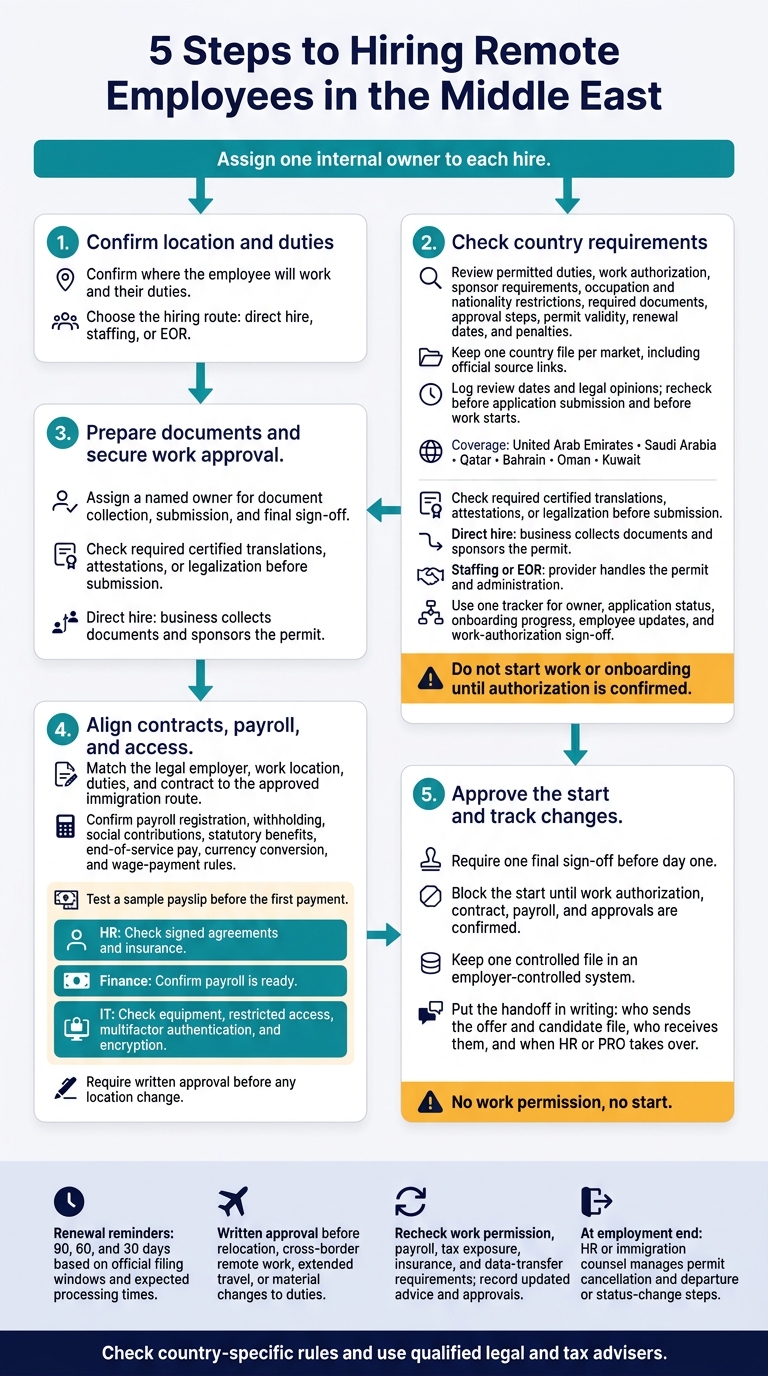
5 Steps to Hiring Remote Employees in the Middle East
2. Check Country-Specific Work Requirements
Once you’ve confirmed the employment route, check each country’s work rules before setting a start date. This helps you avoid hiring delays and compliance costs.
Keep one country file per market. Include official source links, permitted duties, sponsor requirements, occupation and nationality restrictions, required documents, approval steps, permit validity, renewal dates, and penalties.
Assign one owner to log each review date and legal opinion. Recheck the requirements before submitting an application and again before work starts.
Use the same review process across markets, recording only the country-specific differences.
United Arab Emirates and Saudi Arabia
Before setting a start date, confirm permitted duties, work authorization, sponsor requirements, permit validity, and any occupation or nationality restrictions.
Qatar and Bahrain
Qatar: Check permitted duties, work authorization, sponsor requirements, permit validity, and occupation or nationality restrictions before onboarding.
Bahrain: Align employment documents and HR records with Bahrain Labour Law. Complete the compliance check before confirming a start date.
Oman and Kuwait
For each country, confirm permitted duties, work authorization, sponsor requirements, permit validity, and occupation or nationality restrictions before onboarding.
sbb-itb-a23bd6a
3. Prepare Documents and Secure Work Approval
Once you’ve confirmed the route, collect the documents and secure permit approval. Assign a named owner for document collection, submission, and final sign-off.
For direct hires, your business collects the documents and sponsors the permit. In embedded recruitment or EOR models, the provider handles the permit and administration.[1]
Check Required Documents
Collect only the documents required for your chosen route. Before submission, check whether you need certified translations, attestations, or legalization to avoid delays.
Track Applications and Approve the Work Start
Once the file is complete, track the application until work authorization is issued. Use one tracker to record the owner, application status, onboarding progress, employee updates, and work authorization sign-off.
Do not start work or onboarding until authorization is confirmed. In the UAE, working on a tourist or visit visa violates labor law.[1]
4. Align Contracts, Payroll, and Compliance Checks
Once work authorization is approved, align the contract, payroll, and internal controls with the approved route. Resolve any mismatches before the employee starts to avoid payroll errors or delays.
Confirm the Employer and Contract Terms
Match the legal employer, work location, duties, and contract to the approved immigration route. Check that the employing entity is registered for the arrangement, or consider recruitment on demand for more flexible hiring support. Ask local counsel to resolve mismatches and check mandatory employment protections. A governing-law clause does not override those local protections.
Document reporting lines, hours, time zone, pay currency, deductions, overtime, leave, benefits, insurance, equipment, expenses, confidentiality, IP, data security, notice, termination, and dispute terms.
Include a remote-work agreement that names approved locations and requires written approval before any location change. Then check that payroll, onboarding, and system access can support the agreed terms.
Check Payroll, Taxes, and Start-Date Readiness
Finance should confirm payroll registration, withholding, social contributions, statutory benefits, end-of-service pay, currency conversion, and wage-payment rules. UAE establishments subject to the Wage Protection System must pay through approved financial institutions.[4]
Test a sample payslip before the first payment. Get advice on permanent-establishment risk and any required U.S. tax filings.
Document who owns each pre-start check:
- HR: Check signed agreements and insurance.
- Finance: Confirm payroll is ready.
- IT: Check equipment, restricted access, multifactor authentication, and encryption.
Use qualified advisers to resolve legal and tax questions. Keep dated approvals in line with applicable privacy and retention rules, and put renewal and change controls in place before day one.
Track Renewals, Travel, and Role Changes
Set post-approval renewal reminders at 90, 60, and 30 days, based on official filing windows and expected processing times.
Require written approval before relocation, cross-border remote work, extended travel, or material changes to duties. Recheck work permission, payroll, tax exposure, insurance, and data-transfer requirements, then record the updated advice and approvals.
Assign HR or immigration counsel to manage permit cancellation and departure or status-change steps when employment ends.
5. Final Checklist: Assign Owners and Approve the Start
Once permit and payroll checks are complete, require one final sign-off before day one.
- Name an owner: Assign one internal owner to each hire.[3]
- Keep one controlled file: Store the final checklist in an employer-controlled system.[2]
- Set a firm start gate: Block the start date until work authorization, contract, payroll, and approvals are confirmed. No work permission, no start.[1]
- Put the handoff in writing: Specify who sends the offer and candidate file, who receives them, and when HR or PRO takes over. Include this handoff in the signed onboarding process.[2]
FAQs
Can we hire remotely without a local entity?
Yes, you can hire without a local entity, but you need to manage tax and legal risks. An Employer of Record (EOR) can handle payroll, benefits, and local employment compliance. You can also engage independent contractors, provided they’re correctly classified.
Hiring without a local entity can create permanent establishment (PE) risks, potentially triggering local corporate taxes and registration requirements. To limit your exposure, use a cross-border remote work policy, carry out pre-hire tax reviews, and restrict activities such as contract negotiations.
Does a residency visa allow remote work?
No. A residency visa does not automatically give someone permission to work remotely. You must confirm that the worker has the legal right to perform the specific remote work in the country where they are physically located.
If authorization is pending, delay remote work until the required approvals are in place. Filing a permit application does not give permission to work, even remotely. [1]
Could a remote hire create U.S. tax obligations?
Yes. Hiring a remote employee, including someone abroad, may create tax obligations for your business. These can include payroll withholding, Social Security contributions, and local tax registration.
If the employee’s duties create a permanent establishment, your company could also owe corporate taxes in that jurisdiction.
Tax residency and wage sourcing rules depend on the circumstances. Consult qualified local tax advisers before finalizing a remote hiring arrangement.