
If your remote hiring process is slow, unclear, or hard to run, you are not just losing candidates, you are losing time, money, and offer acceptance.
I see the same pattern again and again in scaling tech hiring. Remote hiring can cut travel admin, open access across states, and help teams move faster. But if communication slips or interview stages drag, those gains disappear fast. The article points to three clear pressure points: weak human connection, poor process clarity, and delayed follow-up.
For leaders, the commercial point is simple. You should treat candidate experience as a hiring conversion issue, not just a brand issue. When 62% of candidates lose interest after two weeks without an update, 47% would withdraw due to poor communication, and 42% decline offers after a bad interview experience, process quality has a direct cost. You can rate your recruitment process to identify specific gaps in your remote workflow.
What matters most:
- Clear process design cuts drop-off and saves recruiter time
- Fast, predictable communication helps keep candidates engaged
- Stable interview tech and clear briefs reduce avoidable failure points
- Tracking recruitment metrics stage-by-stage shows where your process is losing people
- When team capacity is stretched, embedded recruitment support can help keep delivery steady
If you are hiring across SaaS, IT, fintech, engineering, security, insurance, or professional services, the message is clear: remote hiring works when the process is tight, human, and well managed.
What research shows remote hiring does well
Remote hiring does two things well: it makes scheduling easier, and it gives you access to more people. Those are clear process wins. They are not the same as proof that the candidate experience is better.
Convenience, speed, and broader access
The data is pretty clear on the upside of online interviews. A 2024 study found that 50% of respondents named convenience as a top advantage, 47.7% pointed to scheduling flexibility, 40.9% cited cost-effectiveness, and 29.5% said remote hiring gave access to a wider candidate pool.[3] For early-stage screening, that matters. Candidates do not need to commute, book time around travel, or cross a city for a first conversation.
For U.S. tech teams hiring across states or time zones, the upside is even more obvious. Remote interviews let you assess people across the country without paying for an initial visit to an office. That opens the door beyond your local market, which can help when niche talent is hard to find or when hiring plans move fast.
You can also move faster, but only if the process is tight. Remote interviews cut out travel admin and make it easier to line up distributed interview panels. That can reduce time-to-hire. But the gain disappears fast if feedback is late, interview rounds drag on, or no one owns the process from end to end.
Speed helps. Trust comes from how fair the process feels.
Perceived fairness and accessibility in structured processes
Remote hiring can also feel more even when the process is structured properly. Research on asynchronous video interviews found that standardised questions and equal response times can support fairness and open access across regions.[2]
That does not happen by accident. It comes from process design. You need the same prep materials, clear instructions, equal time limits, and steady interviewer behaviour. When you share questions or prep guidance in advance, people tend to view the process as fairer and feel more confident, even when nerves are still there.[4]
Once communication slips, the tech fails, or follow-up goes quiet, those gains fall away fast.
sbb-itb-a23bd6a
Where remote candidate experience breaks down
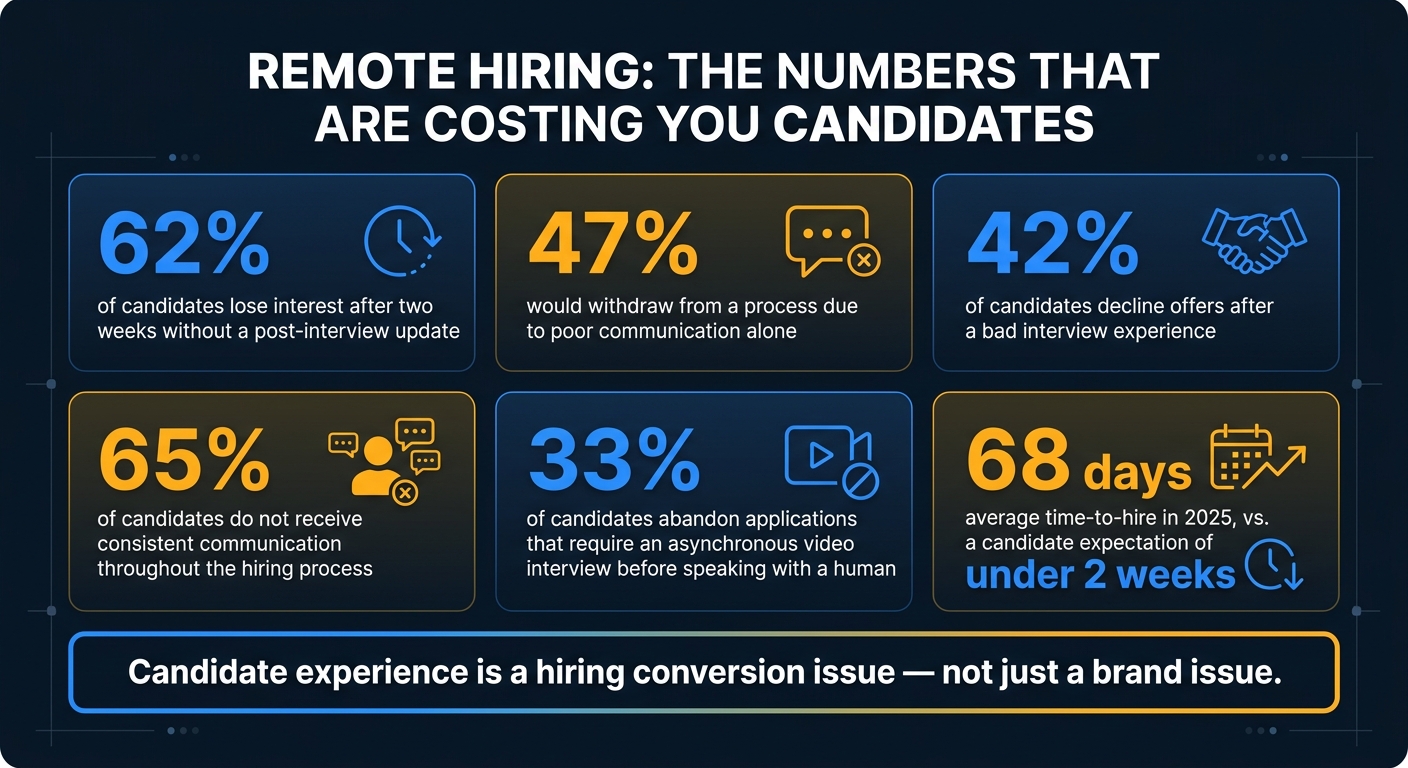
Remote Tech Hiring: Key Candidate Experience Stats That Cost You Offers
Those gains disappear when the process feels impersonal, confusing, or slow. Remote hiring works when speed and reach do not come at the cost of clarity or trust.
Weak human connection and one-way communication
Virtual interviews can make the whole process feel transactional on both sides. 33% of candidates abandon applications that require an asynchronous video interview before they have spoken with a human being.[7] In tech hiring, where strong candidates are often weighing several options at once, that kind of cold first step can be enough to lose them.
A tightly scripted process may look efficient from inside the business. But to an in-demand engineer or data candidate comparing offers, it can suggest that your company cares more about moving people through the funnel than having a proper conversation. Many people still feel uncomfortable on camera, and that affects how they show up.
Once the process starts to feel unclear, each stage becomes harder to navigate.
Unclear expectations, technical friction, and slow follow-up
Poor process design creates friction almost everywhere. Candidates often do not know how many rounds to expect, who they will meet, whether an interview will be technical or behavioral, or how much prep is expected. A short brief before each stage helps cut that friction fast. Include:
- the meeting link
- interviewer names
- interview length
- format
- prep guidance
- a contact for questions
Technical issues are also common. Connection problems, broken assessment links, unfamiliar platforms, and audio failures can stop candidates from showing what they can actually do. It also makes the process feel unfair when people are judged on their setup rather than job fit.
Then comes the silence. 62% of candidates lose interest after two weeks without a post-interview update, and 47% would withdraw because of poor communication alone.[6] The average time-to-hire in 2025 was 68 days, while most candidates expected a response within two weeks.[5] That gap is where withdrawals happen, and where hiring teams lose people they could have hired.
These issues rarely happen in isolation. They build across stages, turning a process that should feel simple into one that feels frustrating and hard to trust.
The next step is to design the process so candidates know what to expect, who they are meeting, and when they will hear back.
How to build a better remote tech hiring process
The fix is a tighter process. Each stage should feel clear, human, and easy to follow. Start by setting expectations. Then make interviews and follow-up consistent.
Set clear expectations before interviews and assessments
Before any interview or assessment starts, candidates should know exactly what’s ahead. Send a one-page outline covering the role scope, work location, time zone expectations, pay range, each hiring stage, and the expected timeline. Include the video platform, meeting link, technical requirements, and a backup contact in case something goes wrong.
For technical assessments, spell it out. Say how long it should take, "approximately 90 minutes" is far better than "a short exercise." Explain what the task is meant to assess, whether candidates can use documentation, search, or AI coding tools, and how the work will be reviewed.
If the usual format does not work because of a disability, caregiving duties, limited bandwidth, or another constraint, offer another option. The less guesswork in your process, the less drop-off you’ll face.
Run two-way interviews and keep communication predictable
Use a shared interview guide, competency-based questions, and a scoring rubric. Before the interview begins, test meeting links, screen sharing, and recording settings. Start with a clear agenda, and leave time for candidate questions.
After each stage, send a short confirmation. Thank the candidate, confirm what was done, explain the next step, and give a specific decision date. If that date shifts, tell them before the deadline passes. Don’t let silence do the talking.
Same-day completion notes and next-step updates within the promised window make a big difference. They save time, cut confusion, and keep your process moving.
When internal bandwidth slips, process quality usually drops right after.
Use embedded recruiting support when internal capacity is stretched
Even a well-built process can wobble when hiring volume jumps and internal teams are stretched. Scheduling starts to slip. Follow-up emails get missed. Feedback sits with a hiring manager for days. Candidates notice, and they move on.
This is where embedded recruitment support can help. Rent a Recruiter places experienced recruiters inside growing teams to run hiring end to end, bringing structure, visibility, and consistency to the process. In a 2025 case study, Unique.ai partnered with Rent a Recruiter and achieved 13 successful hires across a global expansion.[1]
For high-growth tech SMEs that need short-term help or a steadier hiring function, this kind of embedded model helps keep delivery steady without adding permanent headcount.
Once the process is stable, track where candidates still drop off.
How to measure candidate experience and act on the results
Track experience by stage, role and communication quality
If you want to fix candidate experience, you need to measure it stage by stage, not just at the end.
A final score can tell you something went wrong. It usually can’t tell you where it went wrong, when drop-off started, or which roles were hit hardest. That’s why one shared scorecard matters. It should bring together candidate feedback, stage behavior, and conversion outcomes in one place.
After each stage, application, recruiter screen, technical assessment, interviews, and final decision, send a short survey. Ask candidates to score:
- clarity
- scheduling
- platform reliability
- interview comfort
- response speed
- next steps
Use a five-point or seven-point scale. Then add one open question: "What one thing could we improve?"
The numbers show where the friction is. The comments tell you why it’s happening.
Don’t look at survey data on its own. Match it with operational data so you can pinpoint the stage that is slowing hiring or pushing candidates out. Track survey feedback alongside stage-level drop-off rate, median time from stage completion to employer response, reschedule frequency, and offer acceptance rate.
Here’s why that matters. If engineering candidates rate recruiter communication well but still drop out after the technical assessment, the issue probably isn’t recruiter follow-up. It’s more likely the assessment itself, maybe the brief is unclear, the task feels too long, or the platform creates hassle.
Segment every metric. That’s where the pattern starts to show. Break results down by function, seniority, geography, time zone, employment type, and hiring outcome. An overall score can look fine while hiding a sharp fall for staff-level engineering hires in another time zone. That’s the difference between a dashboard that looks busy and one that helps you make decisions.
| Metric | What it reveals |
|---|---|
| Stage-level drop-off rate | Where candidates exit |
| Median response time per stage | Whether communication is fast enough to keep interest |
| Assessment completion rate | Whether instructions and access are clear |
| Offer acceptance rate | Whether the overall experience supports a "yes" |
| Survey participation rate | Whether candidates are likely to respond |
Tie these numbers back to outcomes leadership already tracks: time to hire, recruiter workload, candidate withdrawals, and quality of hire.
A 2025 U.S. recruiting statistics compilation reported that 42% of candidates decline offers because of a bad interview experience, and 65% don’t receive consistent communication.[8] That’s not just a brand issue. It’s a hiring conversion issue, and it costs money.
Once you’ve found the problem stage, make a focused process change, then measure again. That’s how you move from opinion to proof.
Conclusion: build a remote hiring process that is faster, clearer, and easier to scale
Remote hiring can improve convenience, access, and speed, but only if the process is built to deliver those outcomes. Candidates want clear communication, stable tech, two-way conversation, and follow-up they can count on. When those pieces slip, interest drops fast, even if your employer brand is strong.
For leadership teams, the starting point is simple. Audit your last 20 to 30 remote technical searches. Review where candidates dropped off, how long each stage took, and whether communication stayed consistent when hiring volume increased. Then give one owner responsibility for the stage with the most friction, test one or two process changes, and measure the effect on both candidate feedback and hiring speed.
If internal capacity is the bottleneck, an embedded recruiter can help you keep hiring moving and reporting clean. Rent a Recruiter places experienced recruiters directly into scaling teams to run hiring end to end.
FAQs
How many interview stages are too many?
To keep the candidate experience strong and stop interview fatigue on both sides, keep the process to 4 to 6 rounds. Each stage should do a specific job tied to the role, not just add another layer of review.
Spell out the hiring process and share it upfront. Candidates should know the timeline, what each step is for, and what happens next. That simple move saves back-and-forth, cuts drop-off, and sets a clearer expectation from day one.
If you’re losing candidates at the same point in the process, look at the data. That’s usually where delays, duplicated interviews, or unclear decision-making are costing you hires.
What should candidates know before a remote tech interview?
Before a remote tech interview, you should expect a clear interview guide at least 48 hours in advance.
That guide should include:
- The interview format
- Interviewer names and short bios
- Key role responsibilities
- The hiring process and expected timelines
This matters because a well-run interview process saves time, cuts confusion, and gives your team a better chance of seeing how someone will perform in the role.
You should also be proactive about requesting any accommodations needed, such as extra time for assessments, camera-off options, or having questions shown on-screen. Small changes like these can reduce anxiety and help create a better interview experience for everyone involved.
How can teams measure remote candidate experience?
Use a structured feedback system with multi-stage surveys sent 24 to 48 hours after key touchpoints like applications, interviews, and offers. That timing matters. Wait too long, and response rates drop. Ask too soon, and you miss useful detail.
Track Candidate Net Promoter Score (cNPS) as a core metric. A score of 40 or higher is a strong target and gives you a clear read on how people experience your hiring process.
You should also watch the metrics around it, because one score on its own won’t show you where the process is slipping:
- Feedback turnaround time, to see how fast your team responds
- Offer acceptance rates, to measure how well you close
- Application abandonment rates, to spot friction early in the funnel
- External reviews on Glassdoor and LinkedIn, to identify bottlenecks and gauge employer brand
Taken together, these signals help you find what slows hiring down, where candidates drop off, and what may be hurting acceptance rates.